Joshu's Mu
c. 835 CE — Tang Dynasty China · Guanyin Temple, Zhaozhou (modern Hebei) — a small monastery courtyard, an old master, a dog asleep in the dust
Contents
A monk asks a Tang dynasty Zen master whether a dog has Buddha-nature. The master answers with a single syllable. A thousand years of students will break themselves on the sound and call the breaking enlightenment.
- When
- c. 835 CE — Tang Dynasty China
- Where
- Guanyin Temple, Zhaozhou (modern Hebei) — a small monastery courtyard, an old master, a dog asleep in the dust
The monk has rehearsed the question.
He has walked from a smaller monastery three valleys east, sleeping in barns, eating rice he begged at farmhouses, all to put one question to the old master at Guanyin Temple. Zhaozhou is a hundred and twenty by some accounts, eighty by others; either way he is the sharpest teacher in the empire, and the question has been eating at the monk for a year.
The doctrine is clear. The Buddha-nature is universal. All sentient beings possess it. Every sutra says so. Every commentary says so. The monk has memorized the verses. The monk has chanted them at dawn for ten years.
But the dog at the gate is asleep in the dust. It scratches itself. It eats its own vomit. It is, by every measure the monk can apply, not radiating universal awakening. So either the doctrine is false, or the monk is missing something the doctrine assumes.
He bows three times. He puts the question.
“Master — does a dog have Buddha-nature?”
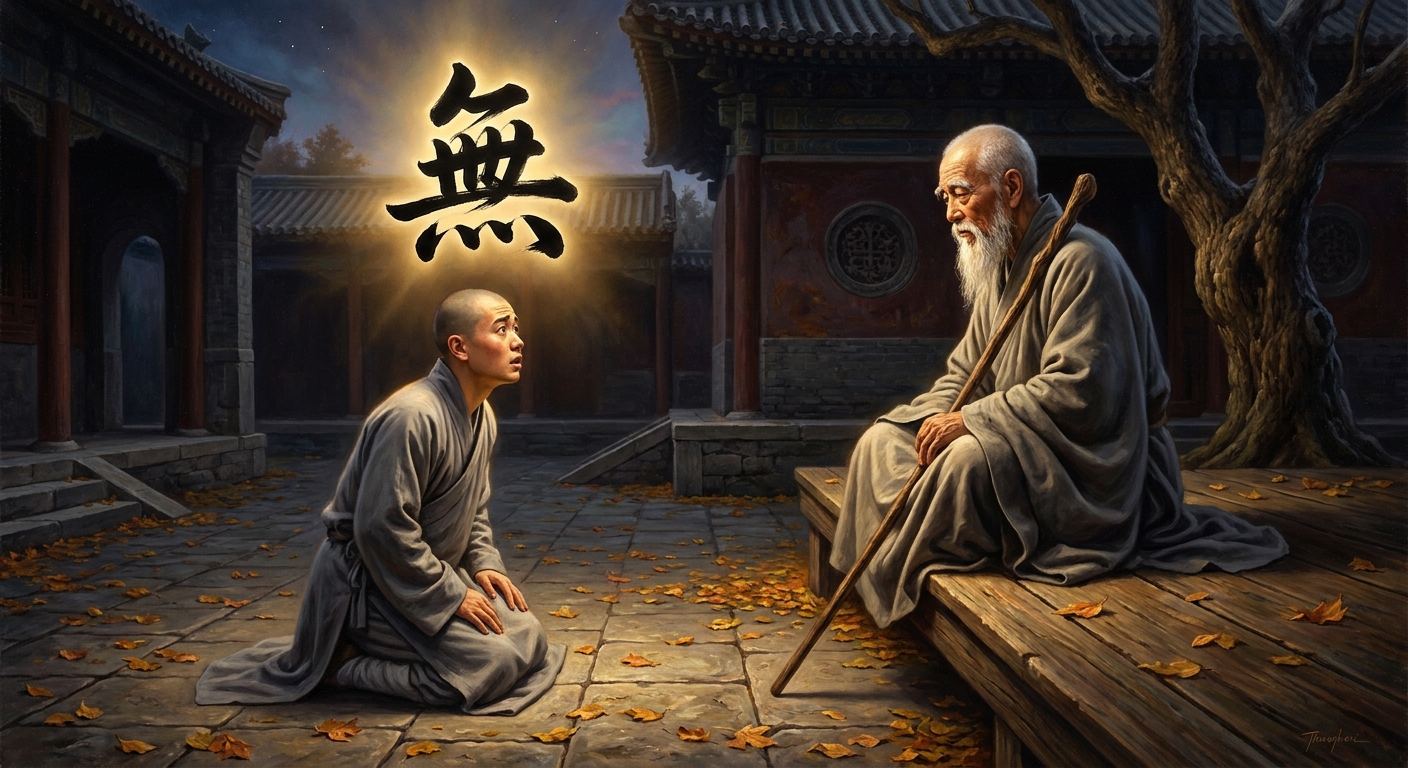
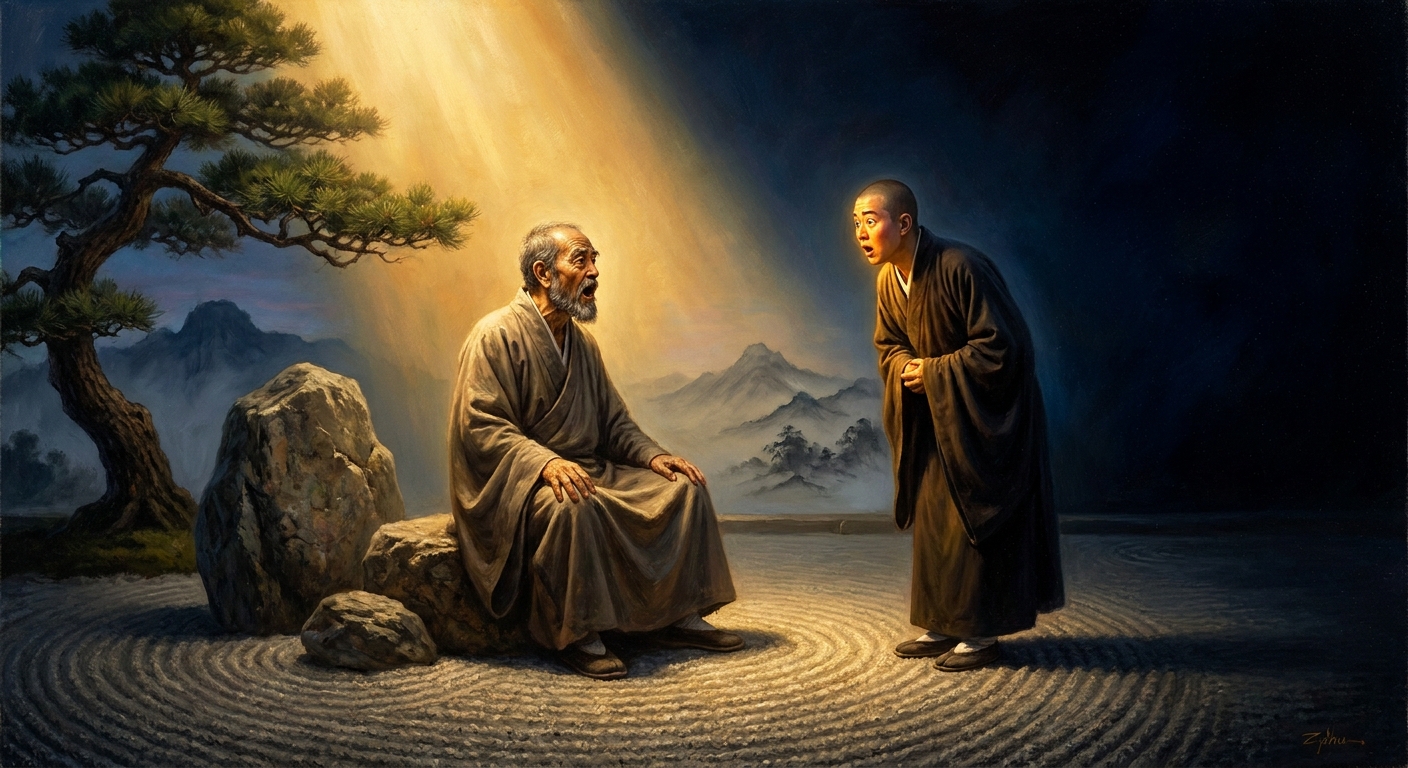
Zhaozhou is sitting in a wooden chair in the courtyard, sun on his thin hands. He does not pause to consider. He does not glance at the dog. He looks at the monk, and the answer comes out as if it had been sitting on his tongue all morning waiting for the right ear.
“Mu.”
One syllable. 無. The Chinese negation — no, not, none — but said in this room, by this man, at this moment, it is not the answer to the question. It is a refusal of the question’s currency. The monk asked yes-or-no. The master has handed him a sound that is neither.
The monk waits. He expects elaboration. None comes. The dog does not stir. The sun moves a fraction across the courtyard tile.
“But the sutras say,” the monk begins — and stops, because the master has not interrupted him, but the sentence has stopped of its own accord, the way a wagon stops when the road runs out.
He does not understand.
He goes back to his cell and sits with the syllable. He sits with it through the evening bell, through the night sit, through the dawn chant. Mu. Mu. It does not become a word. It does not become a doctrine. It sits in his chest like a stone he has swallowed by accident.
He tries the obvious readings. Mu means no. Therefore the dog does not have Buddha-nature. Therefore the doctrine is wrong. The reading collapses; the doctrine is too well-established, and Zhaozhou is too good a teacher to simply contradict it. Mu means the dog has it but cannot manifest it. The reading collapses; that is a yes-answer dressed as a no, and the master gave neither. Mu means the question is wrong. This one holds for a moment — and then dissolves, because if the question is wrong, the master could have said so. He did not.
He says Mu.
The monk realizes, near dawn, that the master has not given him an answer. The master has given him the question’s own throat.
He stays at the temple.
A week. A month. Six months. He sweeps the courtyard. He carries water. He sits with Mu. The other monks stop asking him what he is doing. The dog comes and goes. Sometimes the monk looks at the dog and thinks he is about to understand. Then he looks at the dog and thinks he is about to laugh. Then he looks at the dog and the dog looks back, and there is a moment when Mu is not a syllable in his head but a texture in the air between his face and the dog’s face, and then the moment is gone and he is a tired monk in a courtyard again.
Zhaozhou does not speak to him for the entire six months.
When the master finally does speak, it is not about the dog. He says, in passing, the great way is not difficult; only avoid picking and choosing. The monk hears it and bursts into tears. He cannot say why. He bows. He keeps sweeping.
The case is recorded.
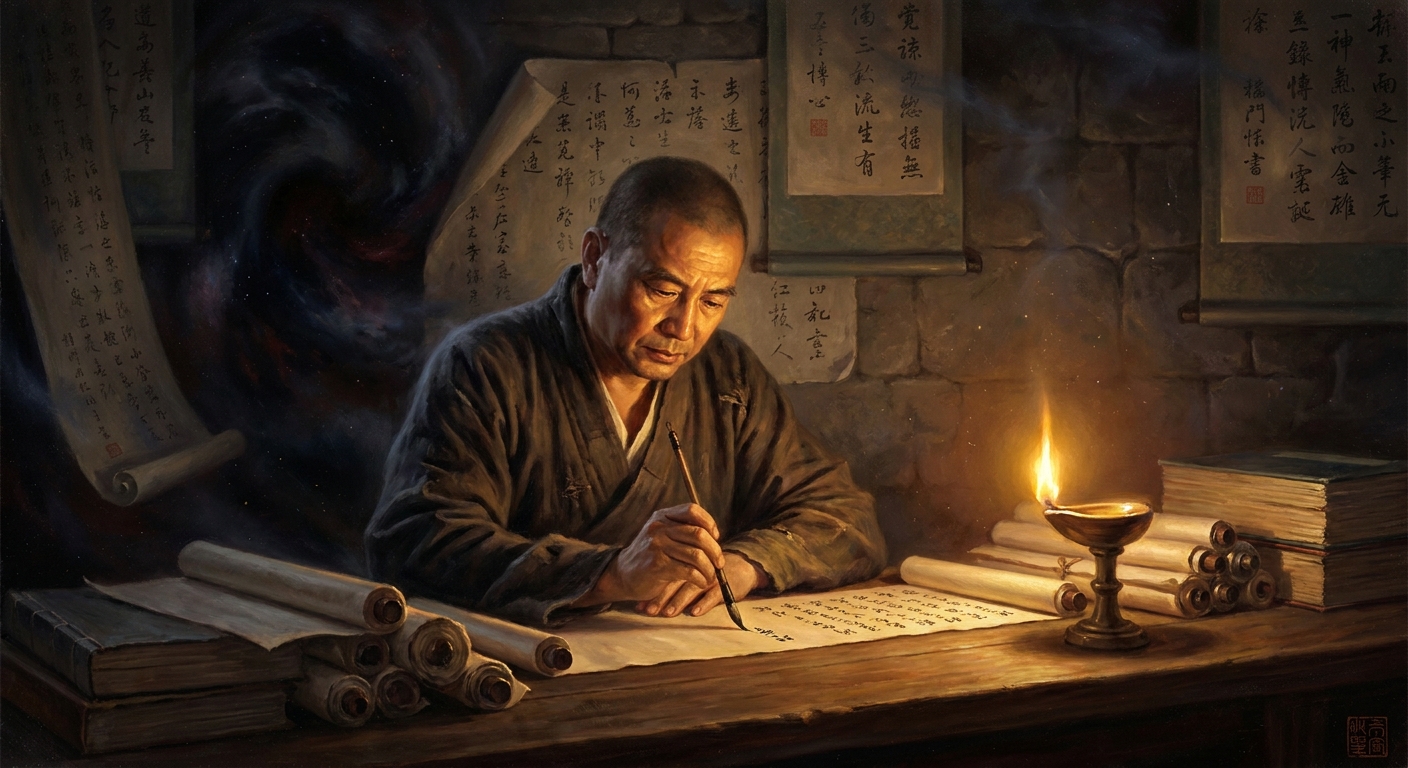
Four hundred years after the master’s death, a Song dynasty Chan teacher named Wumen Huikai assembles forty-eight koans into a manual for his students. He calls it the Wumenguan — the Gateless Gate, a barrier that is not there but cannot be passed. Case one is the dog.
Wumen’s commentary, written for monks who will sit with this case for years:
“Concentrate yourself on this one word Mu. Day and night, become one with it. Do not interpret it as ‘nothing’; do not interpret it as ‘have’ or ‘have not.’ It is as if you have swallowed a red-hot iron ball. You try to spit it out — you cannot. You try to swallow it — it will not go down. Burn away every false conception you have ever held. Inside and outside become one. You will be like a mute who has had a dream — you will know it for yourself alone. And then suddenly Mu breaks open, and you will astonish heaven and shake the earth. You will hold General Guan’s great sword in your hand. You will meet the Buddha and kill him; you will meet the patriarchs and kill them. On the brink of life and death, you will enjoy the Great Freedom. In the six realms and the four modes of birth, you will live in the samadhi of innocent play.”
He adds a verse:
The dog! The Buddha-nature! / The whole presented, openly, complete. / The instant you say have or have not, / You have lost your body, you have lost your life.
The case has not closed.
Eight hundred years after Wumen, Mu is still the first koan most Rinzai students are given. They sit with it for months. Some sit with it for years. They are told, by their teachers, exactly what Wumen said: do not interpret it. Do not solve it. Become it. The ones who break through cannot describe what broke. The ones who do not break through cannot describe what is in their way. The literature on the case fills shelves and explains nothing, because the case is designed to make explanation a kind of failing.
A dog is asleep in the dust at a temple gate in Tang China. A monk has asked a metaphysical question. An old man has answered with a sound. The sound has been ringing for a thousand years and has not yet finished arriving.
The Western mind reads the koan as a riddle and looks for the answer. There is no answer. The koan is not a riddle; it is a wedge. It is driven into the gap between the question and the questioner, and what is split open is not the question but the assumption that the questioner is a stable thing capable of receiving an answer.
Augustine knew the shape of this. So did the writer of the Cloud of Unknowing. So did Wittgenstein, in his own grammar, when he said the solution is the disappearance of the problem.
Mu is not ‘no.’ Mu is what is left when the question stops asking itself.
The dog is still asleep. The master is dead. The syllable is in your throat.
Scenes
The old master in the temple courtyard, a dog asleep at the gate
Generating art… A single syllable — *Mu* — leaving the master's mouth
 Generating art…
 Four centuries later, Wumen sets down his brush
 Generating art…
 Echoes Across Traditions
Entities
- Zhaozhou (Joshu)
- the Monk
- the Dog
- Wumen (Mumon)
Sources
- *Wumenguan* (*Mumonkan* / *The Gateless Gate*), case 1, compiled by Wumen Huikai (1228 CE)
- Robert Aitken (trans.), *The Gateless Barrier: The Wu-men Kuan (Mumonkan)* (1990)
- *Zhaozhou Lu* (*Record of Zhaozhou*) — Tang dynasty
- Heinrich Dumoulin, *Zen Buddhism: A History, Volume 1: India and China* (1988)
- Andy Ferguson, *Zen's Chinese Heritage: The Masters and Their Teachings* (2000)