The Round City's Library
Abbasid Caliphate · c. 750-1258 CE (peak: 813-833 CE under al-Ma'mun) · Baghdad — the Round City on the Tigris, center of the world's largest empire, four miles in diameter, population one million
Contents
In the Abbasid Caliph al-Ma'mun's Baghdad — the largest city in the world — hundreds of scholars translate the entirety of Greek, Syriac, Persian, and Sanskrit learning into Arabic, inventing algebra in the margins, and preserve for the world what would otherwise have been lost forever.
- When
- Abbasid Caliphate · c. 750-1258 CE (peak: 813-833 CE under al-Ma'mun)
- Where
- Baghdad — the Round City on the Tigris, center of the world's largest empire, four miles in diameter, population one million
Baghdad is round.
This is not a metaphor. The Abbasid caliph al-Mansur builds his new capital in 762 CE as a perfect circle — four miles in diameter, double ring walls, four gates pointing to the four cardinal directions, the palace and the mosque at the center. The round city says something about how the Abbasids understand their position in the world: at the center, with everything orbiting them. They are right. By 830 CE, Baghdad is the largest city on earth, population one million, the point toward which the trade routes of silk, spice, paper, and ideas all converge.
The city sits on the west bank of the Tigris. Across the river, the east bank market districts grow so large they eventually swallow the round city’s primacy. Between the two banks the bridges carry more daily traffic than London or Paris will see for another five hundred years. The smell is incense and garbage and river mud and grilling meat and the ink of a hundred scriptoria.
Inside the caliphal complex, in a hall whose name Bayt al-Hikma — the House of Wisdom — will survive everything else about the building, the scholars are working.
Hunayn ibn Ishaq is a Nestorian Christian from al-Hira, and he leads the medical translation team.
He is, by the common consent of every scholar who works with him, the most precise translator of the age. He does not merely know Greek and Arabic — he has studied the theory of translation, the places where Greek and Arabic structure diverge, the traps that catch literal translators. He travels to Alexandria and Syria and Byzantine territories specifically to find better manuscripts before he translates, because he has learned that the text you are translating matters more than the method you use.
He produces full or partial translations of 129 Galenic texts — more than any other translator. He translates Hippocrates, Dioscorides, Paul of Aegina. He translates works of philosophy and mathematics when the medical queue allows. He trains his son Ishaq and his nephew Hubaysh as his translators in Greek, so that the team has depth. He writes a systematic account of his own translations — which manuscripts he found, how complete they were, which he had to reconstruct from multiple copies — that survives as the most detailed record we have of how the translation movement actually worked at the technical level.
He is paid in gold. The Abbasid caliphs pay translators by the weight of the manuscripts they produce. Hunayn is well aware this creates an incentive for verbosity, and works against it, because he values precision above payment, and because his reputation is the asset that commands the fee.
Al-Khwarizmi works in the mathematics section, and he has a problem with Indian numerals.
The problem is not that Indian numerals are unclear — they are brilliantly clear, a place-value system with a zero, far more efficient than anything in Arabic or Greek or Latin. The problem is that most Islamic scholars have not yet adopted them, and the arithmetic they need for astronomy, land survey, and commerce is still conducted in cumbersome older systems. Al-Khwarizmi writes a treatise explaining Indian numerals and their use. This treatise, when translated into Latin in the 12th century, will give the European world what it calls Arabic numerals — which are actually Indian — and the word algorism (from al-Khwarizmi’s name), which eventually becomes algorithm.
But his larger work is the Kitab al-Mukhtasar fi Hisab al-Jabr wal-Muqabala — the Compendious Book on Calculation by Completion and Balancing. The title describes the two operations for solving what we call equations: al-jabr (moving a term from one side) and al-muqabala (balancing by cancellation). The title’s first word, al-jabr, enters Latin as algebra. The book, translated by Robert of Chester in 1145, is the founding document of a branch of mathematics.
Al-Khwarizmi is also a geographer, an astronomer, and a historian. He revises Ptolemy’s geography with more accurate coordinates for hundreds of locations. He produces the first systematic astronomical tables in Arabic, correcting Greek observations with new Islamic ones. He works with a team of astronomers, funded by al-Ma’mun, who measure one degree of latitude along a meridian on the Syrian plain — confirming the spherical earth and calculating its size.
Al-Kindi works in the philosophy section, and he is trying to do something no one has done before: think systematically in Arabic.
There are Islamic theologians — the mutakallimun — who argue about the divine attributes and the createdness of the Qur’an. There are Qur’anic commentators who produce exegesis of extraordinary sophistication. But no one has yet produced philosophy in Arabic in the sense that Aristotle produces philosophy in Greek — a systematic, rigorous inquiry into first principles that proceeds by argument rather than revelation, that is in principle available to anyone who can follow the argument regardless of their religious commitments.
Al-Kindi does it. He produces philosophical treatises on the intellect, on first philosophy, on the definition of things, on how to rebuff attacks on philosophy — using the Aristotelian framework that the translations are producing, and arguing explicitly that Greek philosophy and Islamic religion point to the same truths. He is, in this sense, the originator of the project that al-Farabi, Ibn Sina, al-Ghazali, and Averroes will spend two centuries continuing and arguing about.
He also produces the first systematic treatment of optics in Arabic — the De Aspectibus, which reaches Roger Bacon and John Pecham in 13th-century Oxford and becomes the foundation of the Latin optical tradition.
The caliphs compete for manuscripts the way modern states compete for weapons systems.
Al-Ma’mun negotiates with the Byzantine emperor for access to Greek manuscripts held in Constantinople — sending an embassy specifically to bring back scientific texts. His agents search the markets of Alexandria, Antioch, Harran, Jundishapur for manuscripts that have not yet been translated. They pay large sums for Persian astronomical texts and Sanskrit mathematical works from India. The caliph himself participates in scholarly discussions, debates philosophy with his court philosophers, funds specific translation projects according to what he personally finds interesting.
The Abbasid translation movement runs for approximately one hundred and fifty years, from roughly 750 to 900 CE. In that time it produces Arabic translations of virtually the entire Greek scientific corpus — Euclid, Archimedes, Apollonius, Ptolemy, Galen, Hippocrates, Dioscorides, Aristotle — plus Persian astronomical and historical literature, Sanskrit mathematical and medical texts, and Syriac theological and philosophical works. The library at Baghdad in 900 CE contains more books than anywhere else on earth. The city is the intellectual center of the world.
The Mongols under Hulagu Khan destroy Baghdad in 1258.
The caliph al-Musta’sim is executed. The libraries are burned. The Tigris runs black with ink, say the later chroniclers — the waters of the river colored by the manuscripts thrown into it by soldiers who do not read Arabic. The Round City is rubble. The Abbasid caliphate, five centuries old, is over in two weeks.
What does not die is the translations. The Arabic texts are already dispersed — in Cordoba, in Cairo, in Samarkand, in the madrasa libraries of a hundred cities. The Latin translations are already circulating in Toledo, in Sicily, in Paris, in Oxford. The commentaries and extensions are already generating their own traditions.
Gerard of Cremona, working in Toledo in the 1140s, translates eighty-seven works from Arabic into Latin. His list includes Euclid’s Elements, Ptolemy’s Almagest, the works of al-Khwarizmi, the Canon of Ibn Sina, most of Aristotle. He is translating texts that exist in Latin only because they exist in Arabic, and exist in Arabic only because the scholars in the Round City on the Tigris spent three generations deciding that all human knowledge was worth preserving.
The scribes who throw the manuscripts into the Tigris in 1258 are doing what illiteracy always does in the presence of books — they are trying to stop something that cannot be stopped, because the idea is already somewhere else, already copied, already in the hands of someone who has already understood it.
Scenes
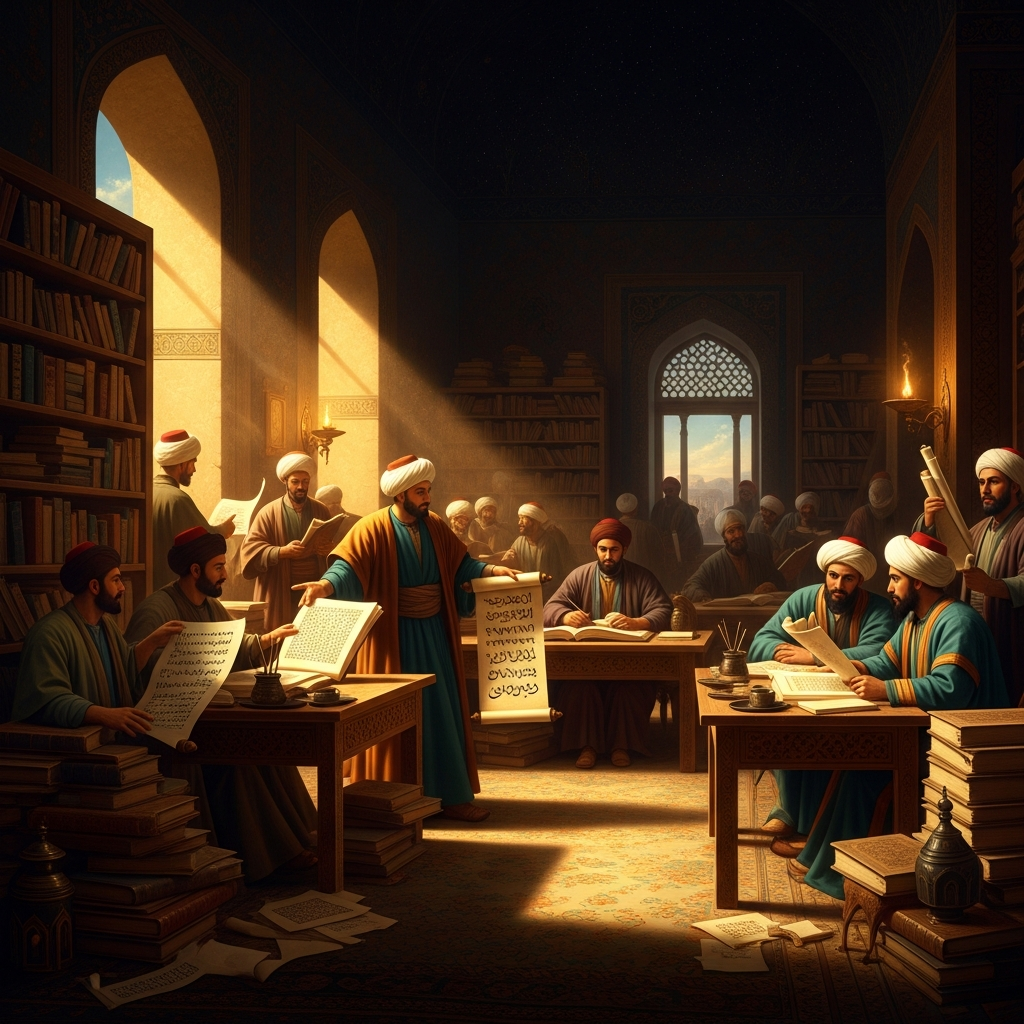
In the scriptorium of the Bayt al-Hikma, translators working in Syriac, Greek, Persian, and Arabic pass manuscripts between tables — the greatest knowledge transfer in human history conducted by lamplight on the banks of the Tigris
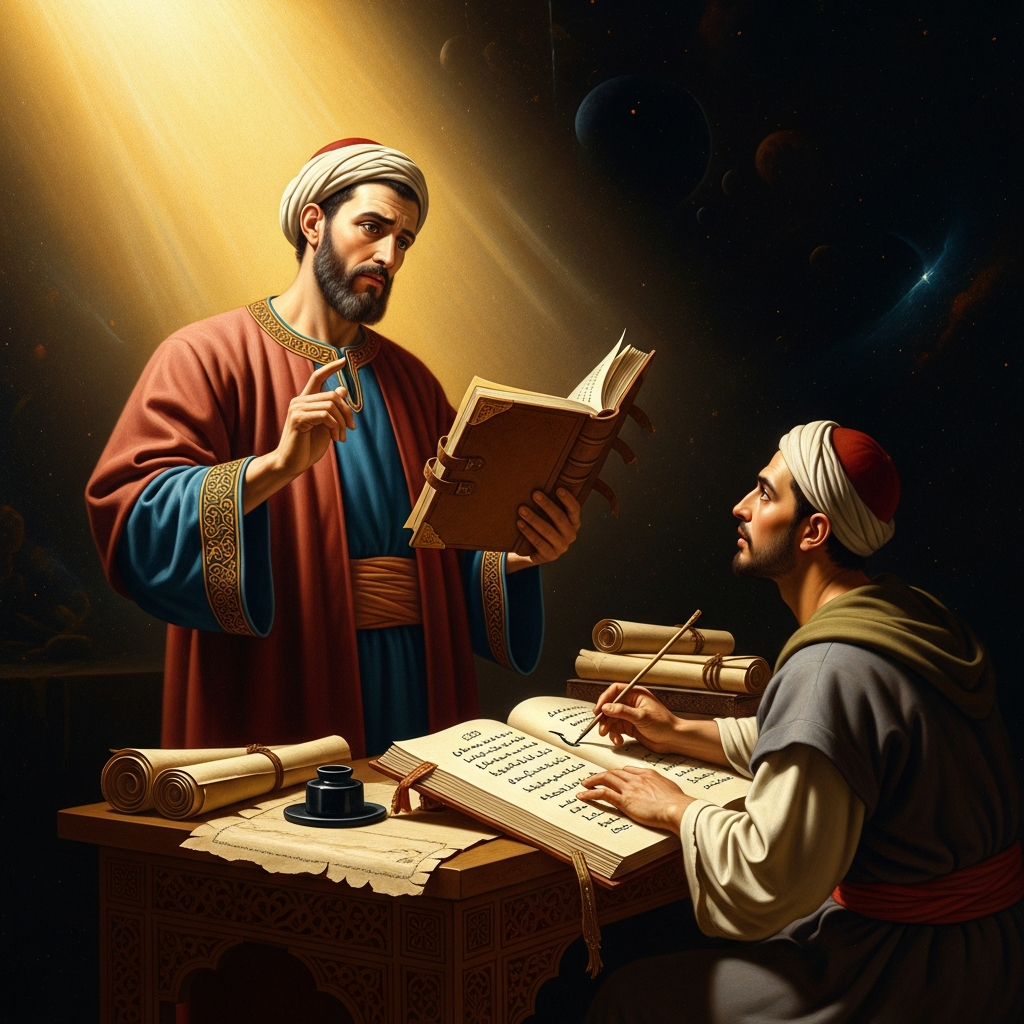
Generating art… Hunayn ibn Ishaq, the Nestorian Christian physician, holds a Syriac manuscript of Galen in one hand and dictates the Arabic rendering to a scribe — searching first for existing translations to correct before writing new ones
 Generating art…
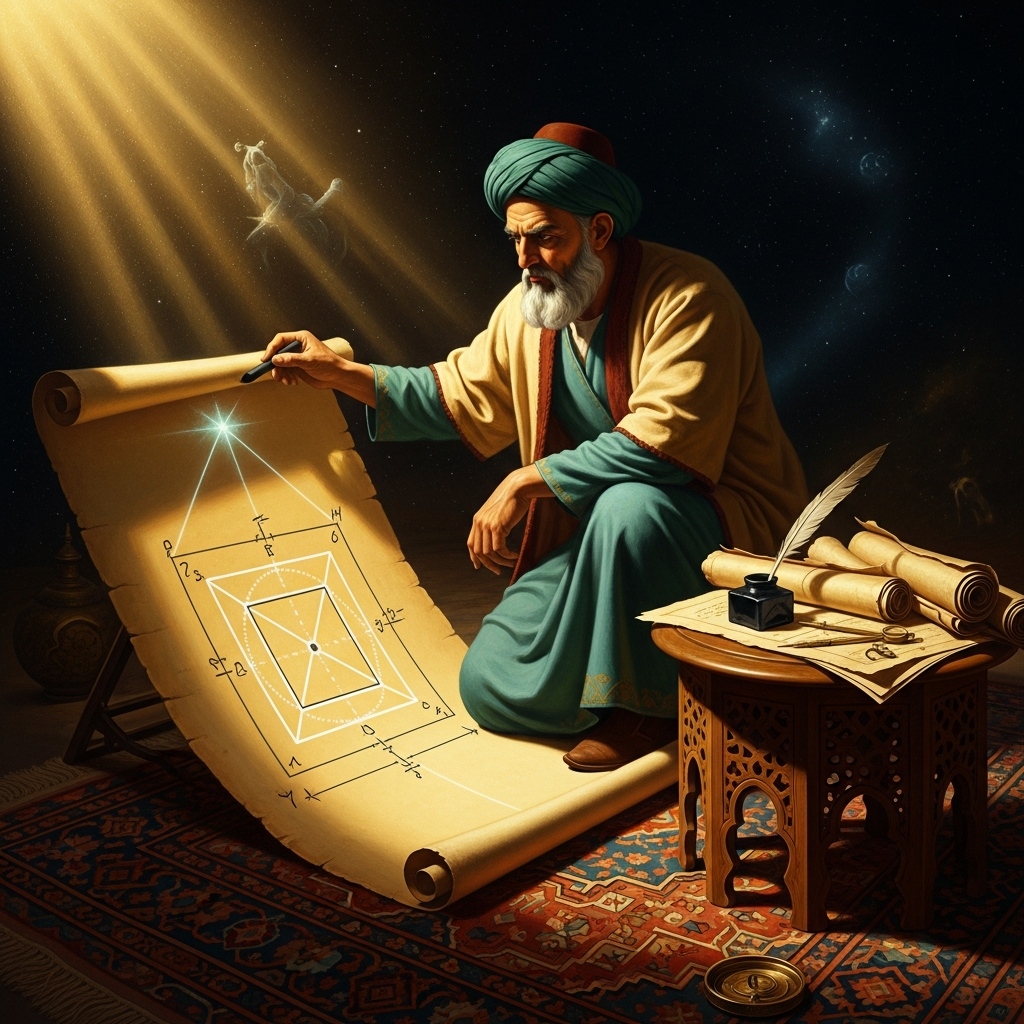
 Al-Khwarizmi draws the diagram that accompanies the geometric proof of his quadratic equation — the image that gives *al-jabr* (the restoration) its name, and eventually gives the world algebra
 Generating art…
 Echoes Across Traditions
Entities
- Caliph Harun al-Rashid (founder)
- Caliph al-Ma'mun (great patron)
- Hunayn ibn Ishaq (chief medical translator)
- al-Khwarizmi (inventor of algebra)
- al-Kindi (first systematic Arab philosopher)
- the Bayt al-Hikma (House of Wisdom)
Sources
- Dimitri Gutas, *Greek Thought, Arabic Culture: The Graeco-Arabic Translation Movement in Baghdad* (Routledge, 1998) — the definitive modern account
- Jim Al-Khalili, *The House of Wisdom: How Arabic Science Saved Ancient Knowledge and Gave Us the Renaissance* (Penguin, 2011)
- Hunayn ibn Ishaq, *Risala* (Letter to Ali ibn Yahya) — his own account of which Galenic texts he translated and how
- Al-Khwarizmi, *Kitab al-Mukhtasar fi Hisab al-Jabr wal-Muqabala* (the Algebra), c. 820 — the title gives us the word 'algebra'
- Al-Kindi, *De Aspectibus* (Optics) and the *Philosophical Encyclopedias* — the first systematic Arabic philosophy
- Jonathan Lyons, *The House of Wisdom: How the Arabs Transformed Western Civilization* (Bloomsbury, 2009)