The Borobudur Ascent
c. 825 CE · Sailendra Java · Borobudur, central Java — the Kedu Plain, ringed by the Merapi and Sumbing volcanoes
Contents
A pilgrim climbs the largest Buddhist monument on earth — through hells of carved suffering, through galleries of the Buddha's previous lives, into the upper terraces where seventy-two stone bells house seated Buddhas — and finds at the summit a single empty stupa.
- When
- c. 825 CE · Sailendra Java
- Where
- Borobudur, central Java — the Kedu Plain, ringed by the Merapi and Sumbing volcanoes
He arrives at dawn.
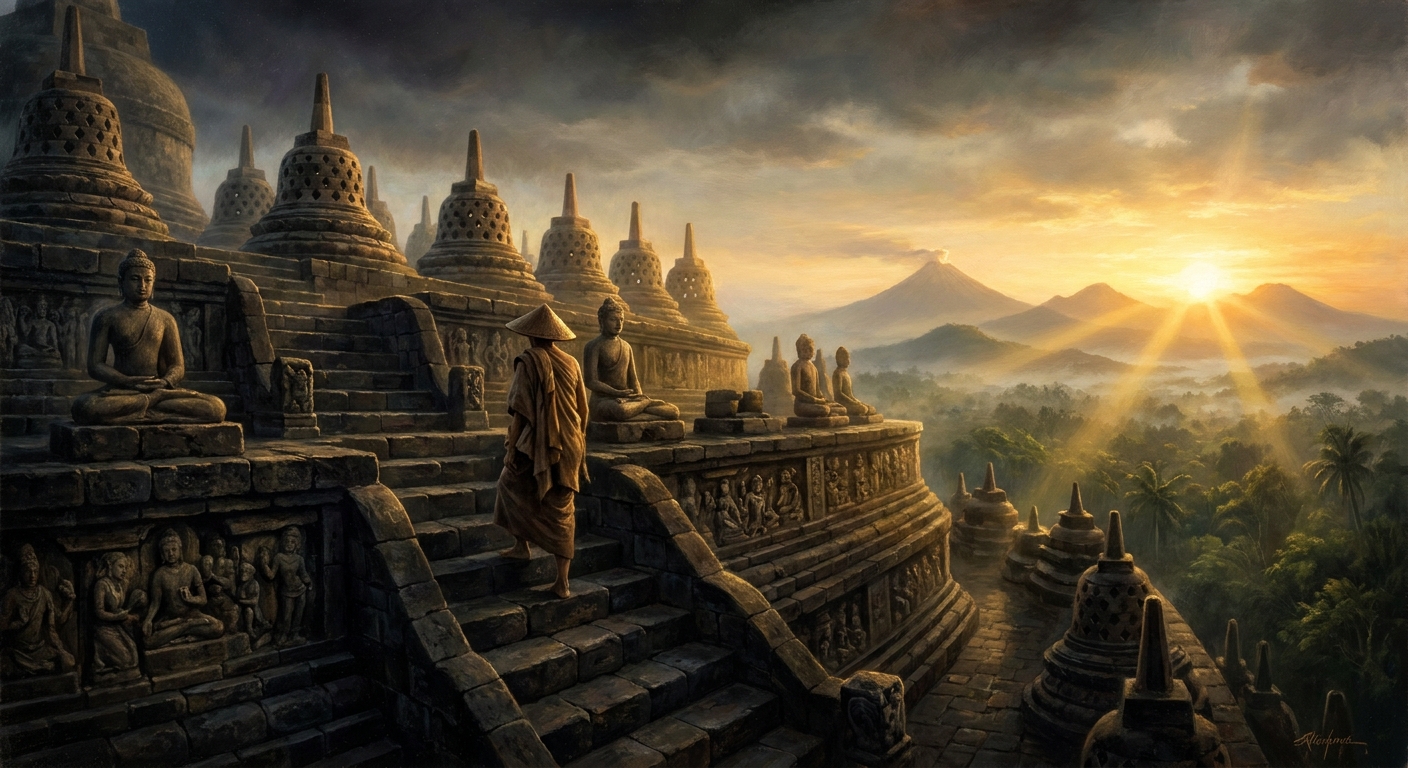
The volcano Merapi is smoking on the eastern horizon — it always is — and the Kedu Plain holds its mist for another hour before the sun burns it off. The pilgrim has walked from the coast, days through rice terraces and palm forest, to stand now at the foot of the largest stone structure in Southeast Asia. He cannot see it whole. From the ground it looks like a low hill capped with bells.
He removes his sandals. He begins, as the priests have taught him, at the eastern stairway. He does not climb directly. He circles. The proper approach is pradakshina — clockwise, the right shoulder always turned toward the monument, the way the planets are said to circle Mount Meru, the way the body of the cosmos turns around its still center.
The first gallery rises above his head, dark stone fitted without mortar.
He cannot see the lowest level.
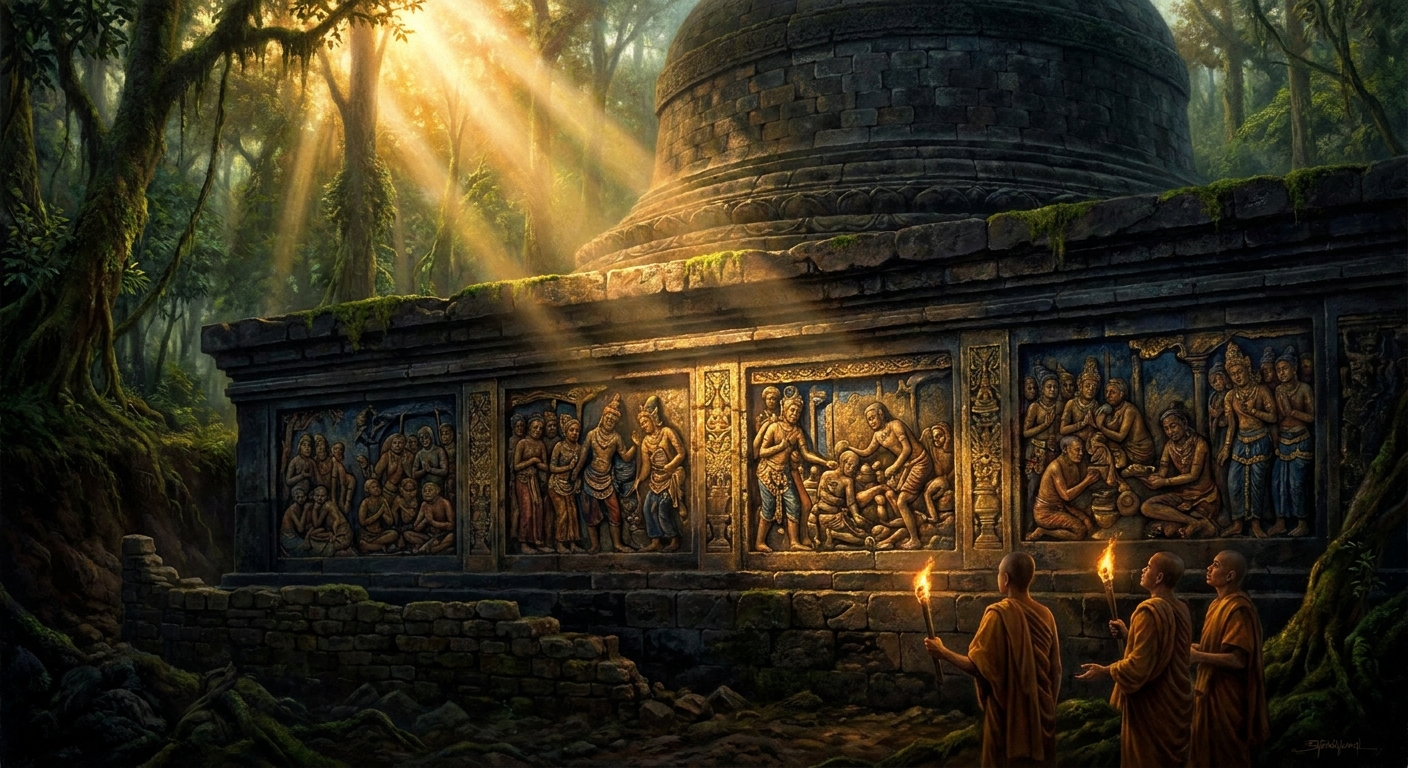
Beneath the first terrace, sealed inside the foundation, is Kamadhatu — the realm of desire. One hundred and sixty reliefs depicting what desire does to those who serve it. A man cleaving his neighbor with an axe and being reborn as a hungry ghost. A glutton devouring children and being eaten by dogs. A miser hoarding rice and starving among his sacks. These panels exist. The pilgrim knows they exist. He cannot walk them.
The Sailendra builders walled them in — perhaps because the southern flank was sliding under the monument’s own weight and needed buttressing, perhaps because a pilgrim is not meant to enter the realm of desire but only to know it is there, beneath everything else.
He begins, instead, at the first circumambulation.
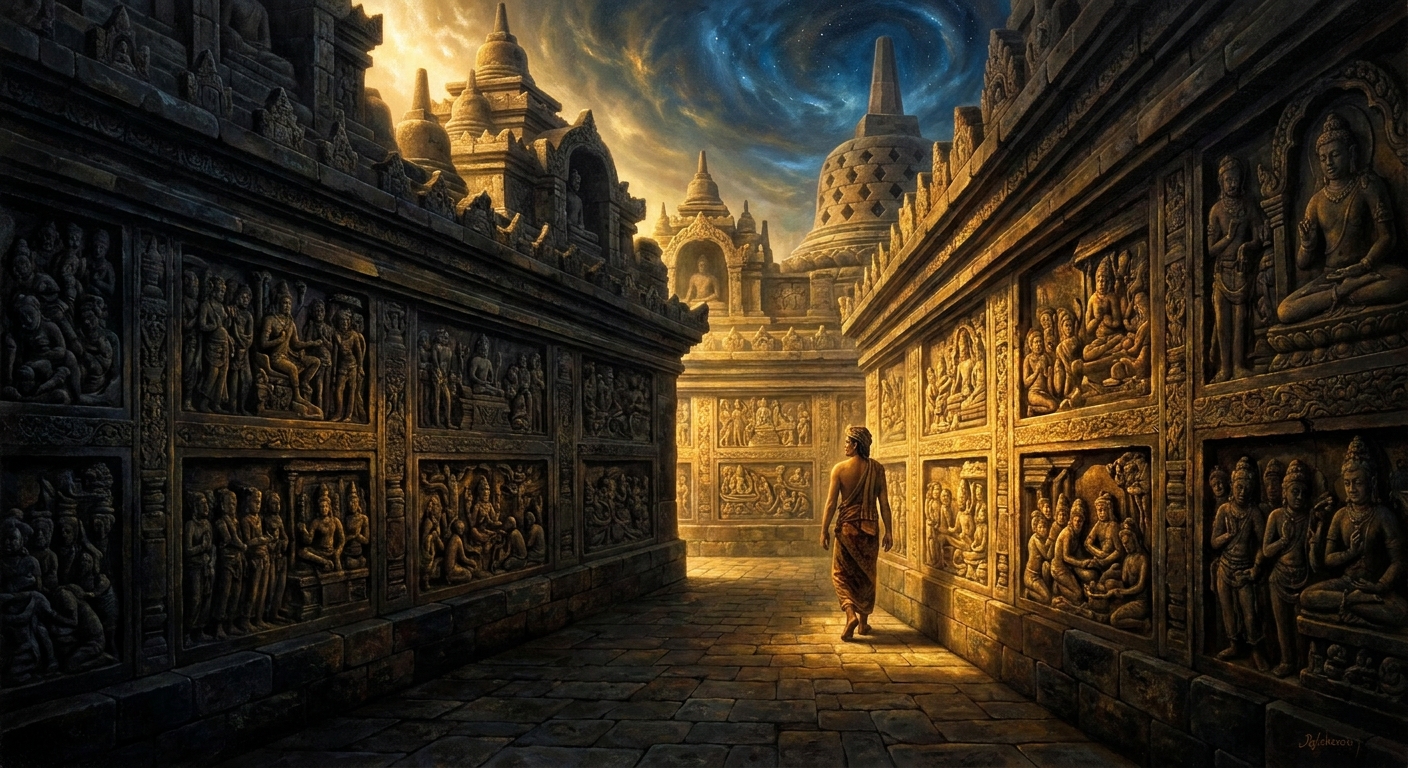
The Lalitavistara opens above him in stone. Queen Maya dreams of a white elephant entering her side. The infant takes seven steps. The young prince leaves the palace by night. He starves in the forest. He sits beneath the bodhi tree. The pilgrim has known this story since he was a child. He is reading it now with his feet.
By the second gallery he has been walking for an hour.
The Jataka tales unfold along the inner wall — the Buddha’s previous lives, his five hundred and forty-seven incarnations, each one a small lesson in some virtue tested under pressure. The hare who throws himself into a fire to feed a hungry beggar. The monkey-king who makes his body a bridge so his subjects can cross to safety. The deer who offers his life to save a doe and her fawn.
The carvings are wearing in places. Volcanic rain has softened some of the faces. The pilgrim runs his fingertips along the relief and feels the slight depression where ten thousand pilgrims before him have done the same. The stone remembers. The stone is what makes the practice transmissible — bodies leave but the carved instruction stays.
He is climbing without realizing he is climbing. Each gallery is slightly above the last. He is moving through the realm of form, Rupadhatu — the world as it appears, the world the senses can hold, the world Buddhism does not deny but does not finally trust.
By the fourth gallery the carvings have changed.
Sudhana, the merchant’s son, walks the wall. Fifty-three teachers. He visits each one and asks the same question: how does a bodhisattva live? Each teacher has a different answer. A monk. A king. A child. A courtesan. A night goddess named Vasanti who gives him a vision of all space and all time at once. The Gandavyuha is the strangest of the carved sutras and the one the pilgrim has never fully understood, but he understands it now in the way a body understands a long climb — as the increasing thinness of the air, the increasing patience of the breath.
The square galleries end.
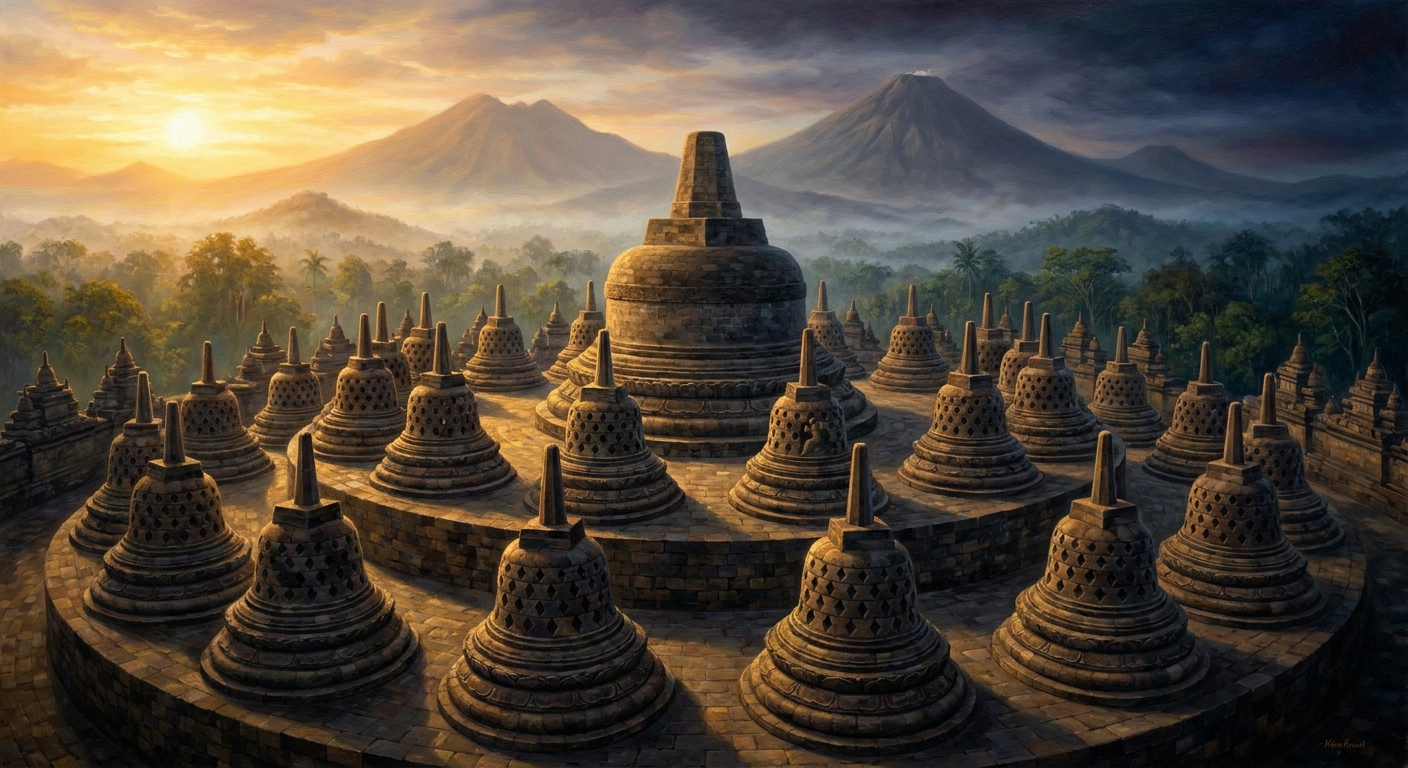
He emerges onto a circular terrace and the geometry of the monument changes. Below him, all is enclosure — walled corridors, narrow sky, narrative pressing in from both sides. Above him, all is opening. Three concentric circular terraces. Seventy-two perforated stone stupas. Each one a bell with a Buddha inside, visible through diamond-shaped lattice.
He has entered Arupadhatu — the formless realm. There is nothing carved here. The narrative has stopped.
He walks among the Buddhas.
Seventy-two stupas, each one shoulder-height, each one with a seated Vairocana inside, the cosmic Buddha who is the dharma-body of all enlightenment. The lattice is cut so the figure is visible but never fully seen — the pilgrim catches a knee, a shoulder, the edge of the dharmachakra mudra, the wheel-turning gesture of the hands. He cannot reach inside. He is not meant to. The stone teaches by withholding.
The wind moves through the perforations and the terrace begins, very faintly, to hum. The Sailendra builders may not have intended this. Or they may have. The pilgrims who tell each other about the hum are convinced it was deliberate. The terraces sing on the right kind of morning, the wind catching the diamond holes at the right angle, and the singing is not loud but it is exactly the pitch of a meditation bell that has been struck once and allowed to fade.
He climbs the last steps to the summit.
The central stupa is sealed.
It is the largest stupa on the monument — taller than the seventy-two below, alone on the highest platform, no lattice, no opening, no Buddha visible inside. Excavators have looked. There is debate about whether anything is in there. Some believe an unfinished Buddha was placed inside and walled up. Some believe the chamber was always meant to be empty. The Sailendra dynasty did not leave a manual.
The pilgrim does not need a manual.
He has climbed through the hells he could not see, through the life of the Buddha and the lives before that, through the fifty-three teachers, through the seventy-two Buddhas behind their lattices. The whole monument has been preparing him for this moment, the moment when he stands at the top of the cosmic mountain and there is nothing inside it. The empty stupa is the answer the entire structure has been arguing toward. Sunyata. Emptiness. The ground beneath all the carvings, the silence the bells were modeling, the place where the self that climbed the mountain stops being a thing.
He sits. The volcano smokes on the horizon. The mist has burned off the plain.
Borobudur is unique among Buddhist monuments in being a building you read with your body. There is no interior chamber, no relic to venerate, no image to bow to. The whole point is the climb. The architecture itself is the teaching: you ascend through suffering, then through narrative, then through form, and at the top you find the absence the entire path was about.
The monument was abandoned around 1000 CE — perhaps because of volcanic ash, perhaps because Java’s center of gravity shifted east, perhaps because the people who built it converted to Islam several centuries later and stopped maintaining it. It was buried under ash and jungle for nearly a millennium. Stamford Raffles cleared it in 1814. UNESCO and the Indonesian government finished the great restoration in 1983.
Two and a half million pilgrims and tourists now climb it every year. The empty stupa is still empty. The instruction at the top has not changed: you carried something up here. Now what.
Scenes
The hidden foot of Borobudur — Kamadhatu, the realm of desire
 Generating art…
 The four square galleries of Rupadhatu, the realm of form
 Generating art…
 The three circular upper terraces of Arupadhatu, the formless realm
 Generating art…
 Echoes Across Traditions
Entities
- Borobudur
- Sailendra Dynasty
- Vairocana Buddha
- Avalokiteshvara
Sources
- John Miksic, *Borobudur: Golden Tales of the Buddhas* (Periplus, 1990) — the standard popular-scholarly introduction
- Soekmono, *Chandi Borobudur: A Monument of Mankind* (UNESCO, 1976) — the lead Indonesian archaeologist's account of the 1973–1983 restoration
- Jacques Dumarçay, *Borobudur* (Oxford, 1978) — architectural analysis
- Donald S. Lopez Jr. (ed.), *Buddhism in Practice* (Princeton, 1995) — for the Mahayana doctrinal context
- Daigan and Alicia Matsunaga, *Foundation of Japanese Buddhism, vol. 1* (Buddhist Books International, 1974) — on the Avatamsaka and Lalitavistara narratives carved into the galleries