Kūkai and the Mountain
806–835 CE · Chang'an (Tang China) and Mount Kōya, Kii Peninsula, Japan
Contents
A young monk crosses to Tang China, returns with the secret tantric transmissions of an empire's last esoteric master, and walks into a cedar mountain in Japan to sit in living meditation until the next Buddha arrives.
- When
- 806–835 CE
- Where
- Chang'an (Tang China) and Mount Kōya, Kii Peninsula, Japan
He is twenty-one and a runaway.
The official career has been arranged for him — Confucian academy, government clerkship, the slow ladder of provincial appointment that his uncle has prepared. Instead he writes a furious dialogue called Sangō Shīki in which a Confucian, a Daoist, and a Buddhist debate, and the Buddhist wins, and then he disappears into the mountains. He sleeps in caves on the Shikoku coast. He chants the mantra of Ākāśagarbha — Bodhisattva of the Sky-Womb — a million times in a hundred days, until the morning star, so the legend says, flies into his mouth.
He comes down the mountain knowing what he is. He does not yet know there is a name for it.
In 804 CE, the Japanese embassy to Tang China is preparing to sail. He talks his way aboard.
The voyage is a disaster.
Four ships leave; two reach the Chinese coast. His ship is blown off course by a storm and lands at Fuzhou, where the local prefect refuses to recognize the embassy as legitimate — the documents have been lost — and threatens to send everyone back as smugglers. The ambassador cannot write his way out of it. Kūkai, twenty-one, takes the brush. He composes a letter in classical Chinese so elegant the prefect personally apologizes, provides horses, and forwards them to Chang’an with an honor guard.
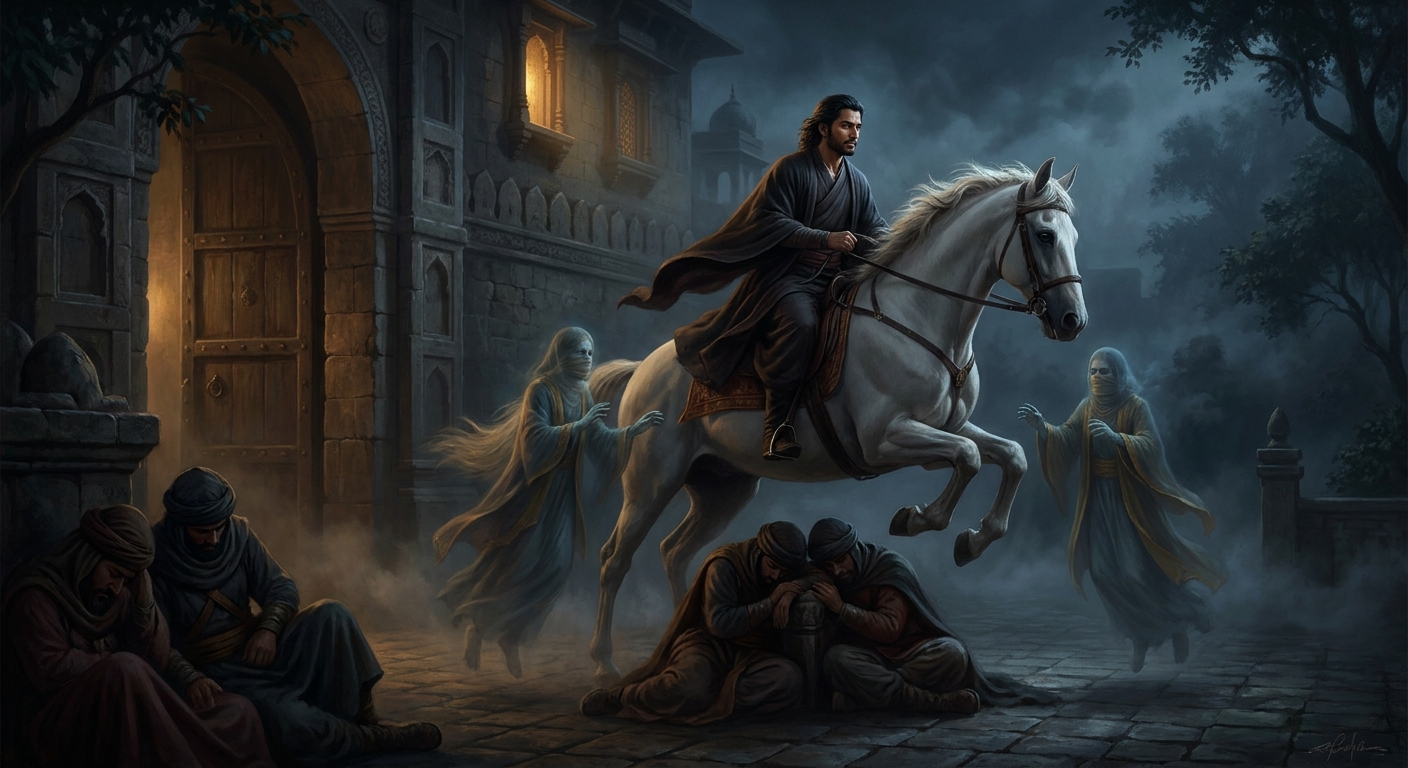
Chang’an in 805 is the largest city in the world. A million people. Persian merchants in the western markets, Sogdian dancers in the wineshops, Nestorian monks at one stele and Manichaean priests at another. Kūkai walks through it the way a starving man walks into a feast.
He finds his way to the temple of Qinglongsi.
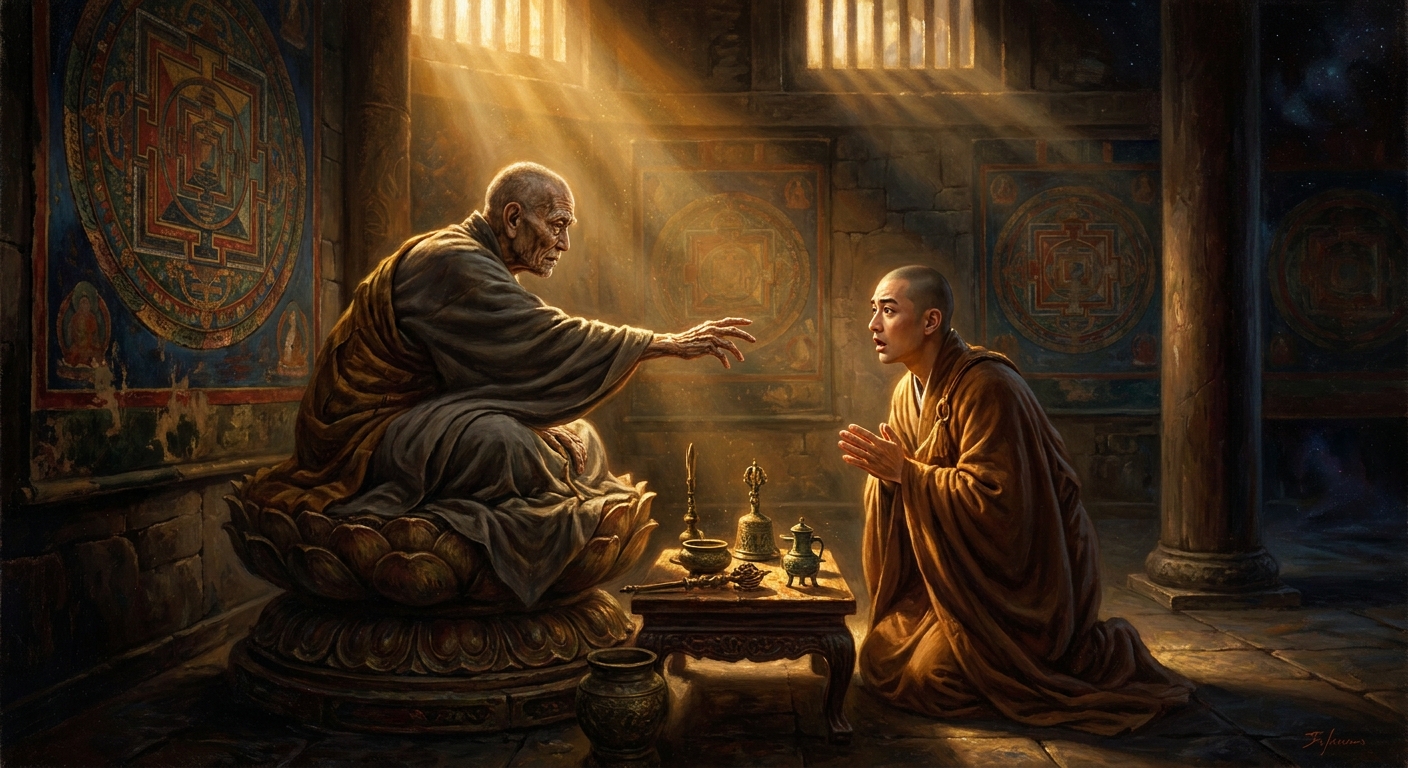
Master Huiguo is dying.
He is sixty years old, the seventh patriarch of esoteric Buddhism in China, the last living holder of the dual transmission of the Womb Realm and Diamond Realm mandalas — the two great esoteric lineages that came out of India in the seventh century. He has been waiting. His Chinese disciples have not, in his judgment, been adequate to receive the full transmission. He has been holding his breath for someone, and he is running out of time.
Kūkai walks in. Huiguo looks up.
“I have been waiting for you. My life is short. There is no one else to whom I can transmit the dharma. Receive the abhiṣeka quickly.”
Three months. That is what Huiguo has left, and that is the time in which he transmits to the young Japanese monk what Indian and Chinese masters had taken decades to pass to single disciples. Kūkai receives the abhiṣekas of both mandalas. He copies sutras, ritual manuals, mantras, the iconographies of every deity. He commissions paintings of the two mandalas. He buys ritual implements — vajras, bells, painted scrolls — by the cartload.
Huiguo dies on the last day of the twelfth month, 805. His final instruction: Take all of this back to Japan. Spread it. Do not let it die.
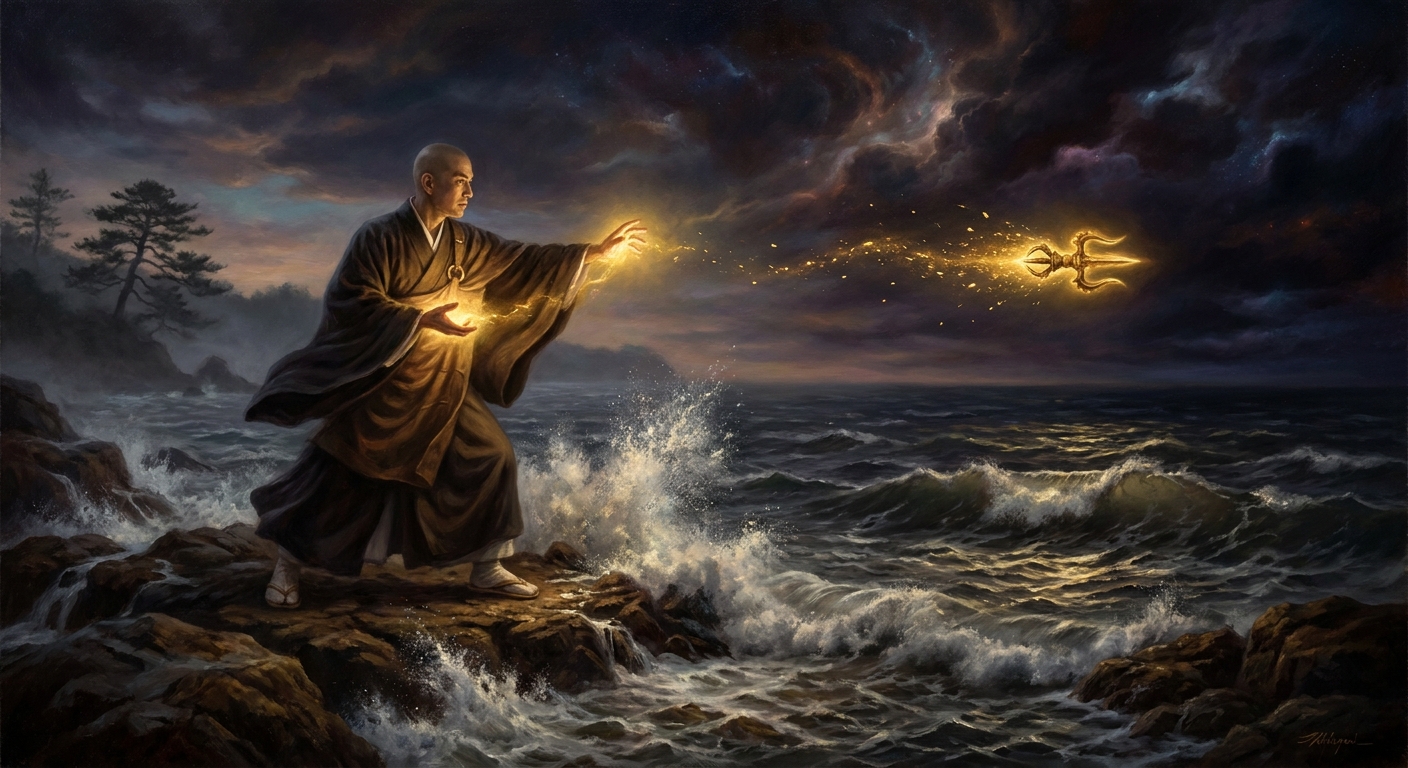
Kūkai stands on the shore at Mingzhou waiting for his ship.
He has the mandalas. He has the manuals. He has, by some accounts, been given a three-pronged vajra of bronze that he holds in his hand at the harbor and weighs against the question of where in Japan this lineage should be planted. Then, in the gesture every Shingon retelling will preserve, he draws back his arm and hurls the vajra east across the sea.
Where it lands, I will build the seat of this dharma.
The ship sails. Years pass.
He returns to Japan in 806 with twenty crates of esoteric Buddhism and finds a court that does not know what to do with him.
Saichō, the founder of Tendai, has come back from China the same year with a more conservative selection of texts and the imperial favor to go with them. Kūkai is held at Dazaifu in Kyushu for two years before he is allowed to bring his texts to the capital. When he is finally received, he writes a memorial — Catalogue of the Imported Items — and the catalogue itself is so vast and so coherent that the court gradually realizes the runaway returned with an entire continent of teaching the Japanese had not previously possessed.
He performs the abhiṣeka rituals in the capital. Saichō himself comes to receive them. The two friendships that follow, with Saichō and with the emperor, give Kūkai the political cover to look for the mountain.
He finds it in 816.
Riding the cedar slopes of the Kii Peninsula, he comes through a high meadow and sees, ahead, a three-pronged bronze vajra caught in the branches of a pine. The legend hardens around the moment. He had thrown the implement from the Chinese coast eleven years before. The mountain had caught it.
This, he says, is the place.
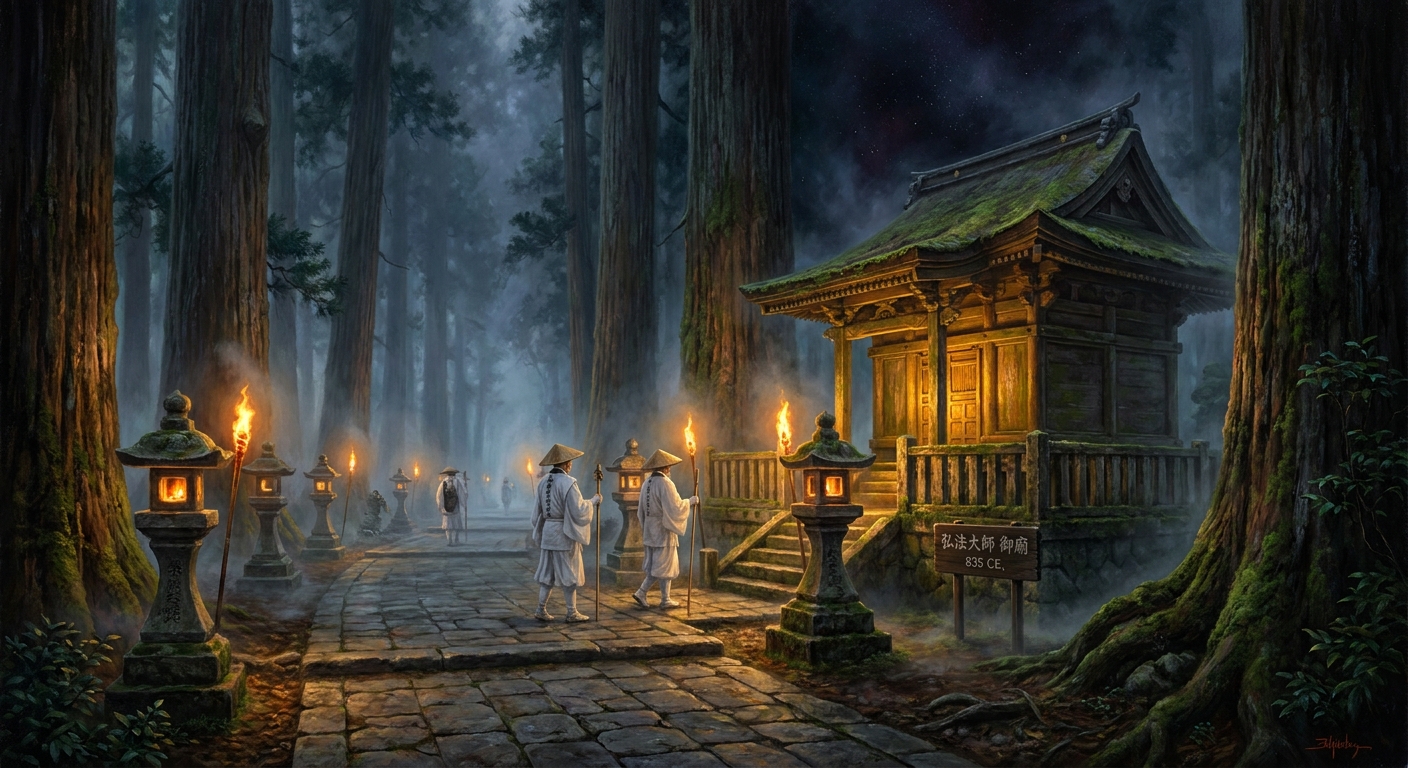
He petitions the emperor for the land. He receives Mount Kōya as a private grant in 819. He begins building. The mountain becomes the garan — the monastic complex — a constructed mandala in which every hall corresponds to a deity, every walk to a meditation, every cedar to a syllable. Pilgrims still climb it. The lamps in the great hall have not been let go out since the ninth century.
In 835, at sixty-one, he announces that he is finished.
He stops eating. He stops drinking. He sits in meditation at the cave-mausoleum he has prepared for himself at Okunoin, the inner sanctum of Mount Kōya. He instructs the disciples on the chant they are to maintain. He tells them, calmly, that he is not dying. He is entering nyūjō: living samadhi. He will sit here, body intact, consciousness suspended at the threshold of nirvana, until Maitreya — the next Buddha, due to arrive in roughly five-point-six billion years — descends to this earth. At which time Kōbō Daishi will rise, walk down the mountain, and accompany the new Buddha through the world.
He closes his eyes. The disciples seal the mausoleum.
For twelve hundred years, twice a day, monks have carried meals to that door. They are not symbolic meals. They are real food, prepared in a kitchen, served on lacquered trays, set inside the gate of a cave that has not been opened in the disciple-life of any monk now living. The robes are changed by ritual. The lamps are tended. The procession does not break.
Shingon is the only complete esoteric Buddhism that survives in East Asia outside Tibet. Kūkai planted it on a mountain that the Japanese never abandoned. Tendai produced Pure Land and Zen as offshoots; Shingon stayed on Mount Kōya and refused to evolve, and that refusal is the reason the eighth-century rituals are still being performed in the cedars exactly as Huiguo transmitted them.
The doctrine Kūkai was willing to be martyred for — though no one ever asked him to be — is sokushin jōbutsu*: this very body, this very life, can become Buddha. Not in some future eon, not after countless rebirths, not somewhere else. Here. The mantra is the body’s instrument; the mandala is the world’s blueprint; the mountain is the cathedral.*
And the master is not dead. That is the claim. The mausoleum at Okunoin is not a tomb. It is an address. Pilgrims walk to it because someone is there to receive them, and the meals are not symbolic, and the lamps are not metaphors, and somewhere in the cedars Kōbō Daishi is still seated, breathing slower than weather, waiting for the next Buddha to come down the road.
Scenes
Chang'an, 805
 Generating art…
 On the shore at Mingzhou, he hurls a three-pronged vajra east across the sea
 Generating art…
 Cedar mountain
Generating art… Echoes Across Traditions
Entities
- Kūkai (Kōbō Daishi)
- Huiguo
- Maitreya

Sources
- Kūkai, *Sangō Shīki* (*Indications of the Goals of the Three Teachings*, 797 CE)
- Kūkai, *Sokushin Jōbutsu Gi* (*The Meaning of Becoming a Buddha in This Very Body*)
- Yoshito S. Hakeda (trans.), *Kūkai: Major Works* (1972)
- Ryūichi Abé, *The Weaving of Mantra: Kūkai and the Construction of Esoteric Buddhist Discourse* (1999)
- Allan G. Grapard, *The Protocol of the Gods* (1992)