Kūkai Throws the Vajra Across the Sea
806–835 CE · Tang China (Chang'an); Mingzhou coast; Mount Kōya, Kii Peninsula, Japan
Contents
Kūkai returns from Tang China in 806 CE with the complete Shingon esoteric transmission. Denied imperial permission to teach, he throws a vajra across the sea — it lands in a pine on Mount Kōya. He climbs to the plateau, founds the monastery, and in 835 CE enters eternal samadhi. The monks still bring him meals twice a day.
- When
- 806–835 CE
- Where
- Tang China (Chang'an); Mingzhou coast; Mount Kōya, Kii Peninsula, Japan
He is twenty-one and already done with the life that has been arranged for him.
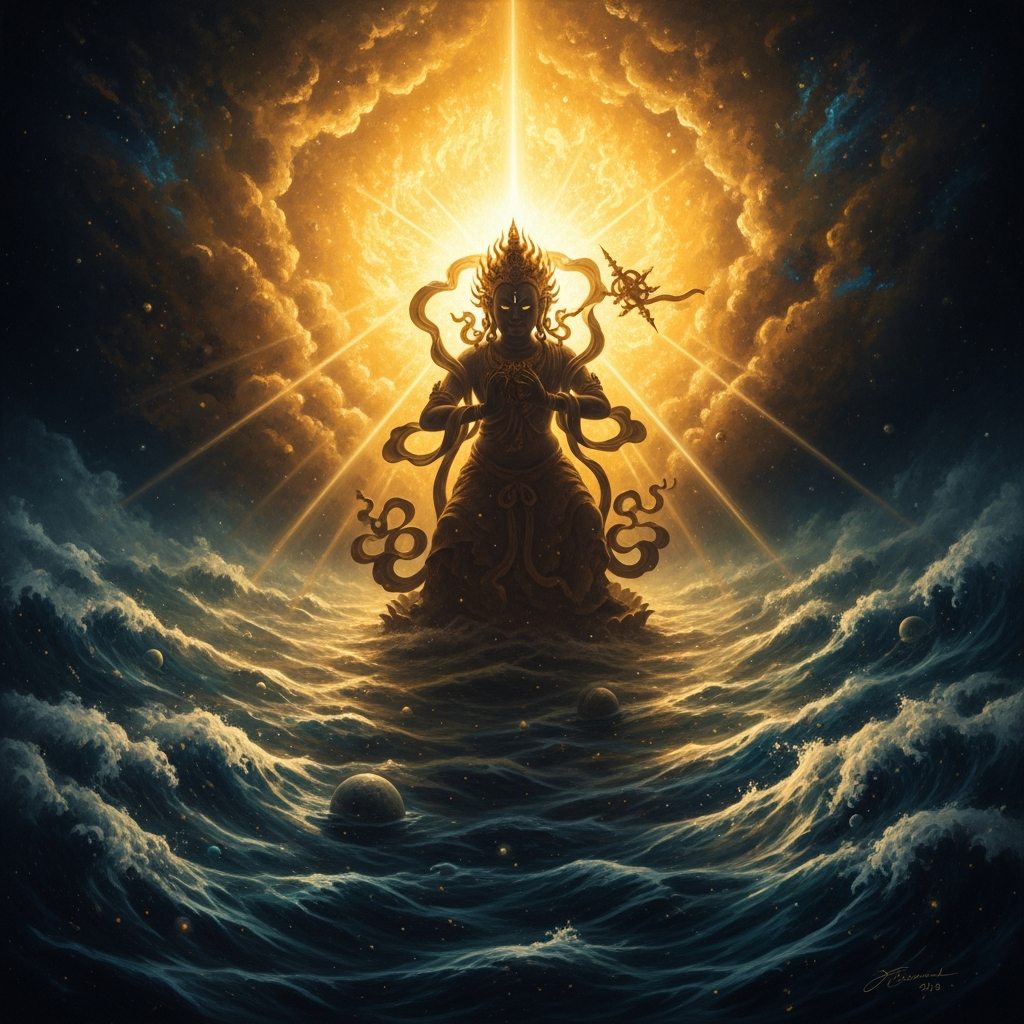
The Confucian academy, the government clerkship, the slow ladder of provincial appointment that his uncle has prepared — none of it is what he is. He writes a furious philosophical dialogue in which a Confucian, a Daoist, and a Buddhist argue the merits of their traditions, and the Buddhist wins, and then he disappears into the mountains of Shikoku and sleeps in sea caves and chants the mantra of Ākāśagarbha — Bodhisattva of the Sky-Womb — a million times in a hundred days. The morning star, the legend says, flies into his mouth at the culmination. He comes down the mountain knowing what he is and knowing there is more of it somewhere than the mountains of Japan contain. In 804, the Japanese imperial embassy to Tang China is preparing to sail. He talks his way aboard.
The voyage nearly kills him.
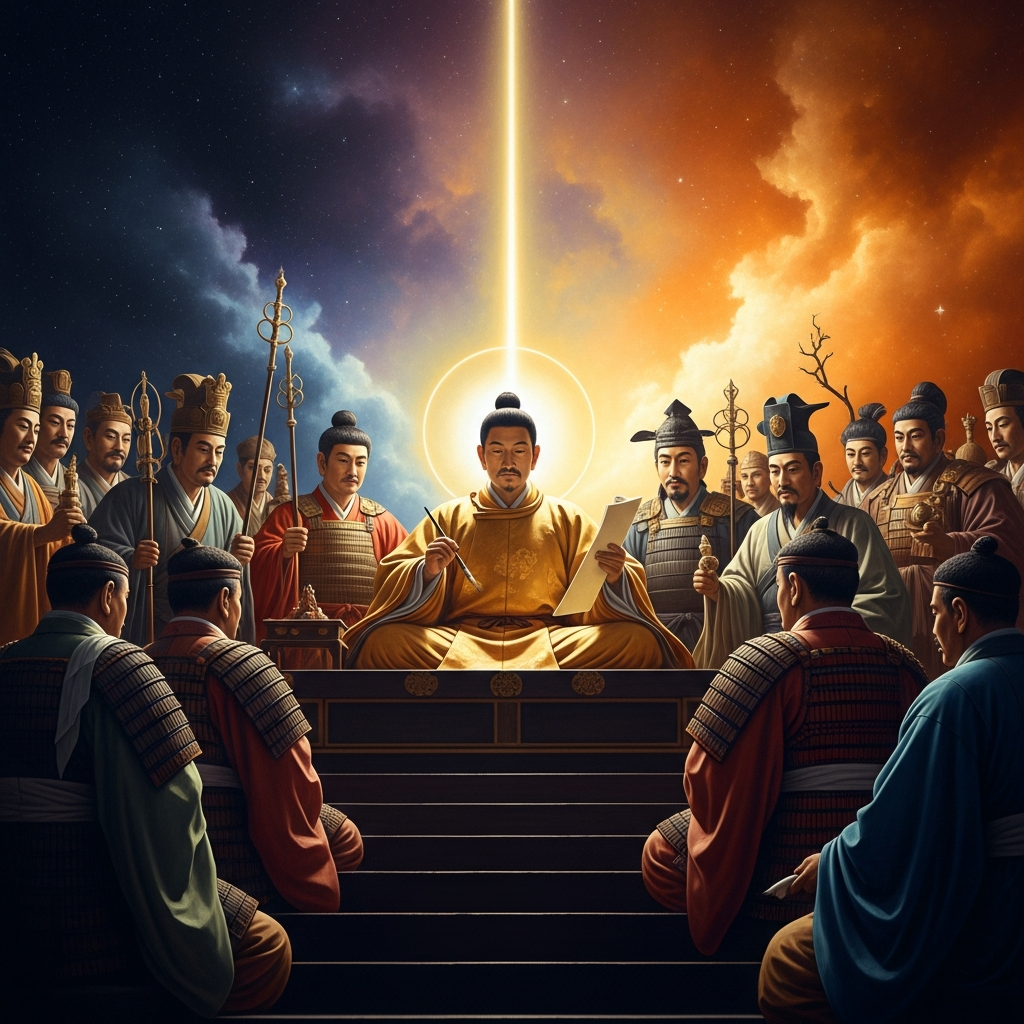
Four ships sail; two reach China. His ship is blown off course and beaches at Fuzhou, where the local prefect refuses to recognize the Japanese embassy — the documents are lost — and threatens to turn them back as smugglers. The ambassador cannot write his way out of it. Kūkai, twenty-one, takes the brush. He composes a formal letter in classical Chinese so elegant and precise that the prefect personally apologizes, provides horses, and sends them to Chang’an with an honor guard. This detail matters: he has not yet received any teaching. He has not yet met the master he is crossing the world to find. And already the instrument — the command of language, the capacity to put the exact word in the exact place with the exact force — is fully present. He does not yet know this is also the doctrine he is going to carry home.
Master Huiguo is sixty and running out of time.
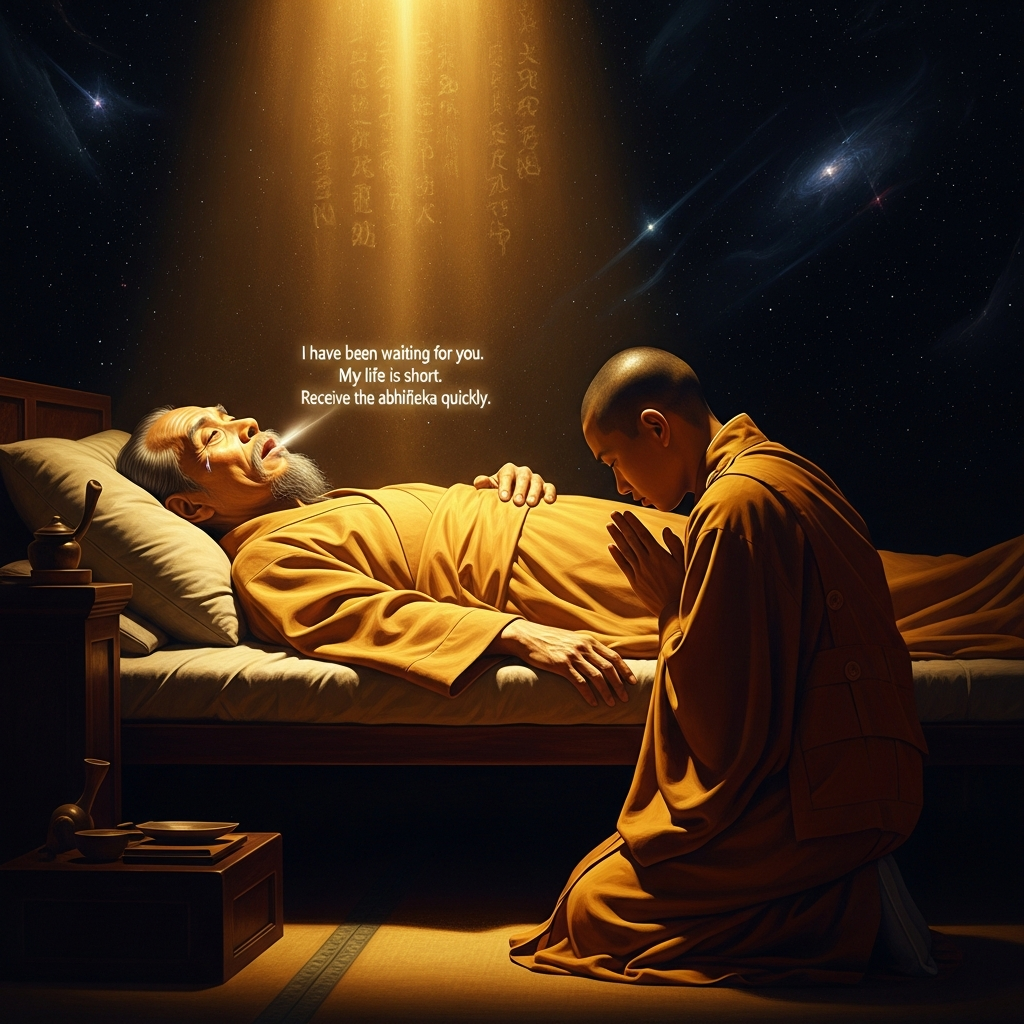
He is the seventh patriarch of esoteric Buddhism in China, the last living holder of the dual transmission of the Womb Realm and Diamond Realm mandalas — two great esoteric lineages that came out of India in the seventh century and that no single Chinese disciple has been judged adequate to receive in full. He has been holding this transmission with nowhere to put it. His health is failing. His Chinese students are capable but not sufficient. And then a young Japanese monk walks into the compound at Qinglongsi, and Huiguo looks up from his cushion, and something resolves in his face. I have been waiting for you. My life is short. There is no one else. Receive the abhiṣeka quickly. Three months. That is what he has, and in those three months he transmits everything — both mandalas, the ritual manuals, the iconography of every deity, the full conferral of both lineages — to a foreigner half his age who arrived without an appointment.
Huiguo dies on the last day of the twelfth month, 805. His final instruction: Take all of this back to Japan. Spread it. Do not let it die.
He stands on the shore at Mingzhou with twenty crates and a question.
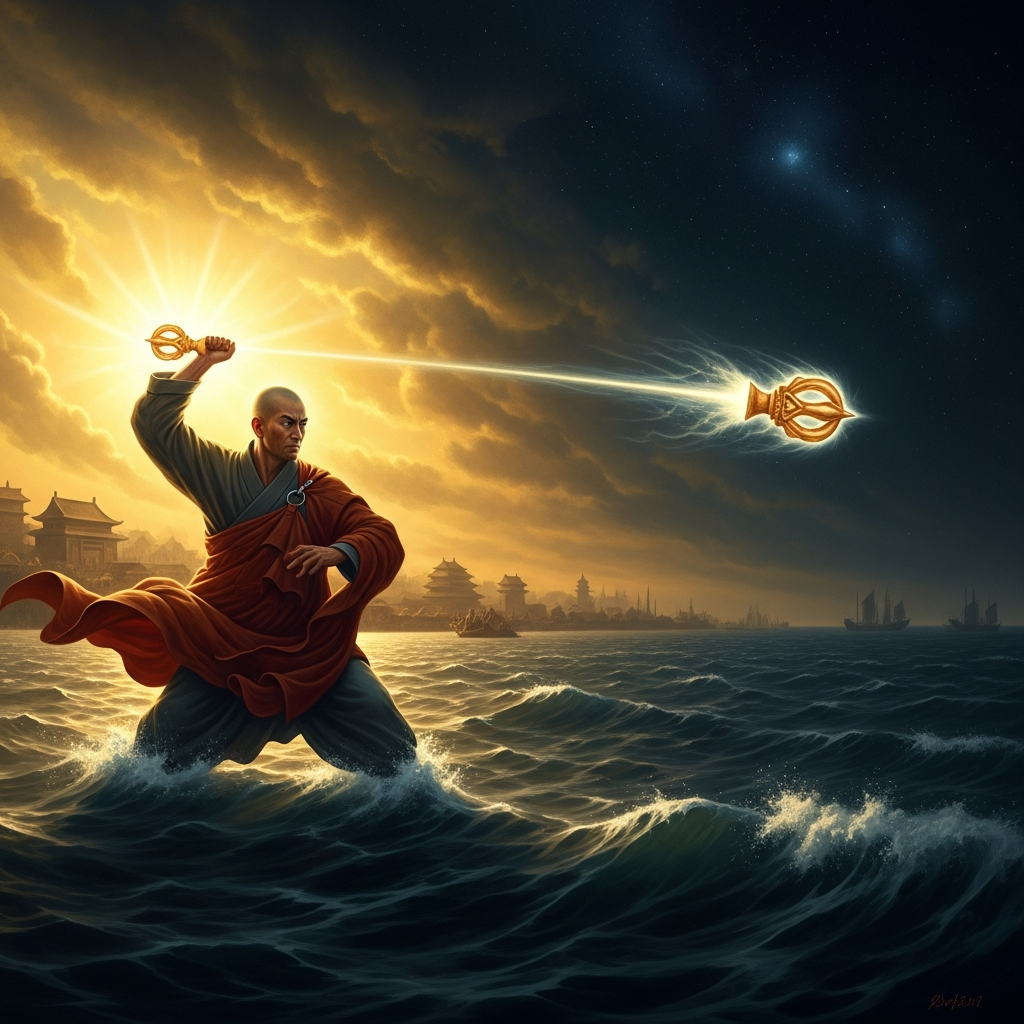
The crates hold the mandalas, the manuals, the painted scrolls, the vajras and bells and ritual implements he bought by the cartload in Chang’an. He has the complete Shingon transmission in portable form. He does not yet know where in Japan to plant it. He holds in his hand a three-pronged vajra of bronze — one of the ritual implements — and he weighs it in his palm and considers the question. Then, in the gesture that every subsequent Shingon retelling will preserve as the hinge of the whole story, he draws back his arm and throws the vajra east across the sea. Where it lands, he says to no one in particular, I will build the seat of this dharma. The ship sails. The vajra disappears over the water. He does not watch it fall.
Japan does not know what to do with him.
He returns in 806 and finds a court already occupied by Saichō, the founder of Tendai, who came back from China the same year with imperial favor and a more conservative selection of texts. Kūkai is held at Dazaifu in Kyushu for two years, not permitted to bring his transmission to the capital. When the court finally receives him, he writes a memorial cataloguing everything he brought back, and the catalogue itself — its sheer scope, the completeness of what it describes — gradually convinces the capital that the runaway nobleman has returned with an entire continent of teaching that Japan did not previously possess. He performs the abhiṣeka rituals. Saichō himself comes to receive them. The friendships that follow give Kūkai the political cover to look for the mountain.
He finds it in 816.
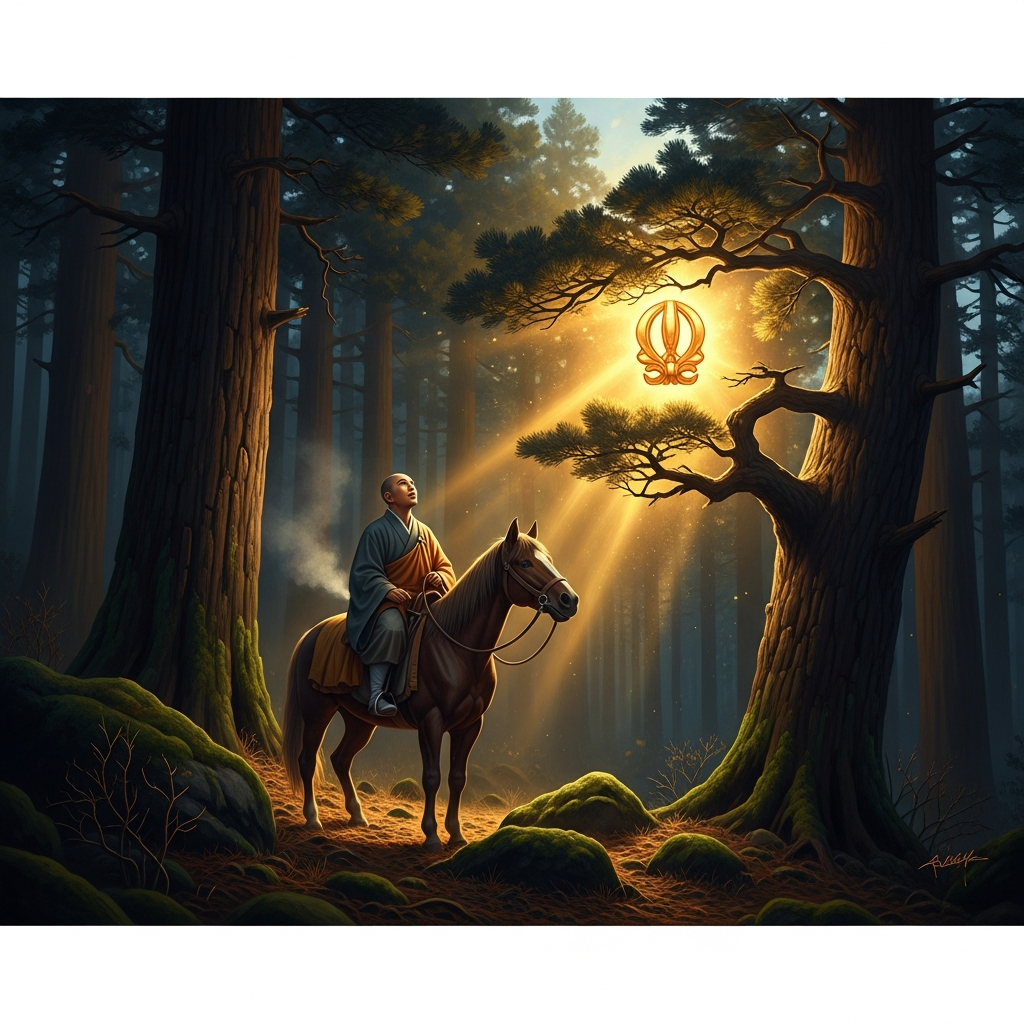
Riding the cedar slopes of the Kii Peninsula, he comes through a high meadow and sees it: a three-pronged bronze vajra caught in the branches of a pine. He had thrown it from the Chinese coast eleven years before. The mountain had caught it and held it. He does not hurry toward it. He stops his horse and looks at it for a long time. This is the place. He petitions the emperor for the land. He receives Mount Kōya as a private imperial grant in 819. He begins building — not randomly, but according to the logic of the Diamond Realm mandala, in which every hall corresponds to a deity, every processional path to a meditation, every cedar to a syllable of the teaching. The garan, the monastic complex, is a constructed mandala on a plateau in the mountains, and pilgrims still climb it, and the lamps in the great hall have not been allowed to go out since the ninth century.
In 835 he announces that he is finished.
He stops eating. He stops drinking. He sits in meditation at the cave-mausoleum he has prepared for himself at Okunoin — the inner sanctum of the mountain — and tells his disciples, calmly, that he is not dying. He is entering nyūjō: living samadhi. He will sit here, body intact, consciousness suspended at the threshold of nirvana, until Maitreya — the next Buddha, expected in approximately five billion years — descends to this earth. At that time, Kōbō Daishi will rise from the cave, walk down the mountain, and accompany the future Buddha through the world. He closes his eyes. The disciples seal the mausoleum. They begin the procession that has not stopped in twelve hundred years: twice a day, monks carry real meals on lacquered trays to the gate of the sealed cave. The robes inside are changed on schedule. The lamps are tended. The door has not been opened in the lifetime of any monk now living.
Shingon is the only complete esoteric Buddhism surviving in East Asia outside Tibet. Kūkai planted it on a mountain that his tradition never abandoned, and it grew into the visual culture, the ritual vocabulary, the very architecture of Japanese religiosity. The doctrine he crossed the sea for — sokushin jōbutsu, this very body can become Buddha, not in some distant eon but here, now, through mantra and mudra and the lived body as instrument — is the most radical claim Mahāyāna ever made, and it is still being practiced on that mountain in the cedars. The master is not dead. The address is still valid. The meals are not metaphors.
Scenes
Chang'an, 805 CE
 Generating art…
 At Mingzhou harbor, Kūkai draws back his arm and hurls the three-pronged vajra east across the sea
 Generating art…
 Mount Kōya, 816 CE
 Generating art…
 Echoes Across Traditions
Entities
- Kūkai (Kōbō Daishi)
- Huiguo
- Maitreya

Sources
- Kūkai, *Sangō Shīki* (*Indications of the Goals of the Three Teachings*, 797 CE)
- Kūkai, *Sokushin Jōbutsu Gi* (*The Meaning of Becoming a Buddha in This Very Body*)
- Yoshito S. Hakeda (trans.), *Kūkai: Major Works* (1972)
- Ryūichi Abé, *The Weaving of Mantra: Kūkai and the Construction of Esoteric Buddhist Discourse* (1999)
- Allan G. Grapard, *The Protocol of the Gods* (1992)