Prince Shōtoku and the Seventeen Articles
593–622 CE · Asuka, Japan — the Yamato court; Hōryū-ji, Ikaruga
Contents
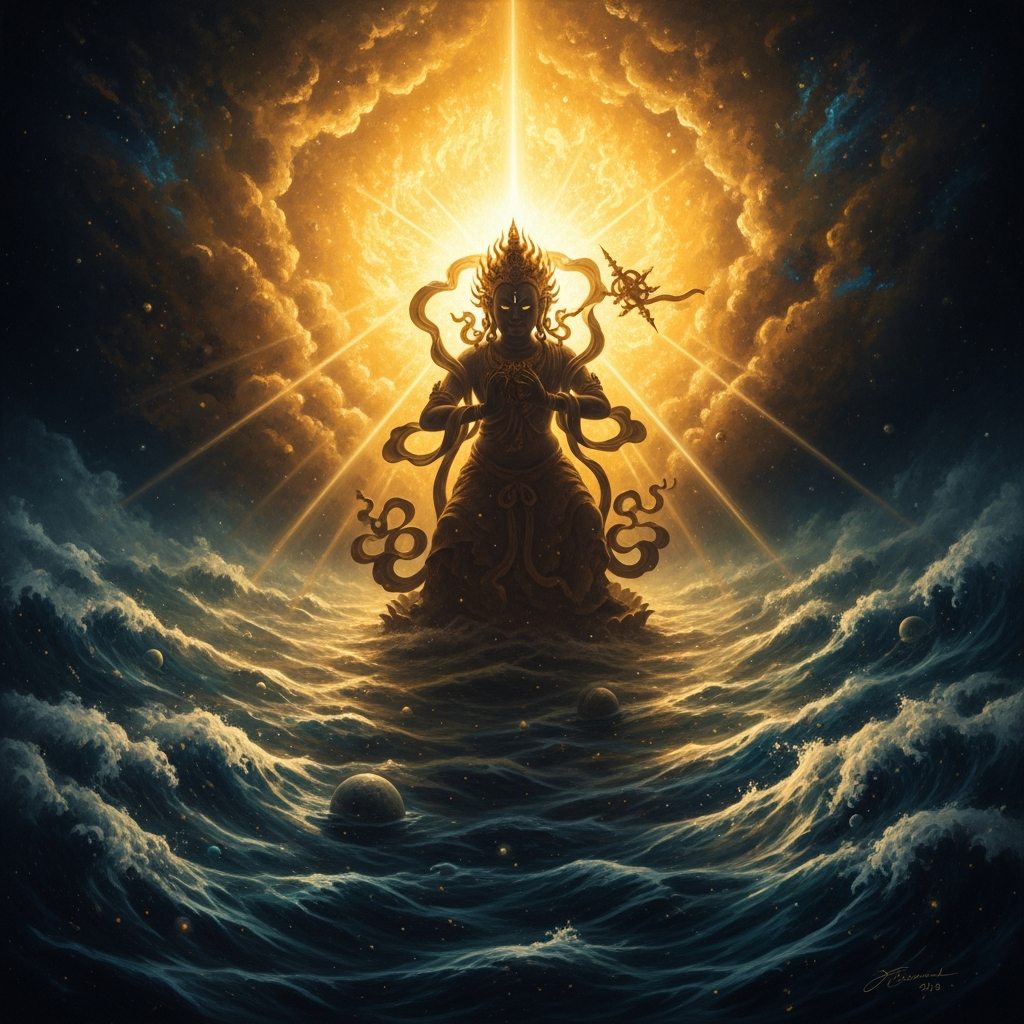
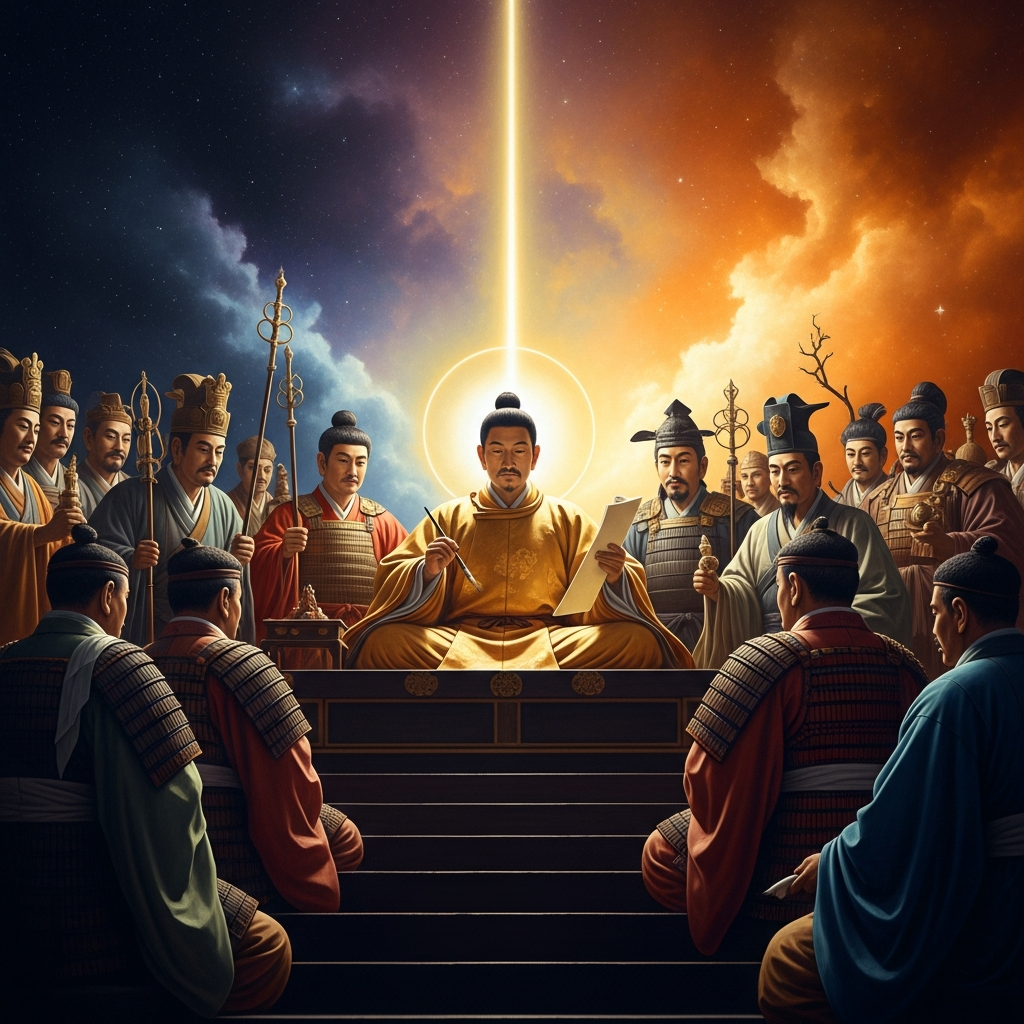
Japan, 604 CE. Prince Shōtoku Taishi, regent for Empress Suiko, writes the Seventeen-Article Constitution — the first document to frame Japanese governance through Buddhist and Confucian principles. Article 1: harmony above all. He builds Hōryū-ji, sends embassies to China, and founds the Buddhist state. He is said to have been born already reciting sutras.
- When
- 593–622 CE
- Where
- Asuka, Japan — the Yamato court; Hōryū-ji, Ikaruga
He is born speaking.
The legend is specific: Shōtoku Taishi emerges from the womb already reciting sutras, already knowing the dharma, having come into this life not to learn but to build. Whether or not the birth story is historical, the pattern it describes is real — he governs from the beginning as a man who has already arrived at his conclusions, who is not deliberating but implementing. When his aunt Empress Suiko takes the throne in 593 CE and names the twenty-year-old prince her regent, what Japan gets is not an administrator waiting to inherit power. It gets a theorist with a platform and a court and the first clear vision of what Japan could become if it decided to become something.
The court at Asuka is a maze of clan politics.
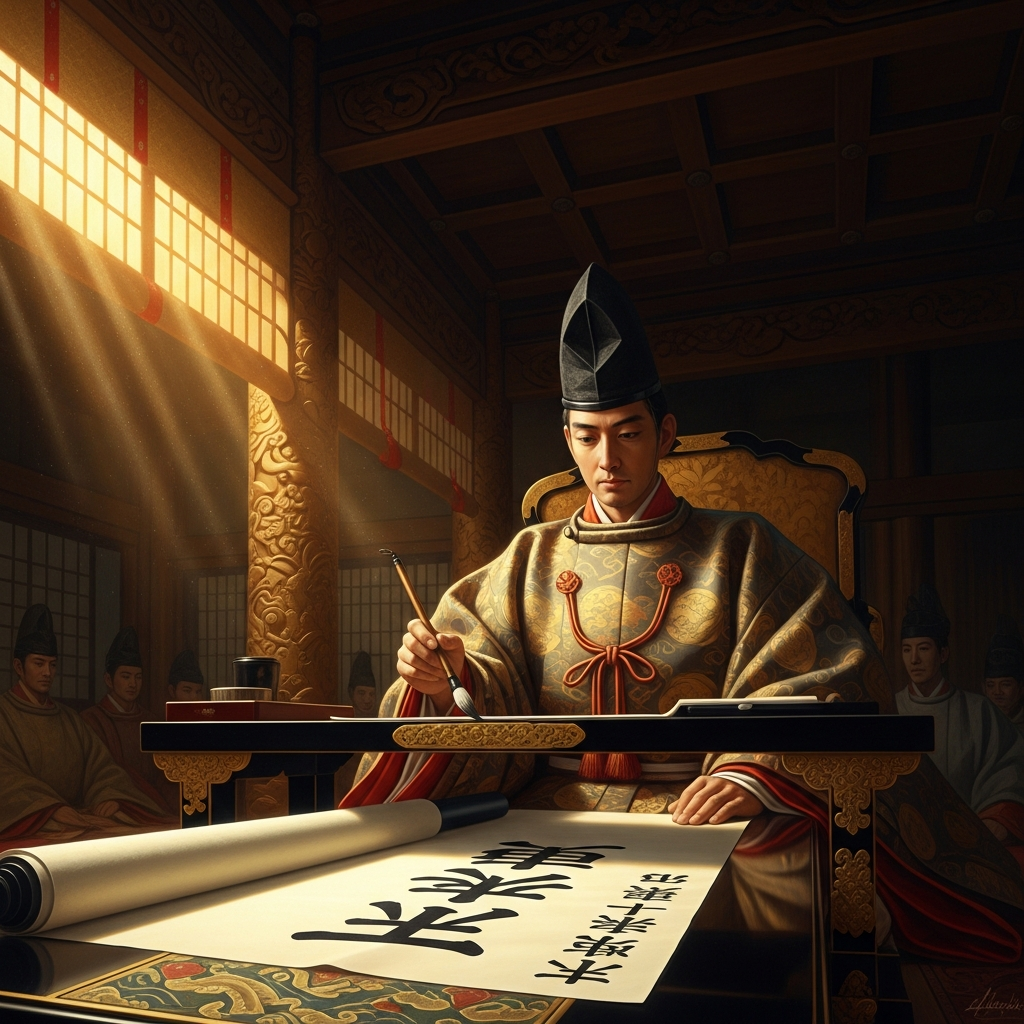
The Soga clan has just won the decisive power struggle against the Mononobe — has just destroyed the faction that wanted to drive Buddhism back out of Japan — and the victory has not made governance cleaner. The great clans still operate as semi-independent powers. Loyalty runs to blood, not to state. The emperor is sacred but constrained. There is no written law, no moral framework that transcends clan interest, no vocabulary for governance that is not also a vocabulary for domination. Shōtoku, regent at twenty, looks at this and writes a document. Seventeen articles. Not a legal code — there are no specific penalties, no enforcement mechanisms. A constitution in the original sense: a statement of what a polity is for.
Article One: Harmony is to be valued.
The Japanese word is wa: harmony, unity, the condition in which different things coexist without destroying each other. Shōtoku places it first, before everything — before the relationship to the emperor, before the instruction about Buddhism, before the guidance on taxation and attendance at court. Wa above all things, because everything else follows from it or fails without it. The phrase he uses is drawn from the Analects of Confucius, but the application is Buddhist in spirit: difference exists, conflict exists, but the task of the statesman is not to flatten difference but to find the space in which it does not tear the community apart. The remaining sixteen articles build on this: reverence for the Three Treasures (Buddha, Dharma, Sangha), respect for imperial command, clear condemnation of envy and personal ambition, the principle that important matters should be decided not by one person but in consultation. It is a document that distrusts individual accumulation of power, including its own author’s.
He builds Hōryū-ji at Ikaruga.
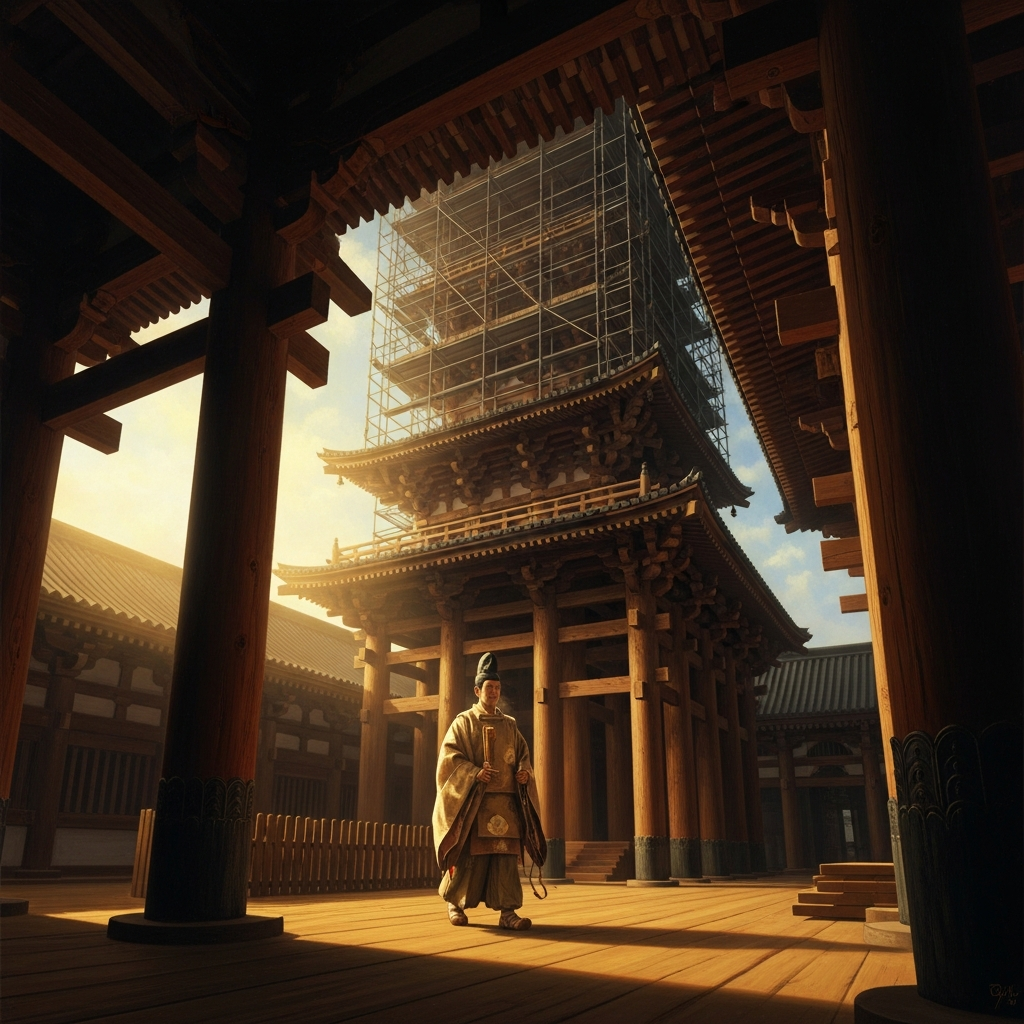
The temple complex rises on a plateau southwest of the capital, its wooden pillars sanded smooth, its bracketing fitted without nails, its proportions derived from the continental Buddhist architecture that Shōtoku has been studying through the Korean and Chinese monks who have been arriving in Japan for a generation. He venerates the Vimalakirti Sutra above all — the teaching of the layman Vimalakirti, who attained enlightenment without becoming a monk, who engaged the world directly rather than withdrawing from it. This is Shōtoku’s Buddhism: not the renunciation of the prince who abandons the palace but the engagement of the statesman who takes the dharma into the palace and governs by it. Hōryū-ji is not a retreat. It is a statement. The oldest surviving wooden structure in the world, its pillars still standing, still jointed in the seventh-century manner, is the physical argument that what he was trying to build was meant to last.
He writes to the Sui emperor as an equal.
The embassy of 607 carries a letter that will rattle the court in Chang’an. The salutation reads: From the sovereign of the land of the rising sun to the sovereign of the land of the setting sun. The Sui emperor is furious — no one addresses the son of heaven as a peer — but he keeps the embassy, because Japan under Shōtoku has become too interesting to dismiss. The students and monks who make the crossing come back with Tang Buddhism, Tang art, Tang governance, Tang calendar, Tang music. Shōtoku is not importing China. He is selecting from it — taking the Buddhist teachings, the Confucian ethics, the administrative models, and grafting them onto a Japan that he refuses to subordinate. The letter with the parallel syntax is the most efficient possible statement of this project: we are learning from you, but we are not beneath you, and the frame of our learning is our own sovereignty.
He is said to have lectured on three sutras simultaneously in three separate rooms.
This detail, from the Nihon Shoki, is one of the miracle stories attached to Shōtoku’s legend. Three groups of students wait in three rooms. The regent walks between them, continuing three separate lectures, picking up each thread as he enters each room, losing nothing. What the story encodes is simpler than a miracle: he had read everything. The Vimalakirti Sutra, the Lotus Sutra, the Queen Srimala Sutra — he wrote commentaries on all three, the oldest known documents of Japanese Buddhist scholarship. He corresponded with the Korean kingdoms. He sent four consecutive embassies to China. He was regent, builder, scholar, and diplomat simultaneously, and the tradition found it easier to say he was lecturing in three rooms at once than to describe what it actually looks like when one person is genuinely doing all of these things at the same time.
He dies in 622 at forty-eight, four days after his wife.
The Nihon Shoki records that the people wept in the fields and in the markets and could not eat. Old men said it was as if the sun and moon had gone out; young men said the soil itself had lost its flavor. He is the only figure in Japanese history — before or after — to be mourned this way in the official record. His son builds his mausoleum at Shinaga. Within a century, the Soga clan will destroy his line completely, and almost everything he built politically will be dismantled or absorbed. What survives is the framework: the wa of Article One, the three Imperial Regalia he helped to sacralize, the temple at Ikaruga with its seventh-century pillars still standing, and the idea — which he was the first to write down in Japan — that governance is a moral activity, that the state is responsible not just for order but for the quality of human life within the order.
Shōtoku never held the throne. He governed as regent for thirty years and died without becoming emperor, and the tradition made him something larger than an emperor: the Bodhisattva-Regent, the man who brought the dharma into the mechanics of the state. The Seventeen-Article Constitution contains no enforcement mechanism because it was never meant to coerce. It was meant to describe a world that Japan could choose to inhabit — a world where wa is the first value, where the Three Treasures underwrite the law, where important decisions are made in consultation and no man’s private judgment is trusted with unchecked power. He wrote it in 604. Japan is still arguing about whether it arrived.
Scenes
The regent's hall at Asuka, 604 CE
 Generating art…
 Hōryū-ji rises at Ikaruga
 Generating art…
 The embassy to Sui China departs, carrying Shōtoku's famous letter: *From the sovereign of the land of the rising sun to the sovereign of the land of the setting sun
 Generating art…
 Echoes Across Traditions
Entities
- Prince Shōtoku Taishi
- Empress Suiko
- Soga no Umako
Sources
- *Nihon Shoki* (*Chronicles of Japan*), Book XXII (720 CE, trans. W.G. Aston, 1896)
- H. Paul Varley, *Japanese Culture* (4th ed., 2000)
- Jonathan W. Best, *A History of the Early Korean Kingdom of Paekche* (2006)
- Ryusaku Tsunoda, Wm. Theodore de Bary, and Donald Keene (eds.), *Sources of Japanese Tradition* Vol. I (1958)