Lalita Tripura Sundari — She Who Plays
Mythic Time · Brahmanda Purana, Lalitopakhyana ~6th-10th century CE; Shri Vidya tradition developed ~8th century onward · The Chintamani Palace on Manidvipa — the Island of Gems in the Ocean of Nectar, the supreme realm that exists beyond all other realms
Contents
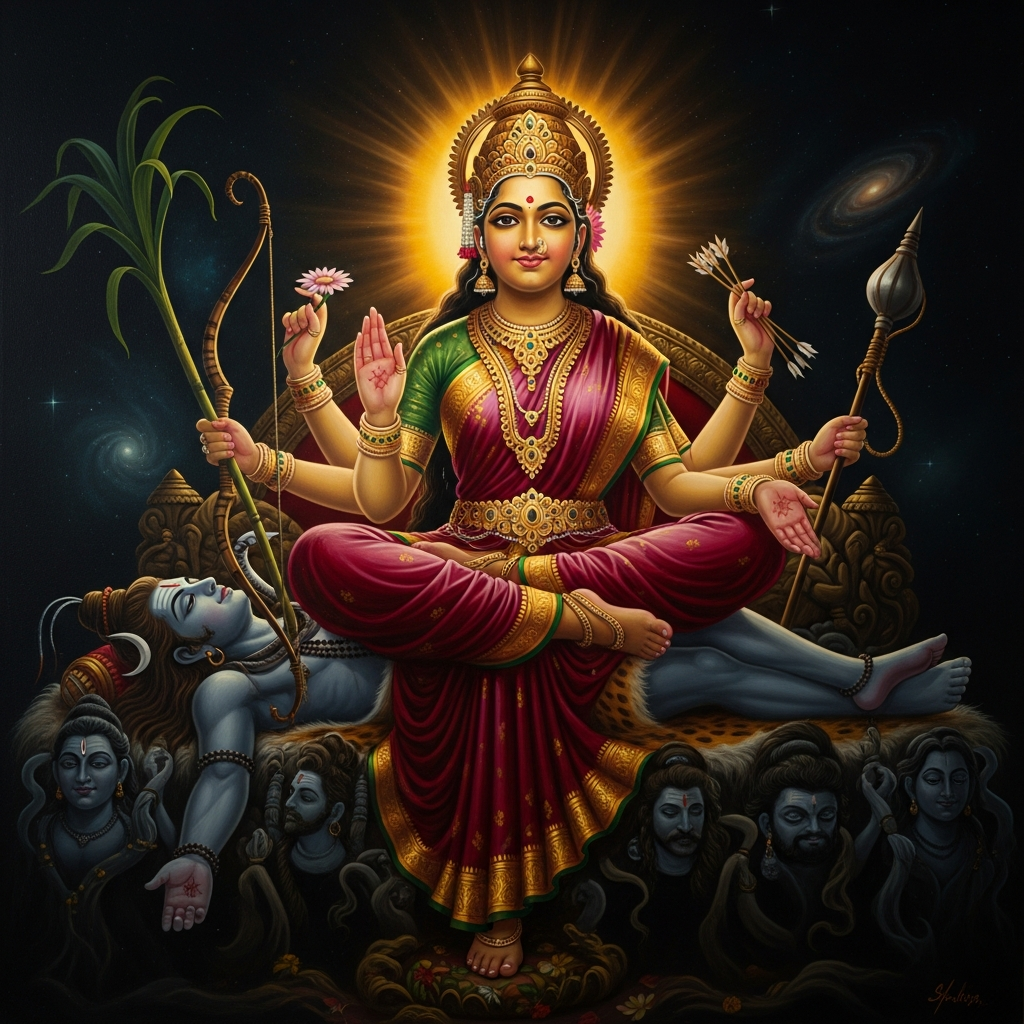
The supreme goddess Lalita Tripura Sundari sits in her Chintamani Palace on the Island of Gems in the Ocean of Nectar, radiating the universe from her own body. She holds a noose, a goad, a bow of sugarcane, and five flower-arrows of the senses. The Lalita Sahasranama names her a thousand times. Each name is a different face of the same truth: the goddess is the world, and the goddess is what lies beyond it.
- When
- Mythic Time · Brahmanda Purana, Lalitopakhyana ~6th-10th century CE; Shri Vidya tradition developed ~8th century onward
- Where
- The Chintamani Palace on Manidvipa — the Island of Gems in the Ocean of Nectar, the supreme realm that exists beyond all other realms
She has always been sitting there.
This is the first thing the Brahmanda Purana wants established before it says anything else about her. The Chintamani Palace on the Island of Gems in the Ocean of Nectar is not a place she arrived at or built or won. It is the place that exists because she exists, the way a flame is the place where burning happens. She did not come from somewhere else. Nothing preceded her arrival. She is what was already the case.
The palace is made of wish-fulfilling gems — chintamani, the name means thought-jewel, the magical stone that grants whatever is asked of it. Every surface of the palace is a form of divine thought made solid. The walls are consciousness made architectural. The floors are what the mind is made of when the mind is not confused about what it is.
She sits at the center of all of this and radiates.
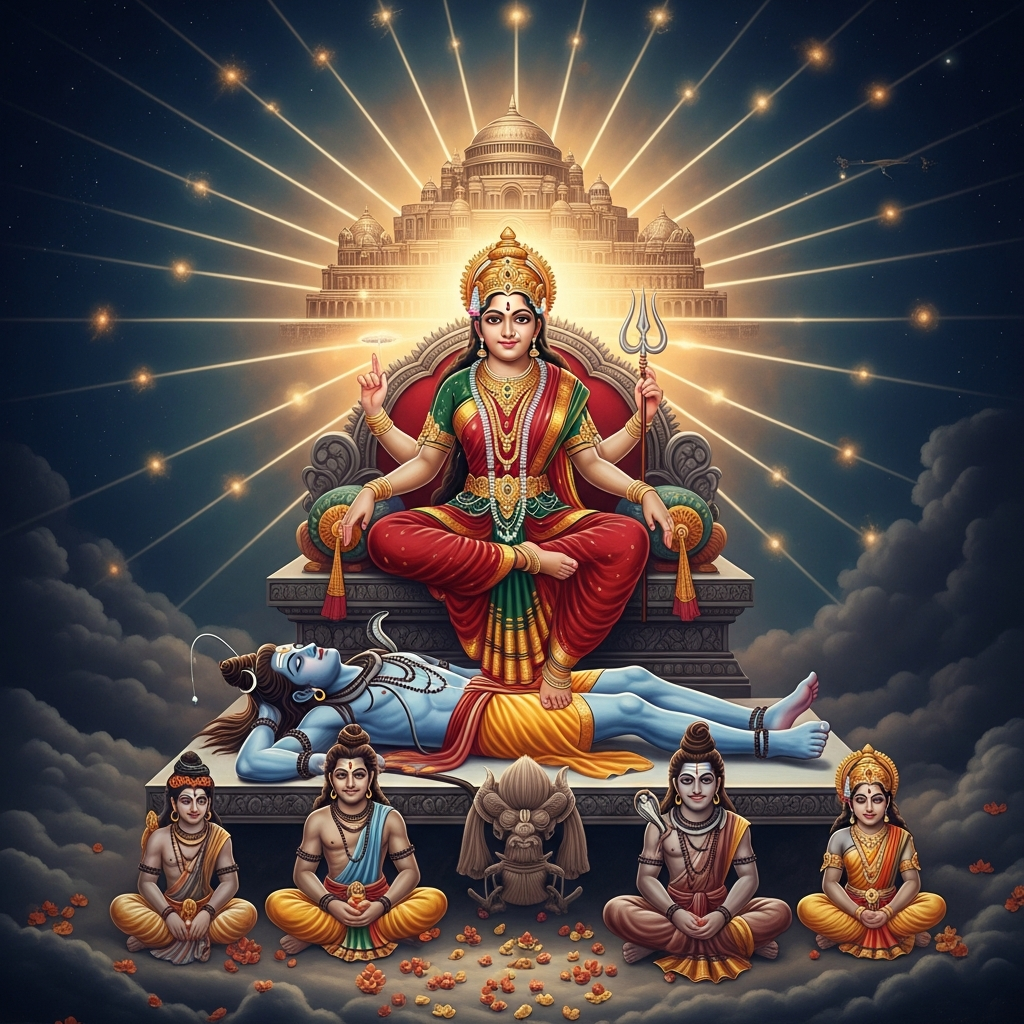
The throne she sits on is Shiva.
Not a statue of Shiva, not a symbol of Shiva — Shiva himself, lying down, made into the couch that holds the supreme goddess. This is the Shakta theologians’ boldest image: the god who dances the cosmos, who holds the drum and the flame, who is himself the destroyer of ages — lies at the goddess’s feet and is her seat. The Soundarya Lahari, the hymn of beauty, says he is a corpse without her; she is what animates him.
The four legs of the throne are Brahma, Vishnu, Rudra, and Ishvara — four aspects of the masculine divine holding the platform that holds the feminine divine that holds all of them. The theology is arranged with architectural precision. The highest thing in the cosmos is what sits, not what holds.
She sits on her husband. She holds the cosmos in her four hands. She looks out at all of it with eyes that are the color of a new lotus and the warmth of a lamp lit for evening prayer.
Look at what her hands hold.
The upper right hand carries the pasha — the noose. It is the force that binds. In her hands the noose is not punishment or imprisonment; it is the principle by which the soul is held in the world long enough to learn what the world is teaching. She binds with compassion. She binds the way a mother holds a child who would otherwise walk into fire — not because she hates the child’s freedom but because the child does not yet know which direction the fire is.
The upper left hand carries the ankusha — the elephant goad. It drives forward. What the noose keeps from going too far, the goad pushes toward what it has been avoiding. The two instruments are the same force applied from both ends: the complete curriculum, nothing left out, nothing rushed past.
The lower right hand carries the bow. But the bow is not made of wood or composite horn or any material a bowyer would recognize. It is made of sugarcane — the sugarcane of Ikshu, the sweet cane whose juice is desire. This is the bow of Manmatha, the god of love, whose weapon is desire itself. She holds the instrument of all longing, all seeking, all the reaching of creatures toward what they want and toward what they need and toward what they do not yet know they need.
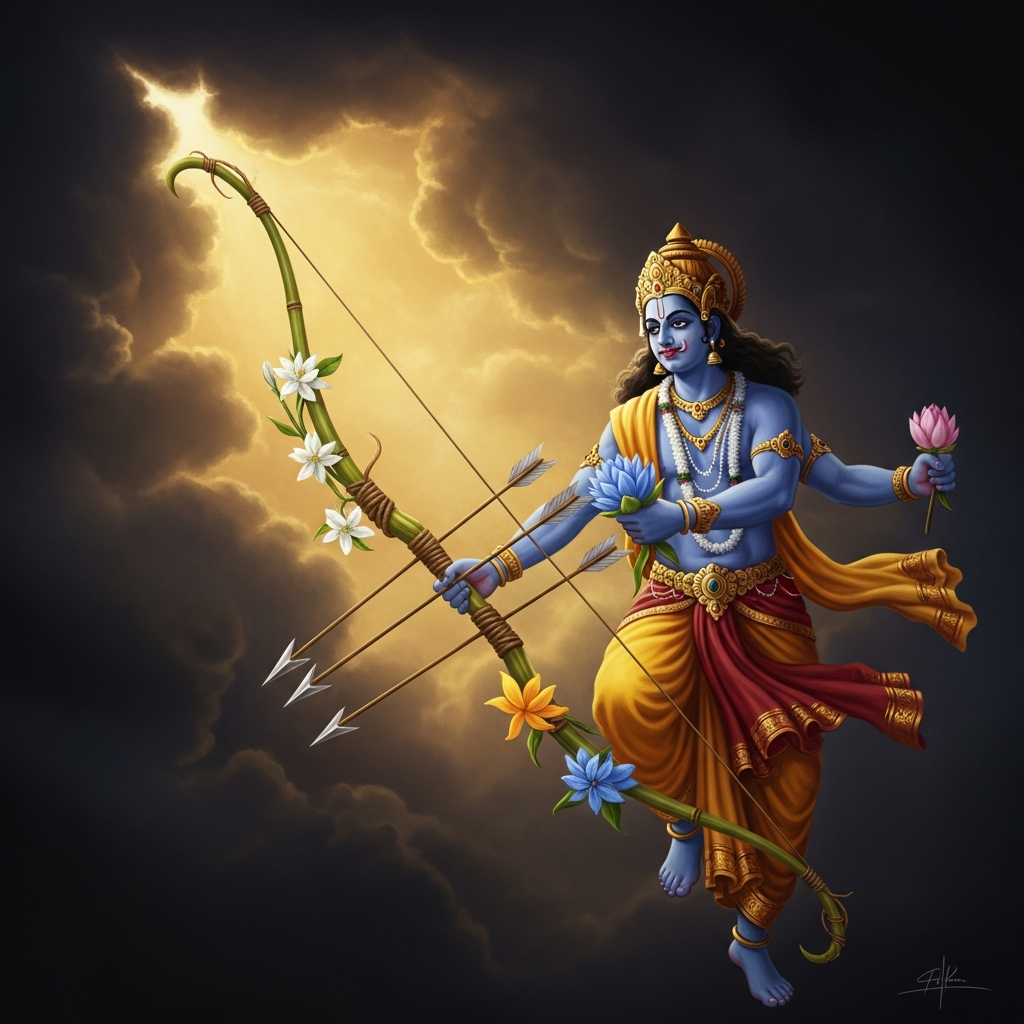
The lower left hand carries the five flower arrows. Each is named for the sense it governs: the jasmine arrow of smell, the mango-blossom arrow of taste, the ashoka-flower arrow of sight, the champak arrow of touch, the blue lotus arrow of sound. The five senses — the five windows through which the world enters consciousness — are her arrows. She made the senses. She uses them. She is the one aiming them at you.
This is the complete description of how you are where you are. You are bound by what you cannot leave. You are goaded toward what you avoid. You are shot through with desire. You experience everything through five arrows she aimed at you before you had a name.
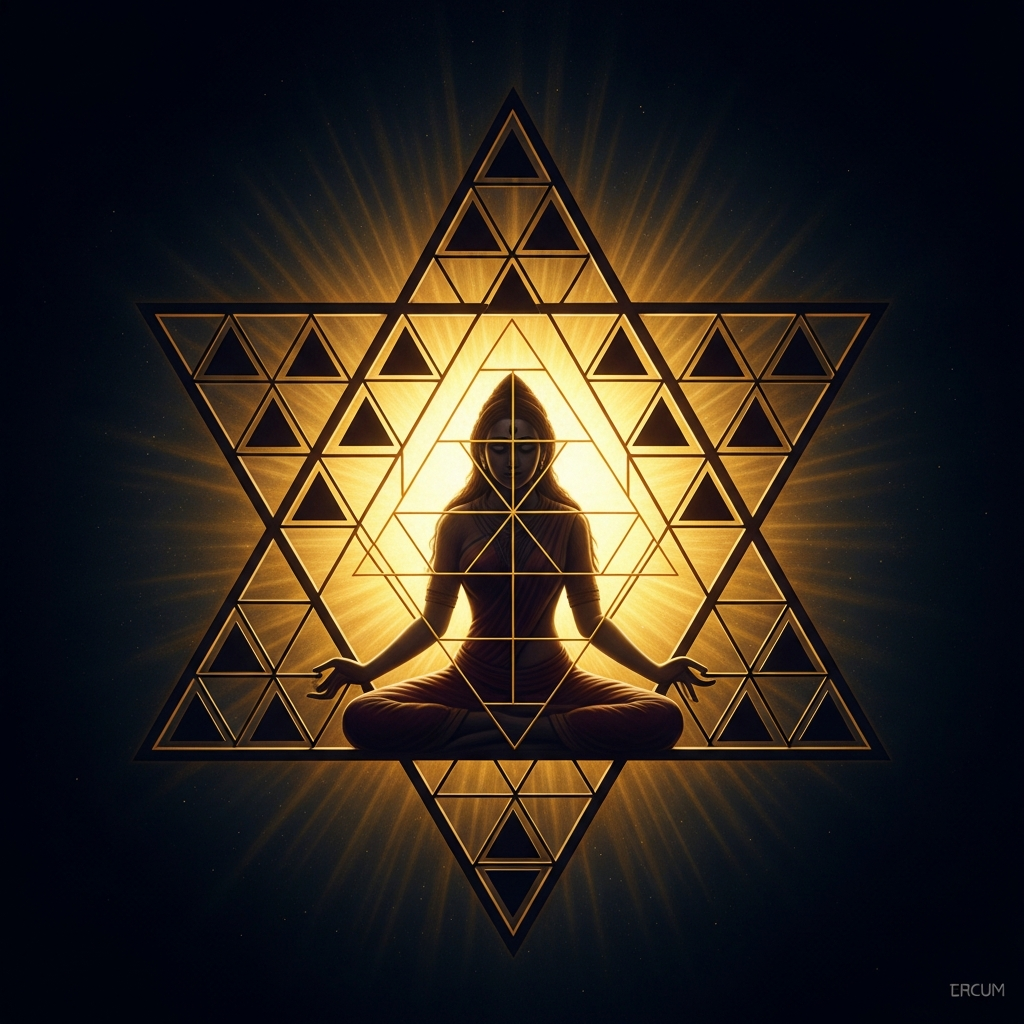
The Shri Chakra is her body.
It is drawn as a geometric figure: nine triangles, four pointing upward (masculine), five pointing downward (feminine), interlocked so that they generate forty-three smaller triangles inside them. These triangles are surrounded by two rings of lotus petals — eight, then sixteen — which are surrounded by three concentric circles, which are surrounded by a square frame with four gates, one at each cardinal direction.
The figure is not a symbol of the goddess. It is the goddess. Every line is a line of her being. Every enclosed triangle is a palace inhabited by a form of her energy. The eight-petaled lotus is her heart. The sixteen-petaled lotus is the circle of desire and fulfillment. The three circles are the three cities of her name — Tripura, the three cities, the three states of consciousness (waking, dreaming, deep sleep), the three bodies (gross, subtle, causal), the three gunas (rajas, tamas, sattva). She is their boundary and their interior and what lies beyond their boundary.
The bindu — the single point at the center, the origin of the figure, the place where the first triangle’s apex touches nothing — is where she sits. The palace at the center of the palace at the center of the palace. Every circle and petal and triangle in the Shri Chakra is a ring of her palace’s walls, and she is at the center, and worshipers approach by moving inward ring by ring, shedding the outer layers of creation as they go.
The Lalita Sahasranama names her a thousand times.
The text is arranged in the Brahmanda Purana as a dialogue: the sage Agastya asks the divine messenger Hayagriva to describe the goddess, and Hayagriva says that she cannot be described but she can be named, and then he names her a thousand times.
Each name is a different facet of the same jewel. Some are descriptions of her form: Aruna (she who is red as the sunrise), Manikhya-mukuta-kara (she whose crown is made of rubies), Padma-raga-sama-prabha (she who blazes like a ruby lotus). Some are descriptions of her nature: Chit (she who is pure consciousness), Ananda (she who is pure bliss), Chidananda-lava (she who is even the smallest particle of conscious bliss). Some are descriptions of her cosmic function: Vishva-garbha (she who is the womb of the universe), Vyapini (she who pervades everything), Vividhakara (she who takes countless forms).
Some of the names contain the whole theology in three syllables. Brahmanda-mandala — she who is the sphere of all the universes. Sarvantaryamini — she who dwells within everything. Para — the supreme one, the final one, the one beyond which there is nothing to be beyond.
The names do not exhaust her. That is the point of a thousand names. A hundred would sound like definition. A thousand sounds like the attempt of a language trying to approximate what it cannot contain — getting closer and closer to the center of the Shri Chakra, the names becoming more precise and more paradoxical simultaneously, until the last name is silence.
She is the world and she is what lies beyond it.
This is the hardest claim and the simplest. The Lalita Sahasranama states it directly in at least thirty of the thousand names, from both directions at once: Vishvamaya (she who is the illusion of the world) and Vishvamata (she who is the mother of the world) and Vishvatita (she who is beyond the world). The same goddess. The same body. The world is her play — lila, the Sanskrit word for divine play, which is also in her name: Lalita means the playful one, the one who sports, the one for whom creation is not labor or obligation but the natural overflow of what she is.
She does not need the world in order to exist. She creates it the way a dreamer creates a dream — effortlessly, continuously, without becoming less herself. The dreamscape is entirely real to what is inside it. The dreamer is not diminished by it. When the dreamer wakes, the dream does not die in the sense of having been meaningless; it was real while it was real, which is all that realness is.
She plays. The cosmos is her game. The noose and the goad and the bow and the flower-arrows are the instruments of the game. The Shri Chakra is the board. The Shakti Peethas are where the pieces were scattered. Every mind that has ever asked what is this, why is this, what am I — every question that consciousness has ever aimed at itself — is a move in the play of the one who holds the bow of desire and knows exactly where she is aiming.
The Shri Vidya tradition — the tradition of the auspicious wisdom that worships Lalita Tripura Sundari — is the most intellectually developed current in Shakta Hinduism. Its practitioners include the mathematician-philosopher Adi Shankaracharya, credited with composing the Soundarya Lahari; the polymath commentator Bhaskararaya; the Tantric masters of Kashmir Shaivism who understood the Shri Chakra as a map of consciousness itself.
The tradition is also one of the most secretive. The Shri Chakra is not explained to the uninitiated. The inner rites of Shri Vidya are transmitted from teacher to student in an unbroken line. The thousand names are recited daily by practitioners across India, each name a step inward, the recitation itself a movement through the palace toward the bindu.
The goddess who sits at the center of the Shri Chakra is not waiting to be found. She is looking outward through her five flower-arrows at the world she made. She has already aimed the senses at you. She has already bound you with the noose of the life you are living and goaded you with the goad of everything you have avoided. She holds the bow of desire and she knows your name — all thousand of them — because she made them.
The Sahasranama ends with silence because the name at the center of the palace is not a name.
Scenes
She sits on the throne that is Shiva made horizontal — her consort as the ground beneath her, the four gods of the Hindu pantheon as its legs
 Generating art…
 The noose catches what needs binding
 Generating art…
 The Shri Chakra — nine interlocking triangles generating forty-three smaller triangles, the geometric body of the goddess — is the map of her palace, the diagram of her being, and the object that focuses worship
 Generating art…
 Echoes Across Traditions
Entities
- Lalita Tripura Sundari
- Mahadevi
- Kameshvara
- the Shri Chakra
- the Lalita Sahasranama
Sources
- *Brahmanda Purana*, Lalitopakhyana (the episode of Lalita), chapters 1-40
- *Lalita Sahasranama* with commentary by Bhaskararaya, ~12th-18th c. CE
- Douglas Renfrew Brooks, *The Secret of the Three Cities: An Introduction to Hindu Shakta Tantrism* (1990)
- Paul Eduardo Muller-Ortega, *The Triadic Heart of Siva* (1989)
- Lakshmanjoo, *Kashmir Shaivism: The Secret Supreme* (1988)
- S.S. Cohen (trans.), *Lalita Sahasranama* (1990)