Patacarā: What the Water Takes
c. 5th century BCE · Savatthi and the roads of Kosala, northern India
Contents
In a single day a woman loses her husband to a snakebite, both children to the river and a hawk, and learns that her parents and brother died the same night in a collapsed house. She walks naked through the streets of Savatthi, mad with grief. The Buddha meets her at the gate. What happens at the river's edge, and what the practice that follows teaches about grief that has no bottom.
- When
- c. 5th century BCE
- Where
- Savatthi and the roads of Kosala, northern India
It happens in a single day, which is the part that breaks the mind.
She is walking with her husband and two children on the road to her parents’ house in Savatthi. Her husband cuts a stick in the jungle to use as a post for the shelter where they will sleep, and he is bitten by a snake at the base of the stick. He is dead before she finishes understanding what has happened. She puts the children under the shelter and goes to find help, and when she comes back the shelter is there and the children are gone — the river has flooded in the night and taken her younger child, and when she finds where the older one crossed to look for the younger, a hawk has taken him from the bank.
She walks into Savatthi. She walks through the gate and through the streets and she is walking fast and then she is walking without knowing where she is going, and her clothes have torn on the road and she has not noticed. The people in the market move aside. Someone calls her mad. She walks to where the Buddha is teaching.
He says her name.
This is the first thing the story records him saying, and it is worth pausing on: he does not say stop or calm yourself or listen to me. He says her name, whatever it was before the tradition called her Patacarā — ragged-robed — and the name lands differently than a command. Someone who knows who you are is speaking to you. You are still someone who can be addressed.
She covers herself with whatever cloth is offered by the crowd. She sits down. She tells him what happened in the day that has just ended — the husband, the children, and then the news from her parents’ house, which reached her on the way: the house collapsed in the storm; her parents and her brother were inside.
The Buddha says: Patacarā, do not think that you have come to one who can be a shelter and a refuge for you. In this great long journey of repeated existence, you have already shed more tears over lost loved ones than there is water in the four great oceans.
This is the teaching that is easiest to misread as cold.
He is not saying: your grief is small compared to a larger quantity of grief. He is not minimizing. He is saying: grief of this kind is not an aberration, not a sign that something has gone wrong with your life specifically. It is the texture of conditioned existence — a texture that has been running since before memory, since before the lives you can remember, through the full length of what the tradition calls samsara. You have already wept more tears than there is ocean water, and you are weeping again, and you will weep again, until the condition that produces the weeping is understood and released.
This is only cold if you believe that the suffering was avoidable, that some different set of choices would have gotten you through the day without losing a husband and two children and parents and a brother. The Buddha is saying it was not avoidable — not because the specific losses were destined, but because conditioned existence produces loss at a rate beyond any individual’s capacity to absorb or prevent. The only exit is not out of the losses but through the understanding of their cause.
She practices. She goes into the order of nuns. She learns the meditation on the four elements — earth, water, fire, air, and the way each of them arises and passes, arises and passes, never the same river twice.
The story that the Therigatha records as hers involves a river at dusk.
She is washing her feet. She watches the water she pours over her foot run down across the skin and fall to the ground. The first pour falls a short distance. The second pour, refilling with more water, falls farther before it hits the ground and soaks in. The third pour goes farthest of all.
She watches this and she understands — the way understanding sometimes arrives not as an argument but as a complete change in how the available information looks. The water that ran the short distance is like those who die young. The water that ran farther is like those who die in middle life. The water that ran farthest is like those who live to old age. And all of it soaks into the ground.
The lamp metaphor she uses in the Therigatha verses comes from this: she takes a lamp and she watches the flame. The flame needs a wick and oil and the absence of wind. All three conditions have to be present for the flame to continue. Remove any one and the flame ends. She is the flame. She has been the flame through every birth she has taken, requiring conditions to continue, ceasing when conditions cease. The cessation that is nibbana is not the tragedy her grief said it was. It is the end of the conditions that produce a life full of days like the day she just survived.
She teaches for decades.
The Therigatha — the Verses of the Elder Nuns, the earliest collection of women’s poetry in world literature — preserves her voice. She is not soft. She does not soften the doctrine for students who are afraid of impermanence. She says: seeing the way things actually are, with insight and with clarity, I took up the lamp and went into my cell, blocked the door. The blocking of the door is concentration. The taking up of the lamp is wisdom. The cell is the practice.
She sends students to the water. She tells them to watch a flame. She does not tell them grief will pass, because grief does not pass in the ordinary sense — it transforms, when the understanding of why it hurts arrives, into something that has no purchase on the person anymore. Not numb. Not healed in the therapeutic sense. Freed.
Her name in the tradition means ragged-robed — what she was called when she walked through the gate in torn clothes with an emptied face. The tradition kept the name as the teaching: she came in broken and became one of the greatest teachers of her century, not because the breaking healed but because she found what the breaking was showing her.
The river that took her younger son runs in the same hills it always ran. The hawk is gone. The house her parents died in fell the year it fell and has not fallen since. What she saw at the river’s edge with the lamp in her hand was not any of these specific things. It was the river-ness of rivers, the hawk-ness of taking, the house-ness of structures that hold and then do not hold. She taught it to every woman who came to her in grief, and what she taught was not that the grief was wrong to feel but that it pointed, like a finger in the night, at the fire that makes it.
Scenes
A road through jungle in monsoon rain
 Generating art…
 The edge of a river at dusk — the water brown with rain, running fast
 Generating art…
 An older woman in grey robes teaching a group of younger women in a garden
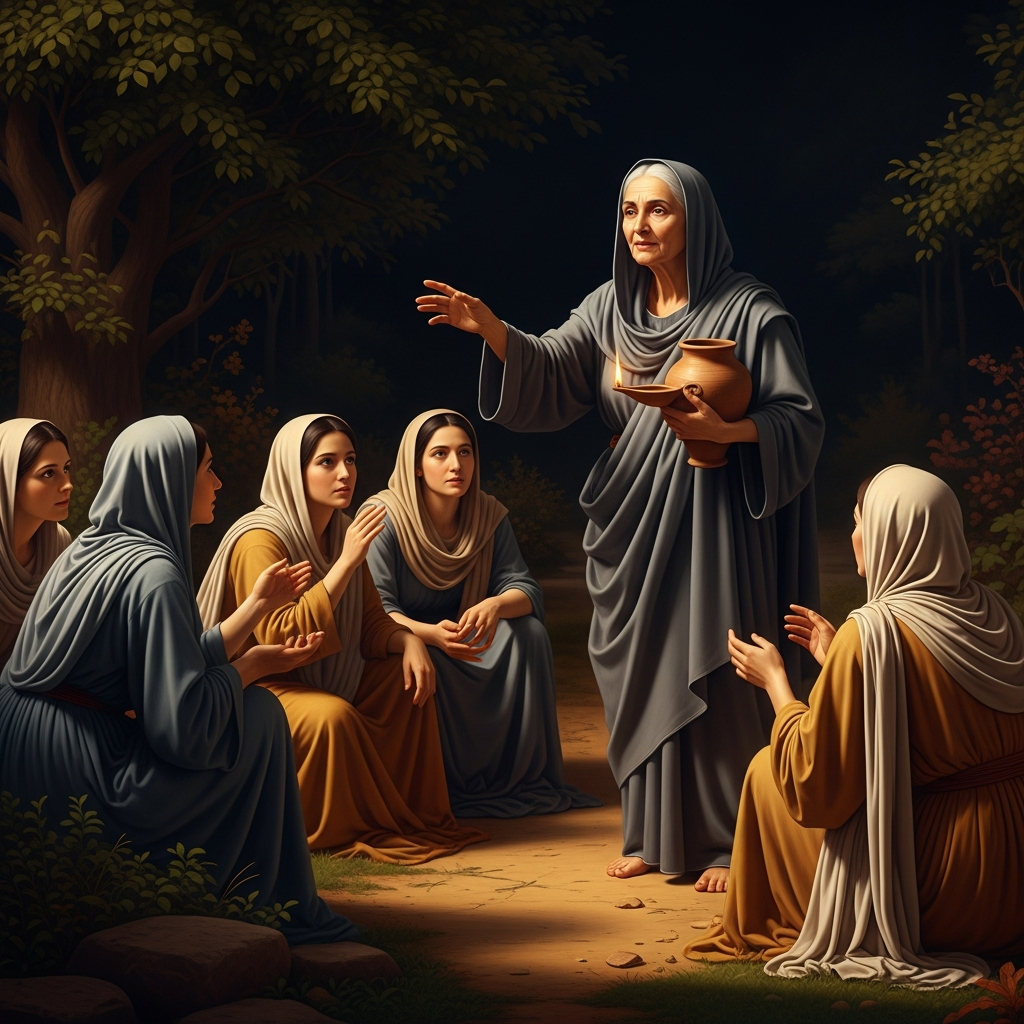 Generating art…
 Echoes Across Traditions
Entities
- Patacarā
- The Buddha
Sources
- K.R. Norman (trans.), *The Elders' Verses II: Therigatha* (Pali Text Society, 1971)
- Bhikkhu Bodhi (trans.), *The Connected Discourses of the Buddha* (Wisdom Publications, 2000)
- Susan Murcott, *The First Buddhist Women: Translations and Commentary on the Therigatha* (Parallax Press, 1991)
- Bhikkhu Analayo, *Daughters of the Buddha* (Windhorse Publications, 2021)
- Walpola Rahula, *What the Buddha Taught* (Grove Press, 1959)