Prometheus Chained
Mythic Time · ~5th century BCE recorded by Aeschylus · The Caucasus mountains
Contents
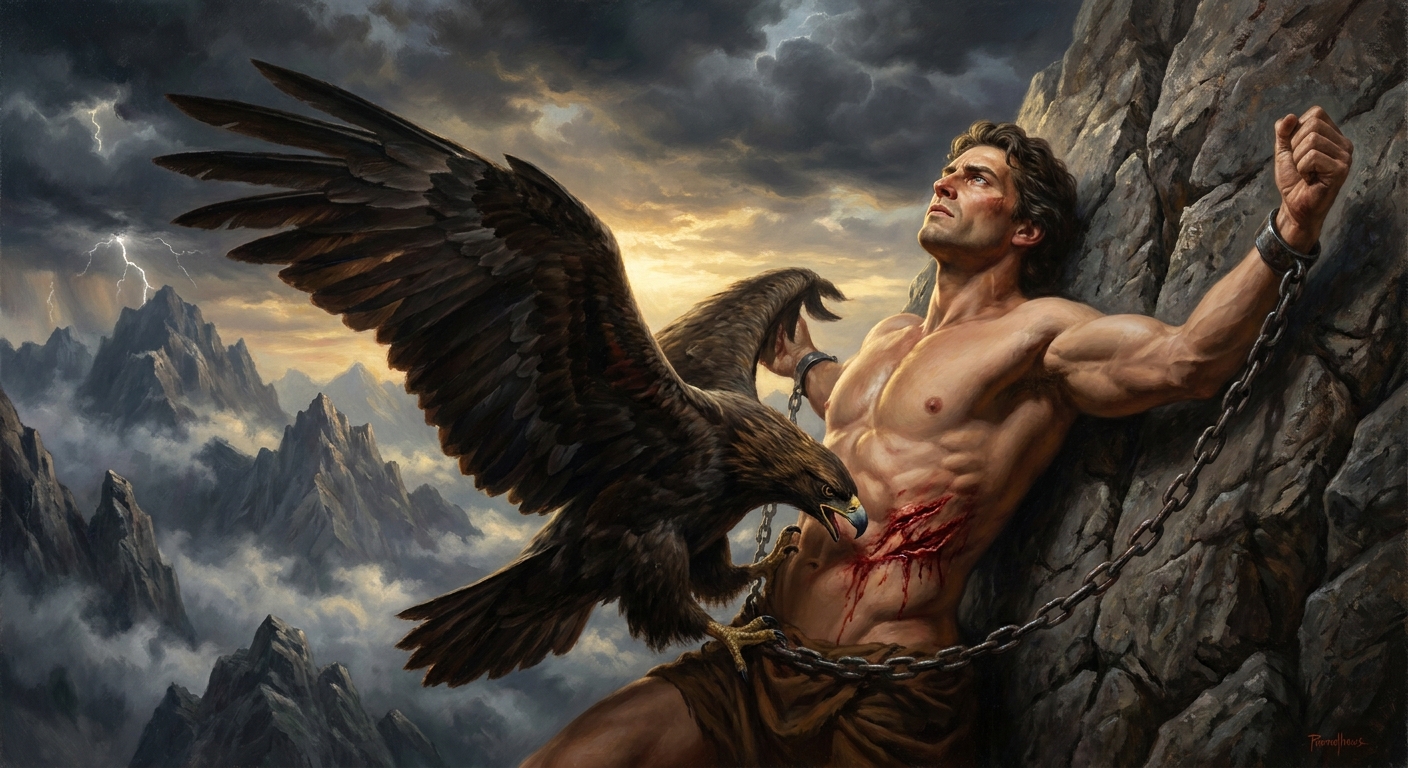
The Titan stole fire from the gods and gave it to humanity. Zeus chained him to a rock in the Caucasus where an eagle devours his liver every day — the organ regenerates each night for eternal torment.
- When
- Mythic Time · ~5th century BCE recorded by Aeschylus
- Where
- The Caucasus mountains
He climbs the mountain at dusk.
The chains are not ready yet. Hephaestus has not arrived with his iron and fire. Prometheus stands at the top of the Caucasus alone, bare-chested, and waits. He has time. He has always had time. Time is the one thing Zeus cannot take from him before the punishment begins.
Below, the world is dark. He can see the scattered lights of human settlements — the places where he distributed the fire, the flames that now warm mortals on cold nights, that cook their food, that let them forge metal and build ships and stand upright against the dark. He did this knowing the price. He has never regretted it.
The first night, Hephaestus comes.
The god of the forge is not cruel, only obedient. He binds Prometheus to a pillar of stone with chains forged from adamant — unbreakable metal, denser than bone, cold as the underworld. Prometheus does not struggle. He watches Hephaestus work, and he sees the shame in the blacksmith’s eyes.
“I am sorry,” Hephaestus says.
Prometheus does not answer. There is nothing to say. Zeus has decreed it.
The second day, the eagle comes.
It is massive — wings like storm-clouds, talons like sword-blades, eyes that burn with something beyond hunger. It lands on his chest without ceremony. It does not speak. It simply begins.
The talons tear the flesh. The beak finds the liver — the organ of blood, of heat, of the will to act. The eagle tears it free. Prometheus screams. The sound echoes across the Caucasus and down into the gorges below, and in distant temples, mortals stop what they are doing and listen, though they do not know what they hear.
It takes an hour for the eagle to finish. By sunset, Prometheus hangs broken and empty.
The first night, he regenerates.
The flesh knits. Blood flows back. The liver regrows — whole, vulnerable, ready. He has not been granted the mercy of death. He has not been granted the mercy of healing. He has been granted only the nightmare of eternal return.
He lies in the dark and counts the stars — the same stars he saw as a Titan in the time before Zeus. The constellations have not changed. They will not change. Only he will change, and then change back, and then change again, forever.
The third day, the eagle returns.
It is hunger without mercy. It is the mechanism, the clockwork of punishment. It does not matter if Prometheus has suffered enough. It does not matter if he has learned his lesson. There is no lesson to learn. There is only the law: those who steal from the gods are devoured until time ends.
The talons. The beak. The tearing. The screaming.
By the second night, he has stopped counting the days.
Millennia pass.
He does not grow numb. The body does not accustom itself to agony. Pain is always new. Every day the eagle tears him apart as if for the first time. Every night he regenerates as if he is being born into the torture over and over.
He thinks of humanity.
He thinks of the old woman in Athens who kept the fire alive in her home for thirty years without letting it go cold. He thinks of the smith who forged weapons to defend his city. He thinks of the artist who used fire to shape clay into vessels. He thinks of children learning to cook food, to see in darkness, to stand warm against the winter.
These things matter. Even here. Even now.
The years collapse. There is no before and after — only the unchanging eternal present of the Caucasus.
Sometimes, a hero passes nearby. Heracles, on one of his labors, ventures close to the mountain. Prometheus, in one of his lucid moments between regenerations, wants to call out. He wants to say: help me. But he does not. He knows Heracles has his own suffering to fulfill. The gods made sure of that too.
He never speaks.
He never begs. He never recants. He never says the fire was not worth it. He never says he would not do it again.
Zeus waits for this. The punishment is not only the eagle. The punishment is the waiting for Prometheus to break, to finally say that wisdom-giving was a mistake, that humanity was not worth the cost. Zeus waits. Time passes. The eagle devours. The liver regenerates.
And Prometheus, chained to his rock, says nothing.
In some versions of the myth, Heracles eventually comes to stay — not as a hero on a labor, but as the agent of liberation. The archer-god shoots the eagle from the sky. The chains shatter. Prometheus is freed.
But not yet. Not in this moment. In this moment, in the eternal mythic present where the story lives, Prometheus hangs from his chains in the Caucasus, broken and burning, knowing that the fire he gave to humanity will outlast him, will outlast Zeus, will outlast even the gods.
Knowledge has a price, and the price is always paid by the one who gives it away.
Odin hung for the runes and came down alive. Christ hung for the sins of the world and rose again. Prometheus hangs for fire — for the fire of human civilization, human art, human defiance — and does not come down. He hangs still, in the mythic eternal, paying the cost of humanity’s ascent.
The gods fear givers more than they fear rebels. A rebel can be defeated. A giver cannot. Every human who tends a flame, who learns a craft, who builds something with their hands, extends Prometheus’s suffering by one more day. But this is not tragedy. This is nobility. This is the price of everything worth having.
To have civilization, you have to accept that someone is being tortured forever to pay for it. The only question is whether that knowledge makes you worthy of the gift.
Echoes Across Traditions
Entities
- Prometheus
- Zeus
- Hephaestus
- the Eagle
Sources
- Hesiod, *Theogony* (c. 700 BCE)
- Hesiod, *Works and Days* (c. 700 BCE)
- Aeschylus, *Prometheus Bound* (c. 430 BCE)
- Ovid, *Metamorphoses* 1.82-88, 2.823-828 (8 CE)
- Pausanias, *Description of Greece* 2.6.2 (c. 160 CE)