Contents
The seventh avatar of Vishnu stands on the shore of Lanka. The demon king's ten heads will not stay severed. One arrow — the Brahmastra, given by the sage Agastya — must end it.
- When
- Mythic Time · Valmiki composed ~5th century BCE
- Where
- Lanka — modern Sri Lanka
The bridge holds.
Ninety miles of ocean, and the vanara army has filled it with stone. Each boulder was carried to the shore and set in the water by soldiers who believed — who knew — that a stone marked with Rama’s name would not sink. Some say it is faith. Some say it is physics of another order. Either way, the stones float, and the army of monkeys and bears has crossed.
Lanka is burning behind them.
Hanuman did that: the son of the wind, who leaped across the ocean in a single bound to find Sita, who slipped through Ravana’s dungeons speaking of rescue, who was caught and had his tail wrapped in oil-soaked cloth and set alight — and who, before anyone could stop him, swung his burning tail across the rooftops of Lanka until the golden city was a storm of fire. He came back across the water with cinders in his fur and Sita’s message in his memory. The city still smolders. Through the smoke, the towers of Ravana’s palace rise unbroken, and the demon king descends to the field.
Ravana is ten heads and twenty arms. The ten heads represent something the texts are precise about: mastery of the four Vedas and six Shastras — the complete architecture of human knowledge, bent entirely toward conquest. He has composed hymns to Shiva of such beauty that the god himself wept. He has practiced austerities that would have destroyed lesser men. He received Brahma’s boon: no god, no demon, no cosmic being would be able to kill him. He forgot to specify: no human.
He walks onto the field the way a man walks into a room he already owns.
Rama faces him. The prince of Ayodhya, exiled fourteen years for the sake of a father’s word, who walked into the forest with his wife and his brother and nothing else — who built an army from nothing, who crossed an ocean on floating stones. He carries the bow. He stands without armor.
Lakshmana is to his left, arrow already nocked. Around them the vanara generals hold the line — Sugriva, Angada, the great bear Jambavan — but they all know this is not their battle. It has never been their battle. They built the bridge. They burned the city. The fight itself belongs to dharma, and dharma has a face today.
The early hours are catastrophic.
Ravana drives his chariot forward and the ground shakes with it. He fires divine weapons — astras of fire, of darkness, of serpent-lightning that multiplies into a thousand arrows at once. The vanara ranks break and scatter. Lakshmana takes a spear to the chest and goes down; Hanuman runs to the Himalayas and tears a mountain from the earth with his bare hands because he cannot identify the healing herb, and carries the whole mountain back before sunrise. Lakshmana rises.
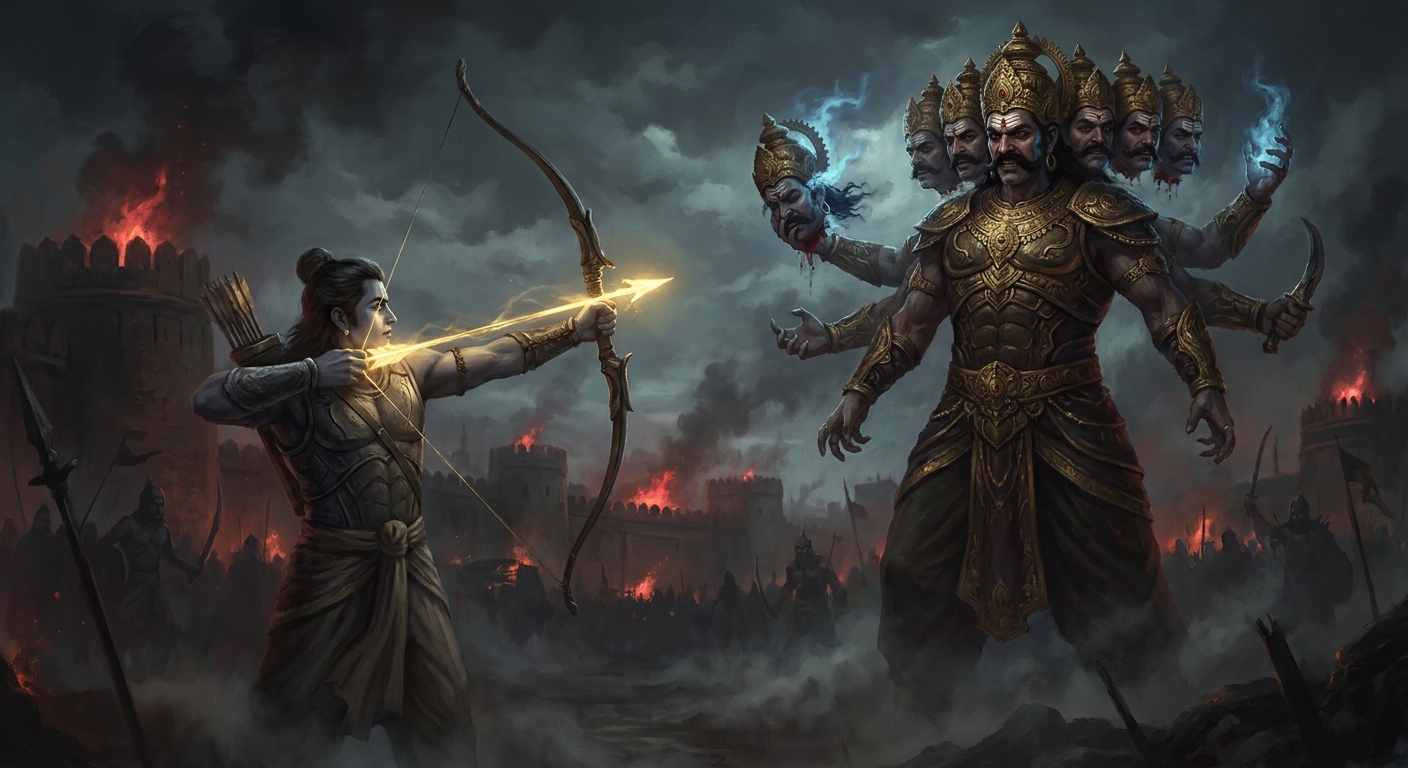
Rama fires and fires. His arrows find Ravana’s chariots, his horses, his drivers. He strikes each of Ravana’s ten heads from the shoulders in sequence. The heads fall. He watches them. Then he watches them grow back.
This is the boon working. Not invincibility — Brahma was more precise than that. What Ravana received was regeneration: the heads return, the wounds close, the power replenishes. You can kill him all afternoon and at dusk he will be exactly as he was at dawn. The Ramayana is clear on this point. It does not dress it up. You cannot defeat him the ordinary way. What is needed is not more strength. What is needed is a different kind of arrow.
The sage Agastya appears at the edge of the field.
He is ancient — old enough that the tradition is uncertain about his origin, only certain about his authority. He has drunk the ocean. He has reduced a mountain range to let the sea through. He walks with the ease of a man for whom urgency dissolved several centuries ago. He comes to Rama, who has just watched Ravana’s ninth head grow back, and he speaks.
“Listen, Rama, to the ancient, secret, eternal mystery that brings victory. The Brahmastra. I give it to you now.”
The arrow is not an arrow in any simple sense. The tip is fire — Agni. The shaft is wind — Vayu and Chandra, sun and moon, binding the cosmos into one weapon. Its feathers are drawn from the wings of Garuda, the divine eagle who carries Vishnu between worlds. In the beginning of things, this arrow was made by Brahma himself, for the god of creation understood that there would come a moment when creation’s enemy could only be ended by creation’s first weapon.
Agastya recites the invocation. Rama listens. He takes the arrow. He places it against the string.
The last charge.
Ravana comes across the field with twenty arms and all ten heads roaring, each mouth a different pitch of fury. Rama draws. He does not rush the draw. He has been a bowman since boyhood; he has passed every test of strength and precision the tradition demands of its heroes. He draws the way a man draws who has done this a hundred thousand times in practice, except that this is not practice, and he knows it.
He holds the draw.
The arrow between his fingers hums — not loudly, but with the frequency of something very old that has waited a very long time.
He releases.
The Brahmastra strikes Ravana in the chest. It does not strike like an arrow. It strikes like a resolution. The fire at the tip opens into Ravana’s body and the wind pours through behind it, and then the weight of sun and moon follows, and there is a sound — the texts struggle with this — like the splitting of something that should have been split long ago. The regeneration does not come. The twenty arms fall. The ten heads fall and do not rise. The demon king of Lanka, master of the Vedas, composer of hymns, the proudest being alive, falls.
He falls the way pride always falls: completely, without negotiation, at the moment it finally meets something equal to its opposite.
The smoke drifts. The vanara army is still. Hanuman is already moving toward the palace. He knows where Sita is — he found her months ago, in the garden called Ashoka, and told her Rama was coming. He has been running toward this moment since before the bridge was built.
Rama stands over the body for a long time.
This is the part the Ramayana includes that lesser epics omit: the grief. He does not celebrate. He knows what Ravana was before the kidnapping — the greatest devotee Shiva ever had, a scholar of incomparable breadth, a king who built a golden city out of sheer will. The sin was not the learning. The sin was the ego that made all that learning serve desire instead of dharma.
“A great king has died,” Rama says, in the tradition as Tulsidas records it. He means it.
Then Sita comes.
She is brought from the Ashoka garden, and when she arrives and Rama sees her — after fourteen years of exile, after an ocean, after an army built from faith — he sets his face into composure. He will explain later, in passages that have troubled commentators for centuries, that a public trial is required, that a king cannot simply take his wife back on the battlefield without accounting for the months of captivity. The tradition argues about this scene endlessly. What is not argued is what happens in Sita’s chest when she walks out of that garden and sees him standing alive in the smoke of Lanka.
She steps through the fire of the trial. She emerges.
They walk to the flying chariot. They cross the ocean going north. Beneath them the bridge they built dissolves back into the sea, having served its purpose. Ahead of them, fourteen years late, Ayodhya prepares its lights.
The Ramayana contains everything the tradition wants to say about dharma: that it costs exactly as much as it costs, not a rupee less. Rama does not get his wife back without the exile. He does not get the exile without Kaikeyi’s betrayal. He does not kill Ravana without Agastya’s arrow. He does not earn Agastya’s arrow without crossing the ocean. None of it is accidental. The chain runs from duty accepted without bitterness to victory won without cruelty.
The lights of Diwali, lit every October or November across a billion homes, are not celebrating military victory. They are celebrating the return of the man who kept his word when keeping it cost everything. That is the story. The battle is just how you can tell whether the word was kept.
Echoes Across Traditions
Entities


Sources
- Valmiki, *Ramayana* (Yuddha Kanda), trans. Robert Goldman
- *Adhyatma Ramayana*
- Tulsidas, *Ramcharitmanas* (16th century)