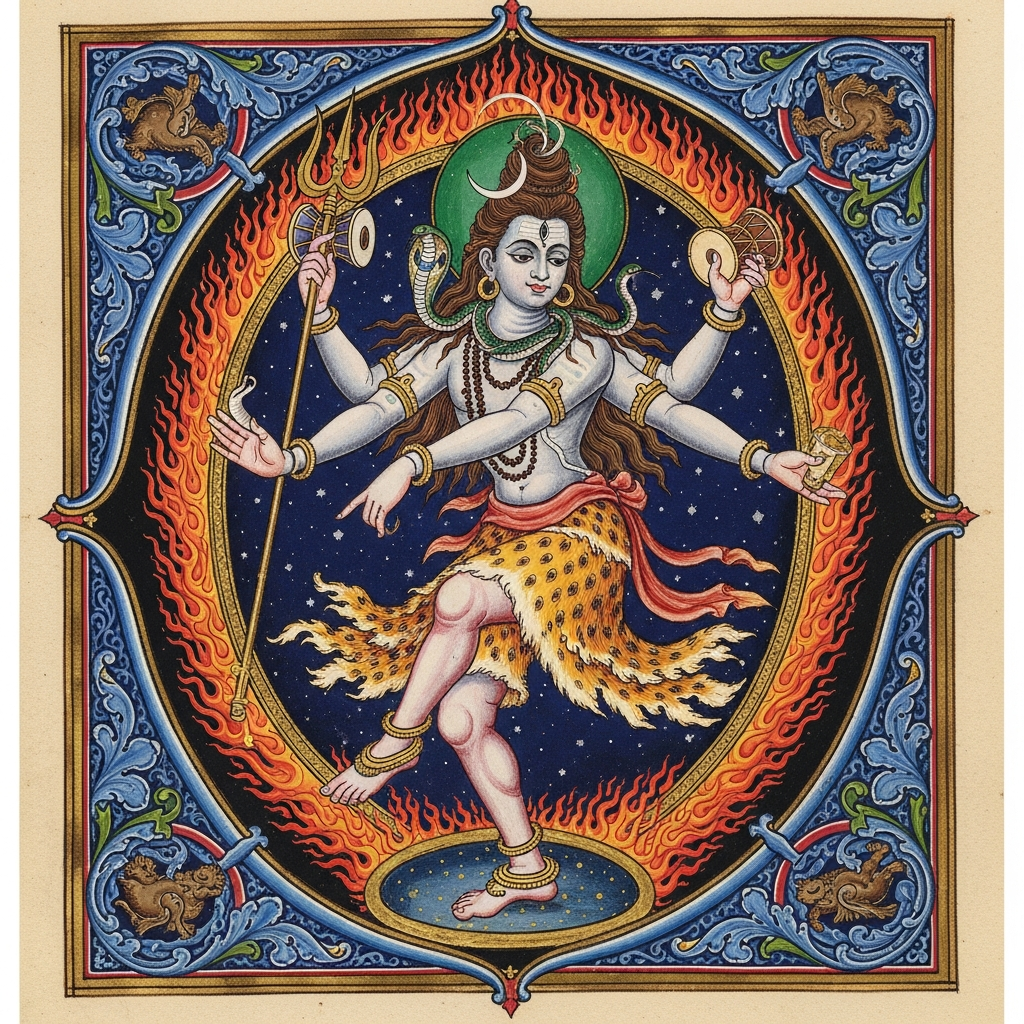
Sati Dies at Her Father's Sacrifice
Mythological time · Daksha's kingdom; the Himalayas; across the Indian subcontinent
Contents
Daksha, king of the gods and father of Sati, hosts a grand yagna and deliberately omits Shiva from the invitation. Sati attends uninvited; Daksha publicly humiliates her husband before the assembled devas. She immolates herself in the sacred fire. Shiva's grief becomes a catastrophe that reshapes the geography of the Indian subcontinent — the 51 Shakti Pithas, each sacred shrine marking where a piece of Sati's body fell.
- When
- Mythological time
- Where
- Daksha's kingdom; the Himalayas; across the Indian subcontinent
The invitation does not come.
Sati knows before the courier returns empty-handed. She has watched her father’s messengers depart for three days — silk-wrapped letters sealed with Daksha’s golden disc, one each for the thirty-three principal devas, the seven sages, the kings of the four directions. She has counted the addresses. She has not seen her own name. She has not seen Shiva’s.
Daksha, king of the progenitors, son of Brahma, lord of sacred rites, has decided that his son-in-law the ascetic — the ash-smeared wanderer who dances in cremation grounds, who keeps company with ghosts and outcasts, who refused to stand when Daksha entered the assembly of gods — does not belong at a yagna. He has decided this publicly, with the deliberateness of a man who has been planning the insult for years.
Shiva does not care. He sits on Kailash in meditation, his breath so slow it is almost absence, and tells Sati not to go.
She goes anyway.
The sacrificial ground at Daksha’s palace is the most magnificent in creation — a pavilion of carved stone open to the sky, the ritual fire already lit at its center, its smoke rising in the clean column that signals a properly performed yajna. The gods are already seated by rank. Indra on his elephant. Agni bright as always near the fire. Varuna, Vayu, the Ashvins. Her own sisters, Daksha’s other daughters, who look at her arrival with something that is not quite pity and not quite relief.
Daksha is at the altar’s head. He sees her. He does not stand. He does not extend the formal greeting due to a daughter. He turns to the assembled company and speaks, loudly enough that everyone within the pavilion can hear, in the careful rhetorical cadence of a man who has composed his remarks in advance.
He speaks of Shiva’s character. The funeral ash. The uncut hair. The necklace of skulls. The habit of sitting in charnel grounds communing with the dead while the living perform their proper rites. The association with beings who stand outside the varna system — the ghosts, the tribal peoples, the wanderers who haunt the margins of the ordered world. He speaks of Shiva as an embarrassment to a daughter who deserved better, and an affront to the cosmic order that proper sacrifice sustains.
He speaks for a long time.
Sati stands and listens. The fire crackles. No one interrupts.
What she feels is not entirely grief. It is something that does not have a clean name in any language — the specific quality of hearing the person you love spoken of as though he were filth, by the person who raised you, in front of everyone you grew up knowing, when you know that the person being spoken of is the truest being you have ever encountered and that your father’s categories cannot hold him and cannot diminish him but are diminishing you, right now, in this moment, in this body that carries his name.
She asks Daksha to stop. She tells him that she knows his reasoning and that it is not reason but pride, that Shiva is beyond the hierarchies Daksha is using to measure him, that the ash and the skulls are not poverty but philosophy, that the company of outcasts is not failure but choice. She uses his own tradition against him: the proper father honors the husband of his daughter. The proper sacrificer includes all the gods. The yagna performed without Shiva is already incomplete.
Daksha does not respond.
She looks at the fire.
She is Shakti, the primal divine feminine energy, wearing the body Daksha gave her. The body is Daksha’s only point of leverage. She decides to remove it.
She steps forward. She sits at the edge of the sacrificial pit. She closes her eyes and draws the inner fire up from the base of her spine — yoginis know this fire, the kundalini that can warm the body in Himalayan cold and that, directed correctly, can also consume — and she directs it outward. The white sari catches. The flame does not harm her. She is the flame.
The assembled gods see a woman burning and cannot move.
The news reaches Kailash in the way that terrible news always travels in the myths — instantly, impossibly, before any messenger could have made the journey. Shiva opens his eyes. His expression does not change in any way that human faces change. Something else changes. The mountain shakes.
He pulls a lock from his own matted hair and dashes it against the ground. From the place it strikes, Virabhadra rises — Shiva’s wrath given form, ten thousand armed, burning, mountainous, a being made entirely of the emotion that has no name between rage and grief. Virabhadra marches on Daksha’s palace with an army assembled from Shiva’s own multiplied being, and what follows at the yagna ground is not punishment in any juridical sense. It is a natural disaster. The gods scatter. The carefully constructed pavilion is rubble. Daksha’s head is removed from his body with a directness that mirrors what Daksha did with his words.
Later — after Brahma intervenes, after Vishnu counsels temperance, after the cosmic mechanics of balance reassert themselves — Daksha will receive back his life, though his head, burned in the sacrificial fire, is replaced with a goat’s head. This is considered a mercy.
Shiva does not notice the mercy. He has found Sati’s body in the ruins of the fire pit, improbably intact, and he has lifted her and is walking.
He walks for a very long time.
The universe watches Shiva walk with Sati’s body and understands that if he does not stop, the grief will consume everything. He is not walking anywhere in particular. He is walking because she is still with him in the only way she can be, and to stop walking is to admit that she is not. His hair streams behind him. The earth trembles at each step. The three worlds hang in a balance that is exactly as fragile as the weight of one god’s sorrow.
Vishnu acts. With his Sudarshana Chakra, the spinning discus of preservation and necessity, he does what must be done: he follows Shiva and cuts Sati’s body into pieces. One by one as Shiva walks, pieces fall. Each piece falls to a specific place on the land — a hilltop, a river bend, a forest clearing, a cave above the sea. Where each piece falls, a goddess rises. Not a memory. Not a marker. A goddess: living, present, receiving worship, embodying a specific quality of Shakti that was held in that part of Sati’s body.
The toe falls in Assam and becomes Kamakhya, the goddess of desire and menstruation and the red mysteries. The eyes fall in Rajasthan and Bengal and Uttar Pradesh — there are multiple eyes because there is that much to see. The tongue falls somewhere in the south and becomes the sharpness of necessary speech. The navel falls in Prayagraj. Fifty-one pieces. Fifty-one sites. The subcontinent becomes a body.
When the last piece falls, Shiva is empty. He sits down somewhere in the Himalayas and goes back into meditation. He will sit there until Sati is reborn as Parvati, daughter of the mountain, and comes to find him.
He waits.
The Shakti Pithas are not metaphors for loss. They are the claim that the sacred feminine cannot be unmade — that Daksha’s violence, patriarchal and procedural and done in the name of proper order, failed completely. He destroyed the body. The body became fifty-one bodies. He silenced the goddess. The goddess became fifty-one goddesses, each at a specific location where her physical presence is still felt, where women go when they are desperate or grateful or seeking something that male-coded shrines do not address.
The myth is also a record of what grief does to the person left behind — how it walks and walks, how it holds what cannot be held, how eventually the universe has to intervene to make it stop because otherwise it will never stop on its own.
Sati chose the fire. The fire distributed her. She is everywhere the fire touched and everywhere the pieces landed and everywhere a woman has ever walked barefoot into a river at dawn because the goddess there is the only one who understands what she is carrying.
Scenes
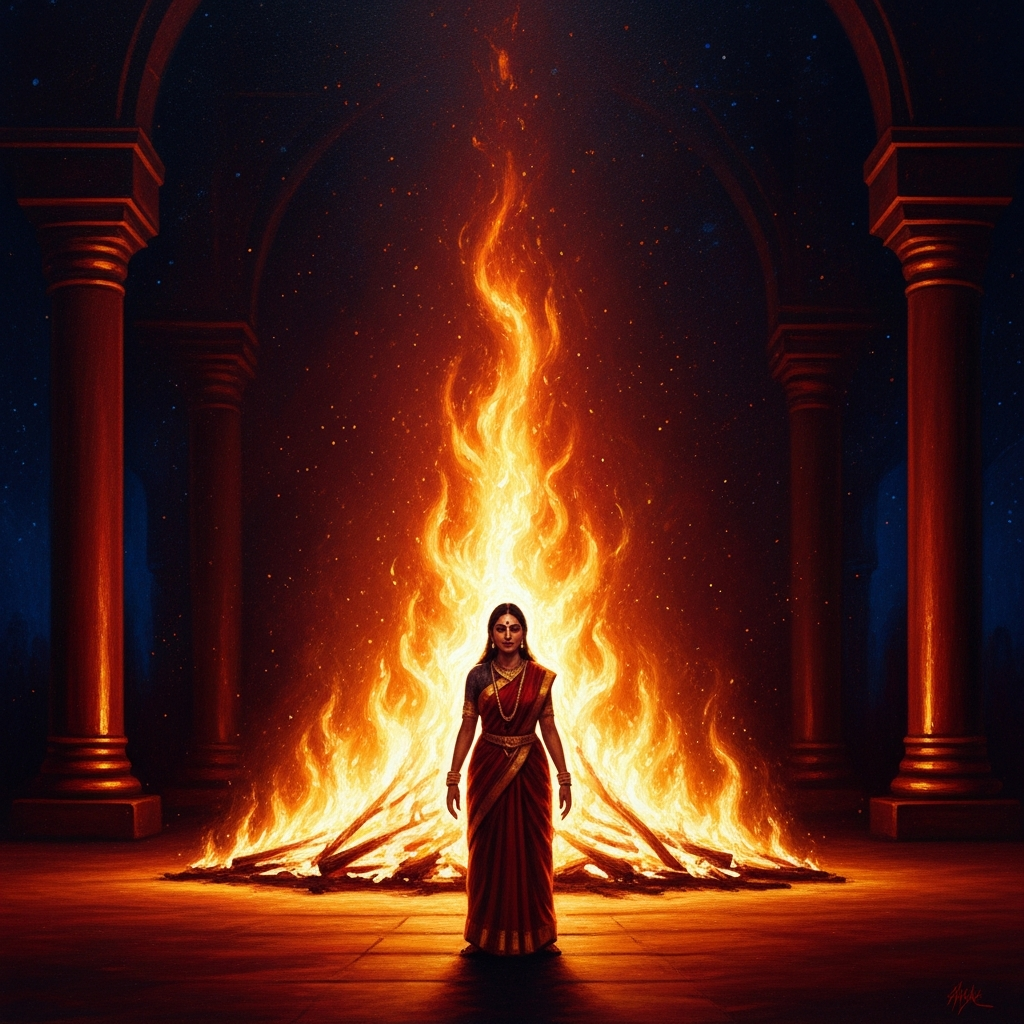
The sacrificial hall blazes with ritual fire
 Generating art…
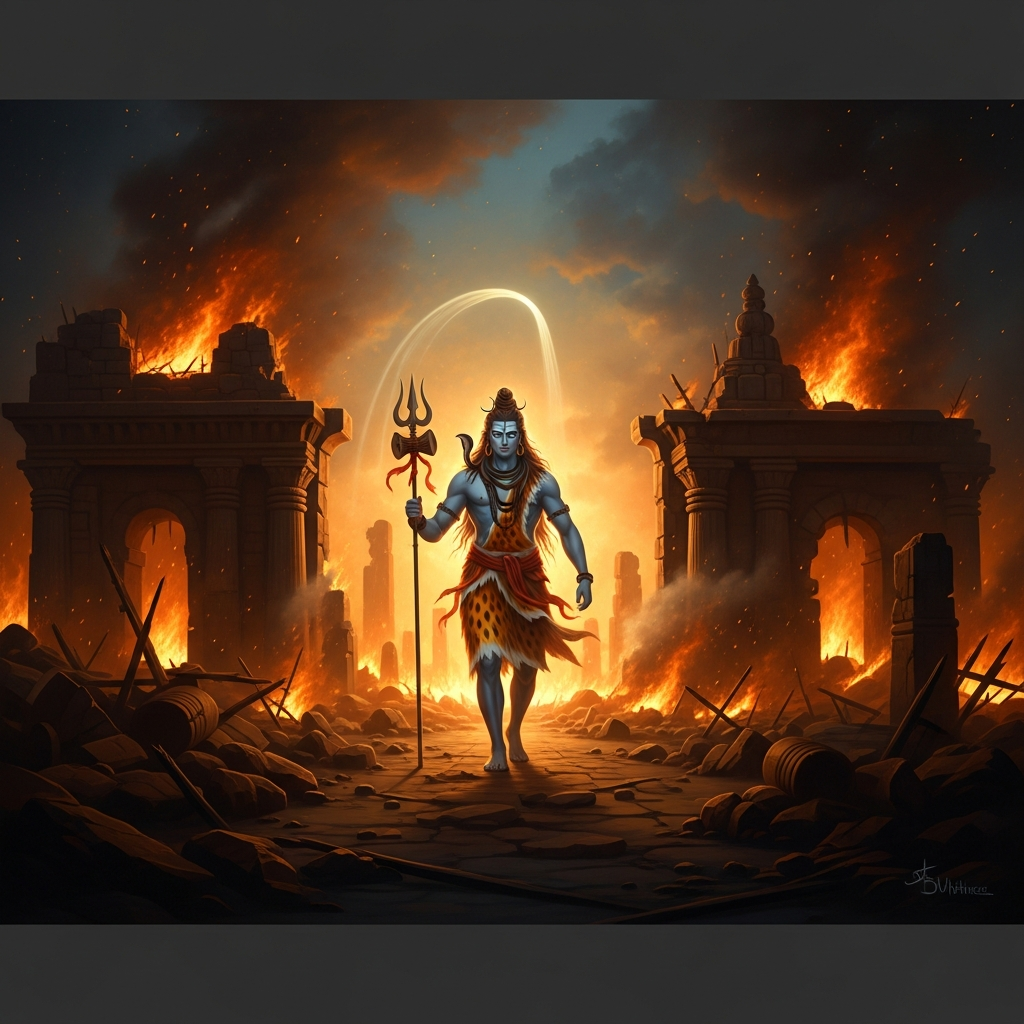
 Shiva strides across the burning ruins of Daksha's palace, Sati's body cradled against his chest, his hair a storm of matted locks, the trident bright as lightning
 Generating art…
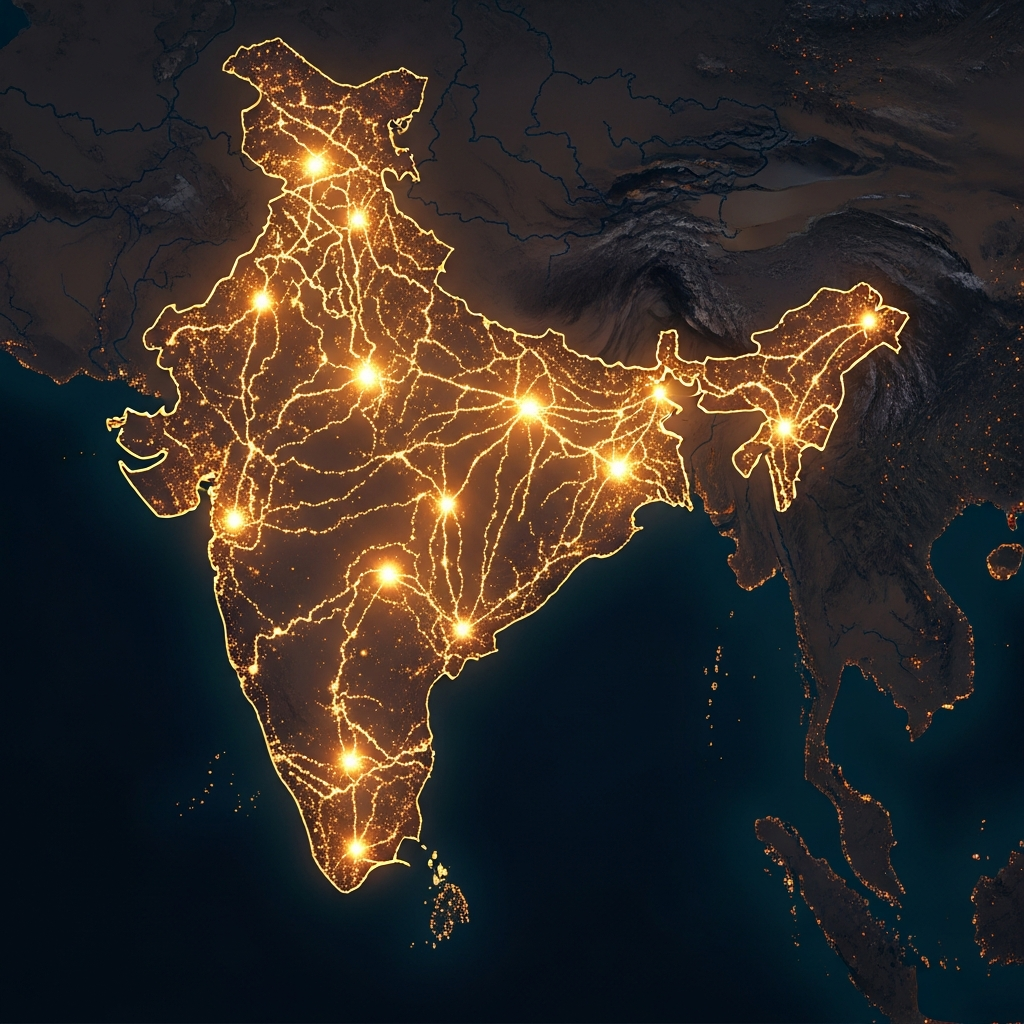
 A stylized map of the subcontinent shows 51 glowing points of light from Kashmir to Kerala, each the site where a piece of Sati fell and became a living goddess — the grief of a god distributed into the sacred geography of the earth
 Generating art…
 Echoes Across Traditions
Entities


Sources
- Wendy Doniger, *Siva: The Erotic Ascetic* (Oxford University Press, 1973)
- David Kinsley, *Hindu Goddesses: Visions of the Divine Feminine in the Hindu Religious Tradition* (University of California Press, 1986)
- Diana Eck, *India: A Sacred Geography* (Harmony Books, 2012)
- Devdutt Pattanaik, *Shiva to Shankara: Decoding the Phallic Symbol* (Indus Source Books, 2006)
- Stella Kramrisch, *The Presence of Shiva* (Princeton University Press, 1981)