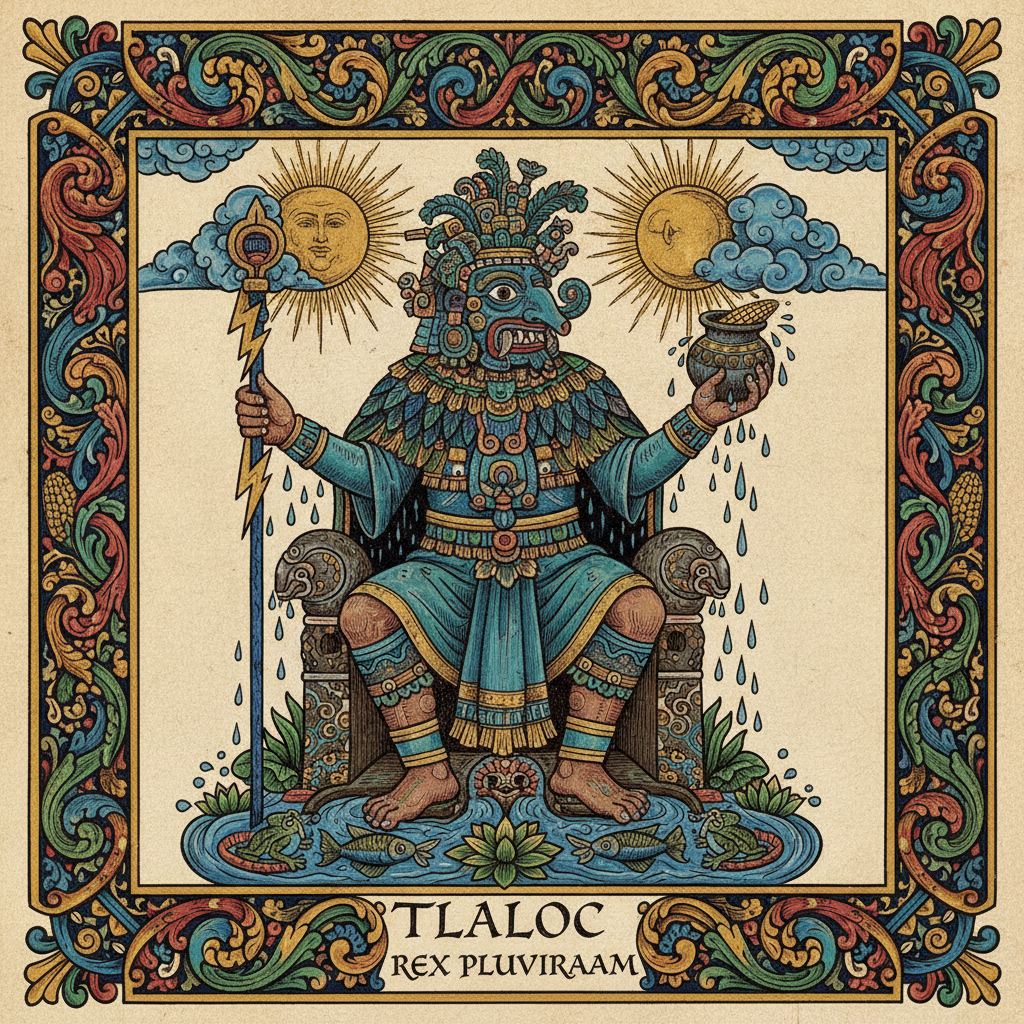
Tlaloc Demands Children
Annual — the festival of Atlcahualo, first twenty-day period of the Aztec solar calendar · attested in *Florentine Codex* Book 2, Sahagún, ~1580 CE · Tenochtitlan and the mountain shrines of the Valley of Mexico
Contents
In the calendar of the Aztec sacred year, the rain god Tlaloc requires a specific offering: children, chosen for the abundance of their tears. The more they cry, the more the god is pleased, because their tears are rain in miniature. A family walks toward the moment the theology requires of them.
- When
- Annual — the festival of Atlcahualo, first twenty-day period of the Aztec solar calendar · attested in *Florentine Codex* Book 2, Sahagún, ~1580 CE
- Where
- Tenochtitlan and the mountain shrines of the Valley of Mexico
In the first twenty-day period of the Aztec solar calendar — the period called Atlcahualo, the Ceasing of Water, the month when the dry season has fully established itself and the question of whether the rains will return is not yet answered — the festival of Tlaloc requires a specific thing. The Florentine Codex is careful and precise about it. The children must be very young. They must be well-formed. They must, above all, cry.
The theology is clear on this point: the tears of the children are the rain in miniature. Tlaloc sees the tears and he understands that the people know what they are asking for. He responds in kind. This is the mechanism of exchange. The people who designed this ritual across the centuries before any particular family was born to participate in it were not inventing cruelty; they were solving an engineering problem. The Valley of Mexico is a semi-arid highland basin where rain is seasonal, capricious, and the difference between adequate and inadequate is measured in the survival of millions. The question of how to influence the rain was not philosophical. It was infrastructural.
A family walks to the plaza.
They are not exceptional, this family. They have brought their child because the priests selected the child as a possible offering — selected based on the quality of the crying, which the family already knew was abundant, because the child cries easily and freely and with the kind of full-body commitment that the very young bring to grief. This is not a defect the family has tried to correct. In Tlaloc’s year, a child who cries well is a child who is noticed.
The Florentine Codex describes the festival procession in careful sequence: the children carried on litters decorated with the paper ornaments of Tlaloc, their faces painted with ulli, the rubber that is Tlaloc’s sacred material, their bodies dressed in the god’s colors — blue, green, the colors of water and growing things. The mountain shrines are their destination: Tlaloc’s own mountain, and the smaller hills around the valley that serve as his local houses, the places where the rain clouds form and where the priests have maintained the god’s presence for generations.
The parents understand what they are walking toward. This is not a misunderstanding.
The theology offers them something in exchange.
Tlalocan is Tlaloc’s paradise, and the Florentine Codex describes it with the specificity of a place the scribes had been told about many times and from many sources: it is the abundance that the dry season makes almost unimaginable. Perpetual green. Corn always ripe. Squash heavy on the vine. Water running clear and cold from every direction. Flowers in colors that the Valley of Mexico’s drought season has burned away. The children who go to Tlaloc do not go to the underworld, do not go to Mictlan where nine rivers must be crossed and nine years must be spent in darkness before dissolution. They go to Tlalocan. They go to abundance. They go to the best destination in the Aztec cosmology, the destination reserved for those who die by water or rain or drowning — because they belong to Tlaloc, and Tlaloc keeps what belongs to him in the best place he has.
This is the other half of the theology. The family walking toward the mountain shrine is not walking toward annihilation. The theology tells them where their child is going, and where the child is going is beautiful.
Whether the theology makes the walk easier is not recorded. What is recorded is the walk.
The priests watch for tears.
This is the detail that makes the ritual distinct from simple offering and transforms it into something that functions, in its own terms, with the precision of prayer: the priests are not indifferent to the children’s emotions. They are attentive to them. The sobbing that would, in any other context, cause the adults around a child to offer comfort — the heaving, helpless, full-lung grief of a child who does not understand what is happening but understands that something is wrong — is here what the ceremony requires. The priests do not comfort the children. They watch them cry and they are satisfied.
This is the point where the theology becomes most difficult to hold at a distance and simply describe. The system requires that the children cry, and so the system requires that the adults around them do not prevent the crying, and so the children cry in a procession of ritual attention with priests watching to confirm the quality of their tears, and this is how the rain comes.
The alternative — the rain not coming — is the death of the crops and the death, by degrees, of everyone.
At the summit, Tlaloc waits.
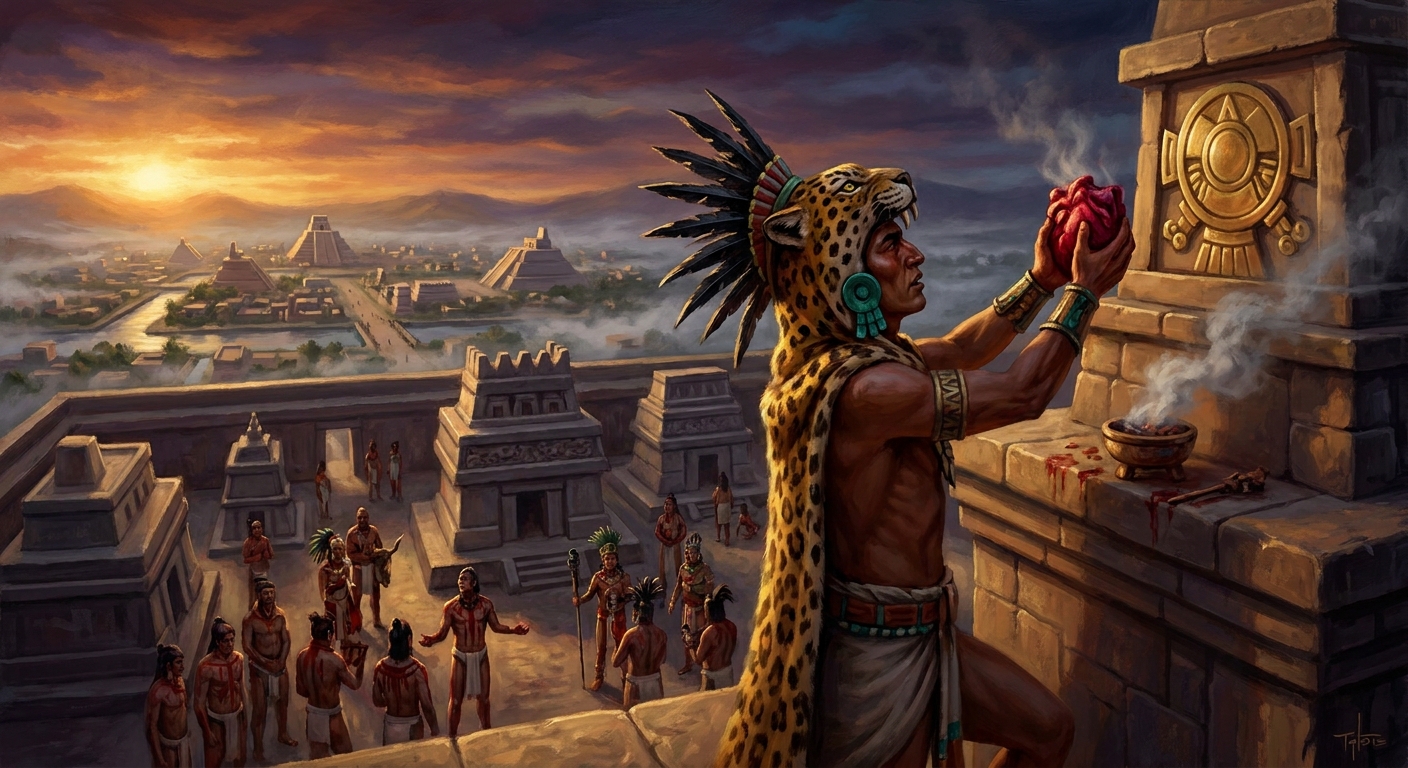
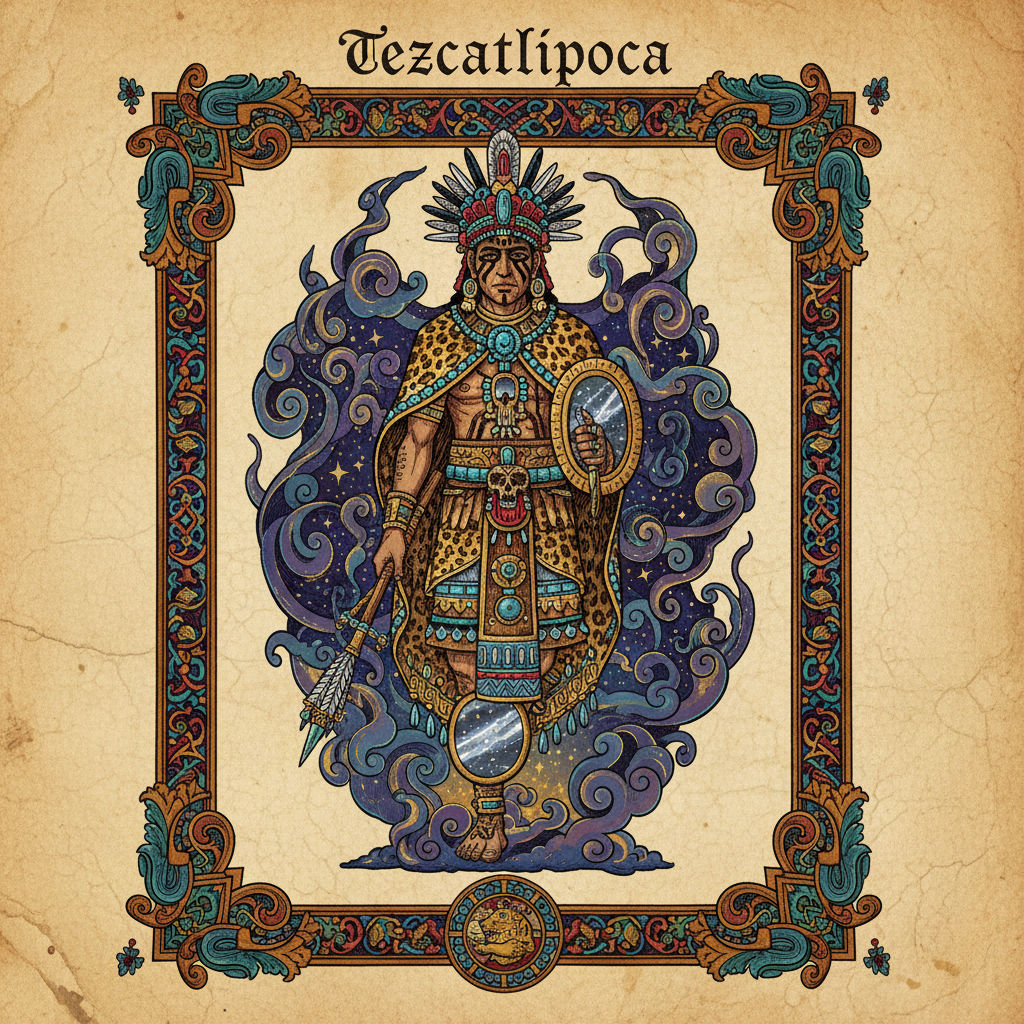
His shrine on the Templo Mayor’s northern staircase faces the mountains where his clouds form — the temple aligned, as the archaeologist Eduardo Matos Moctezuma has shown, so that the god’s gaze goes directly toward the mountain that bears his name and where his rain originates. He is depicted with goggle eyes that see in all directions and fanged jaws and a curl of blue mist around his lips. He is not presented as evil. The Florentine Codex and Diego Durán and every other source that describes him present him as a force of nature that operates by law — the law of exchange — and the priests who serve him as technicians of that law, people who have mastered the terms of the contract.
The contract is old. It predates the Aztecs, predates Tenochtitlan, predates the particular families walking in this particular procession with this particular child. Tlaloc’s worship is documented at Teotihuacan, a city that rose and fell a thousand years before the Aztecs arrived in the Valley of Mexico and claimed its inheritance. The rain god with goggle eyes appears on murals at Teotihuacan that are fifteen hundred years old, and the people who painted them also had children, also had dry seasons, also worked out that the rain requires something in exchange.
What the rain requires does not change because the centuries change.
Tlalocan is green, and the children are there, and the rains do come — they always come, eventually, every year, the clouds gathering on Tlaloc’s mountain and moving across the valley and breaking open over the terraced fields with the force of everything the dry season has been holding back, the water falling so hard and so fast that it runs off the hillsides and fills the irrigation channels and pools in the furrows of the milpa gardens where the corn and squash and beans grow together, each one feeding the others, the whole valley green and wet and running, the exact opposite of what it was — Tlalocan on earth, every year, paid for.
Scenes
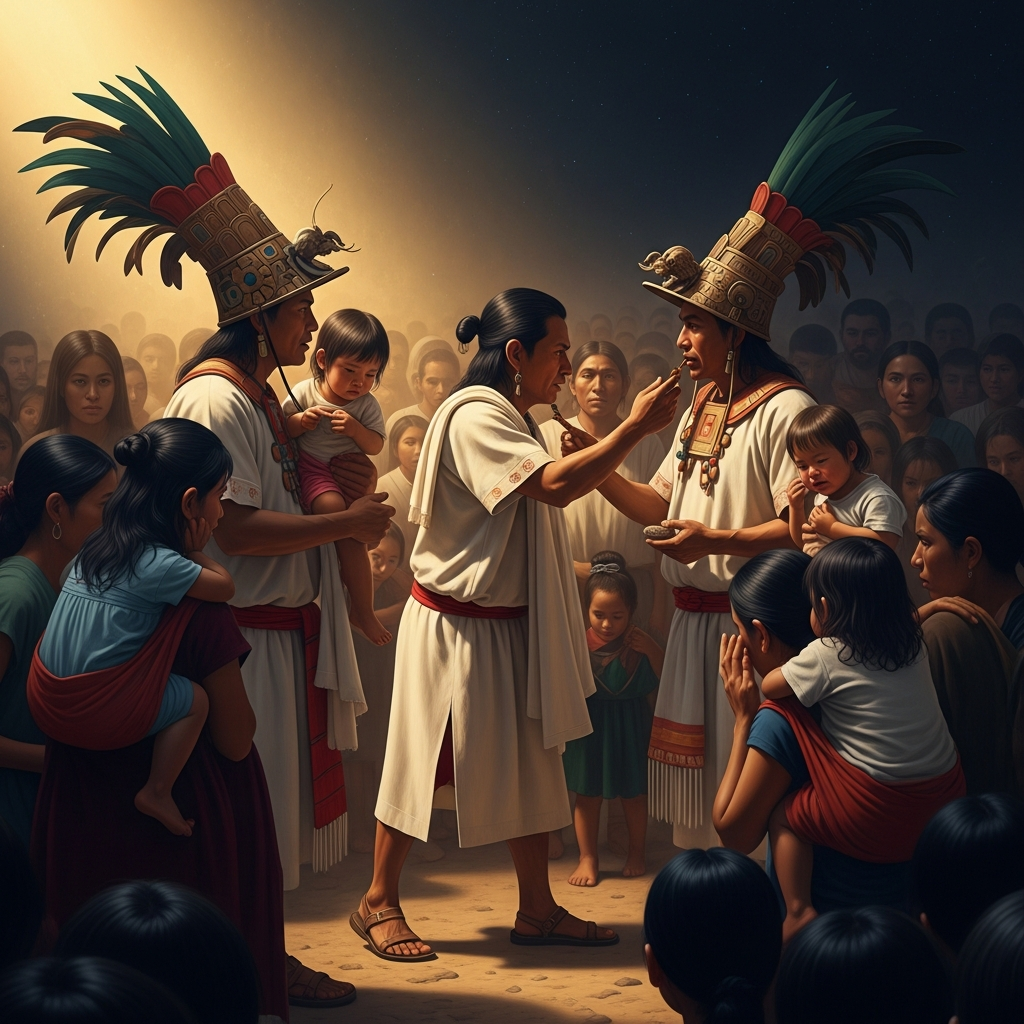
The priests of Tlaloc move through the crowd assembled for Atlcahualo, reading the faces of the children carried by their parents — watching for the ones whose tears come freely, whose grief is the most generous
 Generating art…
 Tlalocan, the paradise of the rain god, is green beyond description — the abundance that Mexico's dry season makes almost unimaginable
 Generating art…
 At the summit of the Templo Mayor's northern stairway, the blue-faced god waits in his shrine
 Generating art…
 Echoes Across Traditions
Entities
- Tlaloc
- the Tlaloque

Sources
- *Florentine Codex*, Book 2 — Bernardino de Sahagún (~1580)
- *Historia de los Mexicanos por sus pinturas* (c. 1535)
- Diego Durán, *Book of the Gods and Rites and the Ancient Calendar* (~1579)
- Johanna Broda, 'Tlaloc y Tlalocan,' in *Mesoamerica's Classic Heritage* (2000)
- Davíd Carrasco, *City of Sacrifice: The Aztec Empire and the Role of Violence in Civilization* (1999)
- Inga Clendinnen, *Aztecs: An Interpretation* (1991)