The Tower
Mythic Time · Genesis composed ~6th-5th century BCE · The plain of Shinar — Babylon
Contents
After the flood, humanity builds a ziggurat to reach heaven. God descends, sees, and shatters human speech. The work stops. The builders scatter across the earth.
- When
- Mythic Time · Genesis composed ~6th-5th century BCE
- Where
- The plain of Shinar — Babylon
The bricks are made. Straw-reinforced clay pressed into molds, dried in the Shinar sun until they ring like struck stone. There are so many of them that no one can count — just as no one can count the people hauling them toward the sky.
It begins after the flood, when the waters recede and the earth dries. The survivors cluster in the plain where the Tigris and Euphrates braid like veins through fertile silt. One language binds them — not many dialects but one, the same words coming from every mouth. A man called Nimrod (mighty hunter, builder-king, depending on which story-strand you follow) looks at the horizon and says: we will make a name for ourselves. We will build a tower, and its top will reach heaven.
No one says “lest we scatter.” But they are all thinking it.
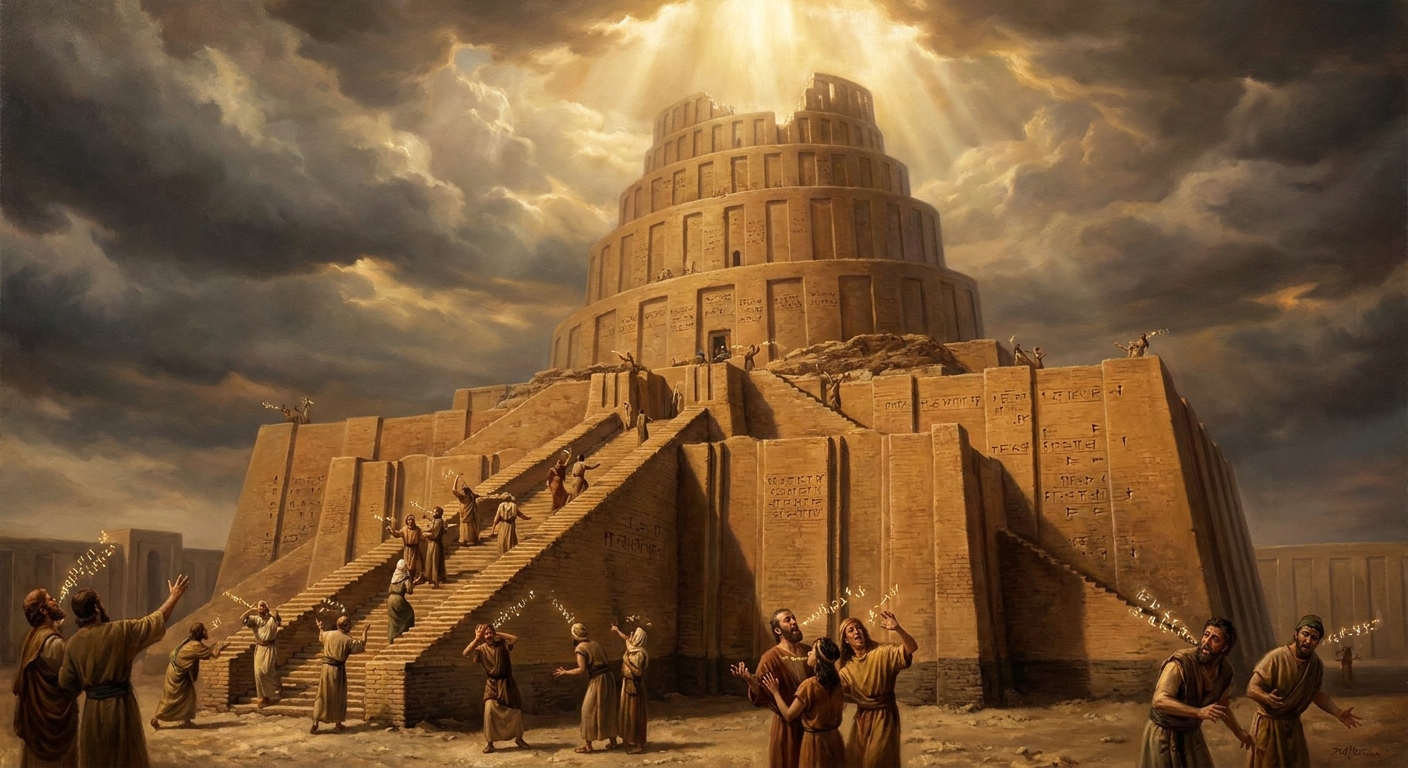
The tower rises. Not overnight, not quickly — decades, maybe centuries, the chronologies blur and the text does not specify. The construction is engineering without precedent. The ziggurats of Babylon rise in stages, each level smaller than the one below, stacked like a cosmic mountain made of human will. The bricks flow like ants. The people do not tire because they are not thinking of tiredness. They are thinking of the top. They are thinking of reaching it.
The work unifies them in a way even blood cannot. Families splinter: a man gives his sons to the tower and doesn’t expect them home. Women bear children specifically to add laborers to the project. The work is the project. The work is the point.
YHWH descends.
Not in thunder, not yet. The text says He came down — the same verb used for visitation, for checking. A god descending from the cosmic distance to see what mortals had wrought. The tone is almost — inspection. A father checking his child’s homework. But what He sees is something no previous human act has produced: a unified will, a concerted species, speaking one language and building upward toward the divine sphere.
The seeing is the judgment.
This is the moment that burns in the West’s memory, though few know it burned first in Mesopotamia: the moment a god decides that human unity itself is dangerous.
Not disobedience. Not breaking a law. Unity. Mutual comprehension. A shared goal pursued in perfect linguistic lockstep.
YHWH does not burn the tower. He does not send plague or flood. What He does is sharper: He breaks the words.
The cuneiform that flows from one mouth into another — the language that has bound humanity — fractures. Not gradually. Suddenly, catastrophically, in an instant. A man turns to his brother and the words coming from the brother’s mouth are no longer words. They are sounds. Meaningless. The brother’s eyes show the same confusion staring back. The sister’s words are a third language no one else speaks. The worker beside you is suddenly, utterly, incomprehensibly alien.
The construction halts immediately. Not because the people stop working, but because working together requires conversation. Conversation requires language. The unified human project fractures in a single divine act.
They scatter.
The tower stands unfinished. Later age will claim that God struck it down, burned it, scattered its stones. The text says something subtler: Therefore is the name of it called Babel; because the LORD did there confound the language of all the earth (Genesis 11:9, KJV).
The name itself is the curse: Babel — from the Akkadian Bab-ilu, “Gate of God.” But Hebrew hears it as Balal, to confound. The tower still stands. Its name is a scar. A monument to the moment human beings stopped understanding each other.
What follows, in the biblical account, is the genealogies scattering. Abraham is called from Mesopotamia (Genesis 12:1). Out of the confusion, one family is singled out — given a covenant, a direction, a path. But the wound of Babel does not close. Thousands of years later, after the Babylonian exile, Jewish scribes sitting in Babylon will copy their own scriptures — retelling Babel in the text while living inside Babylon, the very city sometimes identified with that tower. The irony is crushing and deliberate: you are conquered by the city your ancestors scattered from.
The Tower of Babel does not teach that unity is wrong. It teaches that mutual unity — unity without divine permission, human-forged and unbroken — is the thing God fears most. Or envies. Or recognizes as a threshold that cannot be crossed without catastrophe.
The cure for unity is fragmentation. The species that built together is now a species that cannot speak. And that inability — that wound of incomprehension — is humanity’s inheritance.
It bleeds still.
The Tower is the anti-Pentecost. At Babel, one language becomes many, and the people scatter. In Acts 2, the Spirit reverses it: many tongues suddenly speak, yet all hear their own language. The same reversal, the same healing attempted — but for Christians only, only for the chosen. Babel remains the deeper, older, unstained truth: we do not understand each other. That is the default. That is the curse.
Every empire since Babylon has claimed it could rebuild the Tower. Every technology since writing has promised to re-unify language. And every time, the fracture reasserts itself. We build. We scatter. The tower stands half-finished on the horizon, and we use different words to argue about what it was for.
That is Babel’s final claim: human unity, once broken, cannot be mended. Only briefly, locally, and always at terrible cost.
Echoes Across Traditions
Entities
- YHWH
- Nimrod
Sources
- Genesis 11:1-9
- Babylonian Enuma Elish (cosmic architecture)
- Etemenanki ziggurat archaeology; Josephus *Antiquities* 1.4.3
- Berossus *Babyloniaca* (via Josephus)
- Babylonian King List (Nimrod traditions)