Tripura Sundari and the Geometry of the Universe
Mythological time; Tantric practice context c. 700-1200 CE · The Tantric philosophical cosmos; Kerala, India
Contents
Tripura Sundari, the Beautiful Goddess of the Three Cities, is the universe — not a ruler of it, but identical with it, her body the diagram that precedes all bodies. A Tantric practitioner in Kerala meditates at midnight on the Sri Yantra, the nine interlocking triangles that constitute her form, and encounters the question at the center of the bindu: if the cosmos is a diagram of consciousness, what is the awareness looking at the diagram?
- When
- Mythological time; Tantric practice context c. 700-1200 CE
- Where
- The Tantric philosophical cosmos; Kerala, India
He begins the practice at midnight because midnight is when the boundaries between things are thinnest.
This is not superstition; it is a technical claim about the daily cycle of consciousness. The Shri Vidya system he has been studying for eleven years under his teacher in Thrissur is precise about such things — precise about the angle of the lamp relative to the practitioner’s eyes, precise about the preparation of the copper plate on which the Sri Yantra is engraved, precise about the sequence of mantras that precede the main practice, precise about the breath rate during the meditation itself. The precision is the point. The system claims that the universe is a precise structure, a geometry of consciousness, and that approaching it imprecisely is like expecting to decode a mathematical proof by looking at it casually.
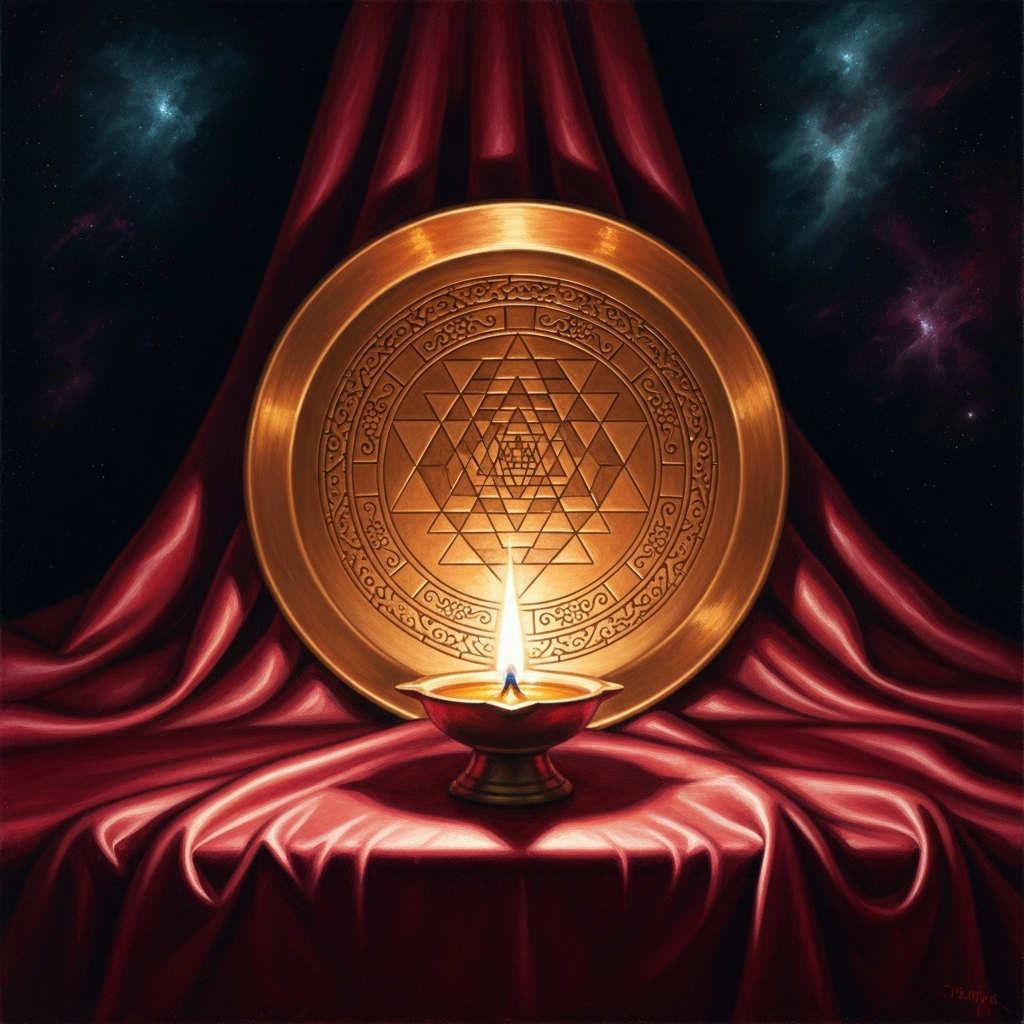
He lights the ghee lamp. The flame catches and doubles in the polished surface of the copper plate. He sits.
The Sri Yantra is in front of him.
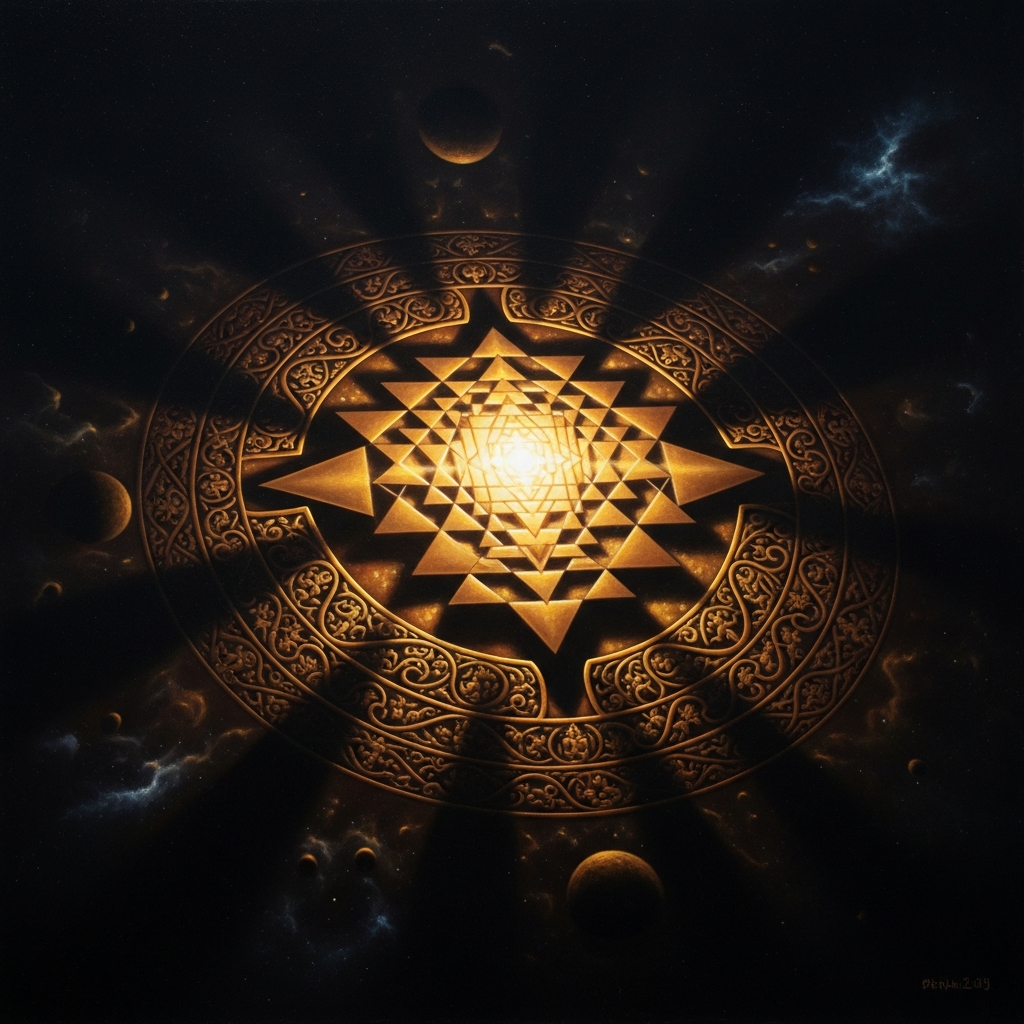
The diagram is not complicated in the way of complexity; it is complicated in the way of exactness. Nine triangles interlock to form forty-three smaller triangles, surrounded by two rings of lotus petals — eight petals in the inner ring, sixteen in the outer — surrounded by three concentric squares with openings at each of the cardinal directions. At the center of everything, at the intersection of all nine triangles, is a single point.
The point is called the bindu.
The system of Shri Vidya begins with the claim that the Sri Yantra is not a symbol of the goddess Tripura Sundari — the Beautiful One of the Three Cities, the crimson goddess who is the totality of beauty and the totality of the cosmos and who is sixteen years old in the eternal way of things that have never been anything other than themselves. It is not a symbol. It is her body. The diagram and the goddess are identical. To meditate on the diagram is to encounter the goddess directly, not through representation but through her actual form, which happens to be mathematical.
This is a specific theological claim with specific philosophical implications, and the practitioner in Thrissur has been working through those implications for eleven years, and tonight he is going somewhere with it that he has not gone before.
The nine triangles are not arbitrary. Four triangles point upward, which in the system’s grammar means they are Shiva-triangles — they represent consciousness as it moves from the particular back toward the undifferentiated absolute, the direction of liberation and abstraction and the return of the wave to the ocean. Five triangles point downward, which means they are Shakti-triangles — consciousness as it moves from the undifferentiated absolute into the particular, the direction of creation and embodiment and the ocean’s becoming waves.
The universe, in this description, is the intersection of these two movements. Not a place where things happen. Not a container. An event — ongoing, dynamic, the product of the continuous interpenetration of Shiva’s upward pull and Shakti’s downward outpouring. The forty-three smaller triangles created by the nine triangles’ interlocking represent the specific modes of this intersection: aspects of existence, from the grossest material facts to the subtlest energies of awareness, each a specific angle of the same meeting.
You cannot draw the Sri Yantra from the outside in. If you begin with the outermost square and work toward the center, you will hit contradictions where the triangles refuse to close cleanly. The diagram can only be generated simultaneously from center and edge, the bindu and the outermost square coming into existence together and the triangles filling in between them. This is not a drafting problem. The Shri Vidya teachers say it is a description of how the cosmos works: center and periphery, absolute and particular, consciousness and matter, co-arising, mutually defining.
The man in Thrissur has drawn it hundreds of times. His hands know it before his mind engages.
Tripura Sundari sits at the center.
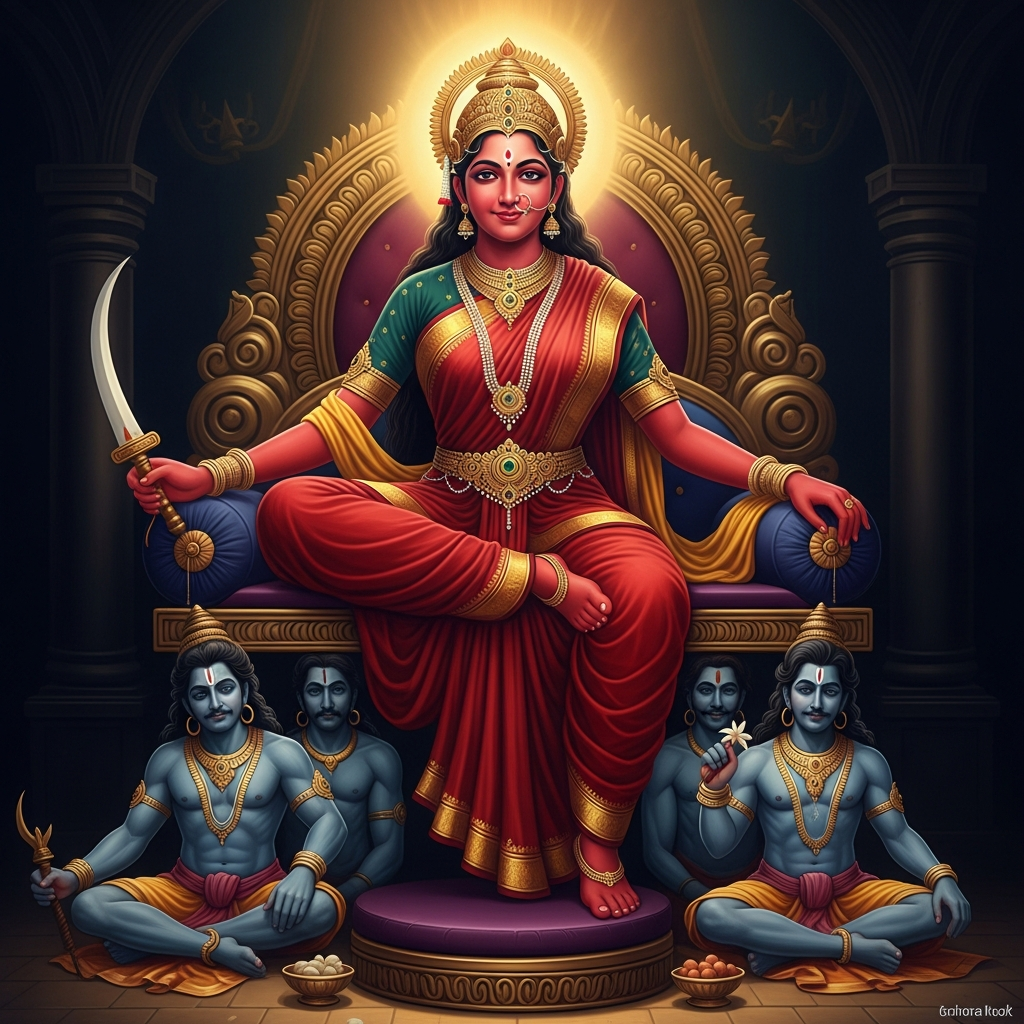
The texts describe her throne as the bodies of five gods — Brahma, Vishnu, Rudra, Ishvara, and Sadashiva — lying face-down, their backs forming the platform, their absolute submission to her constituting her seat. She sits cross-legged in lotus posture on this throne of prostrate gods with the ease of someone for whom all this has been arranged and for whom it is simply correct. She is sixteen, which in the system means she is in the condition of fullness — shodashi, the sixteen-digit moon, the moon that is at its most complete — and she is crimson, which is the color of the rising sun and of desire and of blood and of the internal fire of yogic practice.
She holds four objects in her four hands: a noose, a goad, a bow of sugar cane, and five flower arrows. The noose binds. The goad drives. The bow shoots. The arrows are sweetness, which is the most unexpected of her weapons and the most devastating. She binds her devotees to herself with desire — not for liberation as an abstraction, not for release from the suffering of existence, but for the goddess herself, for the encounter with consciousness in its fully expanded state, which is beautiful in the way that everything is beautiful when it is seen clearly.
She smiles with the smile of someone who has nothing to withhold.
The practitioner brings his attention to the outermost square and begins the inward journey.
The Shri Vidya system’s meditation technique is a structured dissolution — beginning with the grossest level of experience, the physical world, and moving inward through progressively subtler levels, each corresponding to a ring or triangle of the diagram, until the attention arrives at the bindu. This is not a journey through space. It is a journey through increasingly refined states of awareness, each one revealing what the previous level was made of. The physical world is made of the senses. The senses are made of the mind. The mind is made of consciousness. Consciousness is made of — what?
At the bindu, the diagram offers a point.
Not a small area. Not a region. A point in the mathematical sense: dimensionless, without extension, the limit approached as size goes to zero. In the system, the bindu is where the Shakti-triangles and the Shiva-triangles both originate — the place before the movement downward into creation and the movement upward toward liberation have yet begun. Before the nine becomes forty-three. Before the wave differentiates from the ocean.
He has been here before in practice, briefly. Tonight he stays.
What the bindu contains is the question.
The system says the bindu is the goddess in her most concentrated form — Tripura Sundari before she expands into the nine triangles, before she deploys her four weapons, before she sits on her throne of gods. She is, at the bindu, the awareness that is about to become the universe. Pure potential. Pure attention. The consciousness that, when it moves, becomes everything.
He is the practitioner, sitting before the diagram, looking at the bindu.
He is also — this is what the system is saying, what eleven years of preparation has been building toward — the awareness looking at itself. The bindu is not in front of him. The bindu is what is seeing the diagram. The cosmos is not a diagram that consciousness observes from outside. The diagram is consciousness observing itself: the universe is the shape that awareness takes when it turns its attention on its own nature.
Tripura Sundari, the Beautiful Goddess of the Three Cities, is the awareness that is aware of being aware.
He sits until the lamp goes out.
The Sri Yantra presents a problem that no purely abstract philosophical argument can present in the same way: it is there. You can hold it in your hands. The copper plate is cold, then warm from proximity to the lamp. The geometry is exact, reproducible, subject to mathematical analysis. Its failure to draw from outside in is not mystical; it is geometric; it can be verified by anyone with a ruler and compass and patience.
What cannot be verified, but what the system insists on, is that this diagram is identical with the one who is looking at it. The universe is not a puzzle to be solved but the activity of the solving — the nine triangles not a picture of consciousness but what consciousness does when it encounters itself.
Tripura Sundari sits at the center and smiles. She has been smiling since before the diagram was drawn, and she will be smiling after the copper plate corrodes and the lamp oil is gone and the room in Thrissur is empty.
She is what the room is made of.
Scenes
A copper plate engraved with the Sri Yantra sits on a silk cloth before a single ghee lamp
 Generating art…
 The goddess Tripura Sundari sits on her throne supported by Brahma, Vishnu, Rudra, and Indra — the four gods as her furniture, her footstool, her couch
 Generating art…
 The Sri Yantra's nine triangles expand outward from the central point to fill the frame — the downward-pointing triangles of Shakti (consciousness descending into matter) interlocking with the upward-pointing triangles of Shiva (matter ascending back toward consciousness), forty-three smaller triangles created by their intersection, the whole figure pulsing with the implication of generation
 Generating art…
 Echoes Across Traditions
Entities
- Tripura Sundari
- Lalita
- Sri Yantra
- The Bindu
- Shakti
Sources
- Douglas Renfrew Brooks, *The Secret of the Three Cities: An Introduction to Hindu Shakta Tantrism* (University of Chicago Press, 1990)
- David Kinsley, *Tantric Visions of the Divine Feminine: The Ten Mahavidyas* (University of California Press, 1997)
- Madhu Khanna, *Yantra: The Tantric Symbol of Cosmic Unity* (Thames and Hudson, 1979)
- Sir John Woodroffe (Arthur Avalon), *The Serpent Power* (Ganesh and Co., 1918)
- Ajit Mookerjee and Madhu Khanna, *The Tantric Way: Art, Science, Ritual* (Thames and Hudson, 1977)