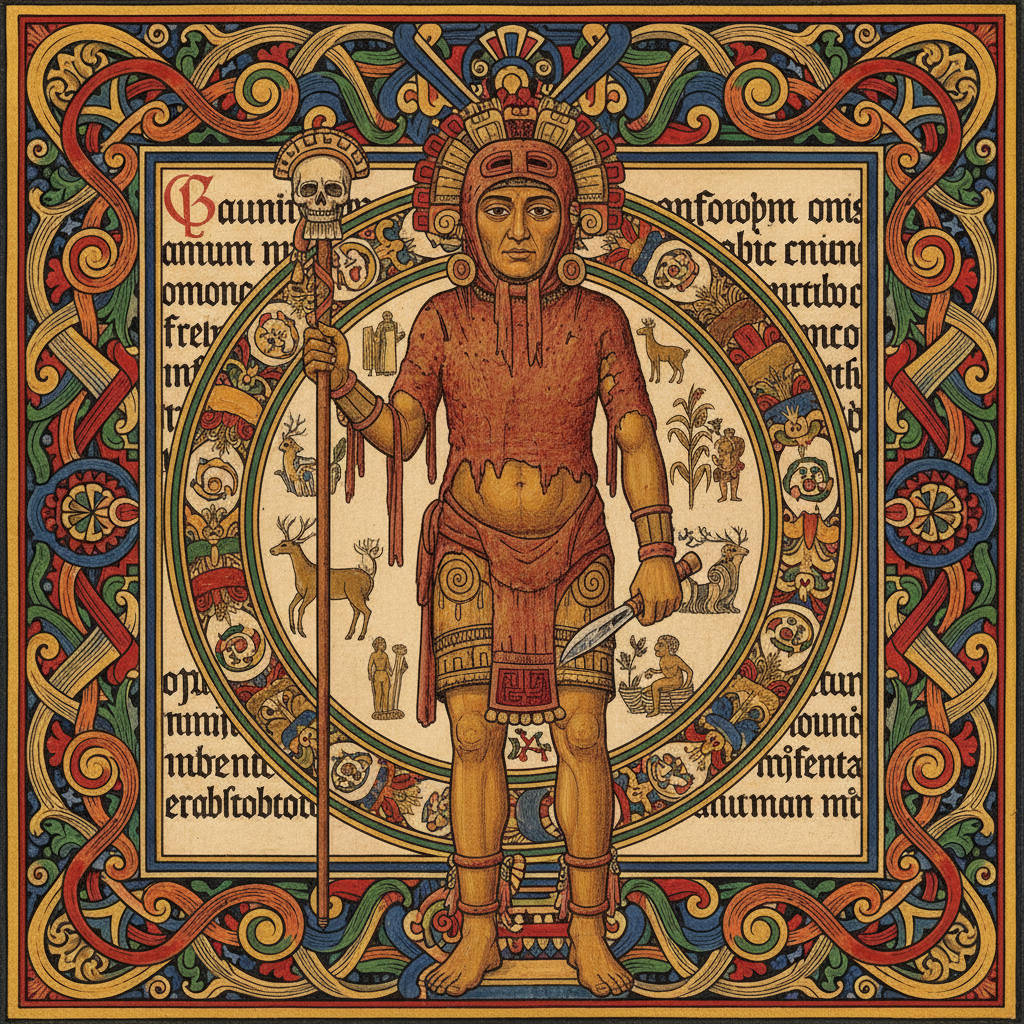
Xipe Totec and the Wearing of Skins
Annual — the festival of Tlacaxipehualiztli, second twenty-day period of the Aztec solar calendar · *Florentine Codex* Book 2, ~1580 CE · Tenochtitlan — the Yopico, Xipe Totec's temple precinct
Contents
Our Lord the Flayed One is the god of seasonal renewal, and his festival requires that priests wear the skins of sacrificial victims for twenty days as they rot away. An old priest assigned to this duty for the first time understands, from the inside, what the festival has always been saying about seeds, death, and what must be shed before anything new can grow.
- When
- Annual — the festival of Tlacaxipehualiztli, second twenty-day period of the Aztec solar calendar · *Florentine Codex* Book 2, ~1580 CE
- Where
- Tenochtitlan — the Yopico, Xipe Totec's temple precinct
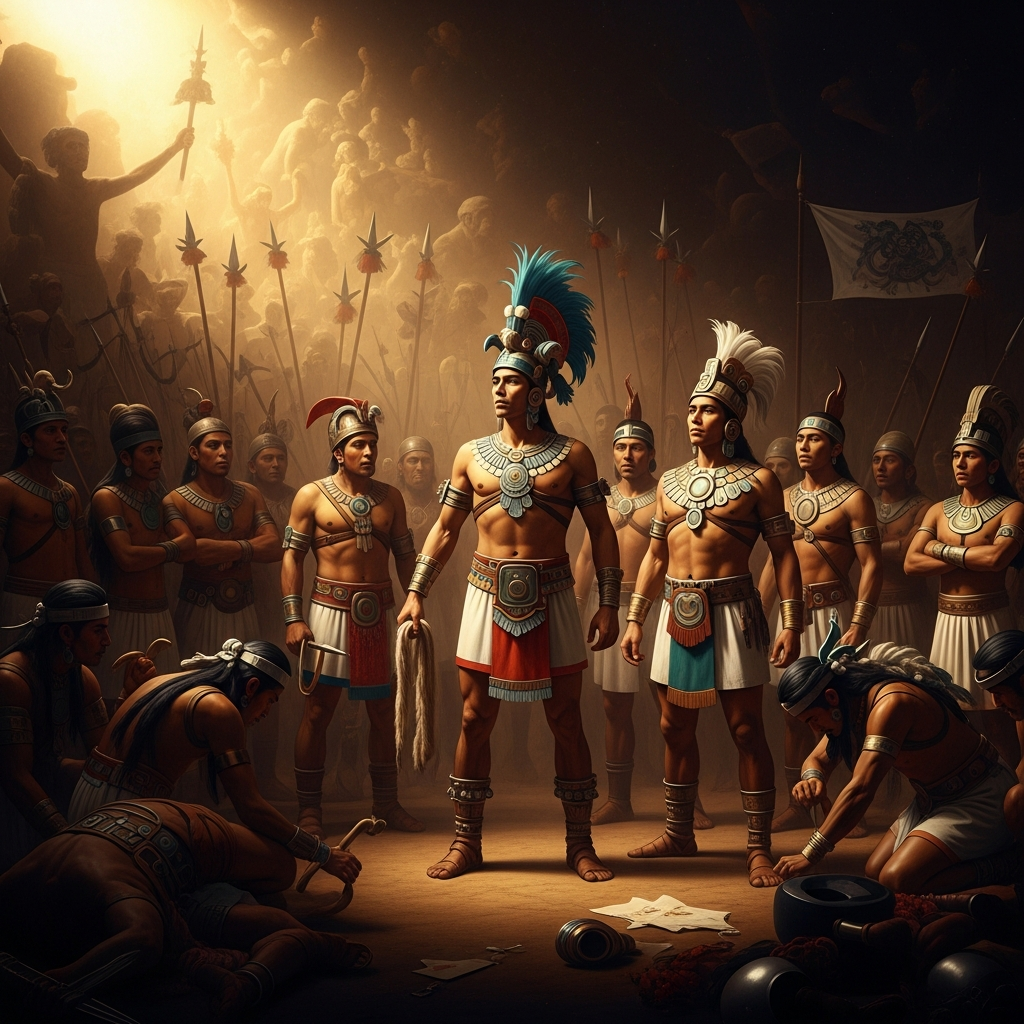
The festival of Tlacaxipehualiztli — the Flaying of Men — occupies the second twenty-day period of the Aztec solar calendar, the stretch from late February into March, the season when the rains have not yet come and the dry earth is at its most extreme and the farmers are waiting for the signal that the cycle has turned. The theologians who designed this festival, across the centuries of its development, placed it in this position deliberately. The festival of the Flayed One belongs to the driest moment of the year because the Flayed One’s theology is a theology of what happens just before the rains come: the husk falls off, the skin is shed, and underneath it the new green thing is already growing.
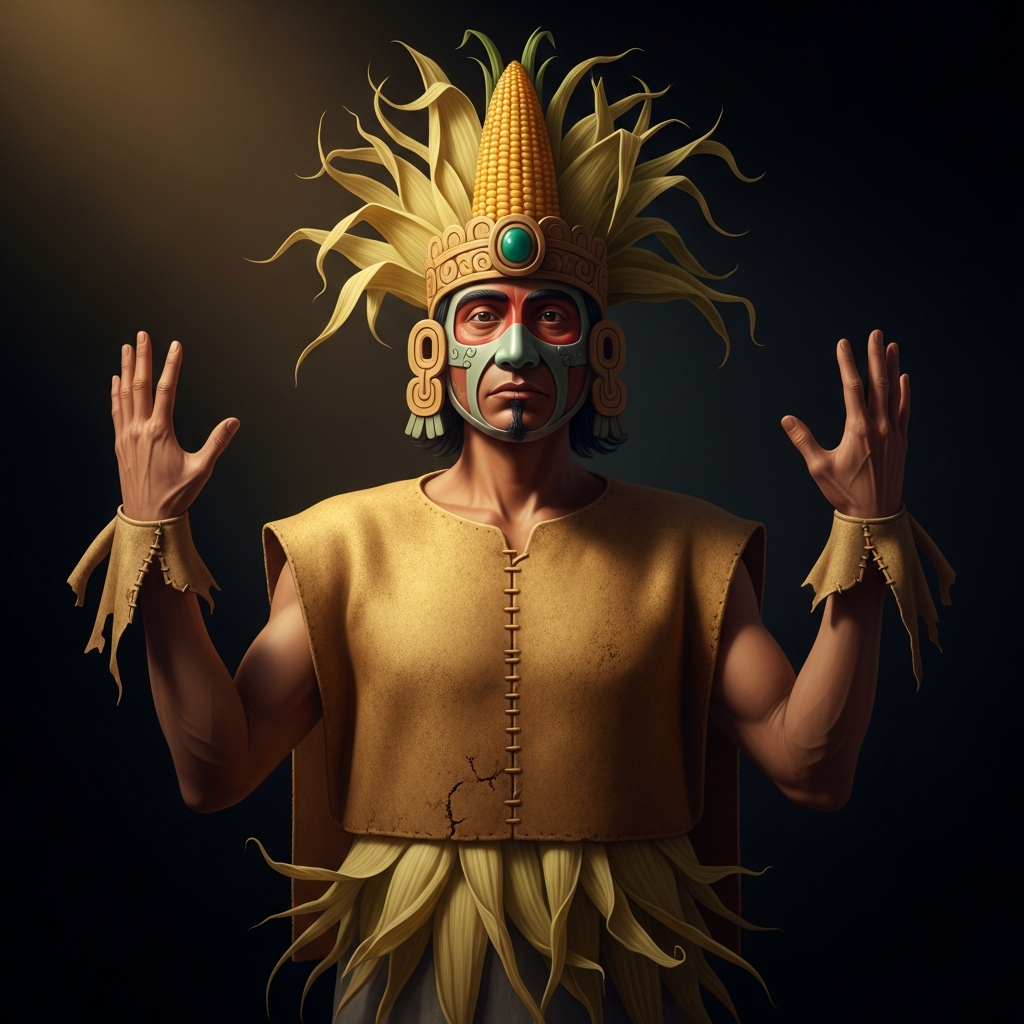
Xipe Totec himself is depicted wearing human skin as a garment. This is not a metaphor. The statuary is explicit: the skin hangs loose at the hands like gloves worn inside-out, the face-skin is pulled over the god’s own face like a mask slightly too large for the features beneath it, the seam runs down the back where the flaying began. The skin is called tlatoc — the golden robe — because twenty days in the sun turns it yellow-gold, the color of dried corn husks, the color of the husk that must crack and separate before the seedling can push through. You can see the logic when you hold it in your hands: the dry outer coat of the corn seed is dead material wrapped around a living germ. The germ cannot get out without the coat splitting. The coat splitting is not the seed’s failure. It is the seed’s mechanism.
An old priest stands in the courtyard of the Yopico.
He has served the god for thirty years. He has participated in the festival of Tlacaxipehualiztli every year since his initiation — he knows the schedule of gladiatorial sacrifice in the second week, knows the sequence of the flaying, knows the prayers that accompany the process of skin-assignment to the priests who will wear them. He knows the ritual names for each of the skins — they are called xipeme, the flayed ones — and he knows the prayers that turn a human skin into a divine garment. He knows everything about this festival except one thing: he has never been assigned to wear the skin. He has watched the other priests put them on. He has never been the one.
This year the senior priest looks at the roster and assigns him to wear it.
There is no explanation. There does not need to be one. He is assigned. He goes to the flaying room where the skins have been prepared — stretched on frames in the sun during the preparation days, then removed from the frames and given back their suppleness by the preparers — and he puts on the skin of a man who died in gladiatorial sacrifice three days ago.
It does not fit the way clothing fits.
He had watched the other priests put on the skins for thirty years and he knew, intellectually, how this worked: the feet of the skin still have their toes, and you slide your feet into the skin-feet the way you put on sandals that are too large. The hands of the skin still have their fingers, and your hands go into the skin-hands the same way. The face goes over your face and you see through the eye holes, and there are lacing cords at the back of the neck to close what the flaying opened. He knew all of this. He did not know what it would feel like.
What it feels like is weight. Not the weight of the skin’s mass — the skin itself is light, lighter than he expected — but the weight of what has happened to it, the specific gravity of material that was recently alive and is no longer alive and now fits itself around his living body. The skin is cool against his back and arms. It smells of the preparations the attendants used — copal, and the herbs that slow decomposition. Underneath those smells is something else.
He stands in the courtyard of the Yopico wearing the golden robe and the festival begins.
Twenty days.
The Florentine Codex describes the priests who wear the skins — the tototectin — moving through the city during the festival period, begging at doorways, receiving offerings from householders who place food and gifts in the outstretched skin-hands. The priests are not hidden away. They are visible, moving through Tenochtitlan in the golden robes as the festival proceeds and the days pass and the skin does what skins do when the warm season approaches and the decomposition process is not halted by cold. It changes. It becomes something different from what it was at the beginning.
He is inside this process. He wears the skin through the second week and the third week and into the fourth, and he begins to understand something about the festival that thirty years of watching could not have told him: the priest wearing the skin does not perform the theology. The priest wearing the skin is the theology. He is the corn seed in its husk. He is the living germ inside the dead coat. Every day the skin changes around him and underneath it he remains himself — the old priest, the man who has served the god for thirty years — and the changing skin is the point, the festival’s entire argument made material and worn on a body and walked through the streets for twenty days so that everyone can see what it means.
On the twentieth day the skin is removed.
The Florentine Codex describes the ceremony of the removal: the lacing cords at the back are cut, the face-skin is peeled back from the priest’s face, the golden robe is taken off the hands and feet and back and torso, and it is carried in procession to the cave beneath the Yopico temple and placed there with the skins of previous festivals, the accumulation of twenty-day-robes going back as far as the festival’s memory reaches. The priest stands in the sunlight without the skin. He is the same man he was twenty days ago. The skin is something else now.
He stands in the courtyard of the Yopico with his face in the sunlight and the warmth on his arms and he understands what he has been wearing.
He has been wearing what had to die so that the living thing inside could emerge into spring. He has been the husk. He has been the outer coat of the seed that must crack and separate and become the ground’s material again so that what was inside it can get out and grow. He has worn the death of the previous season wrapped around the life of the current one, and now the previous season has been carried into the cave, and he stands in the yard in his own skin, and the rains are coming — the clouds are forming on the mountains to the south — and Xipe Totec has done what he always does: accepted the dead coat and returned the living thing.
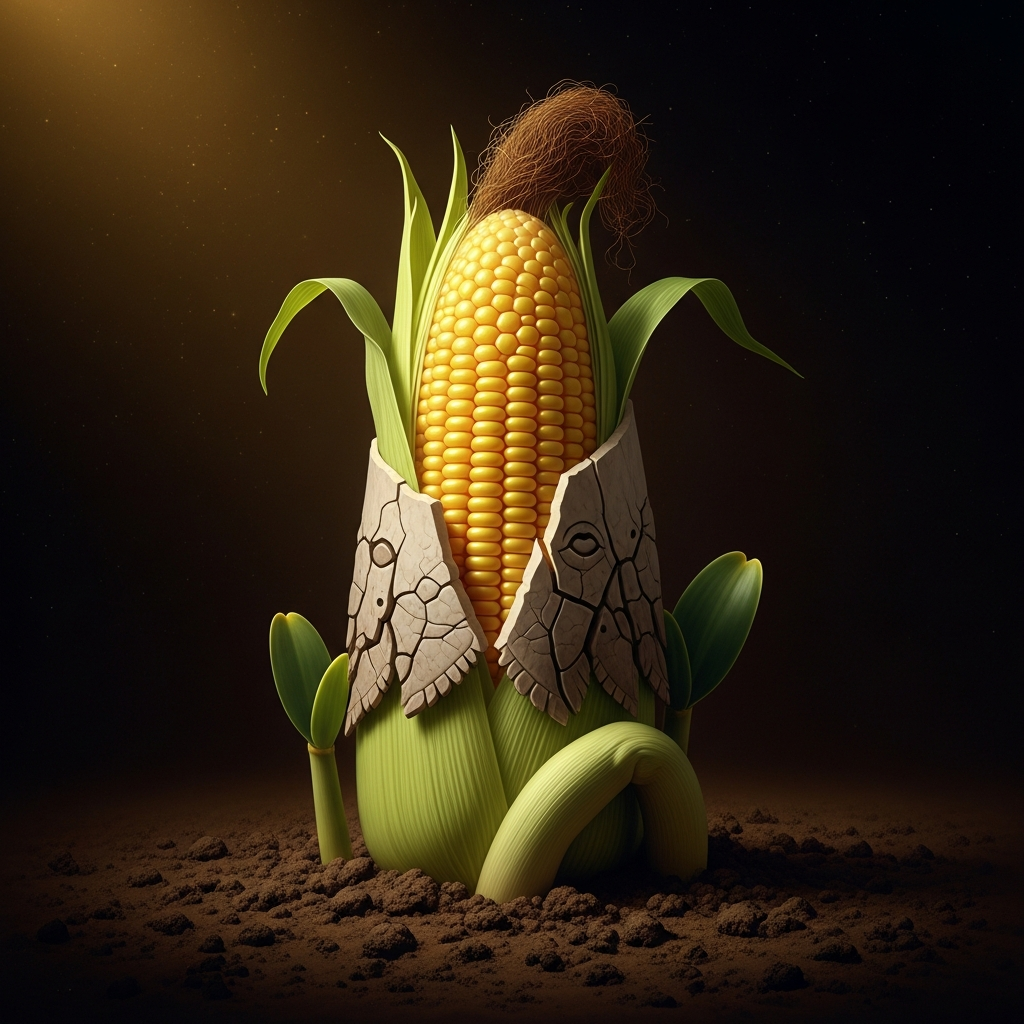
The first rains of the season fall on the planting fields outside Tenochtitlan and soak into the soil where the corn seeds lie waiting, each one wrapped in its dry husk, and in each husk the germ begins to stir in the wet warmth, and the husk cracks open the way it was always going to, and the pale shoot pushes through the crack into the dark soil and turns, as all shoots turn, toward the light.
Scenes
Xipe Totec is depicted wearing human skin as a garment — the loose flaps at the hands, the seam at the back, the face worn like a mask over the god's own face beneath
 Generating art…
 The festival of Tlacaxipehualiztli — the Flaying of Men — fills the second twenty-day period of the Aztec year
 Generating art…
 The corn seed cracks its outer coat and the pale shoot emerges into soil
 Generating art…
 Echoes Across Traditions
Entities

Sources
- *Florentine Codex*, Book 2 — Bernardino de Sahagún (~1580)
- Diego Durán, *Book of the Gods and Rites and the Ancient Calendar* (~1579)
- *Historia de los Mexicanos por sus pinturas* (c. 1535)
- Henry B. Nicholson, 'The Cult of Xipe Totec in Mesoamerica,' in *Religion en Mesoamerica* (1972)
- Richard Townsend, *The Aztecs* (1992)
- Cecelia Klein, 'The Identity of the Central Deity on the Aztec Calendar Stone,' *Art Bulletin* 58 (1976)