Confucius Teaches the Way
~497–479 BCE · Confucius's wandering years and return to Lu · The states of Wei, Chen, Cai, and Lu — the heart of the Central Plains
Contents
In his sixties, Confucius wanders thirteen years through the warring states, seeking one ruler willing to govern with virtue. None will listen. He returns to Lu and teaches instead — and each student gets a different answer, because the truth is fitted to the ear that hears it.
- When
- ~497–479 BCE · Confucius's wandering years and return to Lu
- Where
- The states of Wei, Chen, Cai, and Lu — the heart of the Central Plains
He is sixty-three years old and he has run out of kingdoms.
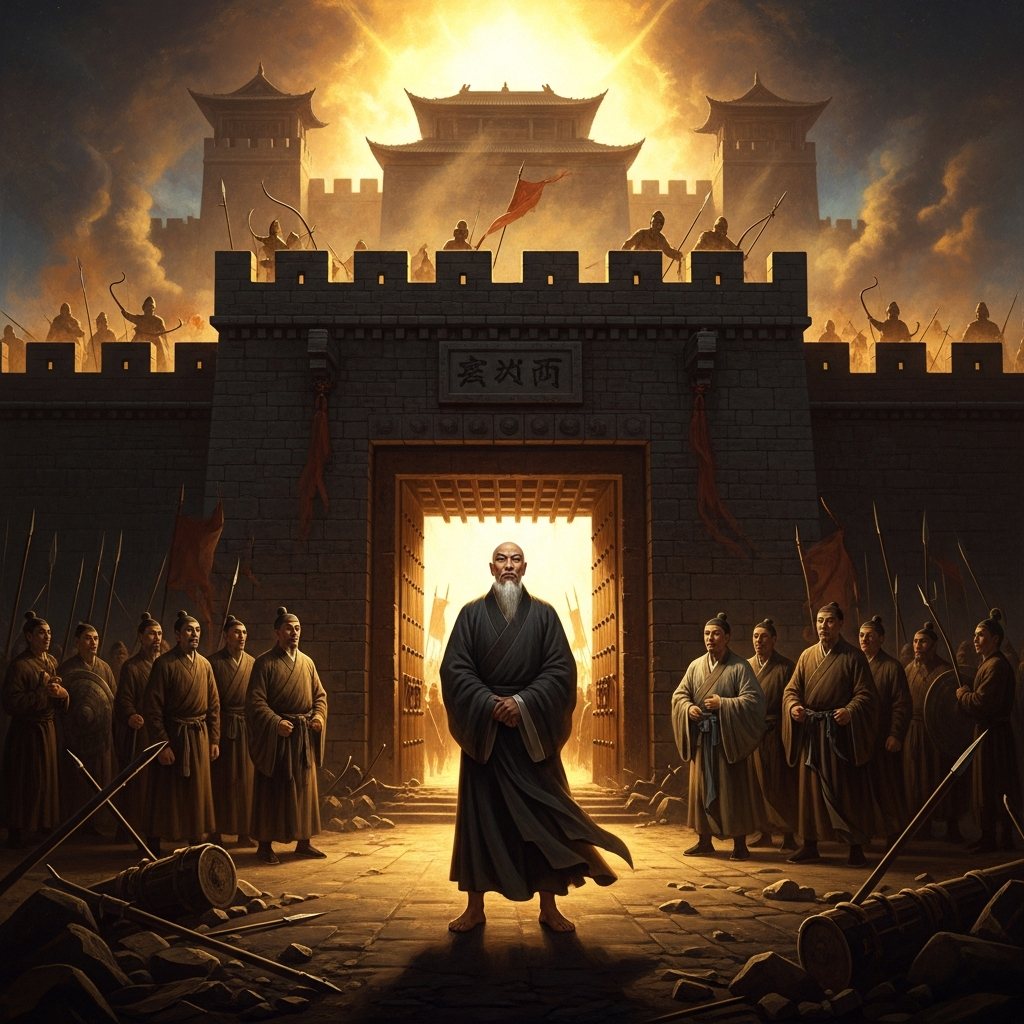
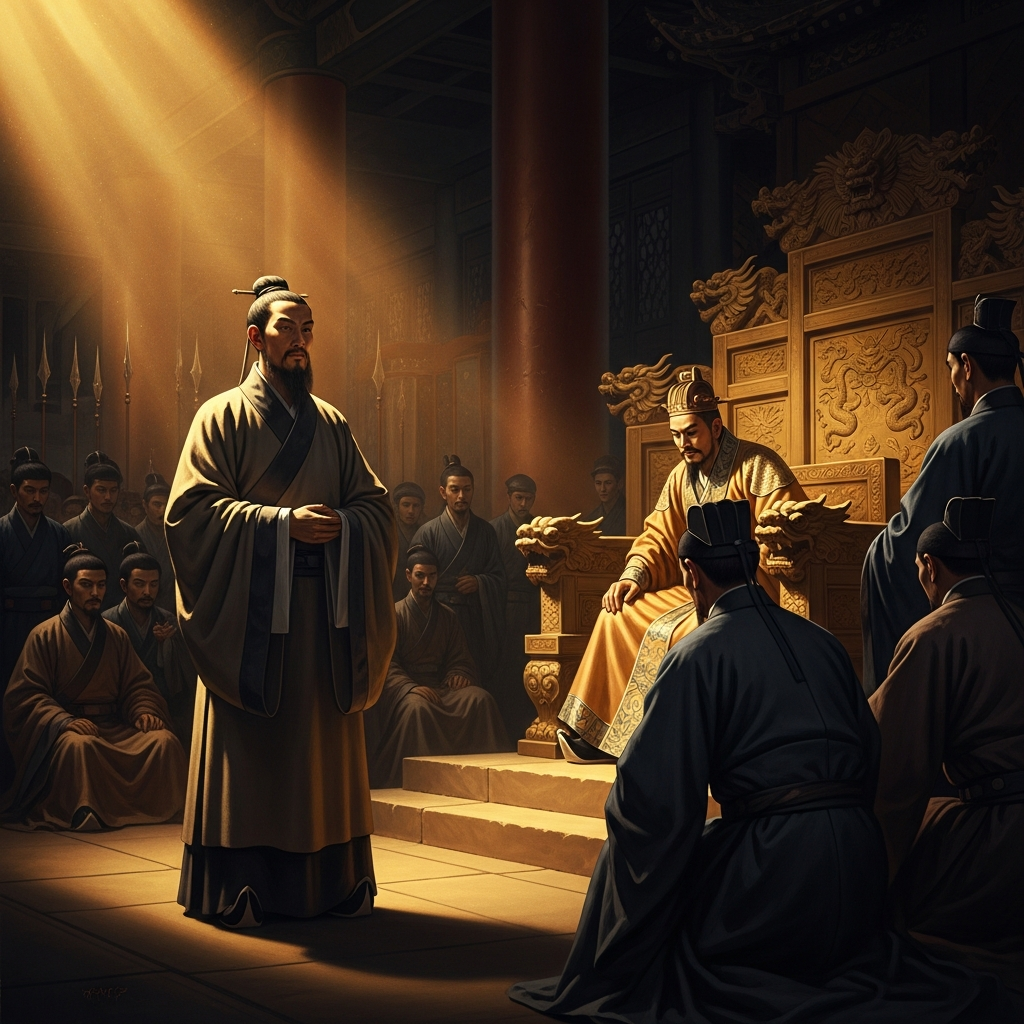
Wei will not have him. Chen fed him and dismissed him. Cai surrounded his party in the countryside for days, cutting off food, and he spent those days playing his lute and teaching, because what else would he do. His disciples grew haggard. He did not. He has the disconcerting quality of a man whose inner order is so complete that external disorder cannot reach it — not indifference, because he cares ferociously about the chaos of the warring states, but something rarer: the ability to maintain form under pressure the way bronze holds its shape under heat. Now the roads of the Central Plains are familiar as the back of his hand and he has nowhere left to carry his argument.
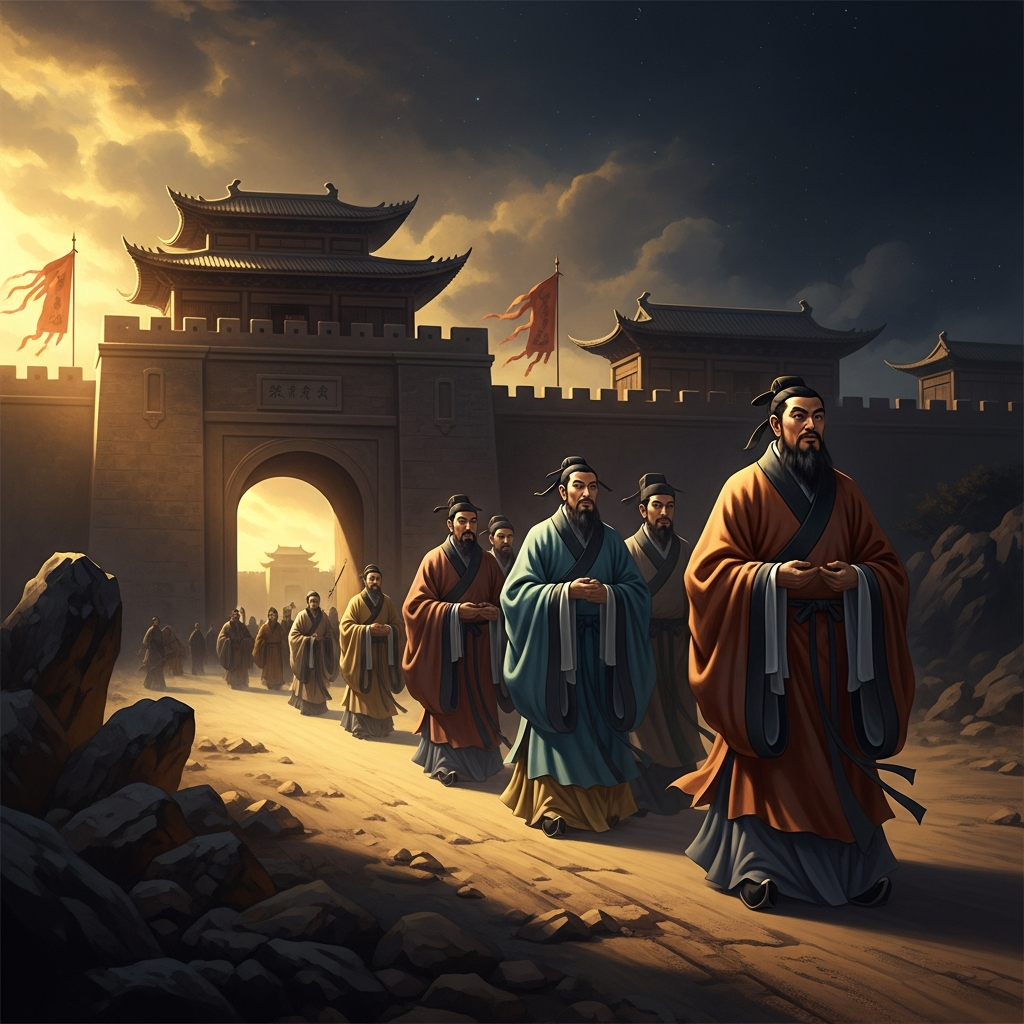
He turns east. He goes home to Lu.
He arrives with seventy disciples who have walked with him, some for a decade, and a conviction that the road was not wasted even though it produced nothing.
He is wrong that he failed and right that the road was not wasted, but he will not live long enough to see how. What he does know: the men around him are different from the men who left. Zilu is still impetuous and loyal, still the kind of man who would rather be wrong loudly than right quietly, but his loyalty has been tested on roads where loyalty had a cost and it did not flinch. Zigong has learned to hold a silence that turns a conversation around without speaking. Yan Hui — the one student Confucius calls genuinely good — has become in his poverty and contentment something luminous, a proof-of-concept for the argument that virtue does not require wealth or rank or the approval of courts. They are the argument now, walking beside him into Lu.
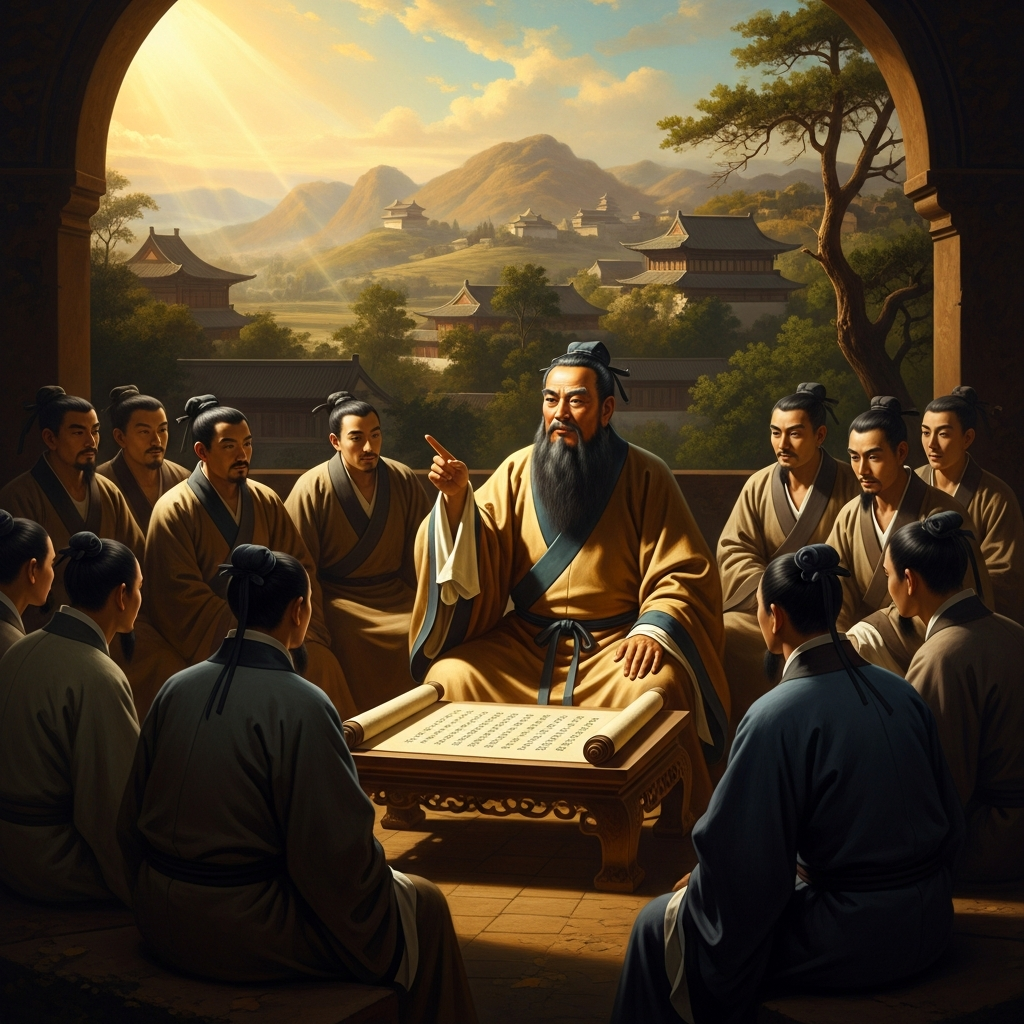
He does not preach. He answers.
Yan Hui asks what benevolence requires.
Confucius answers: Subdue the self and return to the rites. One day of subduing the self and returning to the rites, and all under heaven will call you benevolent. Benevolence comes from within — not from others.
Zhonggong asks the same question the following week.
Confucius answers differently: In public, behave as if receiving an important guest. Set the people to work as if performing a great sacrifice. Do not do to others what you would not want done to yourself.
Sima Niu — anxious, talkative, a man who fills silence because silence frightens him — asks a third time.
Confucius answers: The benevolent person speaks only with difficulty.
Sima Niu blinks. He had expected something grander. Confucius watches him absorb the instruction and says nothing more. The quiet is the lesson.
Zilu asks about government.
Lead by example. Work tirelessly, Confucius says.
Zilu presses for more. Confucius adds only: Without weariness.
Fan Chi, ambitious and practical, asks about the same question a month later. Confucius answers at length — the proper appointment of ministers, the priority of agriculture, the importance of the people’s trust. He notices Fan Chi’s eyes darken with the calculation of a man who is already working out how to apply the answer. He stops talking. The answer for Zilu was a principle; Fan Chi needed a structure. Both are true. Neither is complete. The truth lives in the conversation, not in the formula.
Zigong asks, years later, if there is a single word that can serve as a guide for one’s entire life.
Reciprocity, Confucius says. Do not do to others what you would not want done to yourself. He has said versions of this before and will say it again. It is not a cliche. It is a depth he has not reached the bottom of, and he suspects it has no bottom.
Yan Hui dies at thirty-two.
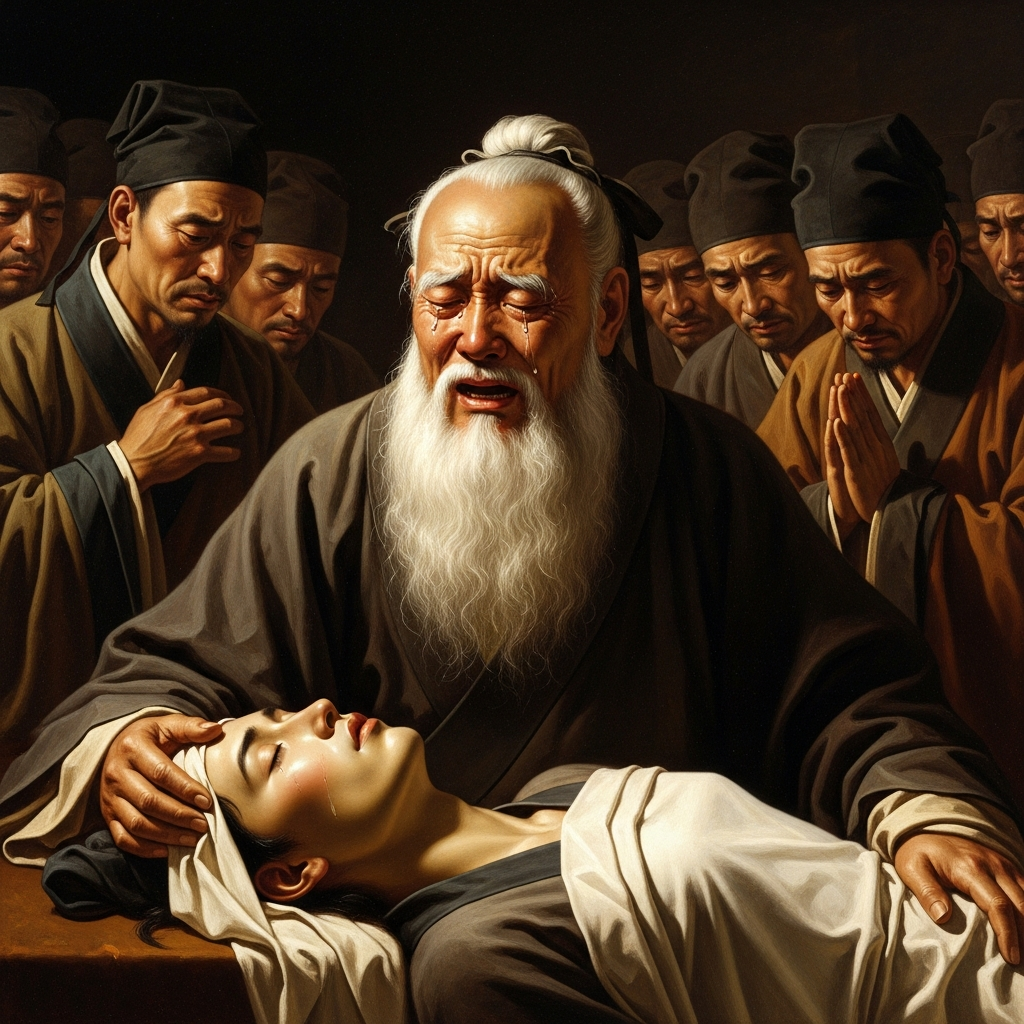
Confucius weeps without control, loud enough to alarm the students standing nearby. One of them says: Master, you are grieving too much. He turns and says: Am I grieving too much? If not for him, for whom should I weep? He does not modulate it. He does not perform composure. The man who has spent his life teaching the correct forms of mourning mourns without any form at all, because Yan Hui was the proof — the one student in whom Confucius saw the project fully realized, virtue flowering in a back lane with nothing to sustain it but itself. Now the proof is gone.
He asks Heaven why. Heaven does not answer. He goes back to teaching.
Someone asks about death.
He says: You do not yet know life. How can you know death?
This is not evasion. He has thought about death as seriously as any man alive — he has catalogued the ancestor rites in more detail than most priests, worked out the correct mourning periods, the proper grades of grief-expression for each degree of kinship. He knows exactly what tradition says happens after. He says it anyway: you do not know life yet. Go back. Look at the living. The dead will wait.
He dies in 479 BCE, in Lu, in the seventy-third year of his life. He has never governed. He has never achieved the thing he set out to achieve. His disciples sit with his body and then scatter to every state in the Central Plains, carrying his words in their heads, arguing about what he meant. The arguments will go on for a century before Mencius systematizes one answer; they will continue for two thousand years after that. The Analects — compiled from student notes, from memory, from the shape of his voice preserved in what the students wrote down — becomes the central text of Chinese civilization.
He did not fail. He succeeded in a form he would not have chosen and would not have recognized.
The man who tailored truth to every ear had no idea how many ears would one day need it.
Every answer in the Analects is addressed to someone specific — and the great challenge of the text is that the reader arrives two and a half millennia late, without knowing which ear the answer was designed for. Confucius understood this would happen. “Does Heaven speak?” he asked his students. “The four seasons pursue their courses and all things are produced. Does Heaven speak?” He spent his life insisting on precision. He chose, at the end, to leave behind a book of conversations, not a treatise — trusting that the conversation itself, in all its particularity and contradiction, would carry more truth than any system he could have built.
Scenes
Confucius addresses a circle of disciples beneath a pavilion — each face registers a different kind of listening
Generating art… A court official turns away the sage at the palace gate; Confucius stands in the rain, unhurried, certain he is right
 Generating art…
 Confucius weeps over the body of Yan Hui — the only student he called genuinely good — without restraint or apology
 Generating art…
 Echoes Across Traditions
Entities
- Confucius
- Yan Hui
- Zilu
- Zigong
- Fan Chi
Sources
- *Analects* 11.22 — Zilu and Ran Qiu ask the same question; Confucius gives opposite answers, explaining he pushes the reckless back and the timid forward
- *Analects* 12.1 — Yan Hui asks about benevolence; 12.2 — Zhonggong asks; 12.3 — Sima Niu asks; each answer is different
- *Analects* 11.9 — Confucius mourns Yan Hui: 'Heaven is destroying me'
- Sima Qian, *Records of the Grand Historian* (*Shiji*) 47 — biography of Confucius
- Annping Chin, *The Authentic Confucius: A Life of Thought and Politics* (Scribner, 2007)