Mozi and the Doctrine of Universal Love
~430 BCE · warring states period, China · The roads of the Central Plains — Lu, Chu, Qi, Song
Contents
The philosopher Mozi confronts the Confucian hierarchy of care — more love for family than strangers, more for countrymen than foreigners — and names it the root of all war, theft, and suffering. His remedy is *jian ai*: impartial, universal love. He walks barefoot across the Central Plains, stopping wars personally, arriving at besieged cities to offer his disciples as defenders of the weaker side.
- When
- ~430 BCE · warring states period, China
- Where
- The roads of the Central Plains — Lu, Chu, Qi, Song
He walks everywhere.
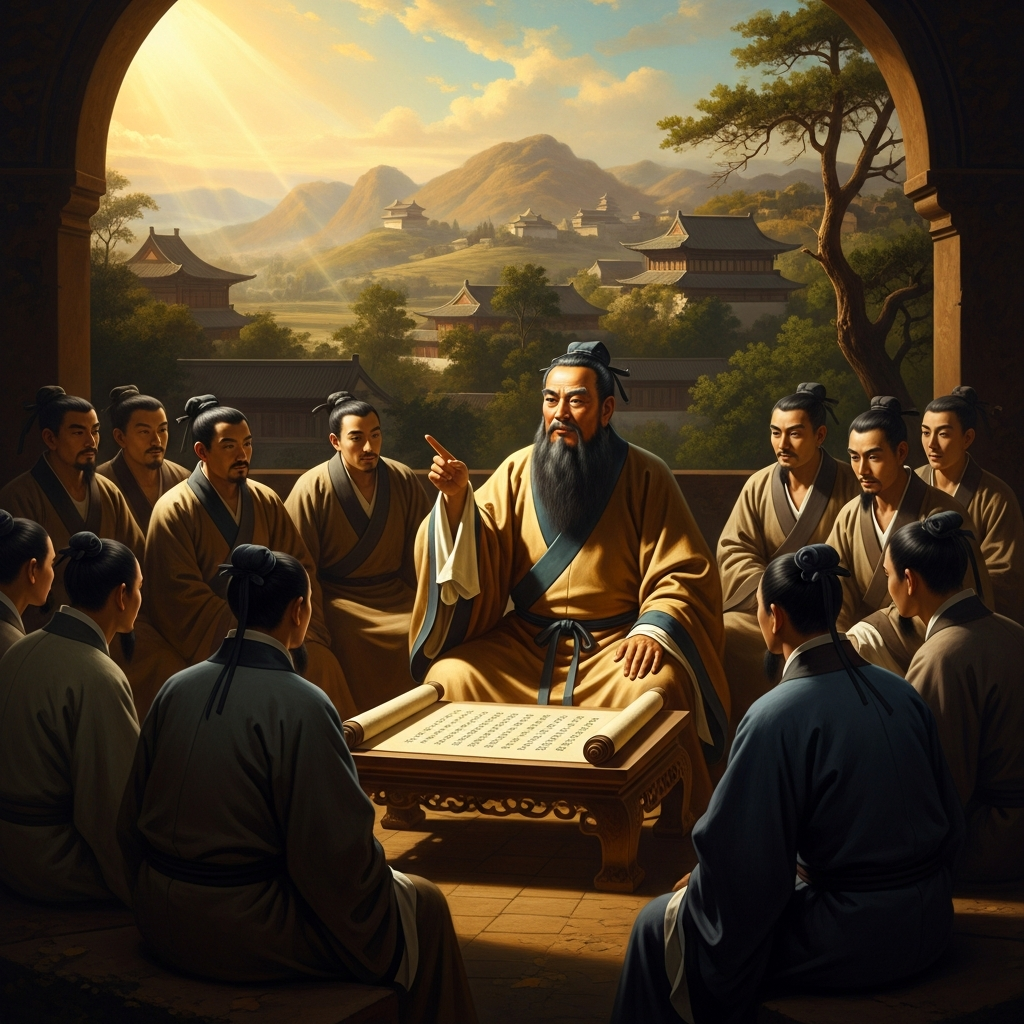
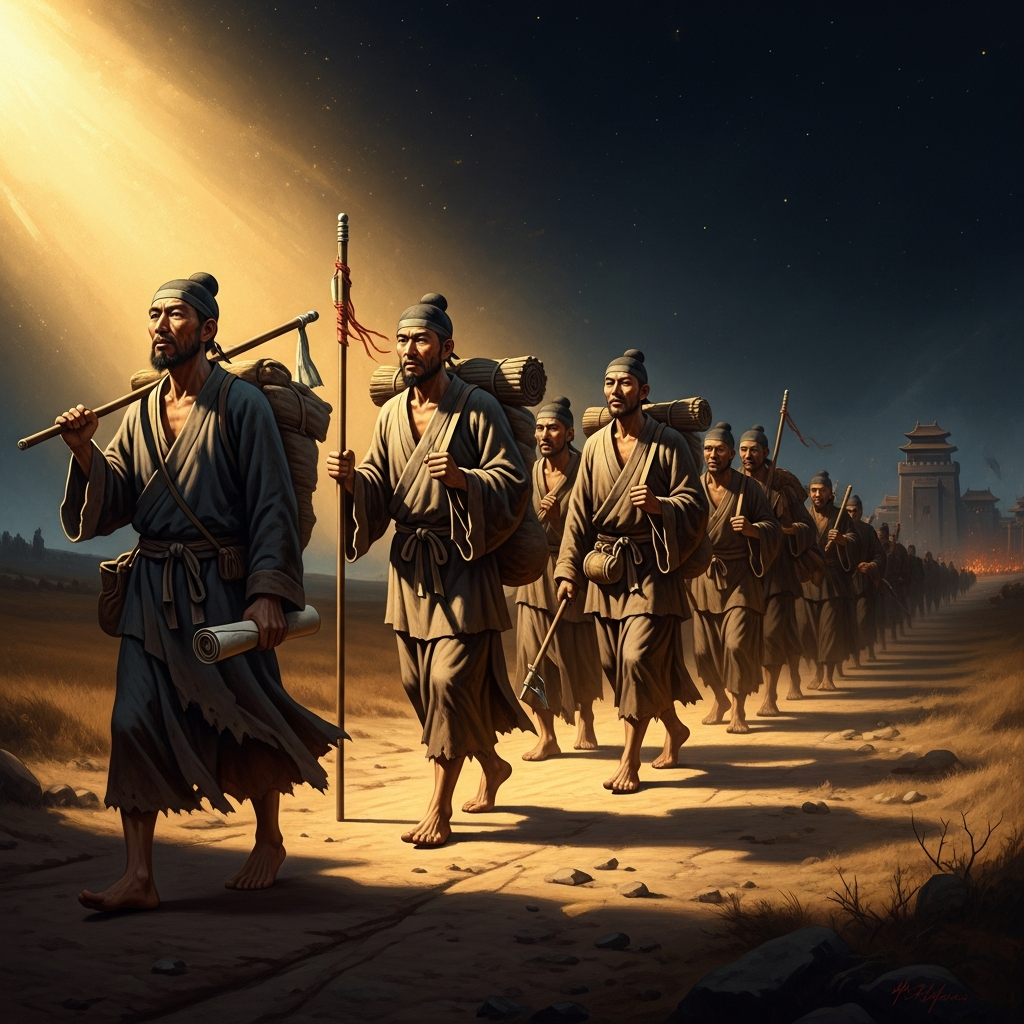
This is not a metaphor. The philosopher Mozi — Master Mo, whose school will rival Confucianism for influence across the warring states before vanishing almost completely after the Han unification — walks barefoot across the Central Plains of China, along roads that bandits use and refugees use and armies use, covering distances that horse-mounted messengers cover in days. He has disciples who do the same. They are recognizable: thin from voluntary austerity, callused from the road, dressed plainly because Mozi has argued in his books that ceremony and music and expensive mourning rituals divert resources from the poor, and he considers it a moral failure to preach what you do not live.
He is on his way to stop a war.
The war in question is this: Gongshu Ban, the master engineer, has built a new class of siege engine for the state of Chu. The King of Chu has decided to use it. The target is the state of Song — smaller, weaker, situated badly, unable to mount a serious defense against the new machines. The attack has not yet happened but it is scheduled, in the way that attacks are scheduled when one side has a new weapon and the other side has nothing new.
Mozi hears about this in Lu.
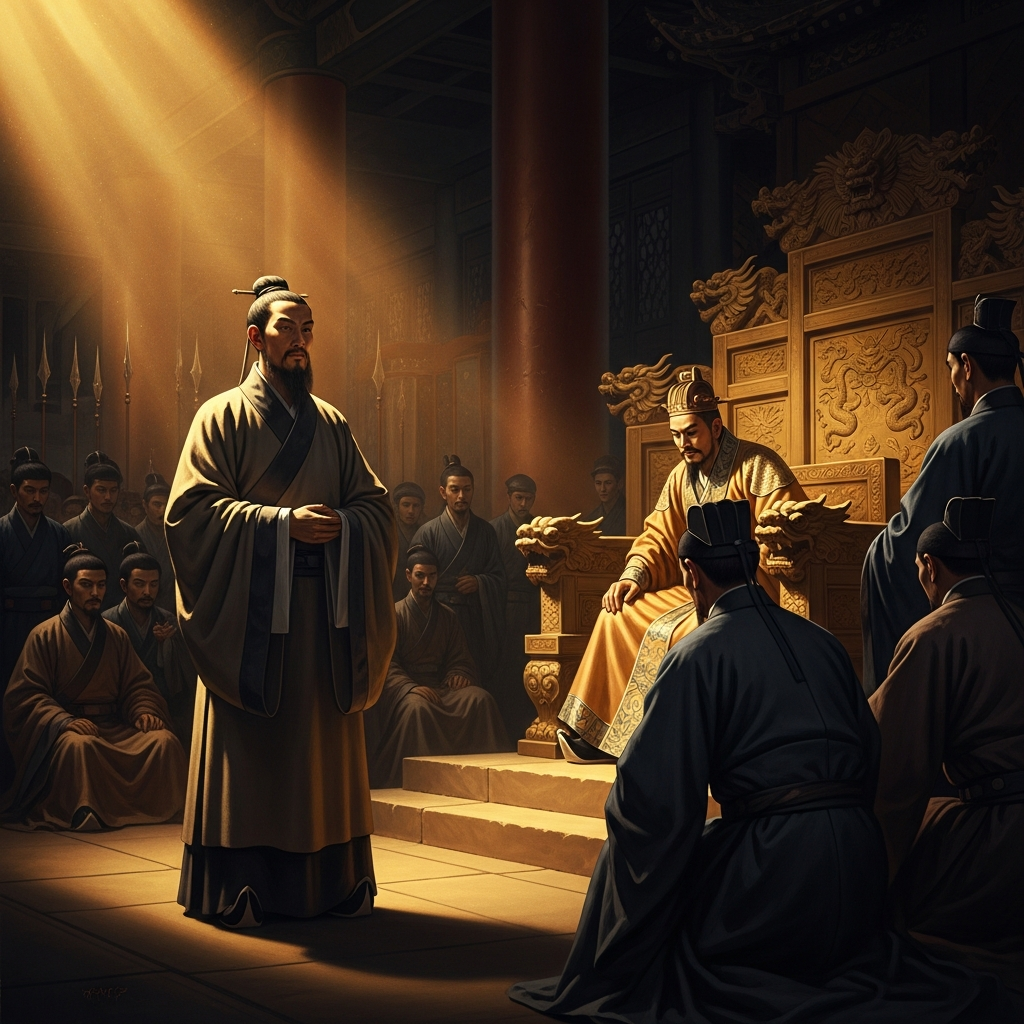
He walks ten days to reach Ying, the capital of Chu — ten days of road, sleeping in fields or under eaves, eating whatever his disciples can acquire. He arrives with the soles of his feet torn and bound in cloth. He is admitted to an audience with Gongshu Ban because he says he has something to show him.
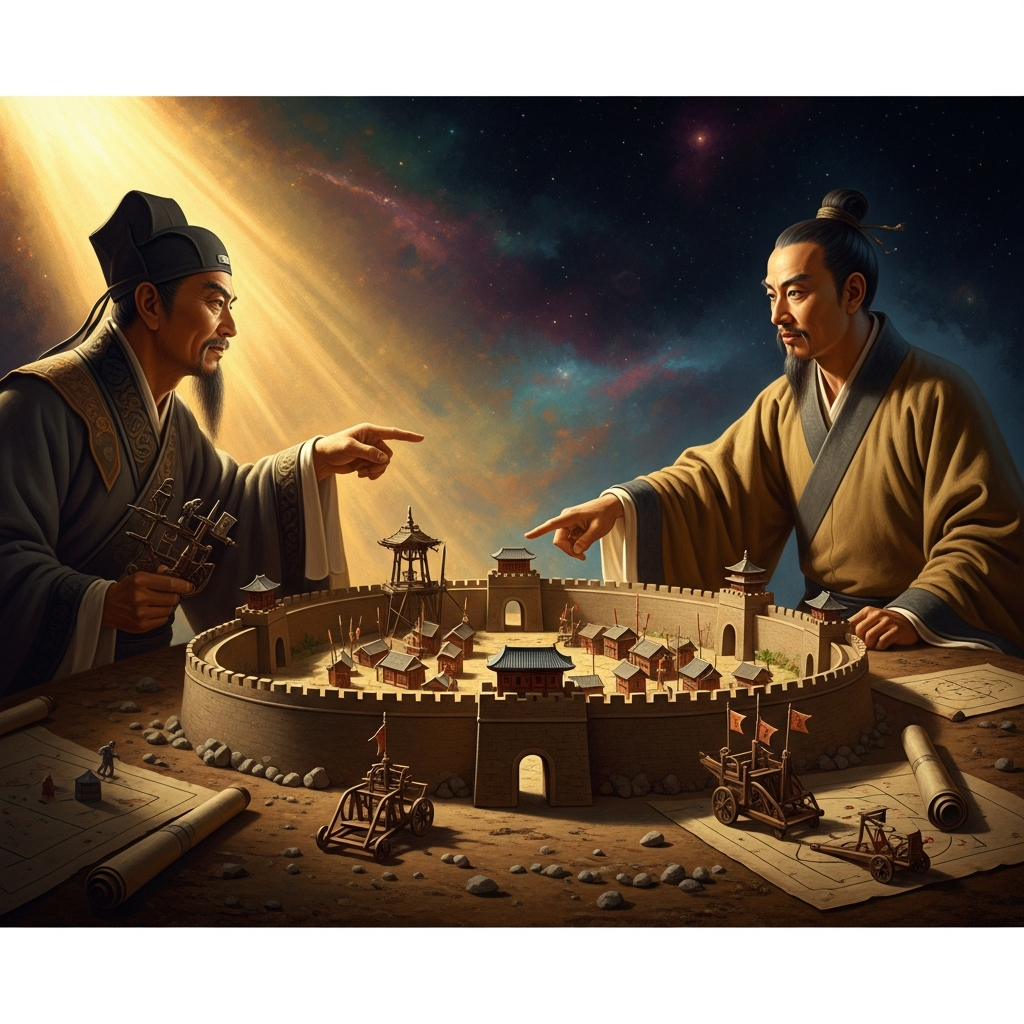
He removes his belt.
He places it on the floor to represent the walls of a city.
He puts small pieces of wood on the floor to represent siege engines and defensive equipment.
Now attack me, he says.
What follows is one of the strangest scenes in Chinese philosophical history: a war game, conducted on a floor with a belt and pieces of wood, between the greatest military engineer of the age and a barefoot philosopher who studied defensive engineering specifically so he could make this argument. Gongshu Ban attacks nine times with every technique in his arsenal. Mozi defends nine times, neutralizing each attack in turn — a different counter for each approach, because he has thought about this longer than the engineer has and in a different direction.
Gongshu Ban sets down his wood.
He says: I know how to defeat you. But I won’t say it.
Mozi says: I know what you’re thinking. But I won’t say it either.
The king is watching all this. He does not understand. Mozi explains: Gongshu Ban is thinking that Mozi, the man who knows the defenses, could be assassinated before reaching Song. Mozi is explaining that three hundred of his disciples are already at the walls of Song, with the plans for every counter-technique, waiting. He himself can be killed. The defense cannot be killed. It arrived before he did.
The king of Chu cancels the attack on Song.
This is what Mozi’s philosophy looks like in practice: not a treatise, a body.
The theoretical argument is this. Confucius taught — and the Confucians after him have systematized — that love is properly hierarchical. You love your parents more than your neighbors, your neighbors more than strangers, your countrymen more than foreigners. This graduated love is the foundation of social order; the man who loves a stranger the same amount as his father is a man without proper relations, and a man without proper relations cannot be trusted. The Confucian position is internally coherent and matches how most people actually feel.
Mozi says this is the source of every war ever fought.
If you love your state more than other states, you will attack other states to benefit yours. If you love your family more than other families, you will steal from other families to feed yours. If each person loves their own circle more than they love others, then every circle is in competition with every other circle, and the competition produces exactly the warring states that everyone in the warring states is exhausted by. The problem is not that people love too little. The problem is the gradient. The uneven love is the weapon.
The solution is jian ai: impartial, universal love. Love others’ families as you love your own. Love other states as you love your own state. Not as sentiment — Mozi is not a sentimentalist — but as a political and economic practice, as a calculation about what kind of world you want to live in. If I treat your city as I treat mine, you will treat mine as you treat yours, and neither of us will need siege engines.
His disciples are carpenters and engineers and military technicians.
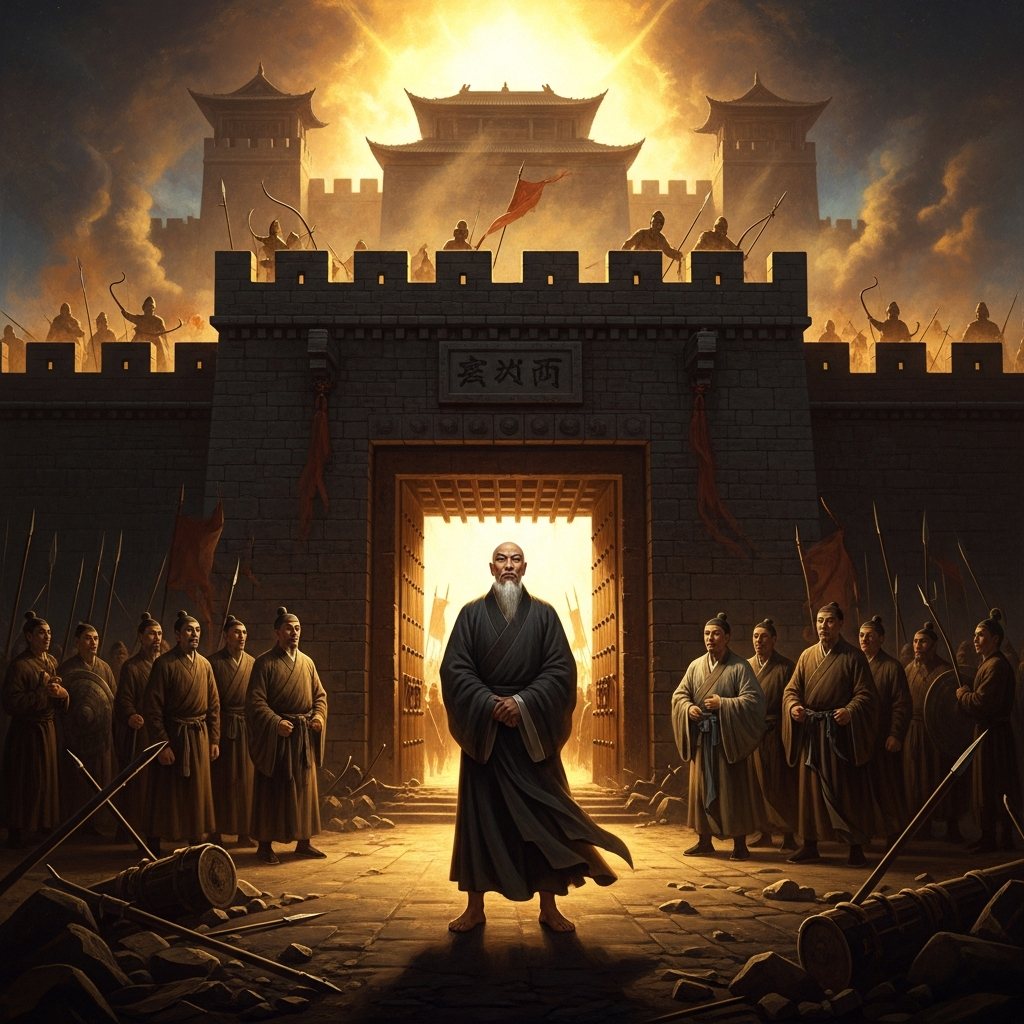
This is not an accident. The Confucians study music and ritual and poetry; the Mohists study fortification and ballistics and logistics. Mozi has worked out that a doctrine of universal love without defensive capacity is a doctrine that gets the weak killed. He therefore trains his followers to defend. They specialize in helping besieged cities hold — the smaller state, the weaker city, the side the great powers have decided to crush. They show up at the gates of the targeted and offer their skills. They do not charge. They sleep rough. They wear out their shoes on roads that lead toward the fighting rather than away from it.
He argues with the Confucians about ceremony. The Confucians say: elaborate funerals honor the dead and express the depth of our grief; the proper three-year mourning period maintains the bonds of filial piety; the ritual music of the ancestral offerings holds civilization together. Mozi says: the grain buried with the aristocrat would feed fifty families for a year. The musicians playing at the state sacrifice trained for a decade that could have been spent farming. Ceremony is luxury dressed as virtue, and luxury in a world of starvation is violence.
He is not wrong. He is also not entirely right. But the force of the argument — utilitarian, unflinching, aimed at the powerful and not the powerless — carries a weight that makes the Confucians uncomfortable for two centuries.
He dies sometime around 391 BCE, after a long career of this.
His school survives him with unusual intensity — the Mohists are organized into cells, each with a leader called a Ju zi, a Grand Master, who holds authority over life and death within the group. They are more like a military order than a philosophical school: disciplined, ascetic, mobile, willing to die for their principles. Several do. Several Mohist leaders execute their own sons for moral infractions, to demonstrate that the doctrine of impartial love is not sentiment and does not bend for family.
The school largely disappears after the Han unification in 221 BCE. The Han emperors adopt Confucianism, which supports hierarchy and order; Mohism, which challenges hierarchy and celebrates the peasant over the aristocrat, is inconvenient. The texts survive only partially, recovered and reconstructed by scholars a millennium later who found them strange and radical and poorly edited and alive.
The doctrine of jian ai reappears in every century thereafter, under different names, in different languages, always generating the same reaction: it is either the most obvious moral truth in the world or an inhuman abstraction that erases the bonds that make us human. The argument is not resolved. It is the argument. Mozi walked barefoot to a hundred courts to make it, and the road is still open.
The Mohists preserved the only detailed accounts of ancient Chinese siege warfare, defensive engineering, and military logistics — not because they were warlike but because they needed to understand war well enough to stop it. The philosopher who argued most strenuously against offensive warfare became the greatest expert on how offensive warfare worked. He could not have defended Song without understanding how Gongshu Ban intended to take it. The ethics required the engineering. The peace required the knowledge of war. Mozi walked toward the violence so he could stand between it and the people it was aimed at — and he trained three hundred disciples to do the same, so that no single assassination could undo what he had built.
Scenes
Mozi stands at the gate of a besieged city, barefoot, his disciples ranged behind him — the philosopher who stops wars by arriving at them
Generating art… Gongshu Ban and Mozi face each other across a makeshift model of a city wall — a war game whose outcome determines whether Chu attacks Song
 Generating art…
 Mozi's followers walk the roads of the Central Plains barefoot, sleeping rough, ready to defend any city that the strong have chosen to attack
 Generating art…
 Echoes Across Traditions
Entities
- Mozi
- Gongshu Ban
- King of Chu
Sources
- *Mozi*, Book 4 ("Jian Ai", Universal Love) — translated by Burton Watson in *Basic Writings of Mo Tzu, Hsün Tzu, and Han Fei Tzu* (Columbia, 1967)
- *Mozi*, Book 17 ("Against Offensive War")
- *Mozi*, Book 50 ("Gongsu") — the siege-engine episode with Gongshu Ban and the King of Chu
- Robin D.S. Yates, "The Mohists on Warfare" — *Journal of the American Academy of Religion* 47 (1979)
- Chris Fraser, *The Philosophy of the Mòzǐ: The First Consequentialists* (Columbia, 2016)