Oedipus at Thebes
Mythic Time · Sophocles's *Oedipus Tyrannus* staged at the Dionysia ~429 BCE · Thebes — the royal palace, the crossroads where Laius died, and the eventual road into exile
Contents
A plague descends on Thebes. The king vows to find its cause and root it out. He investigates with the rigor of a prosecutor — and discovers, methodically, that he himself is the contagion: the killer of his father, the husband of his mother, the prophecy fulfilled. His wife hangs herself. He puts out his own eyes with the gold pins of her dress.
- When
- Mythic Time · Sophocles's *Oedipus Tyrannus* staged at the Dionysia ~429 BCE
- Where
- Thebes — the royal palace, the crossroads where Laius died, and the eventual road into exile
Thebes is dying.
Crops fail in the fields outside the walls. Cattle die in the byres. Women miscarry. The plague has no respect for class or virtue; it takes the priest and the leper alike, the rich and the slave, in numbers that have outpaced the city’s ability to bury them. The streets smell of burning bodies. The temples are full of suppliants who have run out of gods to ask.
A delegation comes to the palace.
They kneel at the feet of the king who once saved them — Oedipus, the foreigner who solved the Sphinx’s riddle and freed Thebes from her appetite, the man they crowned and married to the queen because he had done what no Theban could do. They beg him to save them again. You found the answer once. Find it again.
He has already sent Creon to the Delphic oracle. Creon is back at the door.
The oracle’s answer is simple.
There is a pollution in Thebes. The city harbors the killer of the previous king, Laius, who was murdered at a crossroads on a journey twenty years ago and never avenged. Find the killer. Banish or execute him. The plague will lift.
Oedipus listens. Oedipus issues the proclamation immediately, before the council, before he has even finished his cup of water. Whoever knows the killer of Laius and conceals it, may his harvest fail and his line die. Whoever the killer is, let him be cut off from every house in this city. Let him share no fire, no water, no prayer. I curse him.
He pronounces the curse with the formal verbs of a king. The verbs land where they will land. He does not yet know it.
He sends for Tiresias.
The blind prophet does not want to come.
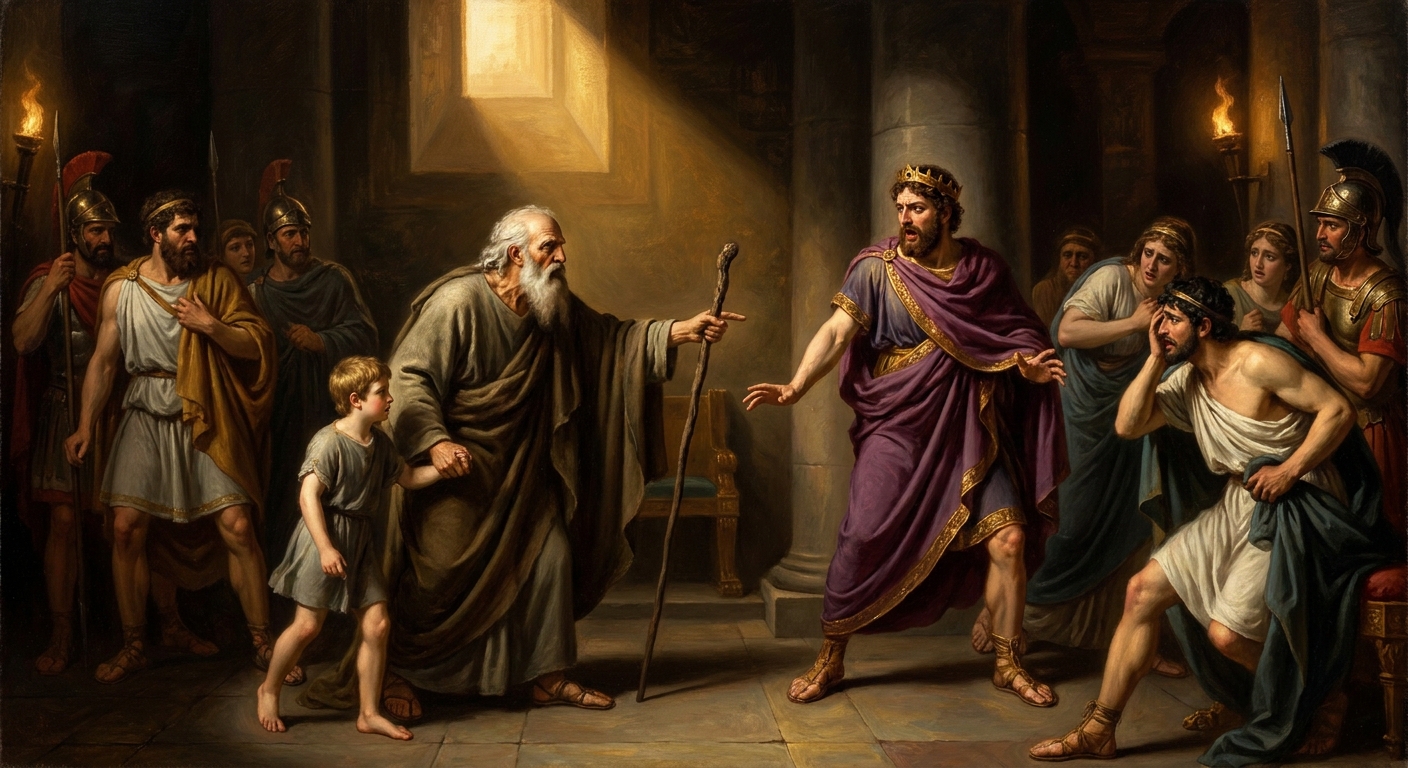
He is led to the palace by a boy. He is old, blind, slow, and angry — angry the way a prophet is angry when a king who has not consulted him in twenty years suddenly remembers him. He stands in the audience hall and refuses to speak. Send me home. Bear your burden, and I will bear mine.
Oedipus is offended. He pushes. He accuses. The prophet has no respect for the throne. The prophet is hiding something. The prophet must be in league with Creon to take Thebes from him.
Tiresias snaps.
You are the pollution, he says. You are the killer you are hunting. You are blind to the company you keep. You will leave this palace not as you came in.
Oedipus laughs. The court laughs with him. The blind man has gone mad in his old age. Oedipus dismisses him with a wave and tells the council to send him home. The riddle, he tells them, is fraud.
Tiresias, at the door, says one more thing. The man you are looking for is here. He thinks he is a foreigner; he is a Theban. He thinks he is his children’s father; he is also their brother. He will go from this house with a stick, feeling for the road.
Then the boy leads him out.
Oedipus does not stop investigating.
This is the catastrophe at the heart of the play: he could stop. Jocasta, his wife, begs him to stop. The shepherd they send for begs to be sent home unquestioned. The messenger from Corinth tries, several times, to drop the subject. Every door Oedipus opens, someone is on the other side asking him to close it.
He opens every door.
He does it the way a prosecutor does it — methodically, in front of witnesses, building the case against an unknown defendant whose identity emerges in the order of the evidence. The previous king was killed at a crossroads on the road to Delphi. I killed a man at a crossroads on the road to Delphi. The previous king’s wife is the woman I married. Then who was the previous king? My adoptive parents in Corinth were not my parents. Then who were? The man who handed me to them as a child was a Theban shepherd. Send for the shepherd.
The shepherd arrives.
Jocasta has already understood. She has gone into the palace. She has not come out.
The shepherd does not want to speak.
He is old. He has spent twenty years trying to forget what he is about to be made to remember. Oedipus threatens him with torture. The shepherd, through tears, tells him: yes. The infant whose ankles I was told to pin together and expose on the mountain. The infant Queen Jocasta gave me. I could not kill it. I gave it to a Corinthian shepherd, who took it to a king without children. The infant lived. The infant is —
He cannot finish the sentence. He does not have to.
Oedipus stands.
The court, around him, has been silent for a long time. He looks down at his own hands. He looks at the throne. He looks at the door behind which his wife — his mother, his wife — has not come out for some time. He walks to the door. He opens it.
She is hanging from a beam.
She has used the gold-embroidered cord of her own robe. Her face, in the half-light of the bedroom, is calm in the way the dead are calm — the eternal indifference of someone who has solved her problem and is no longer present to its consequences. Oedipus walks to her. He cuts her down. He lays her on the bed.
He takes the gold pins from the front of her dress.
There are two of them. They are long, ornamental, sharper than they need to be. He lifts them in his right hand. He looks at the body of the woman he has loved and married and ruined, and he looks at the world around him — the bedroom, the palace, the city beyond it that he has destroyed — and he understands, with the clarity that has been his curse all his life, what his eyes have done.
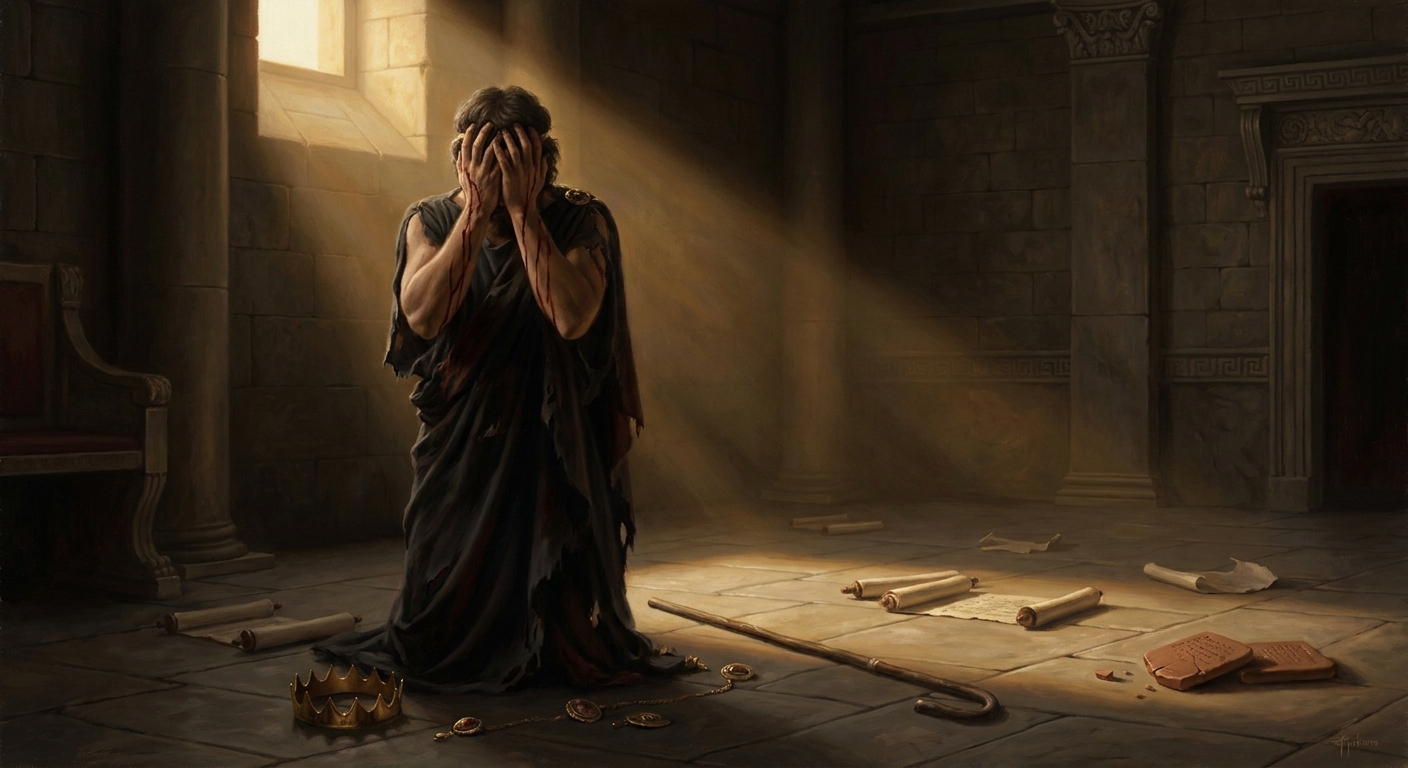
He drives the pins into them.
Once. Then again. Then again. The Greek text counts the strokes; the chorus counts them. He does not stop until he can no longer see anything. The blood runs down his face onto the floor of the bedroom, mixing with whatever fluids the queen’s body has begun to release, and Oedipus, on his knees beside her, makes the sound the plague has been making in the streets of Thebes for weeks.
Tiresias was right. He came in with sight and is going out with a stick.
He does not die.
He could have. The pins were long enough. He chose the eyes instead — chose, deliberately, to live blind rather than die seeing. The chorus asks him why. He says: because if I had gone down to my mother and father in Hades I could not have looked at them. Because there is nothing in the upper world I want to see now either. Because the eyes did this. Let the eyes pay.
Creon, his brother-in-law and now his uncle and now his successor, takes him in. The children — Antigone, Ismene, Polyneices, Eteocles, who are also his half-siblings — are brought to him. He cannot see them. He puts his hands on their faces. He says goodbye.
Then he asks for the road.
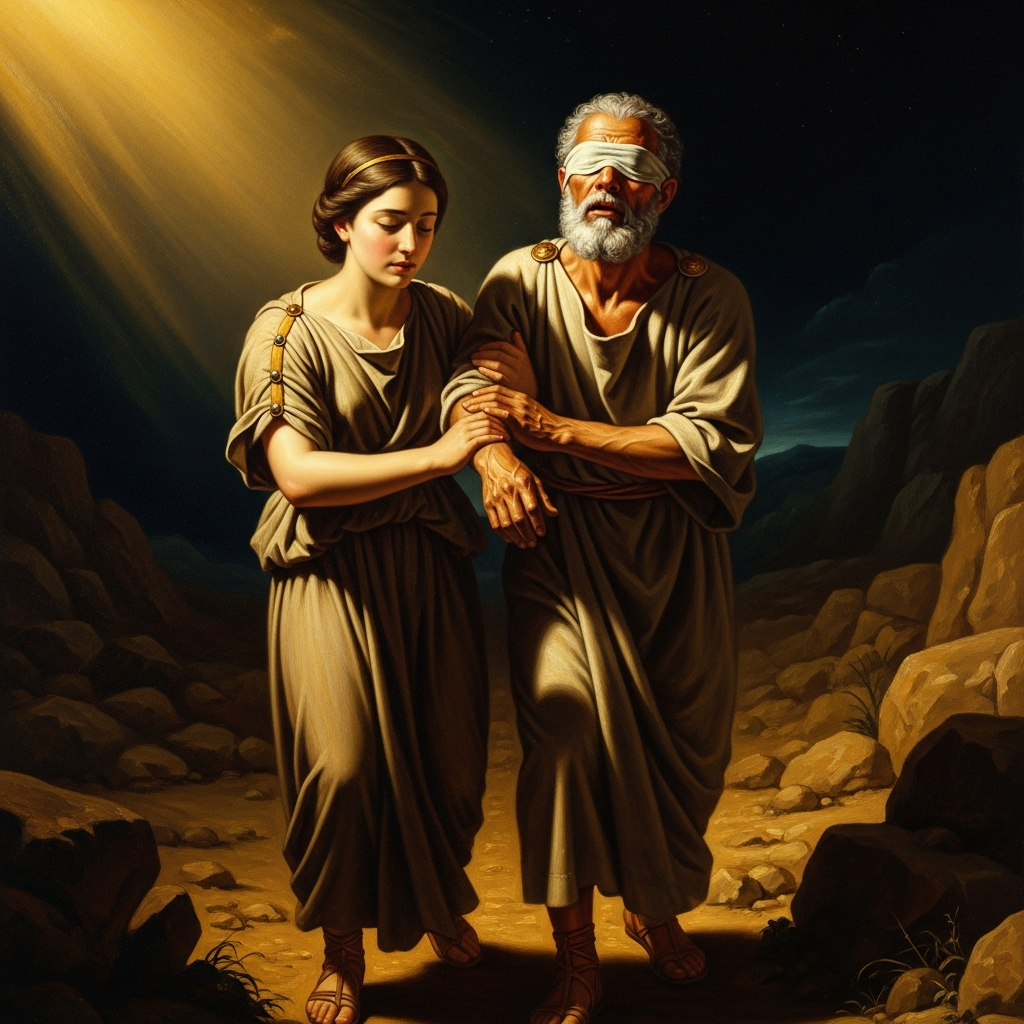
Antigone takes his hand and leads him out of Thebes. The gates close behind him. The plague, in the days that follow, lifts. The city is saved. The pollution has been removed in the only form available — the man who imposed the curse on himself, walking out under it, blind, with a daughter for a guide.
Sophocles staged this play in Athens in the late 420s BCE, in the middle of a plague that had just killed Pericles and a third of the city. The audience watching Oedipus investigate his way into ruin was watching itself: a city that had prided itself on its rationality, its democracy, its capacity to know — discovering that knowing was not always the same as saving.
Aristotle made the play the model of tragedy in the Poetics. Bernard Knox made it the model of the Sophoclean hero — the man whose virtues are also his catastrophe, whose refusal to stop investigating is the same refusal that solved the Sphinx and saved Thebes the first time. The riddle-solver and the patricide are the same person. That is the play’s theology.
Fate and choice are not opposed in Sophocles. They are the same instrument seen from two angles. Oedipus chooses, freely, every step that fulfills the prophecy: he leaves Corinth to escape it, he kills the old man at the crossroads in self-defense, he marries the queen because the city has offered her, he investigates because he is the king and the plague is killing his people. Every choice is right. Every choice is the prophecy. The gods do not constrain him; they do not need to. The man’s own virtue is enough.
David fell. Saul fell. Karna fell. Oedipus is the figure who fell furthest because he was using the brightest light. The play is a warning about light.
The blinding is not a mutilation. It is an argument. Oedipus puts out his eyes because his eyes — clear, sharp, royal — saw everything in the world except the only thing that mattered. The blind Tiresias saw it from the start. To see what Tiresias saw, you have to give up the kind of seeing the eyes do.
That is Greek tragedy at the moment it becomes theology.
Scenes
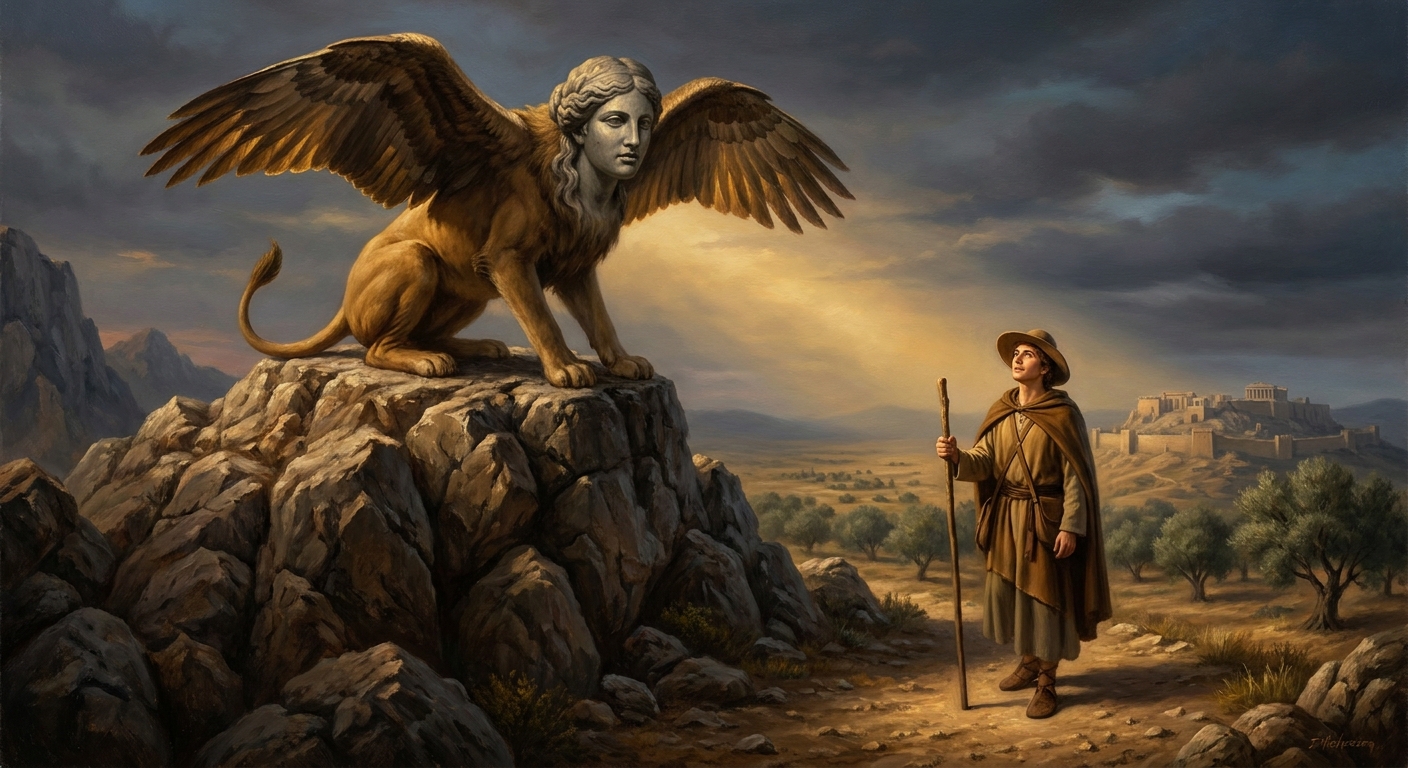
Thebes: Oedipus faces the Sphinx on her high rock and answers the riddle that has killed all others
 Generating art…
 The blind prophet Tiresias points at the king: the killer you seek is you
 Generating art…
 Jocasta dead by her own hand
 Generating art…
 Echoes Across Traditions
Entities
- Oedipus
- Jocasta
- Tiresias
- Apollo
- the Sphinx
Sources
- Sophocles, *Oedipus Tyrannus* (~429 BCE)
- Hugh Lloyd-Jones (trans.), *Sophocles* I-II, Loeb Classical Library (1994)
- Aristotle, *Poetics* 11, 13, 14, 15
- Bernard Knox, *Oedipus at Thebes* (1957)
- Bernard Knox, *The Heroic Temper: Studies in Sophoclean Tragedy* (1964)
- E.R. Dodds, 'On Misunderstanding the Oedipus Rex' (1966)