The Seeing
c. 420 BCE · Eleusis, fourteen miles west of Athens · Eleusis — the sanctuary on the bay, the Telesterion built for the great ritual, the most sacred ground in the Greek world
Contents
A year after his first initiation at Eleusis, a man from Athens returns for the epopteia — the second degree, the seeing. In total darkness inside the Telesterion, something is shown. No initiate ever told what it was.
- When
- c. 420 BCE · Eleusis, fourteen miles west of Athens
- Where
- Eleusis — the sanctuary on the bay, the Telesterion built for the great ritual, the most sacred ground in the Greek world
He has been waiting a year.
Not waiting the way a man waits for a letter, checking at intervals and returning to his ordinary concerns. Waiting the way a thing waits when it cannot stop thinking about what it is waiting for — when the waiting has become the structure of the year, the shape the months took, the thing by which all other events were measured and found, in comparison, light.
His name is Euandros. He is thirty-four. He is a merchant, grain, the route between Piraeus and the northern islands, a man whose life until last September could be described in material terms with some precision. He has a wife. He has two sons. He has accounts.
Last September he walked the Sacred Way to Eleusis with the ten thousand and stood in the Telesterion in the dark and was initiated into the first degree of the mysteries. The myesis. He drank the kykeon. He held the sacred objects. He said the formula. He saw what first-degree initiates are shown.
He has not told anyone what that was. He will not. What he has told people — his wife, his partner in the grain business, his brother — is that something happened, and that whatever it was, it produced in him the persistent and, he admits, rationally unjustifiable conviction that there is a second degree, and that he needs it.
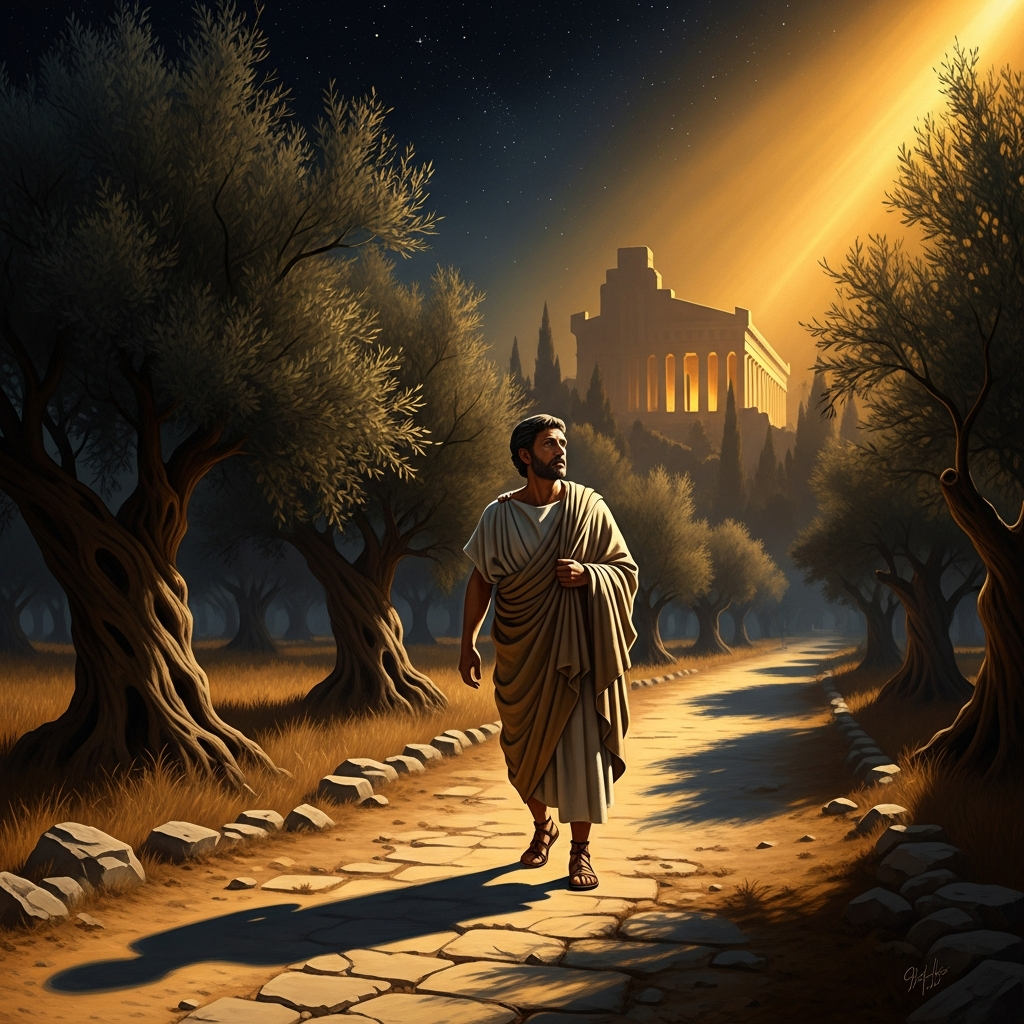
He is back on the Sacred Way in the September dark of the following year.
The procession has the same structure: the basket-bearers, the iacchos cry, the long walk from the Kerameikos out through the salt flats and over the pass at Daphni, the torches lit at sunset. He has walked it before. His feet know the road. What is different this year is that he is walking toward the epopteia — the seeing — which is the second and final degree, the one the tradition marks as the consummation of the whole enterprise.
The epopt — the one who will see — must have completed the first degree at least a year earlier. He must have fasted since dawn. He must have purified himself in the sea at Phaleron — he did this at sunrise, walking into the cold water past his waist, letting it close over his head. He has sacrificed a pig. He has done everything the preparatory rules require.
He walks beside a man from Corinth he has never met, and they do not speak about what they are walking toward. This is not a rule. It is simply the case that the thing ahead of them is not a thing that falls naturally into conversation.
He has heard, from initiates who have completed the epopteia, almost nothing.
This is itself significant. The Eleusinian initiates are under the death penalty for revealing the content of the rites, but the penalty is rarely needed, because the content is not something people naturally want to describe. What he has heard, in the fragments that escape, has the quality of statements that are technically true and completely insufficient. Plato — a man who managed to say something interesting about almost every subject he turned his attention to — got no further than: happy is the man among those on earth who has seen these things.
Pindar said: he knows the end of life and its beginning given by Zeus.
Aristotle, the most systematic mind the Greek world produced, arrived at this: the initiates do not learn anything; they suffer something, and are put into a certain condition.
A certain condition. Aristotle — who could classify the parts of a squid and outline the constitution of Athens and argue about the nature of tragedy and the properties of the unmoved mover — stopped there. A certain condition.
Euandros has been thinking about this sentence for a year.
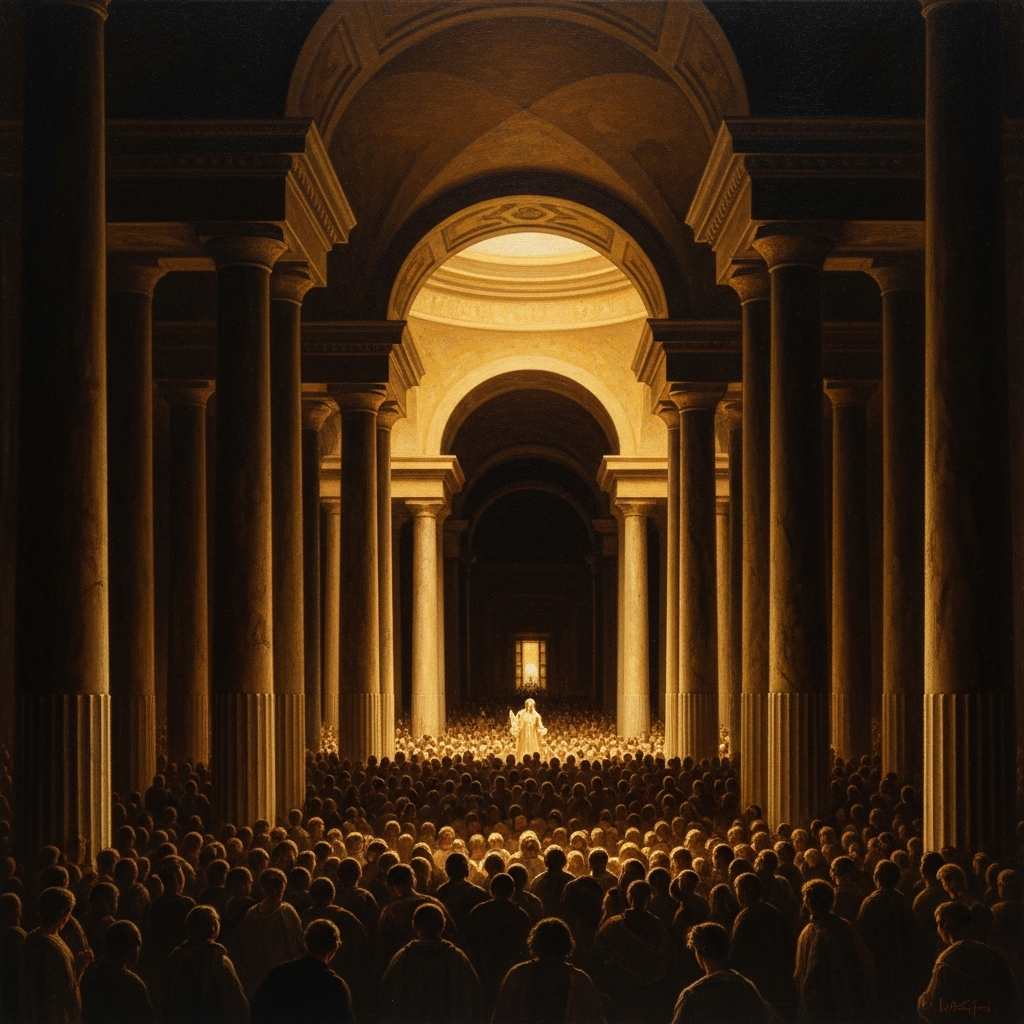
The Telesterion is dark.
Not the comfortable dark of a shuttered room. The dark of three thousand people standing on a stone floor in a building with no windows, the oil lamps far at the front extinguished, the columns invisible, the only light the faint ambient glow of eyes that are beginning to understand that there is nothing for them to adjust to.
He has been fasting since dawn. The kykeon was passed an hour ago — the clay cup moving through the crowd hand to hand, the barley drink cold, the taste of it bitter with pennyroyal, the slight dizziness beginning in the back of the skull that may be hunger, may be the particular quality of this barley, may be both. He is standing. There are no seats. He is standing in the dark beside people he cannot see, breathing air that smells of incense and salt and the body-warmth of a thousand people pressed close.
His feet hurt. He is thirty-four. The kykeon is in his stomach. He is thinking that whatever is about to happen, he has earned the right to be here for it.
Somewhere in the dark, a drum begins.
The drum is inside his sternum before it is in the air.
He does not know how long it plays. Time in the dark of the Telesterion does not behave the way time behaves on a grain ship in the Aegean. It moves differently. It pools. He is aware of each breath as a distinct event. He is aware of the cold stone through the soles of his sandals. He is aware of the silence that exists around and under the drum, the way silence exists around and under everything — the silence that is not an absence but a ground.
He does not know when the kykeon begins its deeper work. He will not be sure, after, what was the kykeon and what was the fast and what was the dark and what was simply what happens when the body is stripped of its ordinary noise long enough for something else to be audible.
He is aware of himself differently. He cannot be more specific than this.
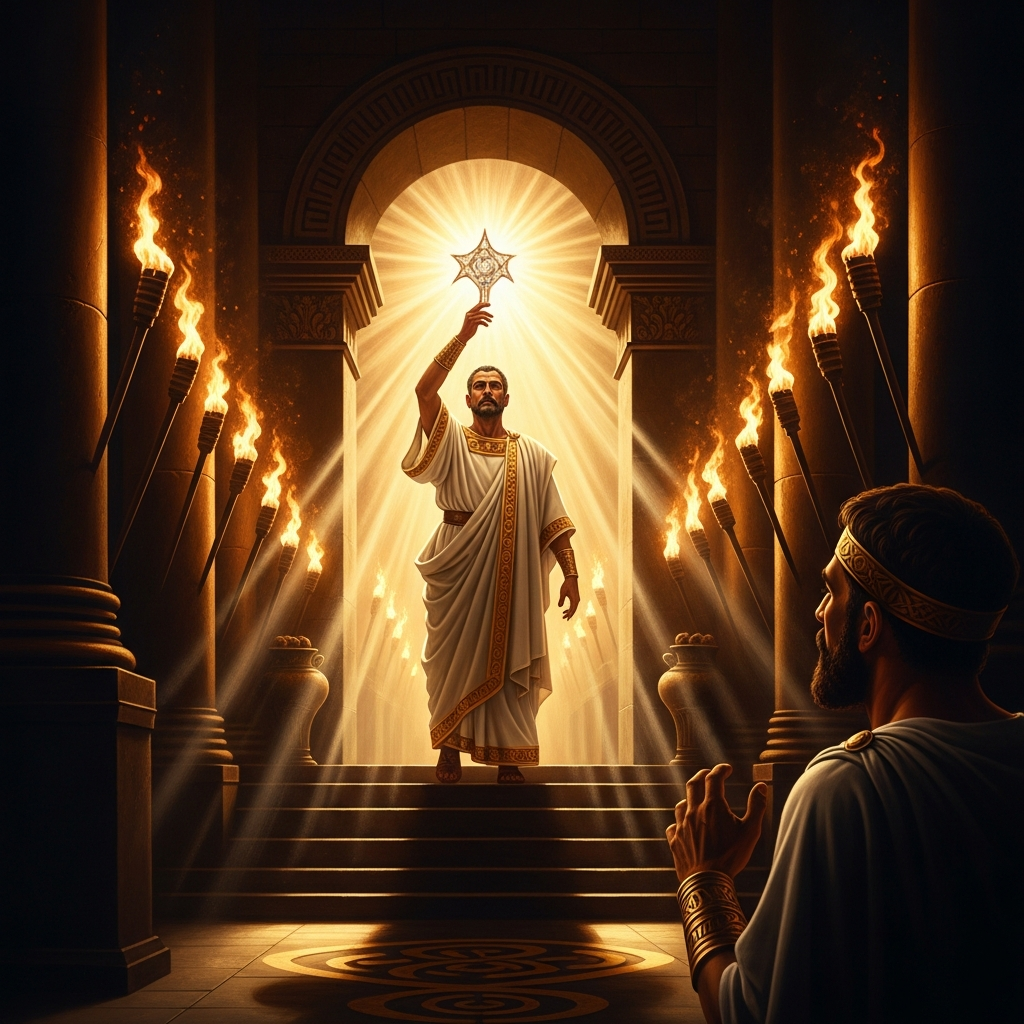
The torches ignite all at once.
He will describe this later, to himself, alone, in the grain warehouse at Piraeus where he does his accounts: the hall floods with fire. Not slowly, not one torch and then another — all at once, as if the darkness simply decides to be light, a thousand torches pulled from sand pits in the walls and lifted, the columns leaping out of the black, the smoke rising through the louvered roof, the ceiling beams orange and enormous.
In the same moment, the hierophant appears.
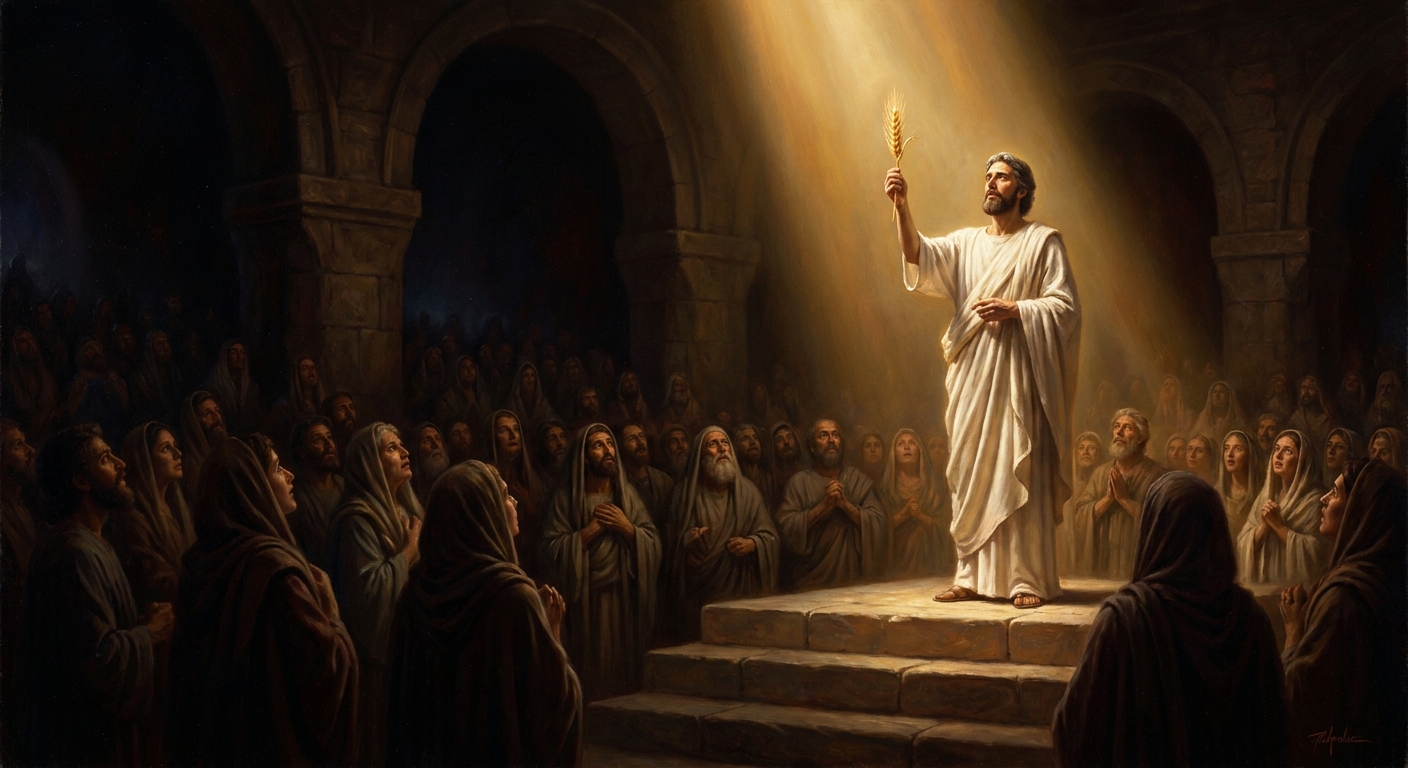
He is at the front of the hall, on the raised platform of the Anaktoron — the inner shrine from which only he may emerge. He is in saffron and white. He is very old. His voice when he cries out fills the hall the way the torches fill it — all at once, completely, reaching every corner without diminishing.
The cry is in a formula Euandros does not know. He will not know it after, either. It moves through him like the drum moved through him.
The hierophant turns to the inner door of the Anaktoron. He goes in.
He comes out.
He raises something above his head.
What he holds, Euandros cannot — even in the grain warehouse at Piraeus, alone, no one listening — say.
He can say: he sees it. He can say: he knows, in the moment of seeing, something that he has not known before and cannot unknow after. He can say: Aristotle was right. He does not learn anything. He is put into a certain condition.
The condition is this: the thing he was afraid of is not the thing he thought it was. The end is not what he thought it was. The shape of his life, seen from inside the Telesterion with the torches burning and the hierophant’s arms above his head, has a different shape than the shape it had from outside.
He cannot say why this is so without saying what was shown, and what was shown cannot be said to someone who has not been through the preparation — the fasting, the kykeon, the year of waiting, the dark, the drum, the sudden fire — because the preparation is not a precondition for understanding the revelation. The preparation is the revelation. What happens when the hierophant raises the sacred object is the culmination of a process that began when Euandros first drank the kykeon a year ago, and what he sees is not a fact but a seeing, and the seeing is inseparable from what has been done to him to make him capable of it.
This is what no one can tell you before you arrive.
He walks back to Athens in the morning.
He walks the Sacred Way from Eleusis to the city in the light of a September day that looks, from the outside, like any other September day. The salt flats by the bay. The pass at Daphni. The city gate. His wife is in the house. His sons are at their schooling. The accounts are in the warehouse.
He is, outwardly, the same man who walked this road yesterday in a crowd of ten thousand shouting iacchos.
He knows, without being able to explain it to anyone who will find the explanation satisfying, that he is not.
Cicero was initiated, sixty years after Euandros’s imagined time, and wrote: we have been given a reason not only to live with joy but to die with better hope. Plato built half his philosophy around the grammar of the initiation — the ascent from the cave, the soul rising toward the light, the final vision that cannot be described but only undergone. Marcus Aurelius rebuilt the Telesterion with his own funds after the Sarmatians burned it.
All of them were put into a certain condition.
All of them carried it back into the world and could not say what it was and went on anyway, living with better hope, the seeing sealed inside them like a coal in ash.
The Telesterion was excavated by Greek archaeologists in the nineteenth century. The foundations are still visible at Eleusis. The site is a fifteen-minute drive from Athens. You can walk across the stone floor where the initiates stood. You can see the socket holes for the forty-two columns. You can stand in roughly the position where the hierophant stood when he emerged from the Anaktoron.
The Anaktoron is a rectangular outline of stone blocks. There is nothing inside it.
What was shown there for two thousand years went into the earth with the people who saw it. We have the outlines: the hall, the platform, the socket holes, the descriptions that stop just before the content. We have Aristotle’s sentence. We have Cicero’s gladness and Plato’s grammar and the fact that Marcus Aurelius, fighting Germans on the Danube, made time to rebuild a sanctuary he had already seen.
We do not have the seeing. We have only the shape of what it did to everyone who had it.
Scenes
The epopt returns to Eleusis a year after his first initiation — older now, changed in ways he cannot account for, walking the Sacred Way again in the September dark
 Generating art…
 Inside the Telesterion: total darkness, the smell of the kykeon, three thousand people breathing in a space where the columns have been swallowed by the black
 Generating art…
 The torches ignite all at once
 Generating art…
 Echoes Across Traditions
Entities
- the Hierophant
- Demeter
- Persephone
- the Telesterion
- the kykeon

Sources
- George E. Mylonas, *Eleusis and the Eleusinian Mysteries* (1961)
- Carl Kerényi, *Eleusis: Archetypal Image of Mother and Daughter* (1967)
- Walter Burkert, *Ancient Mystery Cults* (1987)
- Cicero, *De Legibus* II.14.36 (c. 52 BCE)
- R. Gordon Wasson, Albert Hofmann, and Carl A. P. Ruck, *The Road to Eleusis* (1978)