The God Who Cannot Be Refused
c. 405 BCE · Euripides's *Bacchae*, performed posthumously at the City Dionysia · Thebes — the palace gate, the prison cellar, the slopes of Mount Cithaeron where the Maenads dance
Contents
Dionysus has come to Thebes — his birthplace, the city of his mother Semele, who was destroyed by Zeus's lightning. He has come in disguise: a beautiful young stranger with long hair and wine-dark eyes. The king of Thebes, Pentheus, refuses to acknowledge him as a god. He arrests him. The god escapes from prison effortlessly. He whispers a suggestion to the king: dress as a woman and go up Mount Cithaeron to spy on the Maenads. Pentheus agrees. He goes. His own mother, in the grip of Dionysian madness, tears him apart with her bare hands.
- When
- c. 405 BCE · Euripides's *Bacchae*, performed posthumously at the City Dionysia
- Where
- Thebes — the palace gate, the prison cellar, the slopes of Mount Cithaeron where the Maenads dance
The god comes home.
He has been to Lydia and Phrygia and the gold-bearing slopes of the Tmolus. He has been to Persia. He has been to the cities of Bactria and the windy steppes beyond. He has danced through the Hellenic East, gathering followers, gathering rites, and now he is back where he was born — in Thebes, where his mother Semele was incinerated by the unmediated glory of Zeus when she asked to see her divine lover undisguised.
His grandfather Cadmus founded this city. His aunts — Agaue, Ino, Autonoe — still live here. They have been telling a particular story for twenty years: that their sister Semele had a love affair with some mortal and lied about Zeus, that the lightning was a punishment for her impiety, that the child she was carrying died with her.
Dionysus has come to correct the story.
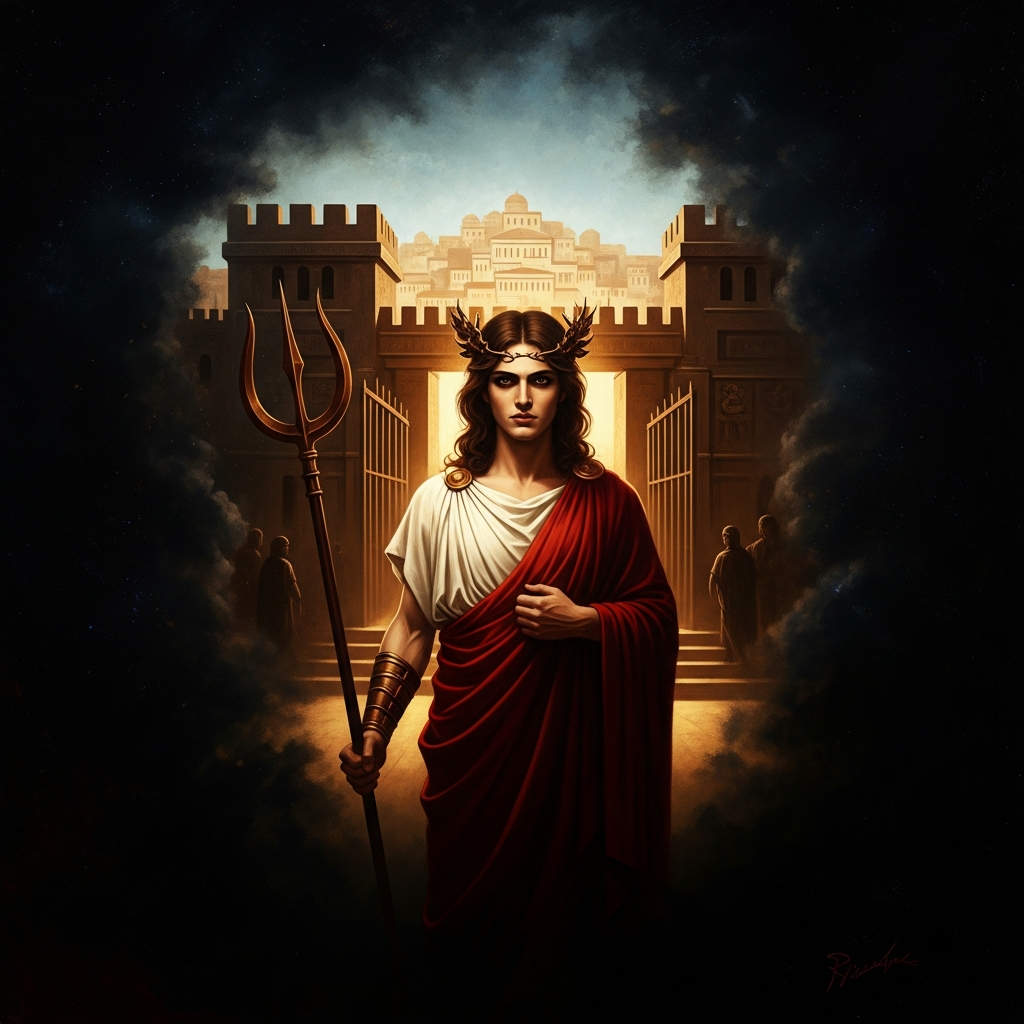
He stands at the gate of Thebes in human disguise — a young man, beautiful in a way that is neither quite male nor quite female, his hair loose and curling, his skin smelling faintly of grape and pine — and he tells the audience, in the prologue, what he is going to do. I have driven the women of this city mad. They are on the mountain, all of them, in the trance of my rites. I will make this city know me. I will make my mother’s sisters retract their slander. I will use whatever means are required.
The current king is Pentheus, son of Agaue. Dionysus’s first cousin. The grandson of Cadmus.
Pentheus believes he is in charge.
Pentheus has just returned from a trip abroad.
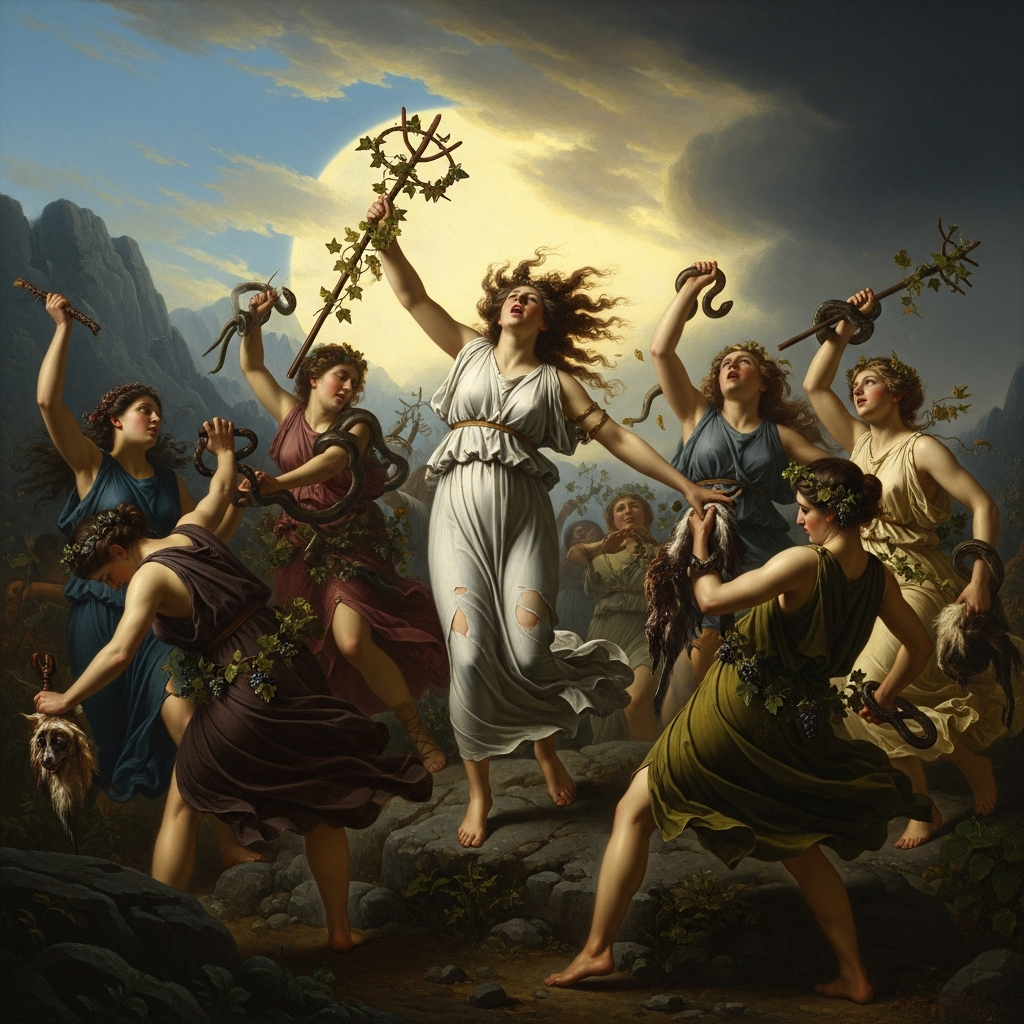
He comes back to find his city in chaos. The women — all the women, including his own mother and his own aunts — have left the looms and the kitchens and the temples and gone up Mount Cithaeron to dance. They have abandoned their husbands and children. They are wearing fawnskins and ivy crowns. They are carrying the thyrsus, the wand of fennel topped with pine cone. They are following some foreign priest who has shown up with a story about a new god.
Pentheus is enraged.
He hears about the rites: women dancing all night, women drinking wine in the woods, women — and he believes this is the worst part — sleeping with men in the underbrush. He is wrong about the last part; the Bacchae is careful that the actual rites are not orgiastic, that the women dance and sleep alone with infant animals at their breasts and snakes around their wrists. But Pentheus assumes lust because he can think of no other reason a woman would leave a household.
He gives orders. He sends soldiers up the mountain. He commands the priest of this new cult to be arrested. He swears he will put a stop to it.
His grandfather Cadmus — old now, very old — comes to him in fawnskin and ivy crown, leaning on the arm of the blind prophet Tiresias, who is similarly dressed. They are both going up the mountain to dance for the new god. They are an absurd sight: two ancient men in costume, hobbling toward ecstasy.
Pentheus laughs at them. He shouts at them. Take that ridiculous costume off. You are old men, you are dignitaries of this city, and you are dressed like maenads.
Tiresias, the man who has been right about every god for sixty years, tells him: Do not be so sure of yourself. This god is real. He is the one who gave us wine. He is the one who relaxes the suffering of mortals. He is the one who lets the soul out of its body. Do not fight him. We are old, and we know better.
Pentheus does not listen. He has soldiers. He has a palace. He has a throne. The old man and the blind man can walk to the woods if they want. He is going to put down the rebellion.
The soldiers bring back the priest.
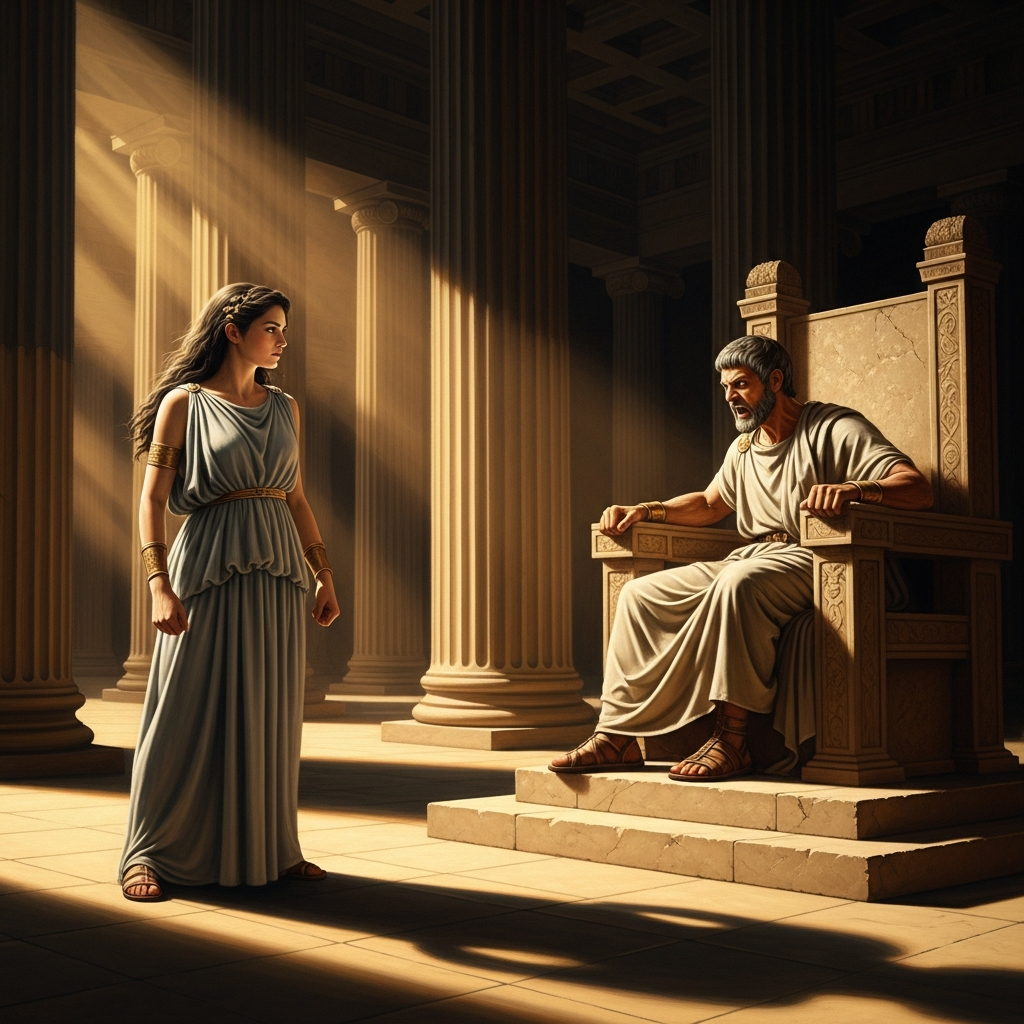
He is a young man, hands bound, smiling. They have caught him in the foothills not resisting at all — like a sheep, the captain says, confused, he came with us as if he wanted to come. They have brought him into the palace courtyard and now he stands in front of the king.
Pentheus circles him. He looks at him. He notes the long curls — grown for sex, not for athletics — and the soft skin and the foreign clothes. He is repelled and attracted at once and he does not understand which feeling is which.
He interrogates the stranger.
What is your name? Where are you from? Whose son are you? What is this god of yours?
The stranger answers calmly. He is from Lydia. His god gave him these rites. Yes, he sees Dionysus face to face. Yes, the rites are wonderful. No, he will not describe them to a man who is not initiated. The god does not allow it.
Pentheus loses his temper. He orders the stranger’s hair cut off. He orders the thyrsus taken away. He orders the man imprisoned in the stables under the palace, chained to the manger, to think about whether his god will save him from a Theban dungeon.
The stranger is led away, still smiling.
The palace shakes.
A messenger runs to the king: the prison is on fire. The chains have come off the prisoner of their own accord. The walls of the stable have cracked. The horses have bolted. There is something happening underneath the city.
The stranger walks back into the courtyard.
He is unbound. He is not even disheveled. He stands in front of Pentheus and remarks, conversationally, that the king’s prison was perhaps not adequate. Pentheus is shaking with rage and fear, and he draws his sword, and the stranger smiles at him the way one smiles at a child holding scissors.
A second messenger arrives — a herdsman from Cithaeron.
He has been on the mountain. He has seen the Maenads. He has watched them. They were sleeping in the leaves, their snakes wrapped around them, their fawn-cubs at the breast. Then a horn sounded, and they all woke up, and the sleeves of the dawn ran across the high pastures.
He describes what they did.
They walked through the high meadows. Where they struck the rock with the thyrsus, water came out. Where they struck the ground, milk came out. They put their fingers into the bark of trees and honey came down. The whole mountain was running with the gifts of the new god, and the women — the housewives of Thebes, the most respectable matrons of the city — were drinking from the springs and laughing.
Then a herd of cattle wandered onto the meadow.
The Maenads tore the cattle apart with their bare hands.
The herdsman swears he is not exaggerating. He saw a young matron — Pentheus’s mother Agaue, in fact — pick up a full-grown bull by the horns and pull its head off. He saw another woman tear a calf in half lengthwise. He saw the women fall on the herd in seconds and reduce it to shreds of meat strewn across the mountain pastures, and the women’s hands and faces and clothes were red, and they were singing.
When the village men came up the mountain to try to stop them, the women turned on the men and chased them down the slopes with the thyrsus. The wands, soft fennel sticks, drew blood like spears. The men fled.
The herdsman has come to warn the king: They are coming down the mountain. They will be in the city by evening. Whatever you are going to do, do it before they arrive.
Pentheus orders the army assembled.
He will lead his men up the mountain. He will end this. He will round up the women with shields and spears and bring them home in chains.
The stranger — who has been standing in the courtyard the whole time, watching — interrupts.
Will you not stop killing the bull, the stranger asks softly, for one moment, and listen to me? I can take you up the mountain. I can show you the Maenads at their rites. You can see for yourself what they do. There is no need for an army. You only have to go quietly. You only have to dress the right way.
Pentheus, who has been an army-commander all afternoon, suddenly hears the suggestion of voyeurism, and his face changes. Dress how?
As a woman, says the stranger. They will not notice you among themselves if you wear what they wear. A long linen gown, hair grown out, an ivy crown, a thyrsus in your hand. I can dress you. We can go.
The audience, watching, knows what has just happened. The god has placed his hand on the king’s forehead, and the king’s mind has turned.
Pentheus, who has spent the entire play raging against effeminacy, against women, against the soft cloth and long hair of the foreign cult, suddenly wants to wear the foreign clothes. He wants to see. He wants to see the women he has been imagining.
He goes inside the palace with the stranger.
When they come out, Pentheus is in costume.
He is wearing a long linen dress. His hair has been combed out and curled. He has an ivy crown on his head. He carries a thyrsus that is too heavy for him. He is asking the stranger anxiously whether the costume sits correctly — whether his belt is straight, whether his hair is in the right place — and the stranger arranges the folds of the gown with the patience of a maid dressing a bride.
Pentheus is hallucinating.
He sees two suns. He sees two cities of Thebes. He sees the stranger as a bull and a snake at the same time. He does not realize anything is wrong. The god is leading him out of the city by the hand, and he is going.
Their dialogue on the way to the mountain is one of the most chilling moments in Greek drama. Pentheus is happy. He is excited. He is, for the first time in the play, smiling. He is going to see what he has been forbidden to see, and he is going to see it dressed as a woman, and he asks the stranger eager questions about how exactly he should hide in the trees, and the stranger answers him kindly.
They go up the mountain.
The messenger returns to Thebes alone.
He tells the chorus what happened. The stranger lifted Pentheus up to the top of a tall fir tree — bending the trunk down and easing him into the branches as if the tree were a ladder, the way a god moves a mortal. He left him in the canopy. Then the stranger himself vanished, and a voice came from the sky — Behold, women of Cithaeron, the man who mocks our rites! — and the Maenads looked up.
Their eyes found him.
They surrounded the tree. They tried to climb it. They could not. So they pulled it. They pulled the trunk. Hundreds of women, in unison, in the strength of the god, pulled the trunk down to the ground. Pentheus was thrown out of the branches and landed on the slope.
He took off his disguise as he fell. He pulled the wig from his head. He cried out: Mother, it is me. It is your son. Do not hurt me.
His mother Agaue was the first to reach him. She was in the trance. She did not see her son. She saw a young lion. She put her hands on his arms and she pulled, and her sisters Ino and Autonoe pulled at his other side, and the women tore him apart in moments.
Pieces of him scattered across the meadow. His head landed at his mother’s feet. She picked it up. She fixed it on the tip of her thyrsus. She walked back to Thebes, holding the head aloft, calling out to the city to come and see what she had hunted.
Cadmus meets her at the gate.
He has been on the mountain too. He has been gathering pieces of his grandson — here a hand, here a foot, here a length of spine — and he has them in a basket, and he is going slowly down the mountain with his head bowed, weeping, when his daughter comes running toward him with her son’s head on a stick.
Father, she says, look what I caught. Look what your daughter has hunted with her own hands. Take this trophy. Hang it on the palace gate. Tell them all that Agaue was the bravest of the women.
Cadmus does not answer at first. He looks at her. He looks at the head. He says, gently, Daughter, look at the sky. What do you see?
The sky, she says.
Look at the head you are holding.
The head of a lion.
Look again.
The head of —
The trance lifts.
The play does not let her say it. The play makes us watch her see it. Her face changes by degrees. The horror enters her in stages — first as confusion, then as denial, then as the absolute breaking that comes when a person realizes what their hands have done.
She lays the head in her father’s basket. She washes her hands. She does not stop washing them. The blood is on her dress, on her face, in her hair. Cadmus holds her, and she does not weep — she has gone past weeping — and they sit together in the courtyard surrounded by the pieces of her son.
Dionysus appears above the palace.
He is no longer in disguise. He is the god — epiphaneia, the manifestation, the thing the rites pointed toward all along — and he speaks from the height of the stage with a voice that the surviving members of the family cannot disobey.
He sentences each of them. Cadmus and his wife will be turned into snakes and driven into exile. Agaue will be expelled from Thebes forever. The whole house of Cadmus is finished.
Cadmus raises one objection. Lord, we acknowledge you. We have wronged you. But this punishment is too heavy.
Dionysus answers: Too late. I am a god. I told you so.
And the play ends with the chorus speaking the same lines they always speak — the gods bring many things to pass that no one expects — and the city of Thebes sitting in silence, the palace gate open, the head of the king resting in a basket of his own pieces, and the women of Cithaeron coming down the mountain quietly as the sun rises, blinking, with no memory of the night.
The god has been acknowledged.
This is what acknowledgment costs.
Scenes
The stranger arrives at the gate of Thebes — long-haired, smiling, smelling of wine
 Generating art…
 On the slopes of Mount Cithaeron, the women of Thebes dance in the wild — leaves in their hair, milk dripping from the rocks, lions sleeping at their feet
 Generating art…
 Agaue, in the grip of Dionysian madness, holds her son's head on a thyrsus and walks back to Thebes calling herself the luckiest of mothers
Generating art… Echoes Across Traditions
Entities
- Dionysus
- Pentheus
- Agaue
- Tiresias
- Cadmus
Sources
- Euripides, *Bacchae* (c. 405 BCE)
- William Arrowsmith (trans.), *The Complete Greek Tragedies: Euripides V* (1959)
- Anne Carson (trans.), *Bakkhai* (2015)
- E.R. Dodds, *Euripides: Bacchae* (1944, rev. 1960)
- E.R. Dodds, *The Greeks and the Irrational* (1951)
- Richard Seaford, *Dionysos* (2006)
- Walter Otto, *Dionysus: Myth and Cult* (1965)