Agamemnon: Ten Years Abroad, One Night at Home
c. 458 BCE · Aeschylus's *Agamemnon*, first play of the *Oresteia*, performed at the City Dionysia · Argos — the palace, the watchman's roof, the threshold where the red carpet is unrolled, the bath at the center of the house
Contents
The Trojan War is over. The signal fires have run across the Aegean — Clytemnestra has watched for them every night for ten years. Now the final fire blazes on the final hill. Agamemnon is coming. He left behind a daughter — Iphigenia, sacrificed at Aulis to bring the wind. Clytemnestra has not forgotten. She has taken a lover, planned everything, and woven a robe with no sleeves. The king walks in on a red carpet, into his own bath, into the net.
- When
- c. 458 BCE · Aeschylus's *Agamemnon*, first play of the *Oresteia*, performed at the City Dionysia
- Where
- Argos — the palace, the watchman's roof, the threshold where the red carpet is unrolled, the bath at the center of the house
It begins on a roof.
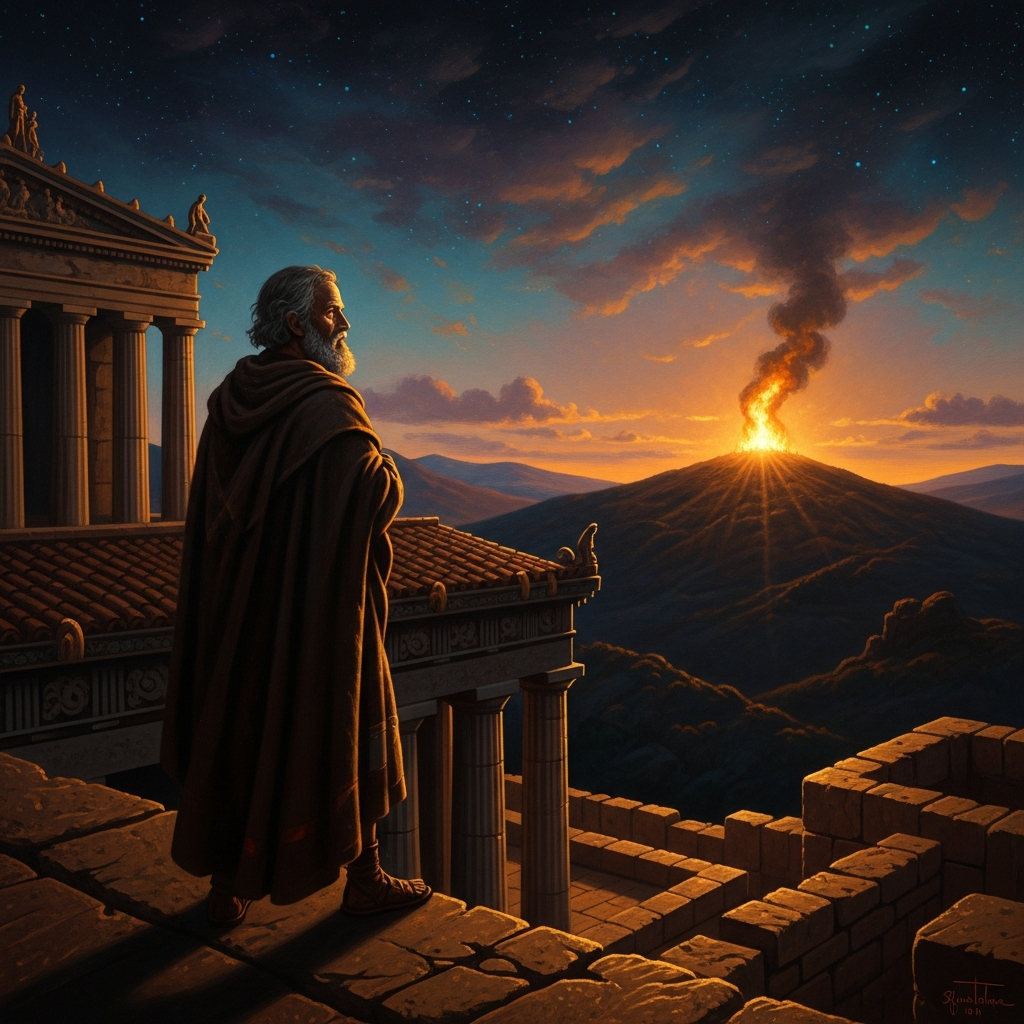
A slave has been lying on the palace roof at Argos for a year. He has been there before that, too — the play implies he has been on the roof for most of the ten years Agamemnon has been gone — and he has been told to watch the horizon for a fire. The Greeks before Troy have planned a signal-fire chain across the Aegean: when Troy falls, a fire on Mount Ida; from Ida, a fire on Lemnos; from Lemnos, fires across Euboea, Boeotia, the Cithaeron range, Aegiplanctus, and finally Mount Arachnaeus, which is in sight of Argos.
The watchman has watched the dark mountains for ten years. He has watched until his eyes have learned to see fires that are not there. He has lain like a dog, he says — like a dog on the elbow — and his back aches and his joints are stiff and he has come to fear that the queen below has forgotten he is up there.
Then, in the first scene of the Oresteia, the fire arrives.
It catches on Mount Arachnaeus. The watchman sees it. He leaps up. He shouts. He claps his hands. He runs to tell Clytemnestra, and his last lines as he goes down the stairs are an aside to the audience: I will say no more. An ox stands on my tongue. The house, if it could speak, could tell its own story. I speak only to those who already know. To those who do not, I have said nothing.
He has said nothing. He has said everything.
Clytemnestra has been waiting for this fire.
The play does not pretend otherwise. She has been planning for ten years — through the rumors of Troy’s siege, through the false reports of Greek defeats, through the long years when no one knew if her husband would ever come home — and she has prepared the house for one specific evening.
She has a lover. Aegisthus is in the palace, has been for years, and the city of Argos has been pretending not to notice. He is the cousin of Agamemnon and the son of Thyestes, and his presence in the house is itself a piece of vengeance: Thyestes was tricked by Atreus, Agamemnon’s father, into eating his own children at a banquet. Aegisthus has been waiting, like a virus, in the family bloodstream, for the chance to repay that meal.
But Aegisthus is not why Clytemnestra is going to do what she is going to do.
The reason is in Aulis.
Ten years ago, before the fleet sailed, the wind would not blow.
The Greeks were assembled at Aulis with twelve hundred ships. They had every man and every supply line for an expedition no one had ever attempted before. And the wind was wrong. Day after day. Week after week. The food began to spoil. The men began to fight. The seer Calchas was consulted, and Calchas said: Artemis is offended. The wind will turn only if Agamemnon sacrifices his daughter Iphigenia at the altar.
Agamemnon hesitated.
Not for long.
He sent home for her. He told Clytemnestra that Iphigenia was to be married to Achilles at Aulis — the great Achilles wanted her, the war could wait for the wedding, send her in her bridal robe — and Clytemnestra dressed her daughter for a wedding and put her on a chariot and sent her down to the harbor.
She arrived to find the priests waiting with knives.
Iphigenia is held down at the altar. The robe is pulled aside. The throat is cut. The wind turns. The fleet sails.
Clytemnestra has been thinking about this for ten years.
The herald arrives ahead of the king.
He confirms what the fire signaled: Troy has fallen, the temples have been sacked, the Greek fleet has been scattered by a storm on the way home, but Agamemnon’s flagship has survived, and the king will arrive within the hour. Clytemnestra greets him with rehearsed grace. She speaks of her ten years of fidelity. She speaks of the joy of seeing her husband. She speaks of what she has prepared in the house.
The chorus — old men of Argos, too old to have gone to the war — listens uneasily. They have noticed her language is too smooth. They have noticed that nothing she says is exactly a lie, but every word has been chosen.
Then the king arrives.
Agamemnon enters in a chariot.
There is a woman in the chariot beside him. She is Cassandra, daughter of Priam, princess of Troy, prophetess of Apollo. She has been given to Agamemnon as a war-prize. She does not speak. She has not spoken since they sailed. She sits in the chariot looking at the palace gate the way a deer looks at a wolf.
Agamemnon makes a speech to the assembled people of Argos. It is the speech of a victorious king coming home: thanks to the gods, gratitude to the elders who held the city, intentions to address civic matters in the morning. It is correct. It is empty.
Clytemnestra answers him.
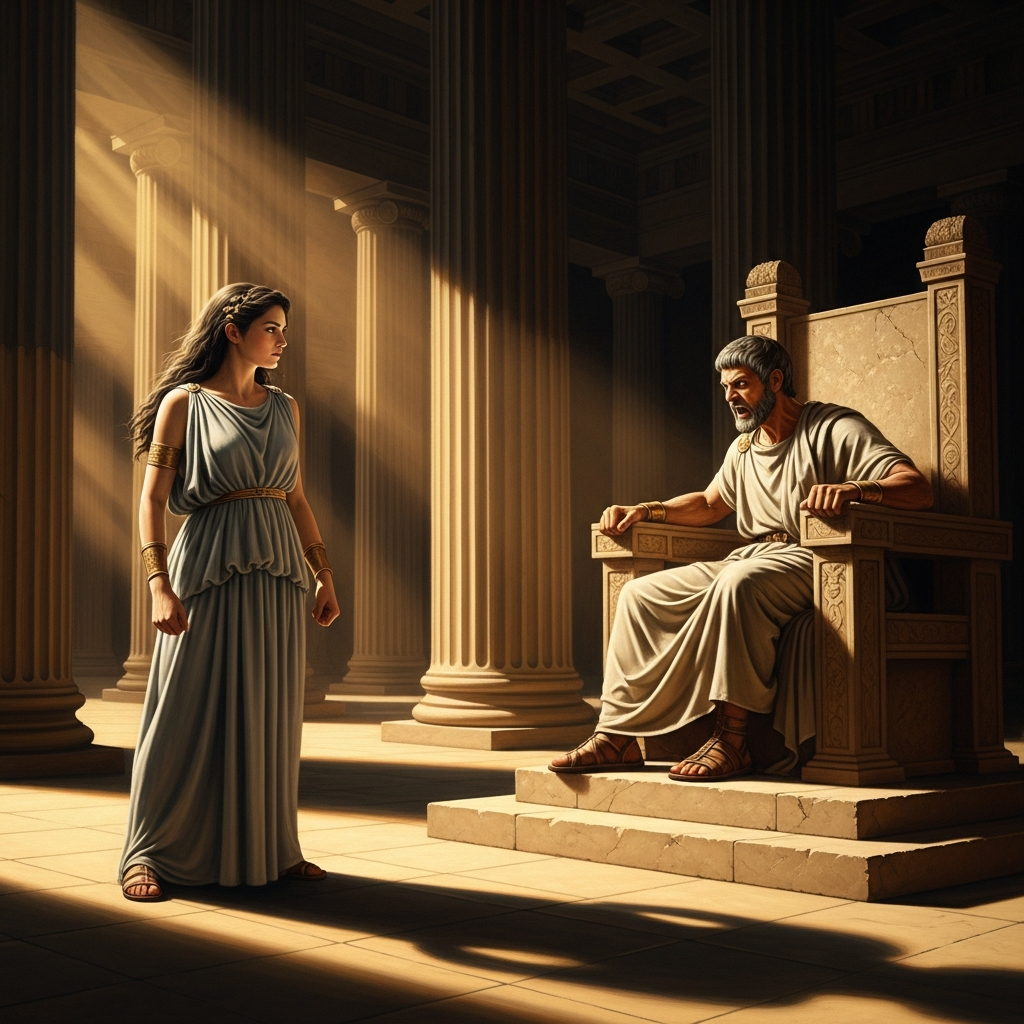
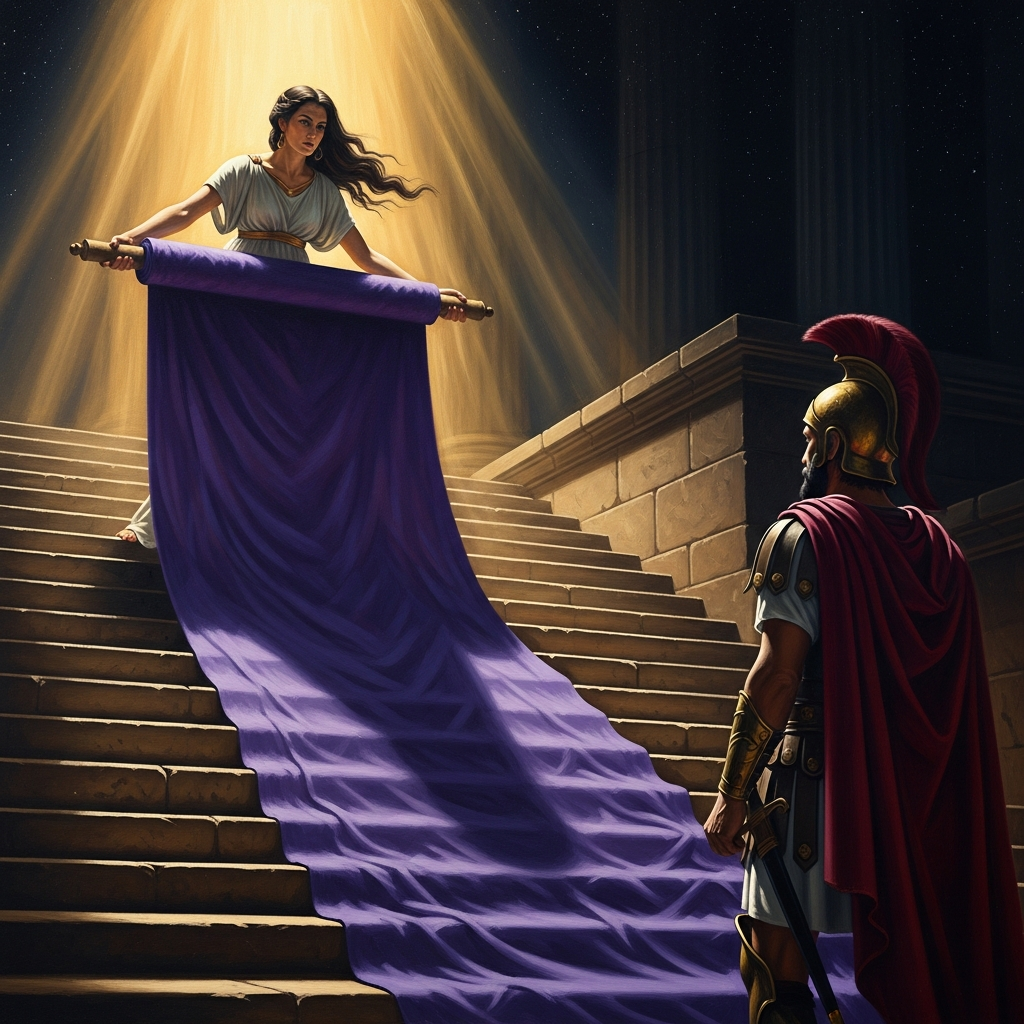
She has prepared this answer for a decade. She tells him how lonely she has been, how she has wept herself dry, how rumors of his death reached her so often that her servants had to cut down ropes she had hung from the rafters in despair. She tells him she has dreamed of his return every night. She tells him she has prepared a path of honor for him into his own house — and she signals her servants to unroll the long bolts of dyed cloth across the courtyard from the chariot to the palace door.
The cloth is purple. Royal purple — the cost of which is not measurable in money. It is the dye that gods walk on. No mortal walks on it.
Clytemnestra: Walk on it, my king. Walk into your house as the conqueror you are. Let us not be miserly with the gifts of the gods on the day of victory.
Agamemnon hesitates.
He knows. The chorus knows. The audience knows. To walk on the purple is hubris — the act of a man who has forgotten he is mortal, who has accepted the worship due to gods. His refusal is the only thing that can save him. I am a man, not a god, he says. Honor me with the speech of men, not the carpet of gods.
She presses. She wheedles. She makes the request smaller and smaller — only this short distance, only this once, only for me — until finally, against his own better judgment, in the rhythm of every husband who has lost an argument with a wife he has not seen in ten years, Agamemnon takes off his sandals and walks across the purple cloth into the palace.
The chorus knows. They sing about it. They sing about the inevitable arrival of consequence, the way the gods see what mortals do, the slow turning of the wheel.
Cassandra is still in the chariot.
The chorus watches her. Clytemnestra, having delivered the king to the threshold, comes back out and addresses Cassandra with a peculiar mix of courtesy and contempt. She tells her to come down. She tells her she will be a slave in this house but will be treated kindly. She tells her not to make a fuss. Cassandra does not respond. Clytemnestra, irritated, gives up and goes inside.
The chorus speaks to Cassandra alone.
And Cassandra finally speaks.
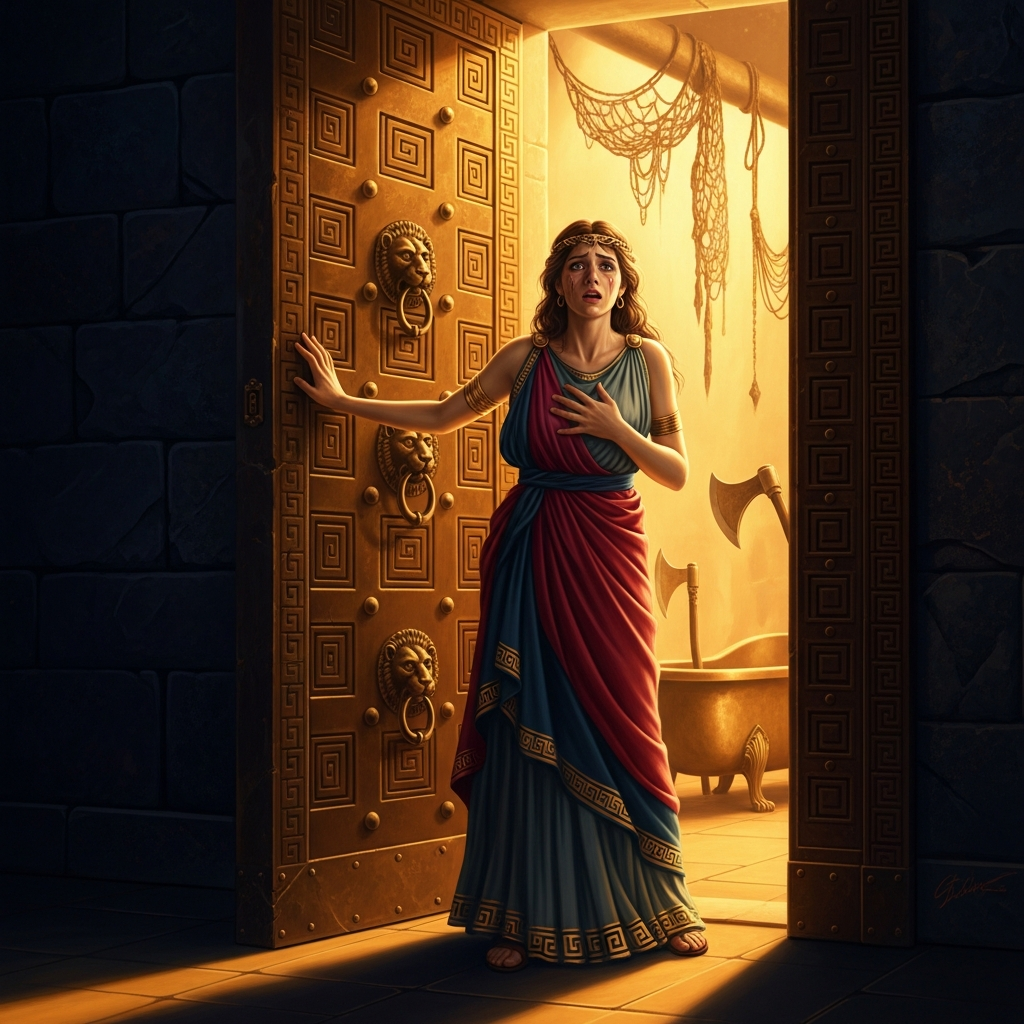
She speaks in cries first. Wordless. Otototoi. Apollon. Apollon. She is reading the air of the palace. She is reading the stones. She is reading the smoke from the altars in the inner courtyard. She begins to describe what she sees: children, butchered at a table, their hands and feet on a platter — the long-ago feast of Thyestes, still in the walls. Then she describes what is happening now: a woman in the bath, holding a net. A man — a great man — in the bath, tangled in the net. An axe coming down.
She describes her own death, in passing, as a footnote.
The chorus does not understand. They never understand Cassandra. That is the curse Apollo gave her — perfect prophecy, never believed — and she has lived inside it since girlhood. She tells them her gift will end this evening: she will see one more thing, and then she will be free.
She climbs down from the chariot.
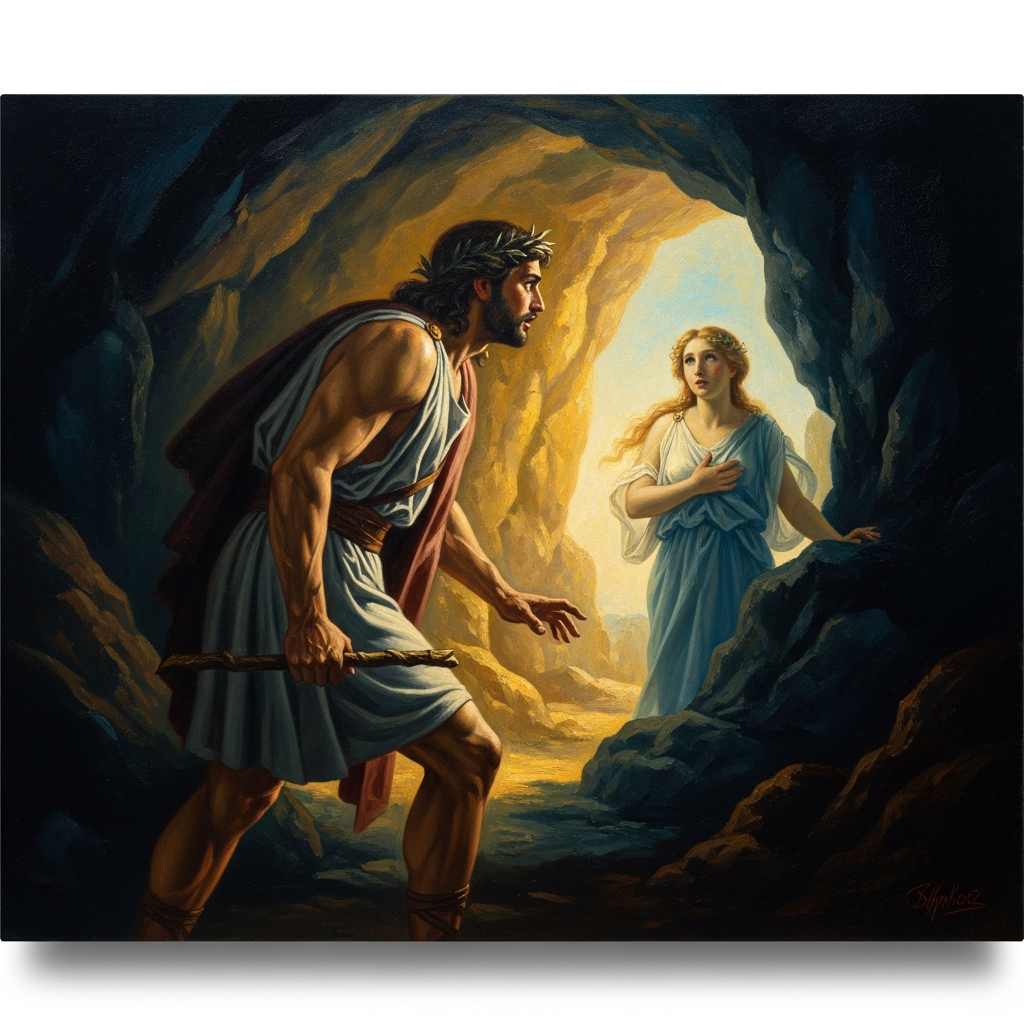
She walks to the palace door. She turns. She looks at the chorus and at the watching audience. I go to my death, she says. Not weeping. Like a Greek girl, not like a slave. She crosses the threshold.
A scream comes from inside the palace.
Aeschylus stages the murder by sound and then by tableau.
Inside the palace — the audience cannot see it, only hear it — Agamemnon is in the bath. Clytemnestra is helping him, or appearing to. She has woven him a magnificent robe to put on after, in his honor. She holds the robe up. He raises his arms to put it on. The robe has no openings — it is a bag, a net, sewn shut where the head and arms should pass — and as he raises his arms it falls over him and entangles him. He is suddenly blind, in the bath, his arms tangled.
She strikes him with an axe.
Three blows, the chorus will report. The first to the head. The second to the chest as he goes down. The third — she has a habit of one extra — for Hades, whose dues are owed.
The bath fills with blood.
Then Clytemnestra walks back out through the palace door. The doors are pushed open from inside. She stands there, axe in her hand, the body of Agamemnon visible on the floor behind her in the tangle of the netted robe, the body of Cassandra on the floor beside him.
She is not hiding.
She speaks to the chorus. She speaks to the city. She tells them, in a long speech of terrible clarity: Yes, I did it. I planned it. I do not deny it. He killed my daughter. I have killed him. Justice is satisfied. He is in the bath and his concubine is on the threshold and the household has its own back at last.
The chorus is appalled.
They argue with her. They invoke the dead king. They predict that vengeance will come for her, that her son Orestes — sent away as a child — will return one day and balance the scales again.
Clytemnestra is not frightened. She has thought about this. She believes she has stopped the cycle, not extended it. She and Aegisthus emerge together to take the throne, and they tell the city — half-promising, half-threatening — that the bloodshed is over.
It is not.
The next play of the trilogy will bring Orestes back. The play after that will bring the Furies and the trial at Athens. The trilogy will end, eventually, with Athena instituting the jury court — twelve human votes, with the goddess casting the deciding vote, replacing forever the rule of vendetta.
But all of that is future.
Tonight, in 458 BCE, on the slope below the Acropolis, the audience watches a king come home from a ten-year war, walk on a purple cloth, take a bath, and not come out. The watchman on the roof was right. The ox was on his tongue. The house, if it could speak, did speak — through the woman who had been sharpening this evening for ten years, holding it like a knife under her dress, walking around the palace with it pressed against her ribs, smiling at every visitor, until tonight, when at last she could let it out.
Scenes
On the palace roof at Argos, the watchman has been waiting ten years
 Generating art…
 Clytemnestra unrolls the royal purple at her husband's chariot — the carpet no mortal should walk on, the carpet he walks on
Generating art… Cassandra stands at the palace door and refuses to enter — she sees what waits inside, the bath, the net, the axe — and then she enters anyway
 Generating art…
 Echoes Across Traditions
Entities
- Agamemnon
- Clytemnestra
- Aegisthus
- Cassandra
- The Watchman
Sources
- Aeschylus, *Agamemnon* (458 BCE)
- Richmond Lattimore (trans.), *The Complete Greek Tragedies: Aeschylus I* (1953)
- Robert Fagles (trans.), *The Oresteia* (1975)
- Anne Carson (trans.), *An Oresteia* (2009)
- Simon Goldhill, *Reading Greek Tragedy* (1986)
- Hugh Lloyd-Jones, *The Justice of Zeus* (1971)
- Oliver Taplin, *The Stagecraft of Aeschylus* (1977)