Contents
Empedocles of Akragas declares himself a god, wears gold sandals and a purple robe, and performs miracles that his disciples believe implicitly. Then he walks to the lip of Mount Etna and steps in — or falls, or leaps, or performs a rite. One iron sandal is later found at the crater's rim. The legend is the philosophy.
- When
- c. 490-430 BCE
- Where
- Akragas and Mount Etna, Sicily
He arrives in a town and people line the road.
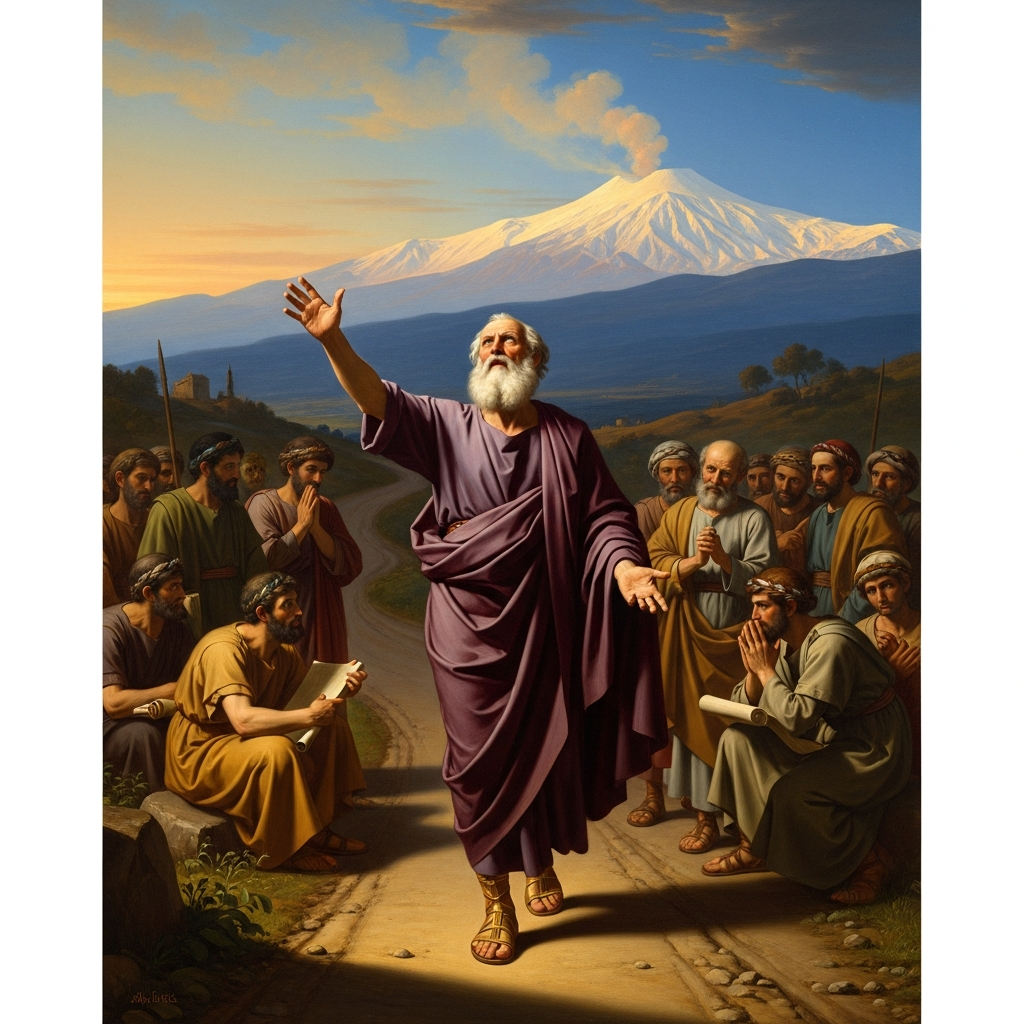
This is not unusual for philosophers in the fifth century BCE — Pythagoras was worshipped in Croton; Parmenides was elected to office in Elea — but the scale of it is unusual even by the standards of the time. They reach out to touch his robe, which is purple, which is the color of royalty and of ritual. His sandals are gold, or bronze finished to look like gold, which catches the Sicilian sun in a way that requires a squint. He has a laurel wreath. He has disciples who walk slightly behind him in a formation that suggests procession rather than conversation. They are writing down everything he says.
He says: I am an immortal god, no longer mortal, honored among all, as is fitting, crowned with headbands and flowering garlands. Whenever I come to flourishing cities, I am reverenced by all, men and women alike.
He means this. This is the difficult thing about Empedocles — the thing that makes him different from Socrates, who was ironic about his wisdom, or Plato, who was careful about his metaphors, or Aristotle, who was scientific about his claims. Empedocles means exactly what he says. He believes he is divine. He believes he has been a bush, a fish, a bird, a boy, and that the current incarnation — this particular assembly of fire and water and earth and air, held together by Love and tending toward separation by Strife — is the last before he steps back into the immortal category permanently.
He is fifty years old or sixty, the sources disagree. The volcano is visible from everywhere on Sicily on a clear day.
The philosophy comes from the body.
Empedocles is the first person in Western thought to systematically describe the physical world in terms of elements and forces. There are four rhizomata — roots, he calls them, not elements, not yet — fire, water, earth, air: eternal, unchanging, neither created nor destroyed, present in different proportions in every compound thing. Blood is a particular ratio of all four, roughly equal. Bone is two parts earth, two parts water, four parts fire. The cosmos is these four, combined and separated in cycles by the two great cosmic forces: Love, which draws unlike things together, and Strife, which drives them apart.
This is a cosmology and also a description of experience. You have loved and felt things combining. You have been lost in grief and felt things pulling away from each other. Empedocles is not being metaphorical when he calls the forces Love and Strife; he thinks the name is accurate. The force that makes blood cohere into a living body and the force that makes you reach toward another person in the dark are the same force. Eros, cosmic and personal and chemical, is one thing operating at different scales.
When Strife had fallen to the lowest depth of the vortex, and Love had reached the center of the whirl, in it do all things come together so as to be one only. This is the paradise state — the Sphairos, the great sphere, where Love has overcome Strife and all four roots have merged into a single undifferentiated whole. Then Strife re-enters. Then separation begins again. Then we have a cosmos — distinguishable things in space and time, some of them alive, some of them aware, none of them permanent.
He teaches this on the road. He teaches it while walking, while eating, while performing the rituals that his disciples have come to expect and that he has apparently ceased to distinguish from philosophy.
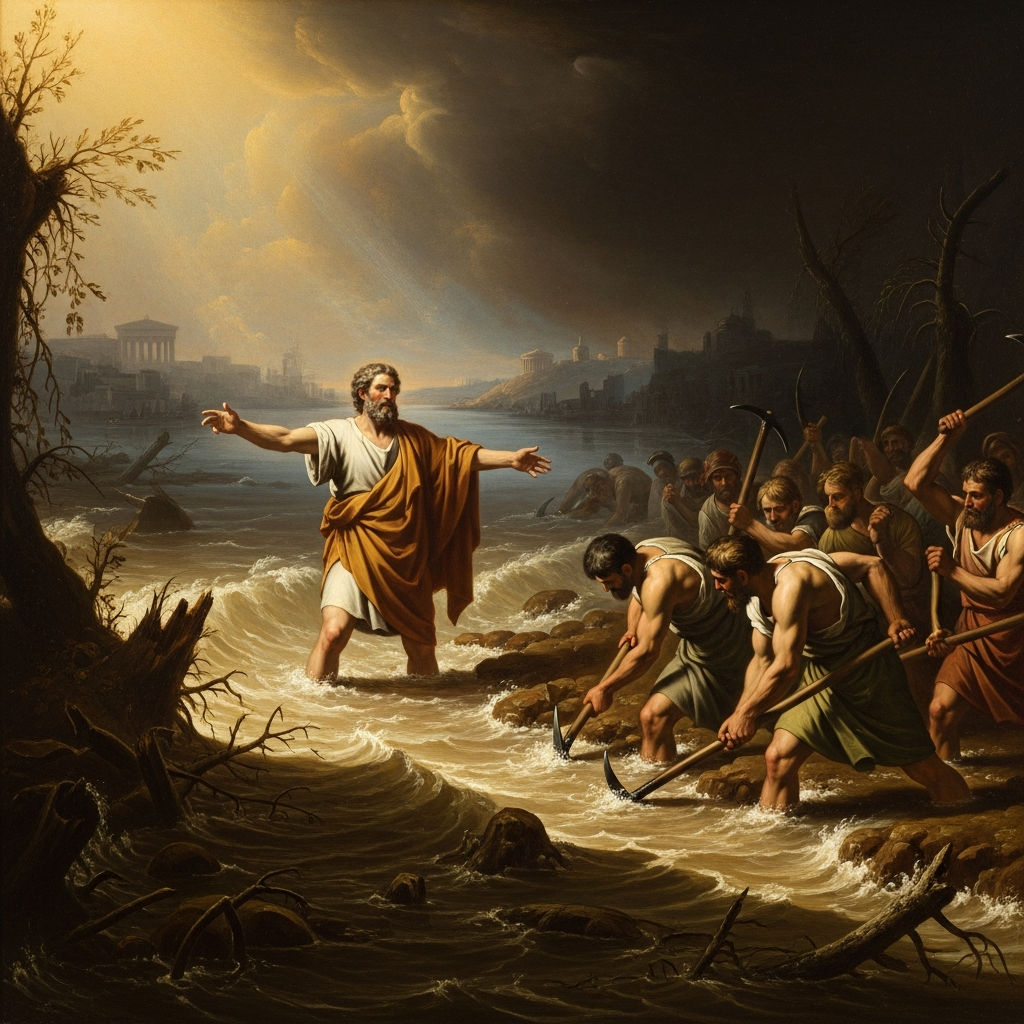
He cures the plague at Selinunte by diverting the rivers.
The city of Selinunte is built in a marsh where two rivers converge, and every summer the marsh produces fevers, and eventually the fevers kill enough people that the city commissions someone to fix it. Empedocles engineers a drainage channel — physical work, surveying and cutting and diverting water at considerable expense — and the fevers stop. He is celebrated as a wonder-worker, a divine healer, a man who commands the forces of the physical world because he understands them more completely than anyone else alive.
He does not correct the interpretation. I know that in these verses I shall teach you about all the drugs that are a defense against evils and old age; for you alone I will accomplish all this, and I will stop the force of the unwearying winds which rush upon the earth with their blasts and lay waste the fields of grain — and again, if you wish, you will lead back the winds in requital. You will cause a timely drought after the dark rains for men, and again you will cause after the summer drought tree-nourishing floods. He says he can stop the winds by sewing up the carcasses of donkeys on the hilltops, and the winds are stopped, and whether or not the donkeys are causal nobody can say for certain.
He raises a woman from the dead, or revives a woman who was in a trance state so deep that her physicians called her dead. He retains warmth in her body for a month by covering it with blankets and controlling the room temperature, and then she breathes again, and this is either medicine or miracle and Empedocles declines to specify the difference.
His disciples write it all down. The scroll grows longer. The volcano is always there, above the plain of Catania, above the green terraces of Etna’s lower slopes, white in winter, smoking in summer.
Before the rim, he explains himself.
He is not secretive about the intention. He assembles the disciples — accounts vary from a few to several hundred — on the slope below the crater, in the late afternoon when the light on the rock face is the color of cooling lava. He has been preparing this for some time, or possibly he has been preparing it for several lifetimes, depending on how seriously you take the doctrine of transmigration that he has been teaching since his twenties.
He says: the four roots are eternal. Love and Strife are eternal. The soul that has risen through enough incarnations — bush, fish, bird, boy, philosopher — has worked its way back to the condition it held before the first separation, before Strife entered the Sphairos and began tearing the one into the many. He has arrived at that condition. He is returning to the fire that was there before the first separation.
He might be talking about death as a philosophical proposition. He might be talking about an actual volcanic ritual — Etna was sacred, fire was the root he associated most closely with the divine — and the leap might be intended as a sacrificial act, a return of the god’s embodied form to the element that preceded embodiment. Or: he slips. The rim of a volcano in sandals is not a stable surface, and Empedocles is old and the sandals are bronze and the pumice crumbles.
He goes in. His disciples watch. They do not follow.
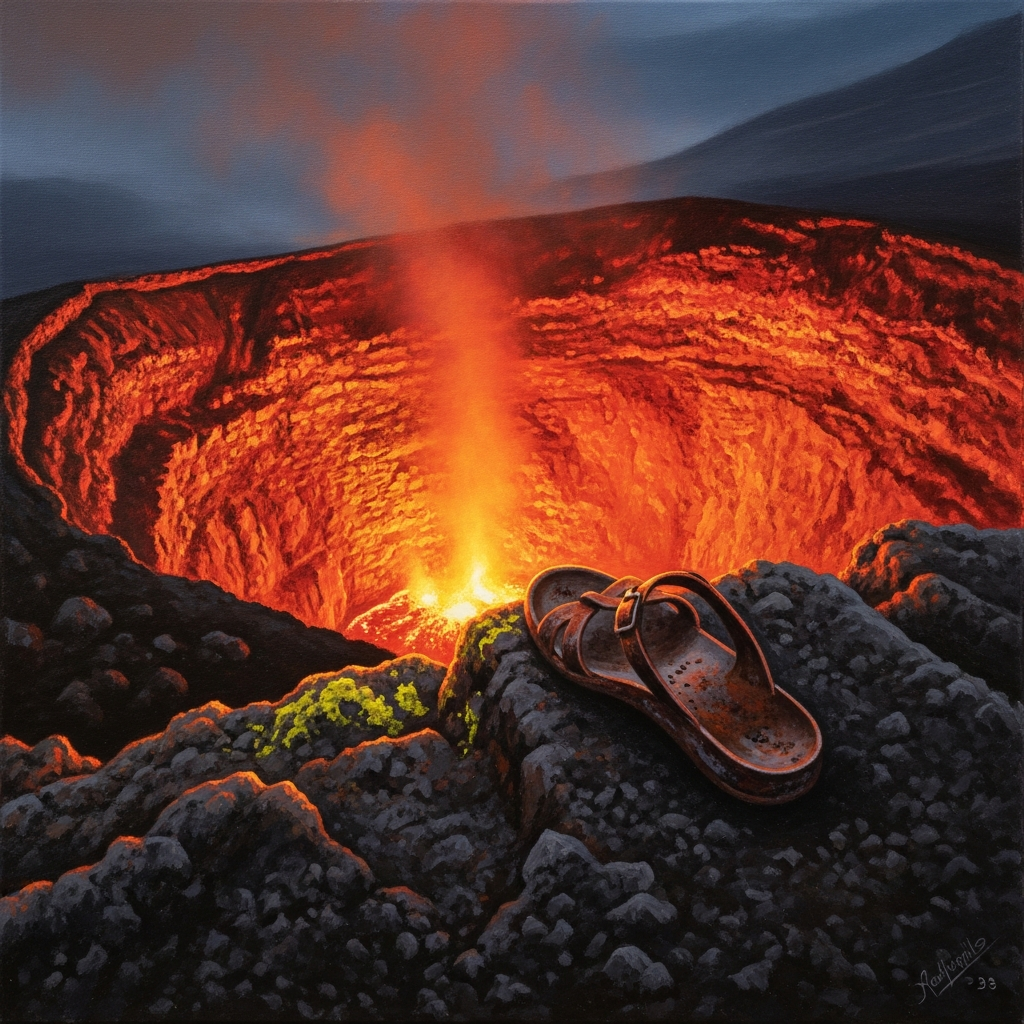
One iron sandal is found later at the crater’s edge. The sources agree on this — Diogenes Laertius, Timaeus, the hostile Heraclides who claims the whole thing was a fraud intended to make the disciples think their teacher had ascended to godhood. The sandal is the only physical evidence. It is the most eloquent artifact of early Greek philosophy.
The legend outlives the sandal.
Matthew Arnold writes a poem in the nineteenth century: Empedocles on Etna, the philosopher’s final monologue before the leap, melancholy, Victorian, completely at odds with the man the fragments describe. The fragments describe someone in a state of ecstatic certainty, not Victorian doubt. The real Empedocles was not melancholy. He was the opposite of melancholy. He was a man convinced he had solved the problem of existence and was taking the solution to its logical endpoint.
His cosmology survives in fragments, collected and argued over by scholars for two and a half millennia. His four elements become the basis of Greek medicine — Hippocrates, Galen, the whole tradition of humoral theory is built on Earth, Water, Fire, Air. His Love and Strife become Aristotle’s efficient causes and eventually, long down the chain, Newton’s attraction and repulsion, the fundamental forces of physics. He was wrong about the elements and almost certainly wrong about personal immortality and wrong about the transmigration of souls, and he was doing something recognizable as physics and biology and psychology in a period when nobody else had found the vocabulary for any of those things.
He put on a purple robe and gold sandals and walked the roads of Sicily explaining the cosmos to anyone who would listen, and at some point — by intention, by accident, by the ordinary failure of footing that kills most climbers — he crossed from the outside of the mountain to the inside.
The disciples, watching, saw what they were equipped to see.
He ascended, they wrote.
There is a version of the Empedocles story in which he is a fraud — an actor playing a god for the credulous, arranging his disappearance at Etna to complete the performance. Heraclides argued this. The iron sandal, in this version, is a prop.
But the fragments make the fraud reading untenable. The thinking is too good, too systematic, too genuinely in advance of its time. You do not do that quality of physics as a sideshow. The philosophy and the gold sandals are the same project: the man believed that understanding the cosmos correctly would eventually dissolve the boundary between the one who understands and the thing understood.
He was trying to think his way back to the Sphairos — the sphere of perfect Love, before Strife, before the four roots separated into a world of distinguishable things. He thought you could arrive there alive, or that arriving there was what living was for.
The mountain took him. Whether that was the plan, and whether the plan worked, is exactly the question Empedocles would have wanted you to leave open.
Scenes
Empedocles in his purple robe and gold sandals on a Sicilian road, disciples behind him in a crowd
 Generating art…
 Two rivers in flood converge at the edge of Akragas
 Generating art…
 The rim of Etna at dawn — sulfur, red light, the drop into fire
 Generating art…
 Echoes Across Traditions
Entities
- Empedocles
- the Four Roots
- Love
- Strife
Sources
- Diogenes Laërtius, *Lives of the Eminent Philosophers*, Book VIII (c. 230 CE)
- Jonathan Barnes (ed.), *Early Greek Philosophy* (Penguin, 1987)
- Peter Kingsley, *Ancient Philosophy, Mystery, and Magic: Empedocles and Pythagorean Tradition* (1995)
- M.R. Wright, *Empedocles: The Extant Fragments* (1981)