Contents
Zeno of Elea arrives in Athens with his teacher Parmenides to defend the most radical claim in the history of philosophy: motion is an illusion, the senses lie, and the real world is a single eternal motionless One. The Athenians in the agora want to stone him. Pericles defends him. The mathematics holds.
- When
- c. 450 BCE
- Where
- Athens; originally Elea (southern Italy)
The arrow is in the air.
Zeno points up at nothing — there is no arrow; the arrow is a thought experiment, and thought experiments do not require props — and he says: at this instant, the arrow occupies a particular position. It fills exactly the space it fills. It is exactly as long as it is. It has not moved yet, in this instant, and it will not move yet, in this instant, because the instant is a point, and a point has no duration, and motion requires duration.
Now: at the next instant, the same is true. The arrow occupies a position. The arrow fills a space. In that instant the arrow does not move. And so at every instant of the arrow’s supposed flight, the arrow is stationary. And the flight is composed entirely of instants. And if the arrow is stationary at every instant, the arrow is stationary throughout its flight.
The Athenian standing nearest to Zeno, a leather-worker from the Kerameikos with dust on his hands and a wholly practical mind, says: but the arrow moves. I have seen arrows move. I have been cut by an arrow.
Zeno says: yes, and?
The leather-worker says: so your argument is wrong.
Zeno says: your sense experience says it moves. My argument says it cannot. Which of these is more reliable — your senses, which have deceived you before, or the logic, which does not contradict itself?
The crowd around them is getting larger.
He came to Athens with his teacher Parmenides.
Parmenides is the source of the problem, or the source of the solution, depending on where you stand. Parmenides of Elea, sixty-five years old, white-haired, the founder of what will later be called the Eleatic school, has written a philosophical poem in hexameters — the meter of Homer, deliberately chosen — in which a goddess leads him on a journey and shows him two roads: the Way of Truth and the Way of Seeming. The Way of Truth says: Being is. Non-being is not. What is is one, eternal, unchanging, undivided, complete like a sphere. The Way of Seeming says: here is the world you think you live in, full of change and motion and plurality, and all of it is doxa, opinion, the unreliable testimony of unreliable senses.
Parmenides means this. He is not being poetic. He believes the world you see is wrong — not imprecise, wrong, a fundamental misapprehension of what is actually the case. What is actually the case is: one thing, unchanging, forever. All appearances of change and motion and multiplicity are appearances only, projected by sense organs that are not epistemically trustworthy.
Zeno is his student and his defender and possibly his lover — the sources differ on the last point, delicately. What they agree on is that Zeno came to Athens specifically to defend Parmenides’s position against the Athenian philosophers who had been making fun of it, and that his method of defense was counterintuitive: instead of arguing positively for the One, he constructed paradoxes showing that the opposite position — that motion and plurality are real — leads to contradictions just as bad or worse.
You say the arrow moves? Here is what motion requires. You say Achilles catches the tortoise? Here is why that requires infinite steps. You say you can cross the room? Here is the infinite series you must complete first.
He is not claiming these paradoxes are physically accurate. He is claiming they are logically valid — that the common sense picture of reality contains internal contradictions that you have not noticed because you have been trusting your eyes instead of your reason.
The tortoise is the most famous.
Achilles gives the tortoise a ten-meter head start, and he runs ten times faster, so he should catch it easily. But: to catch the tortoise, Achilles must first reach the place where the tortoise was when he started. By the time he gets there, the tortoise has moved. He must now reach that place. The tortoise has moved again. At every step, Achilles closes the gap by ninety percent, but the gap never reaches zero — it halves and halves and halves and the tortoise always has a lead, however small. There are an infinite number of steps between Achilles and the tortoise, and infinite steps take infinite time.
The leather-worker from the Kerameikos says: but Achilles does catch the tortoise. I have seen races. This is absurd.
Pericles, who has been standing in the back of the crowd since Zeno began and who is the most politically powerful man in Athens and who has been studying philosophy privately for a decade under Zeno and Parmenides themselves, says: can you show him where the argument goes wrong?
The leather-worker says: he is counting the steps wrong.
Pericles says: yes. Show him how to count them correctly.
The leather-worker cannot. The crowd cannot. Nobody in the agora can, on this particular afternoon in 450 BCE, show Zeno where the argument goes wrong, because the argument will not be resolved for two thousand years, when Leibniz and Newton invent calculus and establish that an infinite series can converge to a finite sum, that the infinite halvings add up to exactly one whole, that Achilles’s infinite number of steps takes exactly the finite amount of time you would expect.
Zeno does not know about calculus. Zeno knows only that nobody can answer him.
The anger is the interesting part.
Mathematics has made enemies before — Pythagoras’s disciples were allegedly murdered for revealing the irrationality of the square root of two, revealing that the beautiful numerical harmony of the cosmos contained an element that arithmetic could not contain — but the anger Zeno produces is different. The Pythagorean anger was religious: you have defiled a sacred secret. The anger in the agora is something closer to vertigo: you have told me something that makes the floor disappear.
If Zeno is right — if the paradoxes actually prove that motion is impossible — then the ground beneath the leather-worker’s feet is not moving the way he thinks it is moving, and the arm throwing the spear is not moving the way he thinks it is moving, and the sun crossing the sky is an illusion, and everything he has ever done or seen or experienced is a collection of false reports filed by unreliable instruments in the service of a mind that does not have access to reality.
Philosophy, for most Athenians, is a pleasant intellectual game. It sharpens the mind. It helps you argue in the law courts. It does not usually threaten to dissolve the world.
Zeno has brought a weapon.
Someone throws a stone at him — not a good throw, the stone lands short — and Pericles steps forward into the space between Zeno and the crowd, and this particular confrontation is over, because Pericles is not someone you throw a second stone at. He says something brief and authoritative, the way he always does, and the crowd disperses or thins, and Zeno picks up the stone that was thrown at him, turns it in his hand, and says: even this did not move.
He smiles when he says it. The sources agree on the smile.
He is arrested eventually.
Not for the paradoxes — for conspiracy against the tyrant Nearchus of Elea, back home, years later. He is tortured to reveal his co-conspirators. He bites off his own tongue to prevent himself from speaking. Or he bites off the tyrant’s ear. Or he reveals only the names of the tyrant’s own friends. The accounts are contradictory and dramatically incompatible, and the incompatibility is appropriate: the man who argued that nothing moves had a violent end, or several violent ends, depending on which source you trust, and his biographers have left the paradox there, unresolved, for anyone who wants to notice it.
The paradoxes themselves are still unresolved, in a sense. Calculus shows that infinite series can sum to finite values — Achilles does catch the tortoise, and we can show the arithmetic. But the philosophical question — whether space and time are made of points and instants, whether the infinite divisibility of space is physically real or merely mathematical — is still open. Quantum mechanics suggests that at the Planck scale, space and time may not be infinitely divisible after all. There may be a minimum interval below which the halving stops. Zeno may have been gesturing toward something real, at the wrong scale, with the wrong tools.
The arrow is in the air. At every instant it occupies exactly one position. The paradox has been standing in the agora for twenty-five hundred years, the crowd still gathered around it, still unable to walk away.
The leather-worker went home that afternoon and tried to demonstrate to himself that he could cross his own doorway. He crossed it. He tried to find the flaw in Zeno’s argument and could not. He crossed the doorway again. He did this several times. He felt worse, not better, each time.
This is the experience Zeno intended to produce. Not certainty, not peace — productive vertigo, the sensation of a mind that has registered a problem it cannot yet solve. Socrates called this aporia. Zeno’s version was more violent: he wanted the floor to drop out and stay out, because only when the floor was gone would you start to build something better.
Achilles runs. The tortoise moves. The arrow flies. All three are real. The philosophy that explains why they are real did not exist until Newton and Leibniz, two thousand years later, invented the mathematics of limits and change.
Zeno was not waiting for Newton. Zeno was the condition Newton needed — the man who made the problem sharp enough to require solving.
Scenes
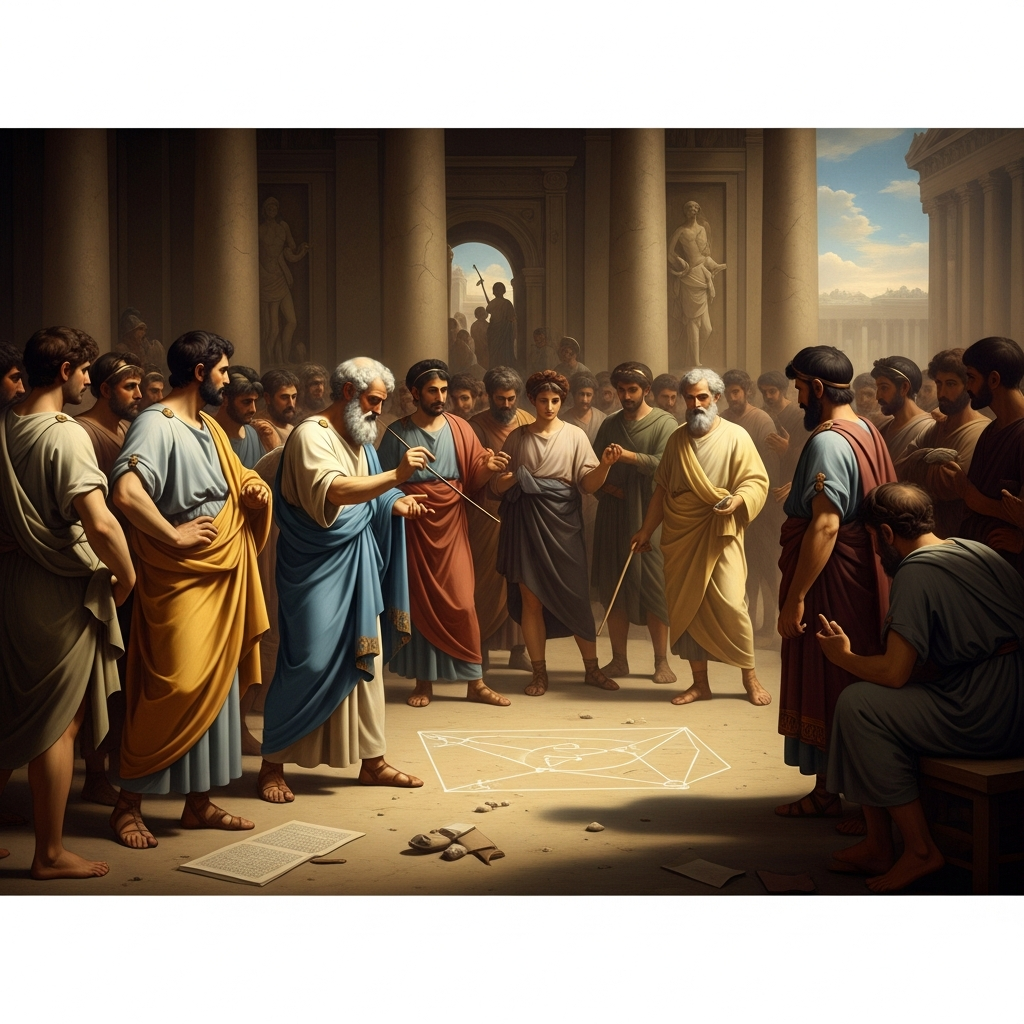
Zeno in the center of the agora, surrounded by Athenians, drawing a diagram in the dust with a stick
 Generating art…
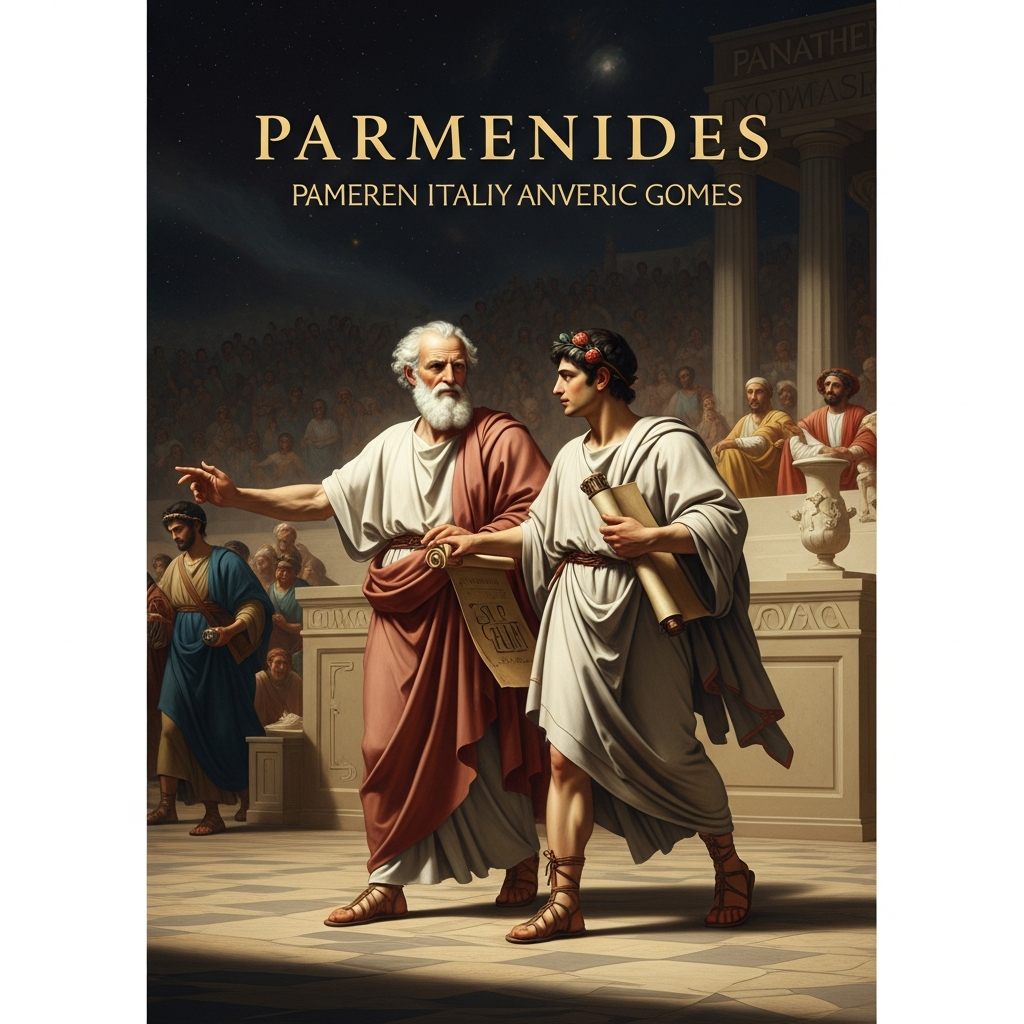
 Parmenides and Zeno arriving at the Panathenaic games — the old man white-haired and deliberate, Zeno younger, carrying a scroll, both of them from a small southern Italian city nobody has heard of, about to change philosophy forever
 Generating art…
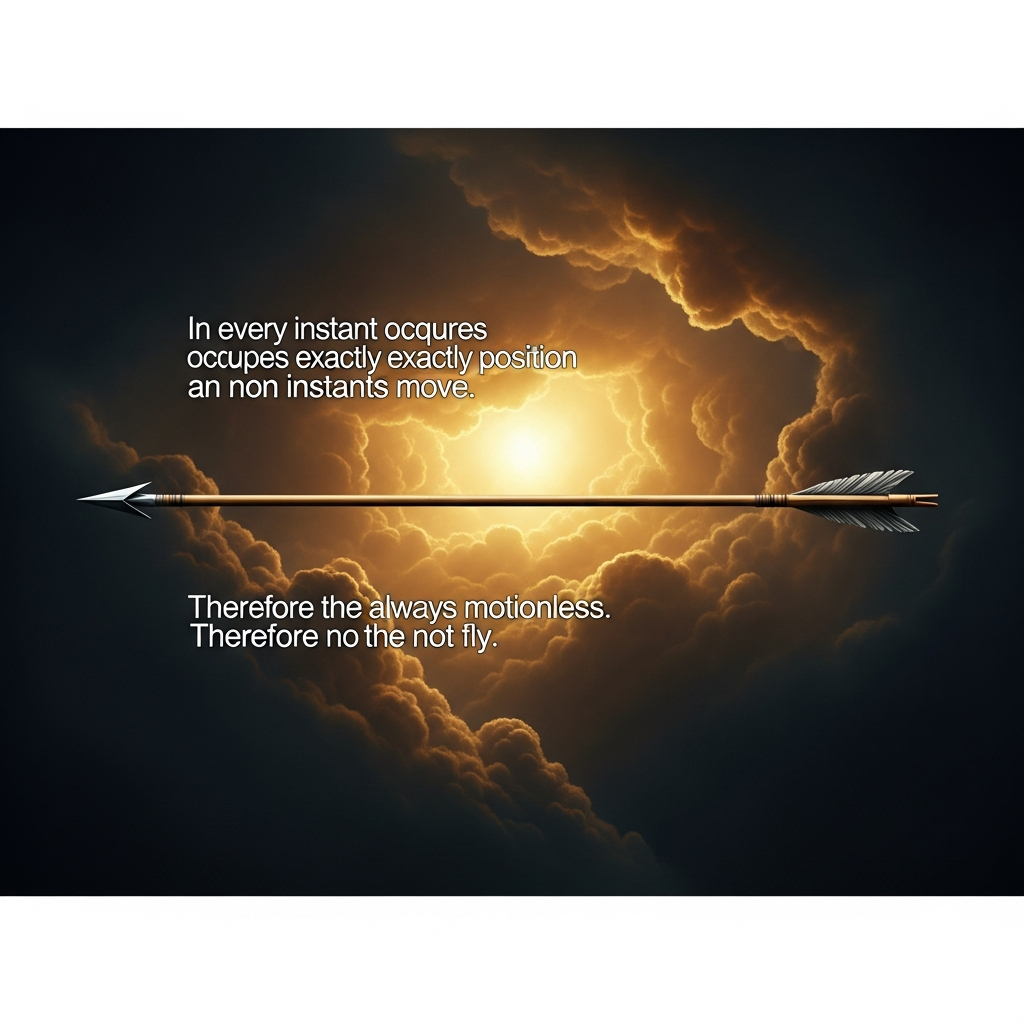
 An arrow at the midpoint of its flight, frozen in the instant between nock and target
 Generating art…
 Echoes Across Traditions
Entities
- Zeno of Elea
- Parmenides
- Pericles
- the One
Sources
- Aristotle, *Physics* Books VI and VIII (c. 350 BCE)
- Plato, *Parmenides* (c. 370 BCE)
- Wesley Salmon, *Zeno's Paradoxes* (1970)