Antigone: The Unwritten Laws
c. 441 BCE · Sophocles's performance at the Theatre of Dionysus, Athens · Thebes — the palace gate, the unburied field beyond the walls, the cave outside the city
Contents
The battle for Thebes is over. Both brothers are dead — Eteocles defending the city, Polynices attacking it. Creon, the new king, decrees: Eteocles will be buried with full honors; Polynices will lie unburied, exposed to dogs and birds, his soul barred from the underworld. Antigone, their sister, buries Polynices anyway. Caught, she stands before Creon and refuses to apologize. There are laws, she tells him, older than yours.
- When
- c. 441 BCE · Sophocles's performance at the Theatre of Dionysus, Athens
- Where
- Thebes — the palace gate, the unburied field beyond the walls, the cave outside the city
The battle ended yesterday.
The seven-gated city has held. The army of the Argives has been driven off. Eteocles, defender of Thebes, lies in state in the palace, washed and oiled, ready for the rites that will speed his soul to the place of the dead. Polynices, attacker of Thebes, his own brother, lies on the field where he fell — and Creon’s first decree as king is that he will stay there.
No burial. No coin under the tongue. No dust scattered. The body will lie in the sun until the dogs come for it, and after the dogs the birds, and after the birds the worms, and the soul that depended on the body’s burial for safe passage to the underworld will wander the upper air forever, neither alive nor properly dead.
Anyone who tries to bury Polynices, the proclamation says, will be stoned in the public square.
Creon believes this is statesmanship. The civil war has ended; the rule of law must be reestablished; the traitor must be made an example. He has lost a nephew on each side and he has chosen which one to honor. The man who defended the city is a hero. The man who attacked it is meat.
It is a coherent position. It is also wrong.
Antigone wakes her sister Ismene before dawn.
She speaks fast, in the dark. Did you hear what Creon has decreed? Our brother is being eaten where he fell. There will be no rites. We have to go bury him.
Ismene is afraid. We are women. We are not made to fight with men. The state has spoken. What can we do against the state?
Antigone says: We can bury our brother.
Ismene begs her to wait. To think. To accept what cannot be changed. Antigone refuses. She has already decided. She tells her sister: If you will not help me, then keep silent — and I will hate you for the silence as much as I would hate you for betraying me.
She goes alone, in the half-light, with a clay jar of water and a handful of earth. She finds Polynices where the carrion-watchers have not yet driven the kites away. She washes the body. She pours libation. She covers him with three handfuls of dust — the minimum the rites require, the symbolic burial that releases the soul.
It is a small gesture. It is enough.
The guards find the body covered.
They are terrified. They draw lots to decide which one will tell the king, because the king has been clear about what happens to anyone who fails him. The losing guard goes to the palace and stands in the throne room shaking, and Creon — already suspicious that some Theban faction is testing him — orders the body uncovered and the watch doubled.
By midday the dust has been swept off. By afternoon the smell is back. By evening Antigone returns.
She does not hide. She comes out of the heat-shimmer toward the body and pours libation again, openly, in full view of the watching guards. They take her. She does not resist. They march her into the palace, and she stands before her uncle the king, and Creon asks her — almost hoping she will deny it — whether she did this thing.
She says: Yes. I did it. I do not deny it.
Creon: Did you know it was forbidden?
Antigone: Of course I knew. The whole city knows.
Creon: And you dared to break the law?
And here Antigone gives the speech that has echoed for two and a half thousand years:
Your law? Yes. But not the law of Zeus, nor the Justice that lives below with the gods of the dead. They did not make these proclamations. I do not believe your edicts have force enough to override the unwritten and unfailing laws of heaven. Those laws are not of today or yesterday. They are eternal, and no man knows when they were first set forth. I was not going to face the gods’ judgment for fear of any man.
She has named the conflict. There are two laws. Creon’s is written; the other is not. Creon’s was passed yesterday; the other has always been. Creon’s punishes its violators with stones; the other punishes its violators with the silent disapproval of the dead. Antigone has chosen which she fears more.
Creon does not hear her.
He hears defiance. He hears a woman publicly humiliating him in his own throne room. He hears the city laughing at him if he lets her live. No woman shall rule me while I live, he says. He sentences her to be walled alive in a cave outside the city — not killed by the state directly, because the state cannot afford the pollution of her blood, but left to die by exposure, with a small ration of food so the gods cannot say she was murdered. A technical execution. A legal evasion.
His own son Haemon — Antigone’s betrothed — comes to him to plead.
Haemon does not start with rage. He starts with reason. He tells his father: The city does not agree with you. The people are saying she should be honored, not punished. Listen to them. Wisdom is to know when you are wrong.
Creon: Are you taking the side of a woman against your father?
Haemon: I am taking the side of justice against a tyrant.
The argument escalates. Haemon storms out, and his last words are that his father will never see him again.
Tiresias arrives.
The blind prophet does not come unless the situation is grave. He has already seen what is happening at the altars: the birds will not eat the offerings, the fires will not burn properly, the gods of Thebes are turning their faces away because the city is polluted. The pollution has a source: a body unburied in the field, a living woman walled in a cave.
He tells Creon: Reverse it. Bury the dead man. Free the living woman. The gods are giving you one chance.
Creon, finally, hears.
He runs. He sends men ahead with shovels to bury Polynices first — duty to the dead before duty to the living, even now — and then to the cave to break down the wall.
He arrives too late.
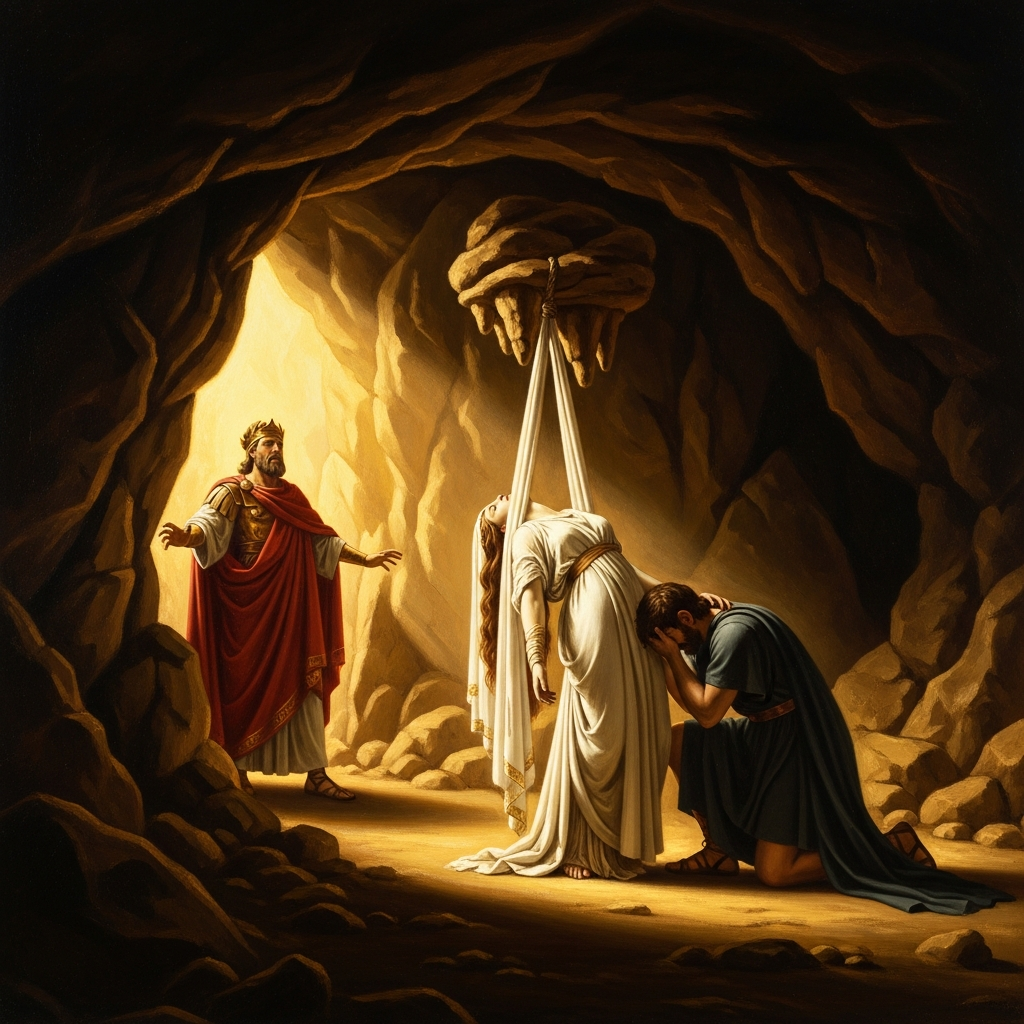
Inside the cave, Antigone is hanging from her own veil.
She has not waited for slow death by starvation. She has chosen the time and the means herself, taking even that authority away from Creon. Her body is suspended in the half-light of the cave mouth, her feet a few inches above the rock, the linen of her wedding-veil knotted at her throat.
Haemon is at her feet.
He has already broken in. He is holding her around the legs, his face pressed against her dead body, and when his father appears at the cave entrance he turns and looks at him and draws his sword. Creon flinches. Haemon does not strike his father. He turns the sword on himself and drives it into his own ribs and falls forward across Antigone, and his blood runs down the cave wall in the same line as her hanging shadow.
Creon carries his son’s body back to the palace.
His wife Eurydice meets him at the gate. She has already been told. She listens to him without speaking, walks back into the palace, and at the household altar she takes a knife and cuts her own throat. The messenger finds her there.
By nightfall, Creon has lost his nephew, his niece, his son, and his wife. He stands alone in the courtyard, holding the body of Haemon, surrounded by the corpses of his family, and the chorus says the line that closes the play:
There is no happiness where there is no wisdom. The proud, in old age, are taught to be wise.
Creon survives.
That is the cruelest detail in the play, and Sophocles is precise about it. The tyrant does not die. He is not killed by the gods. He is not killed by the people. He is not even killed by his own grief. He goes on living in the wreckage of everything his decree produced — the empty palace, the empty altar, the city that watched him be wrong.
Antigone is dead. She is also free. She has died on terms she chose, having done what the gods required, and her name passes out of Thebes into the speech of every later century: the woman who would not bow. The figure More will become at Tower Hill, that Hus will become at Constance, that King will become in a Birmingham cell writing on the margins of a newspaper.
The unwritten laws are still unwritten. They have not been codified. They cannot be voted on. They are still older than any king’s proclamation.
And every generation has to decide, again, whether to obey them.
Scenes
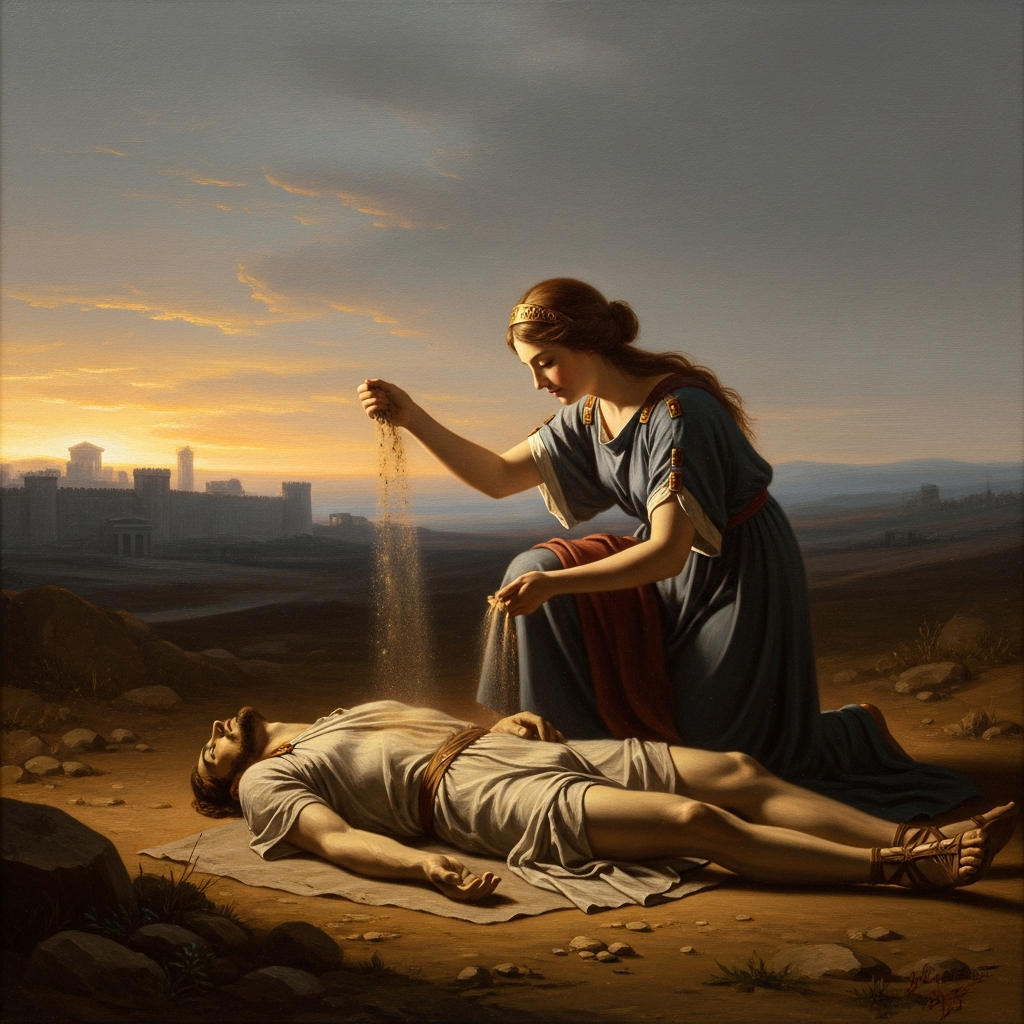
Antigone pours dust over her brother's body at dawn — a handful, a symbol, a death sentence
 Generating art…
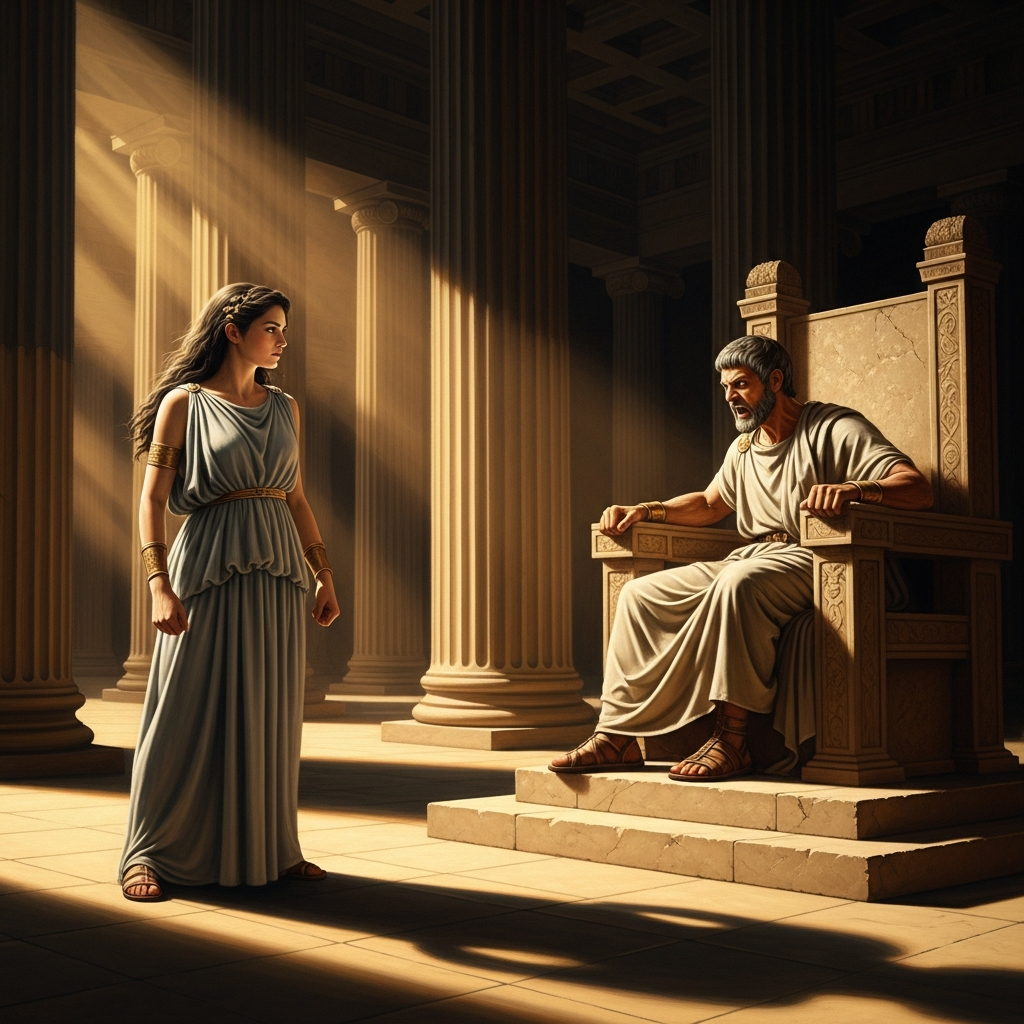
 Before Creon's throne, Antigone refuses to apologize: the unwritten laws of the gods stand above the written laws of men
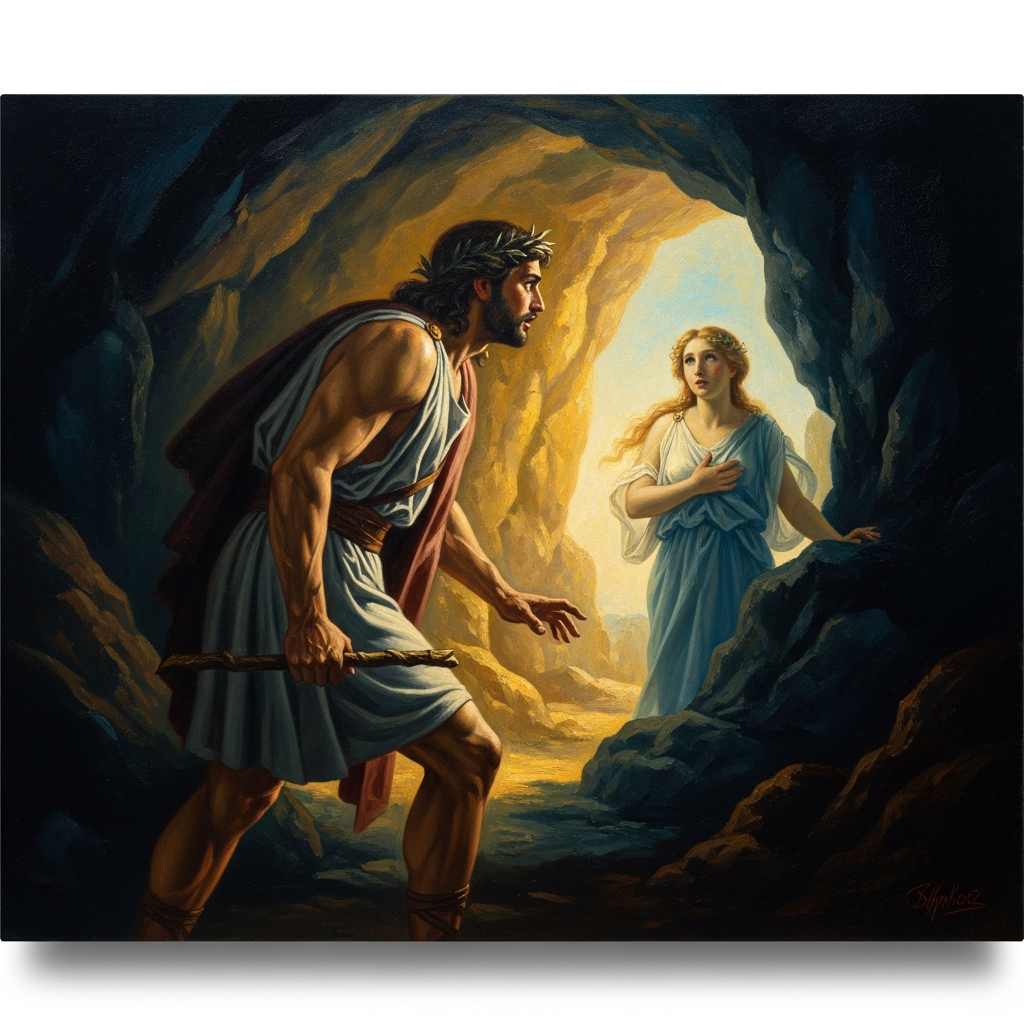
Generating art… Creon arrives at the cave too late — Antigone hangs from her own veil; Haemon kneels beside her
 Generating art…
 Echoes Across Traditions
Entities
- Antigone
- Creon
- Polynices
- Ismene
- Haemon
- Tiresias
Sources
- Sophocles, *Antigone* (c. 441 BCE)
- Richard Jebb (trans.), *Sophocles: The Plays and Fragments* (1891)
- Anne Carson (trans.), *Antigonick* (2012)
- Seamus Heaney (trans.), *The Burial at Thebes* (2004)
- G.W.F. Hegel, *Phenomenology of Spirit* §464-476 (1807)
- George Steiner, *Antigones* (1984)
- Bonnie Honig, *Antigone, Interrupted* (2013)