Medea: What Love Made and What Rage Unmade
c. 431 BCE · Euripides's *Medea* at the City Dionysia, Athens · Corinth — Medea's house outside the palace, the palace gates, the road from Athens
Contents
Medea has given everything. She betrayed her father, killed her brother, used her witchcraft to win Jason the Golden Fleece. She bore him two sons in exile. Now Jason is divorcing her to marry the princess of Corinth — for political advantage, he says, for the children's future. Medea plans her revenge with the precision of a surgeon: a poisoned robe for the bride, a fire that burns the palace, and then the final unthinkable act, the only blow that will reach Jason where he lives.
- When
- c. 431 BCE · Euripides's *Medea* at the City Dionysia, Athens
- Where
- Corinth — Medea's house outside the palace, the palace gates, the road from Athens
The nurse is the first to speak.
She comes out of the house in Corinth — the house Medea has been given as a kind of exile, a kind of shed, while Jason moves up the hill to the palace and the king’s daughter — and she speaks to no one, the way old slaves speak to the air, and what she says is: I wish the Argo had never sailed.
If the Argo had never sailed, Jason would never have come to Colchis. He would never have stood at the foot of the walls and asked Medea’s father for the Golden Fleece. Medea would never have seen him. The witch-princess of the Black Sea would have lived out her life as the priestess of Hecate she was raised to be, married to whatever local prince her father chose, dying at a normal age of a normal disease.
But the Argo did sail.
And Medea fell in love at first sight — Aphrodite’s arrow, in some versions; her own freely chosen passion, in others; Euripides allows it to remain ambiguous — and from that moment everything she did, she did for Jason.
She gave him the magic ointment that kept him from being burned by the fire-breathing bulls. She told him how to defeat the army of warriors that sprang from the dragon’s teeth. She drugged the dragon that guarded the Fleece. When her father pursued them, she killed her own brother Apsyrtus and scattered his body parts in the wake of the ship so her father would have to stop and gather the pieces for burial. When they reached Iolcus and Jason’s uncle Pelias refused to surrender the throne, she tricked Pelias’s daughters into boiling their father alive — telling them it was a rejuvenation spell — and they did it, and Pelias died, and Medea and Jason had to flee again.
Now they are in Corinth.
They have been here ten years. They have two sons. Medea is forty, perhaps, by the chronology of the play; Jason is older. And Jason has just announced that he is divorcing her to marry Glauke, daughter of King Creon of Corinth.
He has given her his reasons.
Jason’s speech to Medea is one of the most chilling in Greek literature precisely because it is reasonable.
He tells her: Be calm. This is for the best. Think of the children. If I marry Glauke, our sons will have royal half-brothers. They will be Corinthians, not foreign refugees. We will all be safer. I am not abandoning you — I will provide for you, and I will speak well of you to my new wife, and you should be grateful that a Greek man took you out of barbarian Colchis and brought you into civilization.
He believes this.
That is what Euripides understands and what makes the play unbearable. Jason is not a melodramatic villain. He is a sensible Greek man making a sensible Greek calculation: the political marriage advances the household; the foreign wife was always provisional; the right thing to do is to be polite about it. He has rationalized everything.
Medea listens. She does not scream. She does not weep yet — that comes later, and is itself a piece of theater. She listens to him explain that her decade of self-mutilation in his service was a transaction in which he held the upper hand, and she nods, and she begins to plan.
King Creon comes to her house.
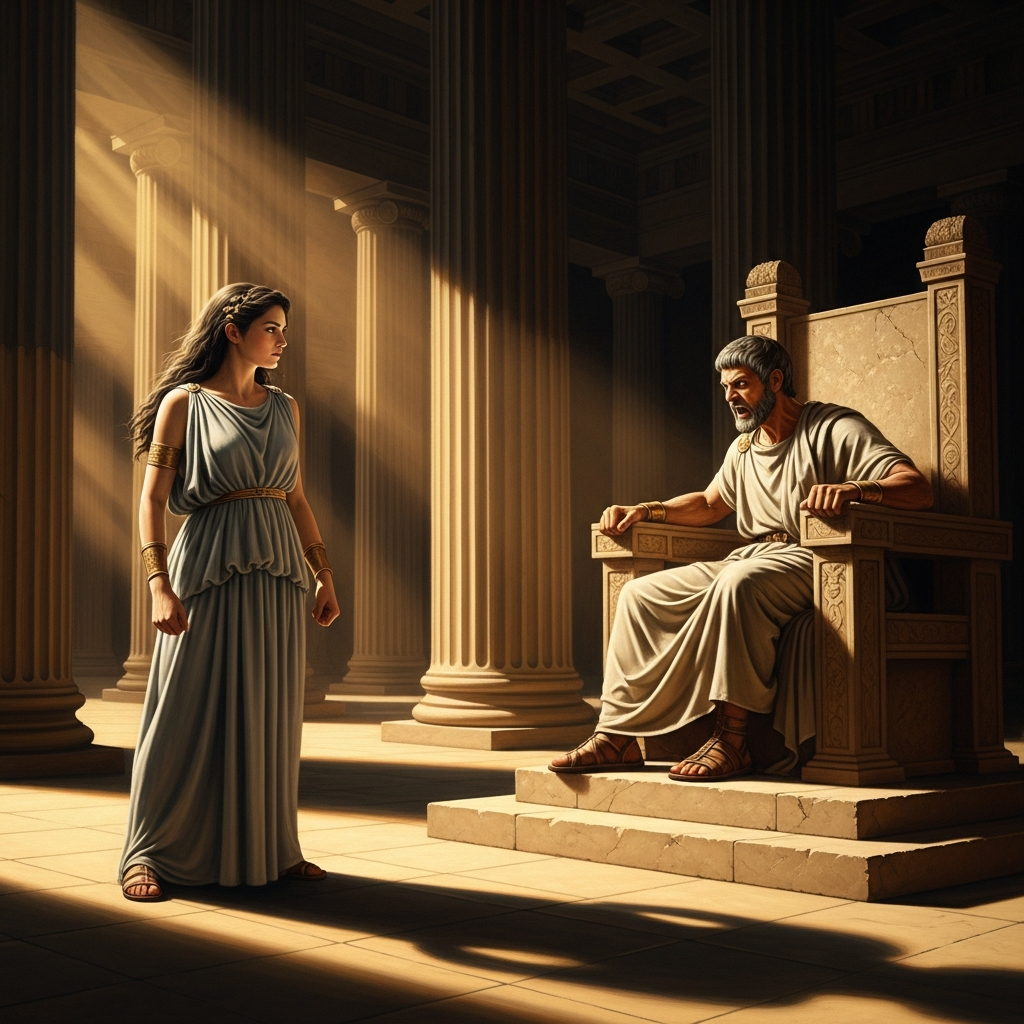
He has heard she has been making threats. He has been told she is dangerous — a foreigner, a witch, a woman with grievances — and he has come to inform her, personally, that she has one day to leave Corinth. He has decided this for the safety of his daughter and the new household.
Medea kneels.
She abases herself. She begs. She plays the broken woman, the abandoned wife, the mother of small children who has nowhere to go. She asks for one day — only one day — to make arrangements. Let me find a place where my sons can be received. Let me speak to a few people. Let me prepare for exile.
Creon, who is not a cruel man, agrees. He gives her one day.
He should not have.
She has the day.
A day is enough. By midday the plan is complete. She has a guest in the meantime — Aegeus, king of Athens, passing through on his way home from the oracle at Delphi. He has been told he is barren and is asking about it. Medea offers to cure him, with her drugs, in exchange for a promise: if I have to flee Corinth, will you give me asylum in Athens?
Aegeus swears the oath. Athens will receive her. She has her exit.
Now she only has to decide what to leave behind her.
The chorus knows what she is going to do before she does it.
Euripides gives Medea a long speech in which she debates with herself — the speech that fascinated Aristotle, that became a model for every soliloquy from Hamlet onward. She looks at her two children. She tells them she loves them. She tells herself that if she leaves them with Jason, they will grow up Corinthian, half-foreign, never quite belonging. She tells herself their lives will be cruel.
Then she tells herself the truth: if I kill them, I will hurt Jason as nothing else can.
She wavers. She sends the children inside, then calls them back. She holds them. She looks at their hands. She lets them go. She picks up the knife and puts it down. She picks it up again.
The Greek word she keeps using is thumos — spirited rage, the part of the soul that wants what it wants regardless of what reason argues. She tells her thumos: I know what I am doing. I know it is bad. I am doing it anyway.
It is the first scene in Western literature where a character explicitly chooses evil with full awareness, having considered the alternative.
She begins with the bride.
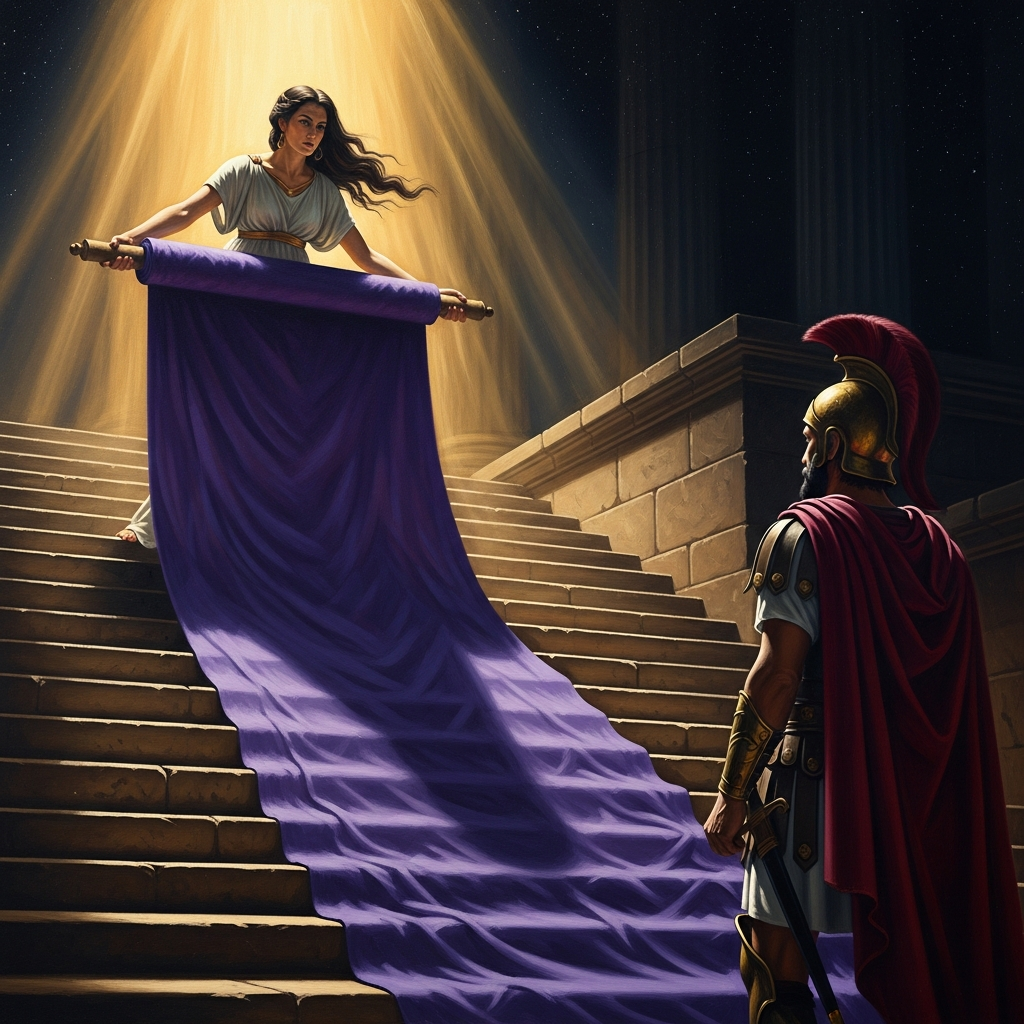
She sends her two sons to the palace with a wedding gift — a robe and a golden diadem, exquisite, royal, the kind of gift only an exile of high birth could give. The children carry the box up the hill. Glauke is at first reluctant; Jason persuades her; she opens the box; she puts on the diadem; she puts on the robe.
The poison Medea has woven into the cloth begins to work as soon as it touches her skin.
The diadem catches fire on her head. The robe melts onto her body. She runs through the palace screaming, and her flesh comes off in strips, and her father Creon — old, devoted, unable to think — runs to her and grabs her and the poison takes him too. They die together, fused, in a heap on the marble floor of the palace bedroom, and the palace begins to burn.
The messenger comes down the hill to tell Medea. She listens, calmly, and asks him to repeat the details. She wants the descriptions. She wants to know exactly how Glauke screamed.
Then she goes inside her house.
She kills the children offstage.
Greek theater does not show murders directly; it shows reports and consequences. We hear the boys scream from inside the house — Mother, no, Mother, please — and then we hear silence, and the chorus on stage covers their faces.
When Jason arrives, running from the palace, his new bride dead, his hair burning, his father-in-law dead, his political future destroyed — he is screaming for his children, hoping that Medea has not yet — and he pounds on the door of the house, and the door does not open, and he runs to break it down, and he stops.
He looks up.
Medea is on the roof.
She is in a chariot drawn by dragons — sent, in the play, by her grandfather Helios, the sun god, who will not abandon his line. The bodies of her two sons are across her lap. She is going to take them with her, even in death; she will bury them herself in Corinth’s sanctuary of Hera, and Jason will not be allowed to touch them.
Jason screams up at her. He says she is a monster. He says no Greek woman would have done what she did. He says she is the disease of the world.
Medea looks down at him.
She tells him: You are right. I am all of those things. I am also the woman who saved your life three times and bore you sons and loved you the way you have never been loved by anything else. You broke your oath to me, Jason. The gods of oaths are with me, not with you. You will live now. That is the punishment. You will go on living in the wreckage of yourself. I will go to Athens. The chariot of the sun is taking me there. We will not meet again.
The chariot rises.
Jason falls to his knees in the courtyard of his burning city, and the play ends with the chorus speaking the same words they will use at the end of Bacchae and Alcestis and Helen — the formula Euripides used five times to close his plays:
The gods bring many things to pass that no one expects. What was thought certain is not accomplished, and what was thought impossible the gods have found a way for. Such is the story we have witnessed today.
Medea reaches Athens.
Aegeus keeps his oath. She lives there for years. Eventually she will plot against his son Theseus — that is another story — and eventually she will return to Colchis, in some versions, and rule it. She does not die in Euripides’s play. She does not die in any version. She is one of the few figures in Greek tragedy who survives her own catastrophe and passes into the next story unpunished, untouched, riding her grandfather’s chariot.
The Greeks did not know what to do with her.
That is why she is still here. Twenty-four hundred years later, every generation finds in her something it cannot quite contain — the woman who gave everything, who was discarded politely, and who answered with a violence so total that the gods themselves chose not to intervene.
She did not have to die.
She had only to refuse to.
Scenes
Medea stands at the threshold of her exile-house in Corinth, watching Jason walk to the palace where he will marry another woman
 Generating art…
 By lamplight, Medea anoints the wedding robe with the poison that will kill Glauke when the cloth touches her skin
 Generating art…
 Above the burning palace, Medea ascends in the dragon-chariot of her grandfather Helios — the bodies of her sons across her lap, Jason screaming below, the gods refusing to stop her
Generating art… Echoes Across Traditions
Entities
- Medea
- Jason
- Glauke
- Creon of Corinth
- Aegeus
- The two children
Sources
- Euripides, *Medea* (431 BCE)
- Rex Warner (trans.), *Three Great Plays of Euripides* (1944)
- Diane Arnson Svarlien (trans.), *Euripides: Medea, Hippolytus, Bacchae* (2008)
- Robin Robertson (trans.), *Medea* (2008)
- Edith Hall, *Inventing the Barbarian: Greek Self-Definition Through Tragedy* (1989)
- Emily McDermott, *Euripides' Medea: The Incarnation of Disorder* (1989)
- Apollonius of Rhodes, *Argonautica* III-IV (3rd century BCE)