Orpheus: The Song That Almost Worked
Mythic time · canonical sources Virgil *Georgics* IV (29 BCE) and Ovid *Metamorphoses* X-XI (8 CE) · Thrace, the cave-mouth that descends to the underworld, the river Styx, the throne room of Hades, the long path back toward the light
Contents
Eurydice is dead. She stepped on a snake on the day of her wedding and died before nightfall. Orpheus — whose lyre stops rivers, whose singing makes stones weep — walks down to Hades to get her back. He plays for Charon, who weeps and rows him across. He plays for Cerberus, who sits. He plays for Hades and Persephone, who weep, and they grant his request on one condition: he must walk ahead, she must follow, and he must not look back until they reach the light. He walks. He cannot hear her. He turns. She is gone.
- When
- Mythic time · canonical sources Virgil *Georgics* IV (29 BCE) and Ovid *Metamorphoses* X-XI (8 CE)
- Where
- Thrace, the cave-mouth that descends to the underworld, the river Styx, the throne room of Hades, the long path back toward the light
It begins with a wedding.
Eurydice is in her bridal robe. She has finished the ritual at the altar of Hera; the blessings have been given; she is walking through the long grass beside the river toward the wedding feast. The musicians have already gone ahead — including her new husband, Orpheus, who has been playing them all the way from the temple — and she is following behind with her companions.
She does not see the viper.
It is in the grass at her foot. It strikes the moment she steps. The fang sinks into her ankle, and the venom enters the bloodstream of a young woman who has been a wife for less than an hour, and by the time her companions can get her to a bench her face is already grey.
She is dead before sunset.
Orpheus, who has been at the wedding-house arranging the meal, comes running when the messenger reaches him. He arrives to find the women of his wife’s family washing her body. Her bridal veil is still on her hair. The coin is being placed under her tongue. The fee for Charon — the standard fee, the obol — has been counted out from her father’s purse.
He does not weep at first.
He picks up his lyre.
Orpheus is not an ordinary musician.
His mother is the muse Calliope. His father, in some accounts, is Apollo himself; in others, the Thracian river-king Oeagrus. The instrument was given to him by Apollo or by Hermes — the sources vary — and the music he produces with it has been understood since his childhood to be a different order of phenomenon than ordinary music.
When he plays beside the river, the river slows.
When he plays in the forest, the trees pull up their roots and walk closer.
When he sang on the deck of the Argo, sirens went silent. When he played at his own birthday feast as a boy, the rocks of the hillside rolled themselves into a circle around him to listen.
He is not a musician who happens to be loved. He is a musician whose music has metaphysical force. The mountains move when he plays. Rivers reverse. Stones weep — literally, in Ovid’s account; the Greeks did not mean this as metaphor.
So when Eurydice dies, Orpheus does what he has always done with the unbearable: he picks up the lyre, and he plays, and he plays down.
He walks toward the cave at Tainaron.
The cave is one of the entrances to the underworld — the Greeks knew several of them, mostly in caves where rivers ran underground — and Orpheus has chosen this one because the path through it is the most direct. He carries the lyre. He carries nothing else. He has not eaten since he heard the news. His face is the face of a man who has walked away from the world.
He enters the cave.
The path goes down. It goes down for a long time. It goes down through layers of darkness that have textures — the dry darkness of empty stone, then the wet darkness of underground water, then the cold darkness of air that has not been breathed by anything alive in a long time. He plays as he walks. The notes do not echo. There is no acoustic. The notes simply travel down the path beside him, the way a dog travels beside its owner.
He reaches the river.
The Styx is wide.
It is wider than the Greek imagination originally allowed; later traditions made it nine times around the world, but for Orpheus it is whatever it needs to be — a black river running between black banks, with no lights on it and no other side visible.
Charon is at the near bank.
The ferryman has been doing this work for an inestimable period. He is a small old man with a beard like soot, in a small boat with no sail, carrying a long pole. He looks up from the boat as Orpheus arrives, and his expression is the expression of someone who has seen many things attempt this route and refuse most of them.
You are alive, Charon says. I do not carry the living.
Orpheus does not argue. He sits down on the bank. He places the lyre on his knee. He plays one phrase.
It is a song about Eurydice. He has not played it before. He composes it in the moment, in the way he has always composed — out of the thing in front of him, with the lyre as the instrument of immediate testimony — and the song is short and clean and it describes the wedding, the snake, the bench, the funeral, the missing decade of a life that should have been.
The song ends.
Charon is weeping.
He puts his pole into the water. He says nothing. He does not ask for the obol, which Orpheus does not have. He gestures for Orpheus to step into the boat, and Orpheus steps in, and the boat begins to cross the Styx.
Behind them, on the near bank, the souls of the dead — who have been waiting in queues for the passage they cannot afford, who have watched many ferries depart without them — stand in absolute silence. They have heard the song too. They have wept too. They have remembered, briefly, the lives they used to have and the names they used to be called.
On the far side, Cerberus rises.
The three-headed dog is the gate-keeper. It has three sets of teeth and three sets of eyes and the body of a mastiff scaled to the size of a temple. It does not eat. It guards. It permits no living person to pass and no dead person to leave. The three heads work in shifts — one always alert while the other two rest — and the result is that the gate is never unwatched.
Orpheus plays.
The first head pricks up its ears. The second head, which has been sleeping, opens its eyes. The third head turns toward the sound. The ears of all three heads incline at exactly the same angle, and the dog sits.
It does not lie down. It is too dignified for that. But it sits, and watches Orpheus, and follows the music with three pairs of eyes the way a dog follows a hand holding food, and as Orpheus walks past it the dog continues to sit and continues to watch the music recede.
Orpheus walks through the gate.
He passes through the fields of the dead.
He sees Sisyphus. The great rock has stopped on the slope; Sisyphus has stopped pushing it; he is sitting on the rock listening. Tantalus, who has been reaching for the fruit and the water for centuries, has stopped reaching; he is standing in the pool with his head tilted toward the sound. The wheel of Ixion is no longer turning. The Danaids have set down their leaking buckets. The whole apparatus of underworld punishment, which has been running for as long as anyone can remember, has paused.
Even the Furies are weeping.
This is the detail Ovid is careful about. The Erinyes — the snake-haired ones, who do not weep, who are themselves the embodiment of unweeping vengeance — have wet faces. Their snakes have stopped hissing. They are listening with the same suspended attention as everyone else.
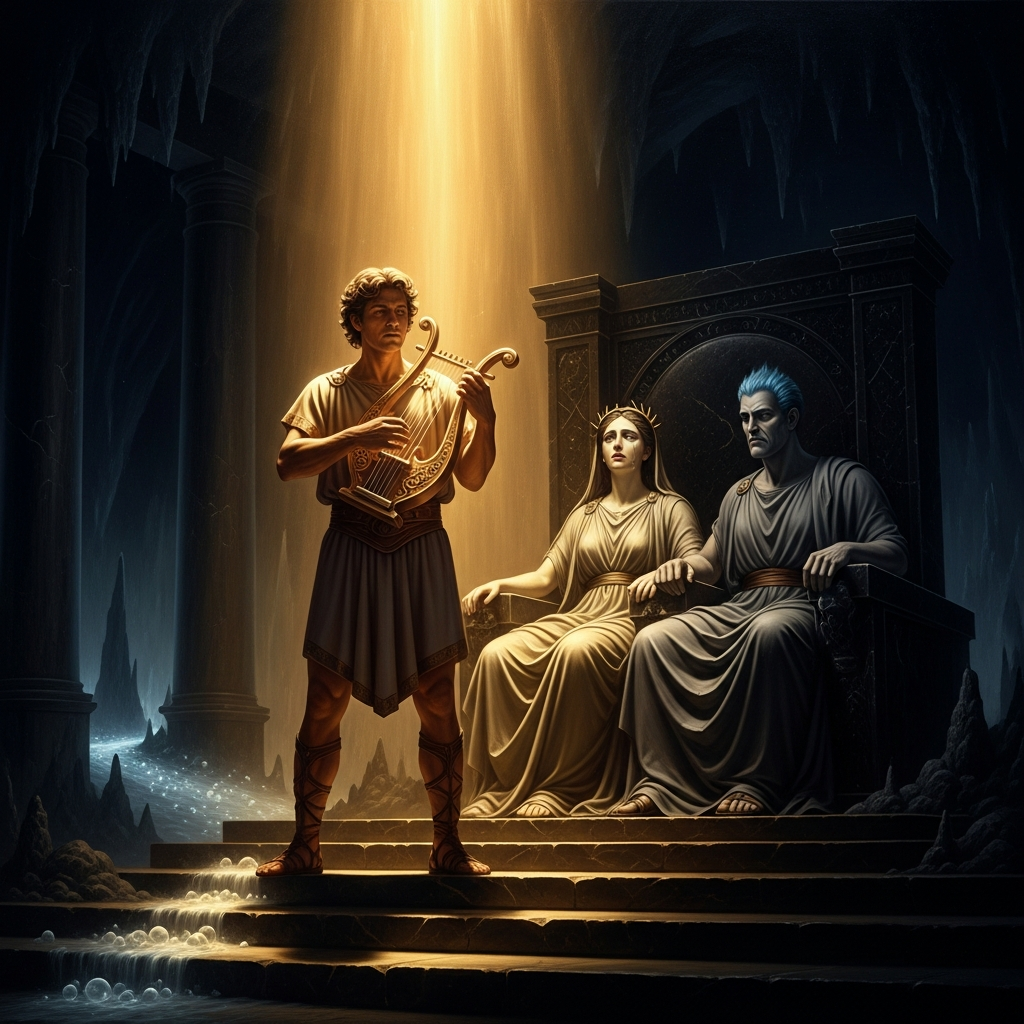
Orpheus arrives at the throne.
Hades and Persephone sit together.
Persephone is in her dual aspect: the queen of the dead for half the year, the daughter who returns to her mother for the other half. She is wearing the dark robe and the pomegranate crown. Hades is in the great seat, broad-shouldered and unsmiling, the king who has not visited the upper world in any version of the myth and does not intend to.
Orpheus does not speak. He plays.
The song he plays for them is the longest of his career. Ovid gives us a paraphrase: he speaks of Love, the god who has reached even into this underworld — for did you not, Persephone, marry by the same compulsion? — and he speaks of the brevity of Eurydice’s life and the unfairness of the snake and the smallness of his request. He is asking only that the order be slightly disturbed. Eurydice will come to you eventually; everyone does. He is asking only for a delay. He will pay for it later. He is asking for the years she should have had.
He plays.
When the song ends, Persephone is weeping. Hades is sitting still. The hall is sitting still. The dead in the antechamber are sitting still. Even Charon, far away on the river, has stopped his pole.
Hades speaks.
Take her. On one condition. She will follow you up the path. You will not turn around. You will not speak to her. You will not look at her until you have both crossed back into the upper world. If you turn before then, she returns to me, and you will not be permitted a second descent.
Orpheus agrees.
Eurydice is brought from somewhere behind the throne — they bring her, the play does not specify who — and she stands behind Orpheus. He does not see her. He has not seen her since the wedding. He hears her breathing, faintly. He hears nothing else.
He turns toward the path. He begins to walk.
The walk is what the myth is really about.
Every later poet who has retold the Orpheus story has understood that the descent and the negotiation are exposition. The story is in the climb. It is the longest scene in the myth and the one Ovid spends the most time on, and Virgil before him, and Rilke after him.
Orpheus walks.
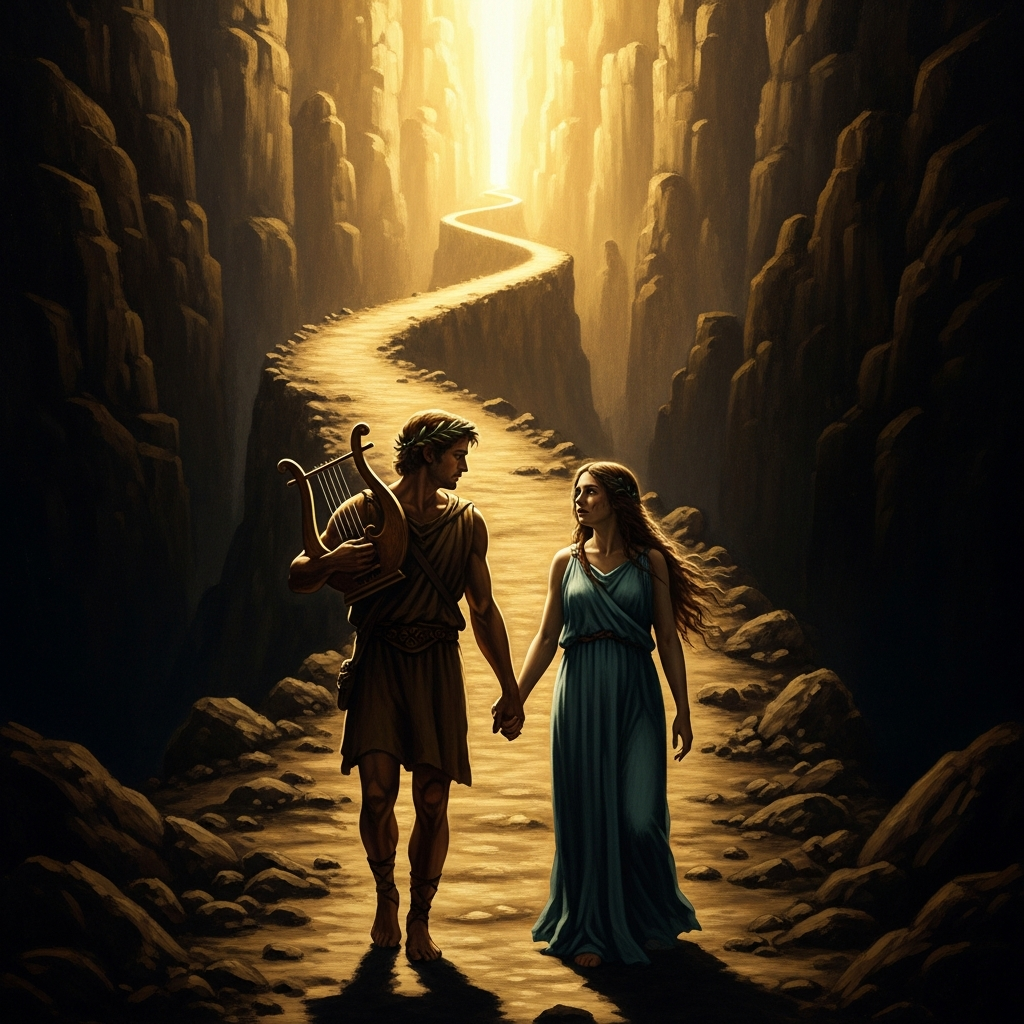
He walks through the throne room, then through the antechamber, then onto the path that leads up. He hears Eurydice behind him. He hears her in the first stretch. Her footsteps are light — she is in a shade-body, not a real body, and the soles of her feet do not make sound on the rock the way his do — but he can sense her, just behind him, perhaps three paces back.
He walks for a long time.
The path goes up. It goes up for as long as the path going down went down. He passes the gate where Cerberus sits — the dog watches them go past, and does not interfere. He passes the river. Charon is there with the boat. Orpheus steps in; behind him, he hears or imagines he hears Eurydice step in too. They cross. He does not turn around. He does not look at her on the boat. He stares at the far bank.
He climbs.
The cave begins now. The cave is the longest stretch. It is hours of walking — possibly days, the myth is unclear about underworld time — and the air is not changing yet. He cannot tell how close he is to the surface. He is straining his ears. He cannot hear her footsteps anymore. The shade-body makes no sound on dry stone. He is walking up a tunnel without knowing whether anyone is behind him.
This is the test.
Hades knew. Persephone knew. The condition was not a punishment; it was an examination. The question was whether Orpheus could trust the agreement he had made — whether he could sustain the absence of evidence long enough for Eurydice to cross back into the world. The negotiation was easy. The trust is the hard part.
He almost makes it.
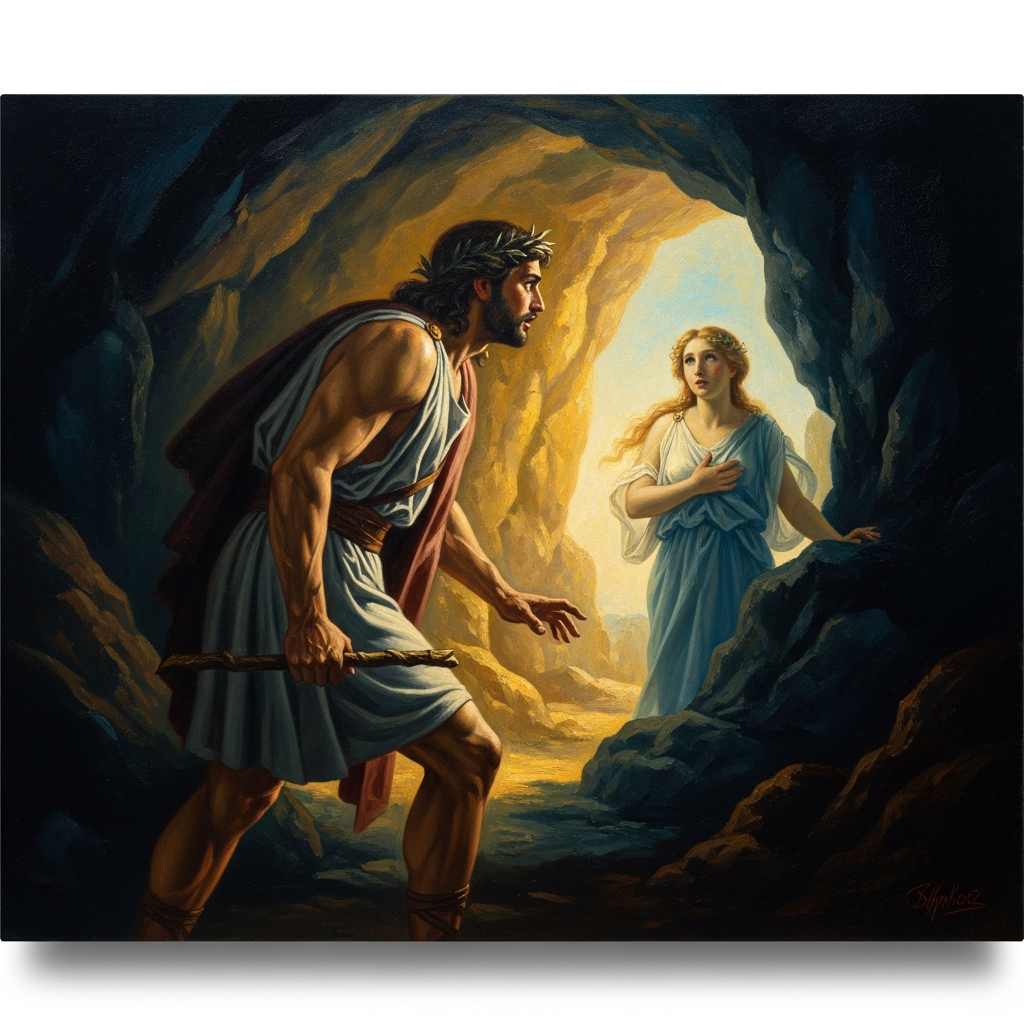
The cave-mouth is in sight.
He sees it ahead — a small grey shape in the distance, the light of the upper world filtering through the entrance, perhaps a hundred yards away. He has walked for what feels like a lifetime. He has heard nothing for the last several miles. He has begun to wonder, quietly at first and then increasingly, whether Eurydice was actually given to him at all — whether the figure behind him on the boat was a trick of his hope, whether the whole agreement was an elaborate underworld joke.
He cannot bear it any longer.
He turns around.
She is there.
She is exactly where she should be — three paces behind him, in the bridal dress, her face the face he remembers but with something already underworld about it, the eyes already half-shaded, the mouth open as if to say something —
— and she begins to slide backward.
It is not a sudden disappearance. Ovid is precise about this. She slides. She is pulled backward down the path, her arms reaching toward him, her mouth forming a word — Virgil records it as vale, farewell — and her face dissolves slowly into the dark of the tunnel as a face dissolves in shallow water when you stir it. She does not cry out. She does not blame him. She simply recedes.
He runs after her.
The tunnel closes against him. The path that took him days to climb is now solid stone behind him. There is no second descent permitted; Hades made that clear; the rule is one-way. Orpheus pounds on the rock. He plays the lyre. The lyre does not work this time. The stone does not weep. The dead do not pause. Whatever permission the underworld granted him has been spent.
He sits at the place where the tunnel sealed for seven days.
He does not eat. He does not drink. He does not move. Then he stands up and walks back to the upper world alone.
He cannot return to ordinary life.
He wanders Thrace. He plays. The music is more beautiful than ever — the trees still walk closer, the rocks still weep — but he himself is not. He refuses every other woman who approaches him. The Thracian women, in some versions, take this rejection as an insult and kill him for it: they tear him apart on a hillside, in a Maenad-frenzy, and his head and his lyre float down the river Hebrus to the sea, still singing.
The lyre and the head wash up on the island of Lesbos.
The lyre is hung in a temple. The head, in some versions, becomes an oracle that speaks for a generation before Apollo silences it.
In other versions, Orpheus is reunited with Eurydice in the underworld at last — they walk there together, freely, neither having to lead — and Hades is content because the deal he made was technically honored: Orpheus did not bring her back. Whether they actually meet in the underworld, the sources disagree.
What no source disagrees about is the moment in the tunnel.
He had her. He was almost out. He turned because he could not bear not knowing whether she was there. He looked at her, in the act of looking he confirmed her existence and removed her at the same time, and the door closed behind her, and the door closed behind him, and the music — the music that moved rivers — could not move that one stone.
The myth is about the cost of needing to see.
It is the oldest religious problem in the world. Faith asks you to walk forward without confirmation. Doubt asks for one look. The look is always available. The look always wins. And what the look costs is everything you were walking toward.
Scenes
Before the throne of the underworld, Orpheus plays the song that has never been played there — and Persephone, who has never wept, weeps
 Generating art…
 Up the long path toward the light: Orpheus walking ahead, Eurydice walking behind, neither one able to speak, the silence stretching for miles
 Generating art…
 Within sight of the cave-mouth, Orpheus turns
Generating art… Echoes Across Traditions
Entities
- Orpheus
- Eurydice
- Hades
- Persephone
- Charon
- Cerberus


Sources
- Virgil, *Georgics* IV.453-527 (29 BCE)
- Ovid, *Metamorphoses* X.1-85, XI.1-84 (8 CE)
- Plato, *Symposium* 179d (the philosophical critique of Orpheus)
- Boethius, *Consolation of Philosophy* III, meter 12 (c. 524 CE)
- W.K.C. Guthrie, *Orpheus and Greek Religion* (1935)
- Charles Segal, *Orpheus: The Myth of the Poet* (1989)
- Rainer Maria Rilke, *Sonnets to Orpheus* (1923)
- Anne Carson, *Autobiography of Red* (1998, modern reception context)