What the Mountain Gave Back
c. 400 BCE · Cithaeron and Parnassus — the mountains above the cities of Thebes and Delphi · The mountains of Boeotia — Cithaeron above Thebes, Parnassus above Delphi — where the Maenads gathered for the triennial Dionysiac rites
Contents
The Maenads run up the mountain in winter and the god enters them. Three days later they come down with pine needles in their hair, smelling of smoke and snow. The question the men in the city below never ask: what did it feel like from the inside?
- When
- c. 400 BCE · Cithaeron and Parnassus — the mountains above the cities of Thebes and Delphi
- Where
- The mountains of Boeotia — Cithaeron above Thebes, Parnassus above Delphi — where the Maenads gathered for the triennial Dionysiac rites
She leaves at dusk.
Her husband knows she is going. This is important to understand: he knows. The city knows. The biennial departure of the Dionysiac women from the cities of Boeotia is not a secret and not a scandal. It is on the religious calendar. The city of Thebes sends women to the mountain of Cithaeron and the city of Delphi sends women to Parnassus, and the women of Athens go up to join the Delphic Thyiades, and this has been happening since before anyone can remember. The city makes its accommodations and waits.
Her name is Charis. She is thirty-one. She has a six-year-old daughter and an eight-year-old son and a husband who sells wool and a house in the craftsmen’s quarter near the south gate. She has been a Dionysiac woman for nine years. She goes up every second winter. She comes back.
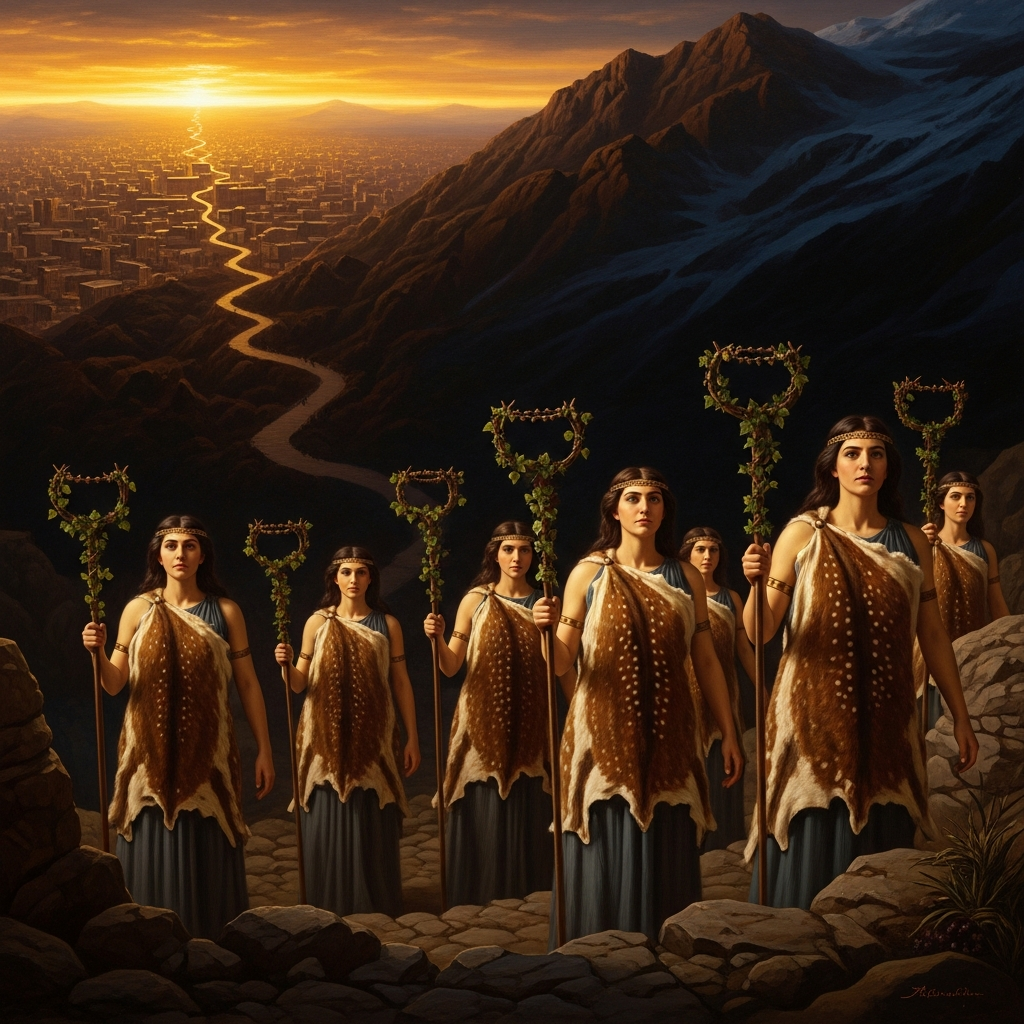
She takes from the cedar chest: the fawn-skin, the thyrsus — a fennel stalk topped with a pine cone, the official emblem — and the low wool robe that she will tie with ivy. She wraps the fawn-skin over her shoulder the way the women showed her the first time. Her daughter watches from the doorway with the particular gravity of a six-year-old who knows something significant is happening and is reserving judgment.
Charis goes out the south gate and up.
The mountain is cold.
It is January — the lenaia, the winter festival, the season when Dionysus is said to be alive in the mountains because he is not yet alive in the vines. The snow on Cithaeron does not fully melt until March. She climbs by torchlight with the other women of her thiasos — the group — thirty of them, ages ranging from seventeen to sixty, the young ones with the breathless energy of people approaching an experience they cannot fully imagine, the older ones with the particular ease of people who have done this before and are already, on the climb, beginning to feel the god come near.
She cannot describe the feeling of the god coming near except by analogy, and all the analogies are insufficient.
It is like — and she knows this is inadequate — the moment before a storm when the air changes quality before the first drop falls. It is like the sensation in the body when a piece of music resolves after a long dissonance. It is like the feeling of recognizing a word in a foreign language that you did not know you knew. Something in the body that knows before the mind knows that it is about to be entered.
By the time they reach the high meadow, the torches are unnecessary. The moon is full. The snow reflects it. The mountain is silver.
She cannot tell you exactly what happens next.
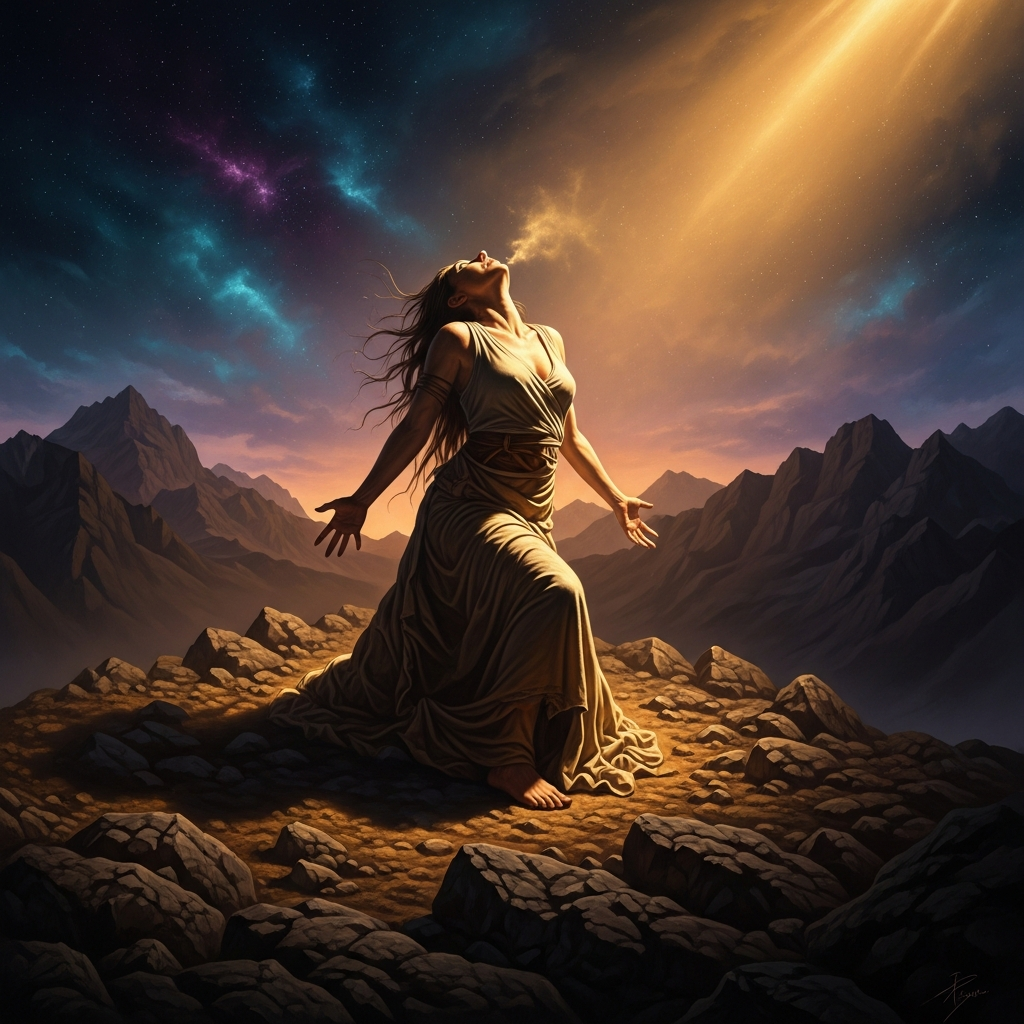
Not because she is protecting a secret — the Maenads did not swear oaths the way the Eleusinian initiates did — but because the thing that happens next is not something that happened to her. It happened through her. The mania — which is not madness in the clinical sense, not the madness of Heracles who killed his children or Ajax who attacked a herd of sheep believing them enemies — is something more precise. It is the state in which the ordinary self, the Charis-who-sells-wool-adjacent-to-a-wool-merchant, steps aside.
What steps in is the god.
This is what she can say: her hands know things her mind does not. Her body moves in patterns that are not patterns she has practiced. The other women are moving around her and she is moving with them in a way that does not require coordination because they are all moved by the same thing, which is not coordination but something older. The sound she is making — and she is making a sound — is not a sound she makes in the house near the south gate.
She is cold and she is not cold. The snow is on the ground and she does not feel it on her feet.
She is three things at once: herself, the god, and the animal that is also the god, the animal whose fawn-skin she wears, the creature that runs without calculating whether running is wise.
The men in the city watch from below.
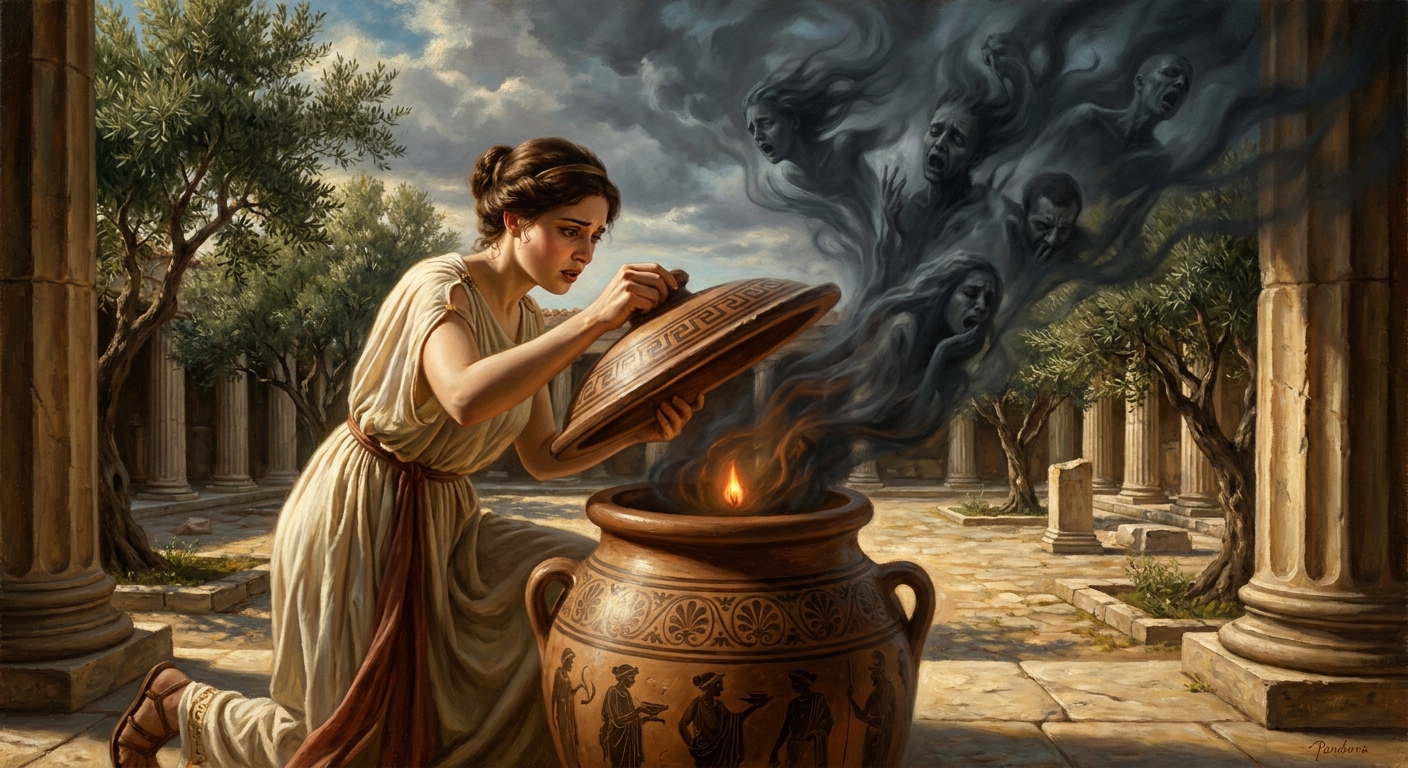
When Euripides staged the Bacchae — a play about the god’s revenge on the city of Thebes for refusing his worship — he showed Agave, queen of Thebes, tearing her own son Pentheus apart on the mountain, carrying his head back on her thyrsus believing it a lion, coming into the city still in the mania, proud of her kill, the horror of the recognition when the mania breaks and she sees her son’s face in her hands.
The horror is real. The play is a masterpiece. But Euripides is writing from outside the mania, from the city’s perspective, from the point of view of Pentheus, who comes to the mountain as a spy and sees the women at rest between their revels — calm, nursing fawns, drawing milk from the ground with their thyrsus staves, doing nothing that looks threatening — and then provokes the catastrophe by staying.
The tragedy is about a man who cannot leave what he came to watch.
The women on the mountain, in the actual biennial rites that Thebes and Delphi and Athens organized and sanctioned and performed every second winter — those women were not tearing people apart. They were running. They were dancing. They were entering the mania and coming back out of it, and they were doing so in the care of a community of women who had done it before and would do it again.
The third morning, the mania begins to lift.
Charis is aware of its lifting the way she is aware of anesthesia wearing off — not that she was in pain while it held, but that she can feel the boundaries of her ordinary self reassembling. The thirty women of her thiasos are lying or sitting in the meadow. The snow around them is trampled and cleared. One of the older women is tending a fire. Two of the younger ones are asleep, leaning against each other, still wrapped in their fawn-skins.
She can see her breath in the cold air.
She is very hungry. She is also something else — the closest word she has is clean, though she knows this is not right. Not clean the way a washed body is clean, but clean the way a room is clean after a long window has been opened. Something that had been stale in her has been aired. She does not know what it was. She knows it was there, in the wool-merchant’s house, accumulating in the corners — the compressed weight of being Charis-who-is-someone’s-wife-and-someone’s-mother-and-someone’s-neighbor — and now it is not there in the same way.
She is still all of those things. She will be all of those things in the house near the south gate this afternoon and tomorrow and for the next two years until she comes back to the mountain. But she will be them differently. She has had three days of being something prior to all of them, something that was Charis before Charis had a role, and she will carry the memory of that priority — the fact of her existence prior to her function — back into the house with her.
This is what the city is actually buying, when it puts the women on the religious calendar and makes its accommodations and waits.
The descent takes the morning.
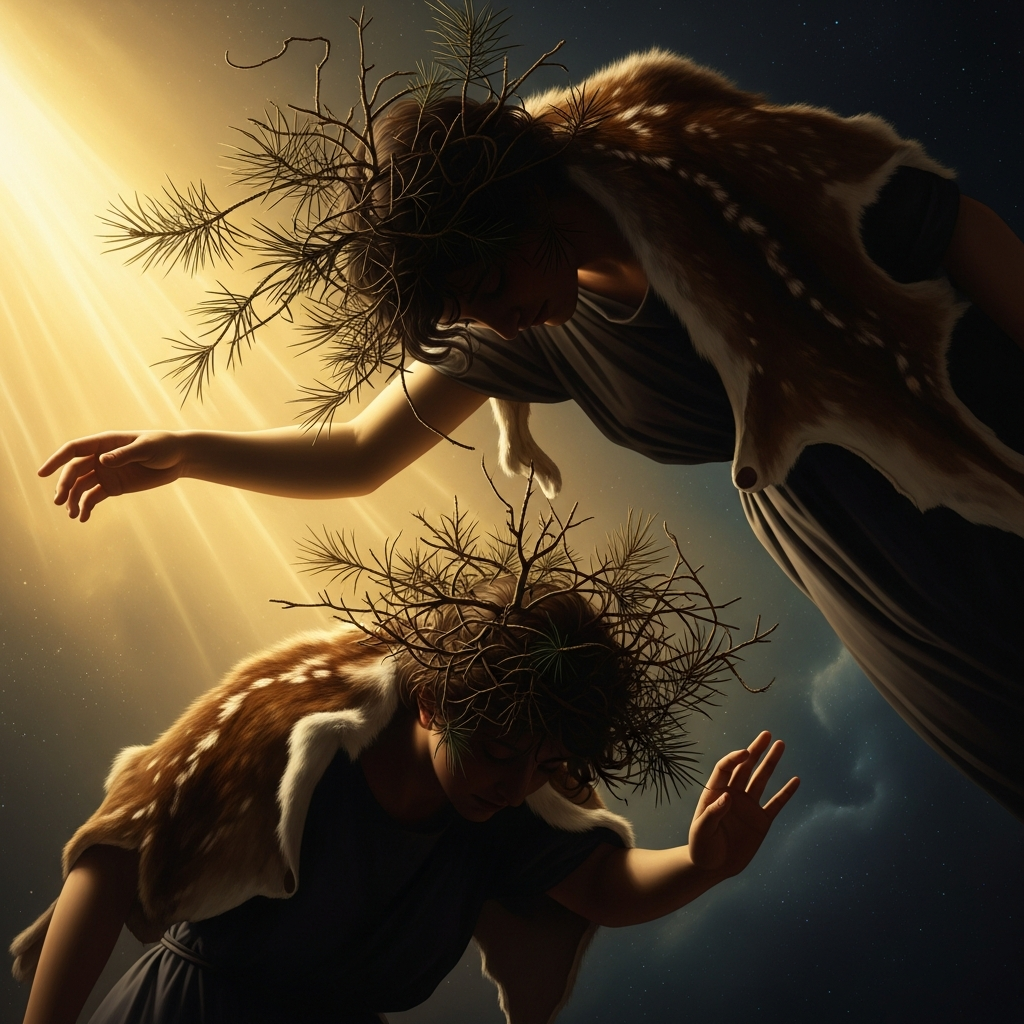
They walk down in the early light, thirty women with pine needles in their hair and the smell of cold and smoke on their fawn-skins, the thyrsus staves carried loosely, the kind of silence among them that is not the silence of people who have nothing to say but the silence of people who have been somewhere together and do not need to discuss it because they were all there.
At the city gate, the families are waiting.
Her daughter runs to her before she is through the gate. Charis picks her up. The child smells of bread and lamp oil and sleep — the particular smell of a warm house in winter — and Charis holds her with the specific quality of attention that comes from having been somewhere for three days that is not the house, that is not anywhere near the house, and returning to the house with the knowledge of the difference.
Her husband says nothing. He has waited before. He knows the look she comes back with. He finds, every time, that it is easier to live with the woman who came back from the mountain than the woman who left.
Euripides ends the Bacchae with Agave carrying the head of her son.
He ends it in the city, in the return of sanity, in the unmediated horror of recognition. The Maenads, in the city’s telling, are the warning: this is what happens when the god enters. Violence. Dissolution. The tearing apart of what the city values.
But the city also gave the women the mountain every two years. The city of Delphi maintained the Thyiades as an official religious institution. The city of Athens sent women to Parnassus with the official sanction of the polis. They understood something that the play, for all its genius, does not quite say: that the mania is not a violation of the women but a permission. That the dissolution it produces is not destruction but renewal. That the women who come down from the mountain in the morning are not diminished by what happened there.
They are, if anything, larger.
The word Euripides uses for the Maenads — Bacchae — comes from Bacchos, one of Dionysus’s names. The word maenad comes from mainesthai, to be mad. The god of theater, of wine, of the dissolution of the self, is also the god of masks — the god who is always someone else, always behind a face, always the one who lets you be someone other than who the city requires you to be.
The masks are still in the museums: the painted terracotta faces of Dionysiac women, the open mouths, the eyes that look past whatever they were looking at when the painter fixed them. They do not look mad in the clinical sense. They look like people in the middle of something that is taking all of them.
The mountain is still there above Thebes. Cithaeron is limestone and pine. It is cold in January. It would still, on the right night, under the right moon, with the right company, be a place where the civic self could be left at the tree line.
No one goes up anymore. The god’s calendar has been rearranged. But the mountain remembers the weight of the women who climbed it, and the meadow at the top is still cleared.
Scenes
The women leave the city at dusk, fawn-skins over their shoulders, thyrsus in hand — the long climb to the mountain where the god waits in the cold and the dark
 Generating art…
 The mania: the god enters, the civic self strips away, and what remains for three days on the mountain is something older than the woman who climbed up
 Generating art…
 They come down in the morning with pine needles in their hair and fawn-skin on their shoulders and the particular silence of people who have been somewhere the city cannot follow
 Generating art…
 Echoes Across Traditions
Entities
- Dionysus
- the Maenads
- the Thyrsus
- Agave
Sources
- Euripides, *Bacchae* (c. 405 BCE)
- Walter Burkert, *Greek Religion* (1985)
- Ross S. Kraemer, *Ecstasy and Possession: The Attraction of Women to the Cult of Dionysus* (1979)
- Albert Henrichs, *'Male Intruders Among the Maenads': The So-called Male Celebrant* (1982)
- Renate Schlesier, *Bacchic Rites and Female Initiations in Ancient Greece* (1993)
- Richard Seaford, *Dionysus* (2006)