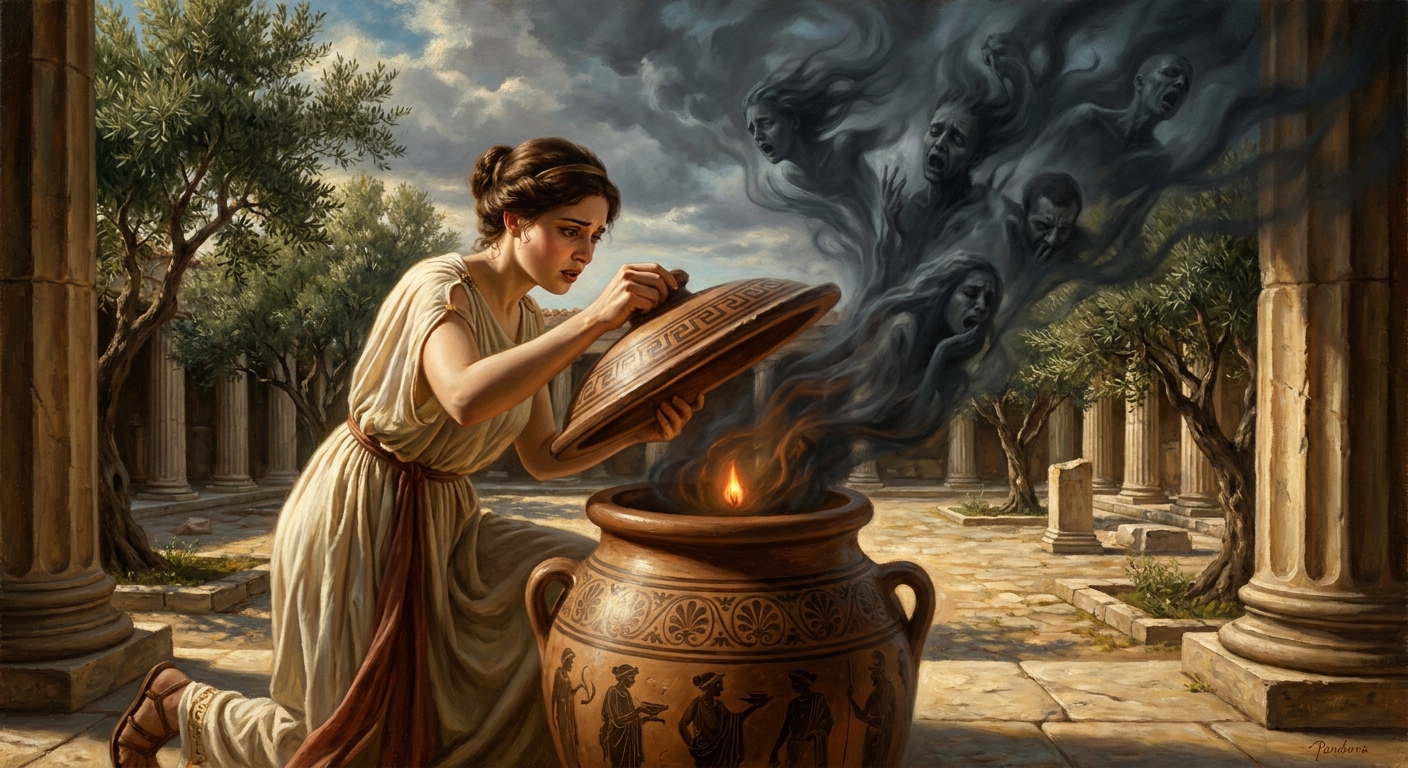
Born Twice
Mythic Time · Hesiod, *Theogony* 940-942; Euripides, *Bacchae* (405 BCE) · Thebes, then Nysa — the mythical mountain of the god's fostering
Contents
Semele asks to see Zeus in his full divine glory and is instantly incinerated. Zeus rescues the unborn fetus and sews it into his own thigh to gestate. Dionysus is born twice: once of a woman who died of divinity, once of a god who can survive it. The god of wine, ecstasy, and theater is also the god who teaches that suffering is not the end of the story.
- When
- Mythic Time · Hesiod, *Theogony* 940-942; Euripides, *Bacchae* (405 BCE)
- Where
- Thebes, then Nysa — the mythical mountain of the god's fostering
Hera engineers the death.
She always does, in the myths that give her something to do. Hera is the goddess of marriage, and Zeus has taken a mortal woman to his bed — Semele of Thebes, daughter of Cadmus, a woman who is already pregnant by the god when Hera arranges the visit. Hera comes to her in disguise: an old woman, a neighbor, someone trustworthy. They sit together. The old woman asks questions, sympathetically, about the father of the child. Zeus, yes? Are you sure? Did he show you anything that proved it? Men claim to be gods. Men claim all kinds of things.
She plants the question the way a weed is planted: under the topsoil, out of sight, where it grows in the dark.
The Homeric Hymn to Dionysus gives the story simply: Zeus loved Semele. Hera arranged her death. But it is Ovid who gives Semele her voice, and Euripides who understands what the double birth means for everything that comes after.
Semele goes to Zeus with the question already burning in her.
She wants proof. Not argument, not reassurance — proof, the divine kind, the kind that admits no ambiguity. Show me as you are. Show me what you are when you are not accommodating yourself to my mortality, when you are not reducing your reality to something my eyes can survive. Show me the actual thing.
Zeus refuses, at first. He knows what the actual thing does to mortal eyes. He is not Hera; he does not want her dead. He loves her. The mortal woman carrying his child is someone the god has chosen to be with in the complicated way the gods of this tradition choose things — not simply, not cleanly, with consequences they did not plan for. He refuses.
She insists. She does not know what she is insisting on, but she insists.
He has made an oath — Ovid gives him the oath on the river Styx, the only oath a god cannot break — to grant her whatever she asks. And she has asked. So he comes to her as he is.
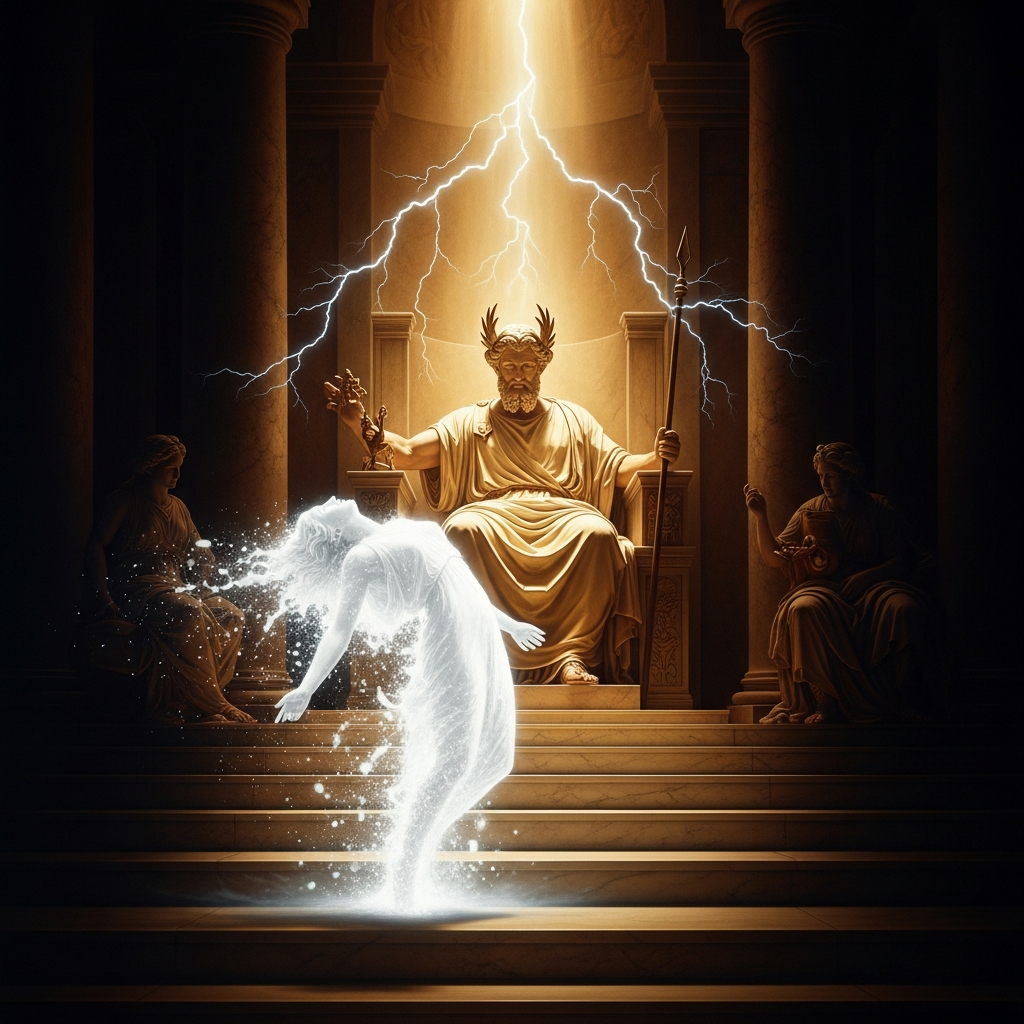
The lightning arrives before the light. The lightning is not a weapon here; it is Zeus’s natural state — the full expression of divine power in an atmosphere it was not designed for, the way a hand pushed through a soap bubble does not cut the bubble, it simply reveals that the bubble and the hand cannot coexist in the same space. Semele does not have time to regret the question. The fire is instant. The room is white. She is gone.
But the child is not gone.
Zeus acts with the speed that distinguishes gods from mortals in crises: he reaches into the fire and takes the unborn child. Hermes helps him, in some versions; in others, Zeus acts alone. The fetus is premature — too young, by the human calendar, to breathe outside a womb. There is no womb. The mother is ash. The divine child needs a container that the divine fire will not destroy, and there is only one container in the cosmos that qualifies.
Zeus opens his own thigh.
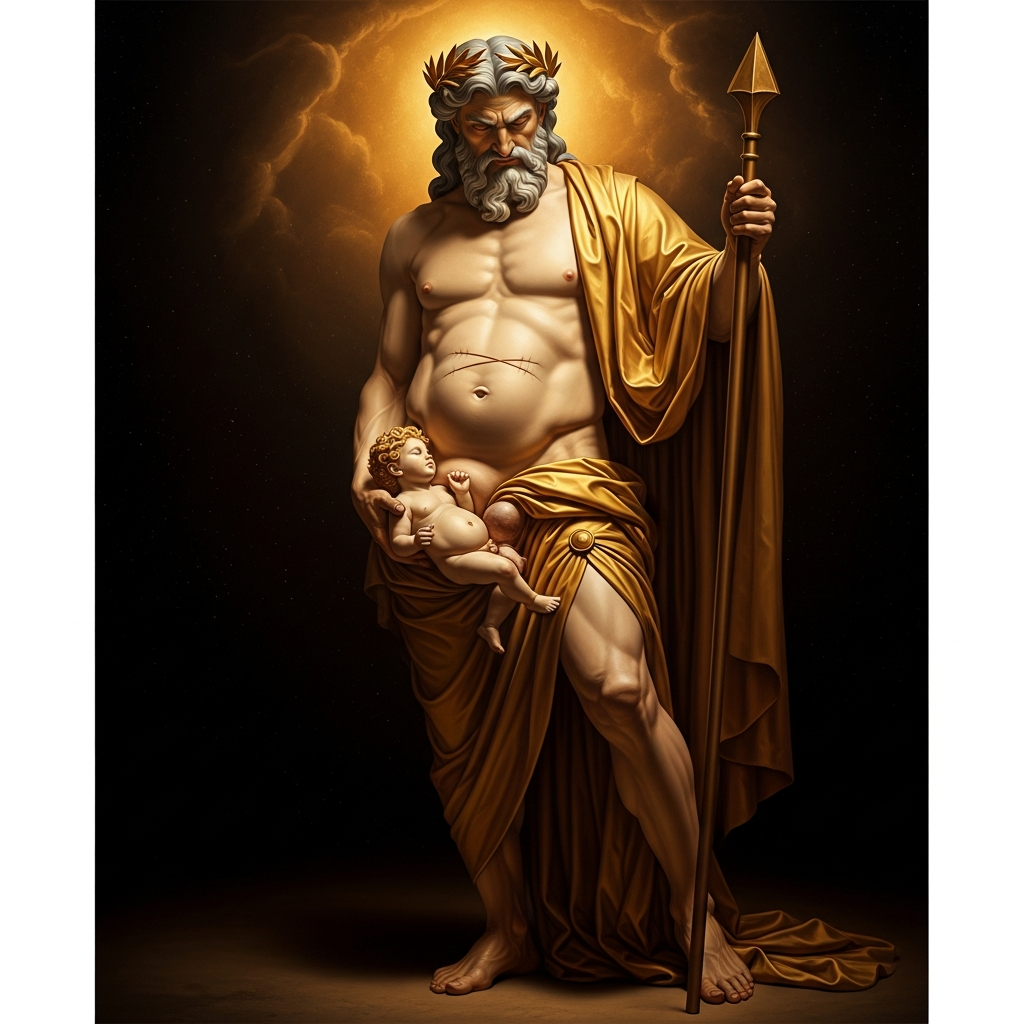
He places the fetus inside. He sews the thigh shut. He carries the child in his own flesh for the remaining months of gestation, which is — depending on how you calculate a divine pregnancy — somewhere between three months and the full term of a mortal child.
This is the fact the myth insists on returning to: the king of the gods serves as a mother. Not a father who delegates the carrying to someone else — Zeus himself carries Dionysus in his body, gestates him in the muscles of his own thigh, and gives birth to him when the time comes. The most powerful being in the Greek cosmos performs the one act that Greek culture assigns exclusively to women, assigns to them so completely that it defines their role in the household and the city.
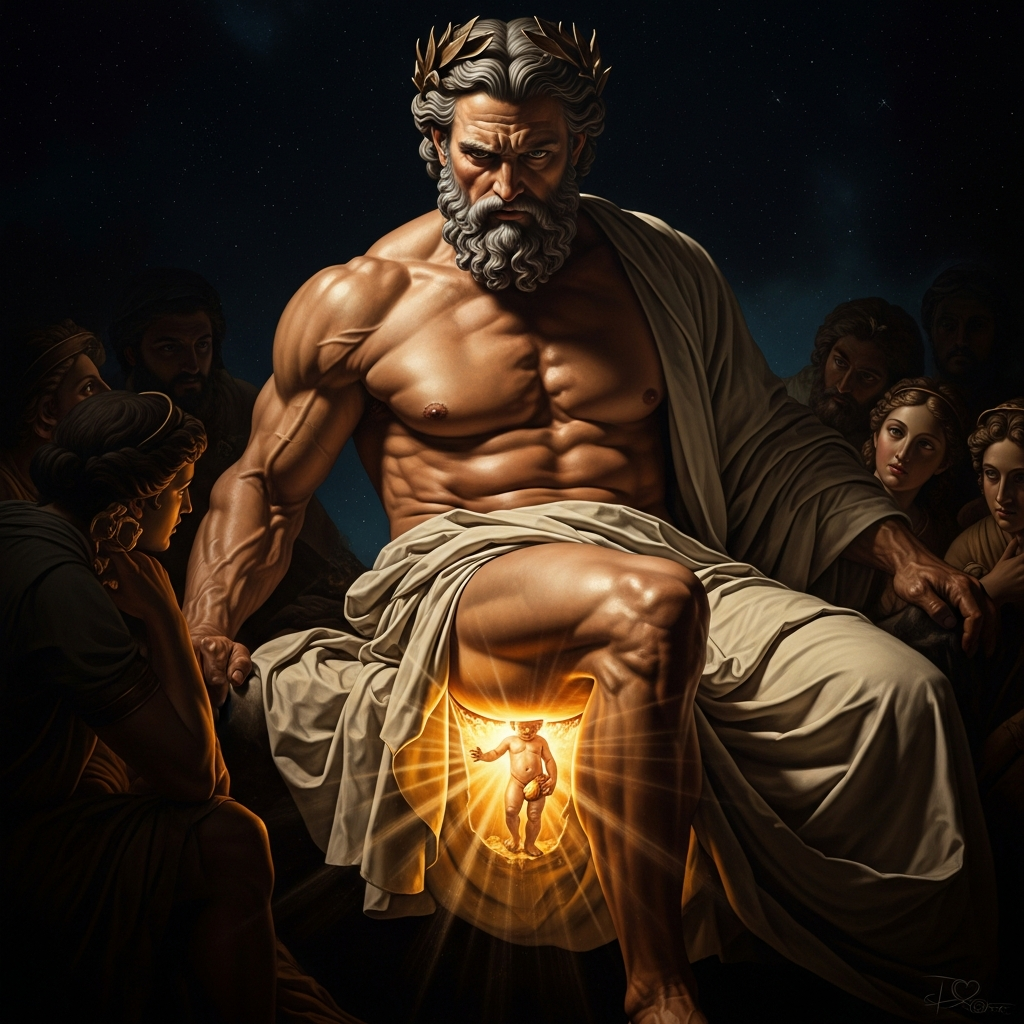
The birth from the thigh does not produce shame in the myth. It produces a title: Dimethios, twice-born. The god who was born from a woman and then from a man, born from a death and then from a body that death cannot reach. This is not symmetry. This is a theological argument: the divine cannot be destroyed by what destroys the mortal. The fire that incinerates Semele is the same fire that gestates Dionysus. The difference is the vessel.
The child is given to the nymphs of Nysa.
Nysa is a mountain that does not correspond to any particular mountain on a Greek map; it exists in mythological geography, the kind of place that is located precisely where the story needs it to be. The nymphs of Nysa raise the child on honey and grapes and the damp air of a mountainside, and what they produce is the god of wine.
The wine is not incidental. Wine is the sacrament of Dionysus precisely because wine does what the god does: it dissolves the ordinary boundary of the self. The person who drinks wine is briefly a different person — not worse, not better, but different, the edges of the self temporarily permeable, the distance between the individual and everything around them reduced. This is the experience the Dionysiac cult sought to intensify through the thyrsus and the dancing and the hillside running and the tearing of raw animals: not drunkenness exactly, but the dissolution of self that wine approximates and the full Bacchic rite completes.
The god who was twice-born — who passed through destruction and came back — is the god who shows that the self’s apparent boundaries are not its ultimate limits. You can go further than the self allows. What is on the other side of the self’s dissolution is not nothing. It is the god.
This is the theological content of the double birth. Semele could not survive the full presence of the divine; the mortal container broke. But what she was carrying survived, because the divine is not destroyed by what destroys the mortal. The twice-born god is the proof.
He descends to the underworld and brings his mother back.
This is the part of the myth that gets less attention than the birth, but it completes the argument. Dionysus is grown. He knows what happened to Semele. He descends through the gate at Lerna — the lake whose depths Cerberus cannot guard against a god who knows the way — and he finds her in Hades and he gives her a different name. She is no longer Semele, mortal woman of Thebes. She is Thyone, the raging, ecstatic one. She ascends from the underworld and becomes an Olympian goddess, and the ascent is the final confirmation of what the double birth meant: not just that the divine survives what kills the mortal, but that the mortal who was touched by the divine and destroyed by it comes back changed.
The destruction was the beginning of something.
Theater is born from his festivals.
This is the historical fact that the myth backs up: the great tragedies of Athens — Aeschylus, Sophocles, Euripides — are performed at the City Dionysia, the spring festival of the god. The theater is a Dionysiac space. The masks are Dionysiac. The chorus, with its collective voice and ritual movement, descends from the Dionysiac thiasus, the band of followers who process with the god. Tragedy is the art form that shows characters destroyed by forces they cannot accommodate — mortal containers unable to survive what they are given to carry — and the theater is the space where the audience watches this and does not die.
The audience does not die because the theater is the container the god provided for the experience of destruction. You sit in the seats of the Dionysiac theater and you watch Oedipus blind himself and Medea murder her children and Agamemnon walk into the bath where Clytemnestra waits and you feel what those things feel like without those things happening to you. Aristotle calls this catharsis — the purging of pity and fear through pity and fear. The theater does what the thigh does: it holds the destructive experience in a vessel that can survive it.
Dionysus, born twice, builds the institution that allows the living to survive what kills the characters inside it.
Euripides wrote The Bacchae at the end of his life, in exile from Athens, in the court of King Archelaus of Macedon. He died before the play was produced. His son brought it back to Athens and it was performed posthumously, and it won first prize at the Dionysia in 405 BCE.
The play is about Dionysus returning to Thebes in disguise, gathering his followers, and destroying the king who refused to accept him. Pentheus, the king, will not acknowledge that the god is a god. He disguises himself as a woman to spy on the Bacchic rites on the mountain and is torn apart by his own mother, who in her ecstasy believes she is killing a lion.
Euripides was the most skeptical of the three great tragedians. He spent his career questioning the gods’ justice, depicting them as vengeful and arbitrary, putting rational arguments against piety in the mouths of his characters. And then, at the end of his life, in exile, he wrote the most devastating case for Dionysus that any Greek text contains: the argument that the god you refuse will destroy you, not out of malice but out of the inexorability of what you have denied.
Pentheus will not be twice-born. He will not descend and return. He will not allow himself to be dissolved. He insists on the hardness of the container. The container breaks.
The double birth has been structuring Western thought for twenty-five centuries without being named. When Paul writes that he has been crucified with Christ and no longer lives, but Christ lives in him (Galatians 2:20), he is describing the Dionysiac replacement: the old self, the hard-edged container, replaced by the divine life that can survive what the old self cannot. When Meister Eckhart preaches that the soul must die to itself before it can be born into God, he is using Semele’s grammar. When the Sufi poet says the self must be annihilated before fana — extinction in God — can occur, the same grammar holds.
The twice-born god is the myth that insists on transformation through, not around, destruction. Not the survival of the self intact, but the survival of what was in the self when the self burns away. Semele burned. What she was carrying did not.
The question the myth puts to every reader is Semele’s question, asked in different registers: what are you carrying that the fire cannot take? And the answer Dionysus gives, surfacing from the thigh of a god and descending to bring his mother home, is: you will not know until the fire comes.
Scenes
Semele before Zeus in his full divine radiance: the woman incinerated in a flash of unclouded lightning, the mortal body unable to survive what the immortal presence requires — a classical marble frieze, the throne room of the gods, the mortal woman dissolving into white light
 Generating art…
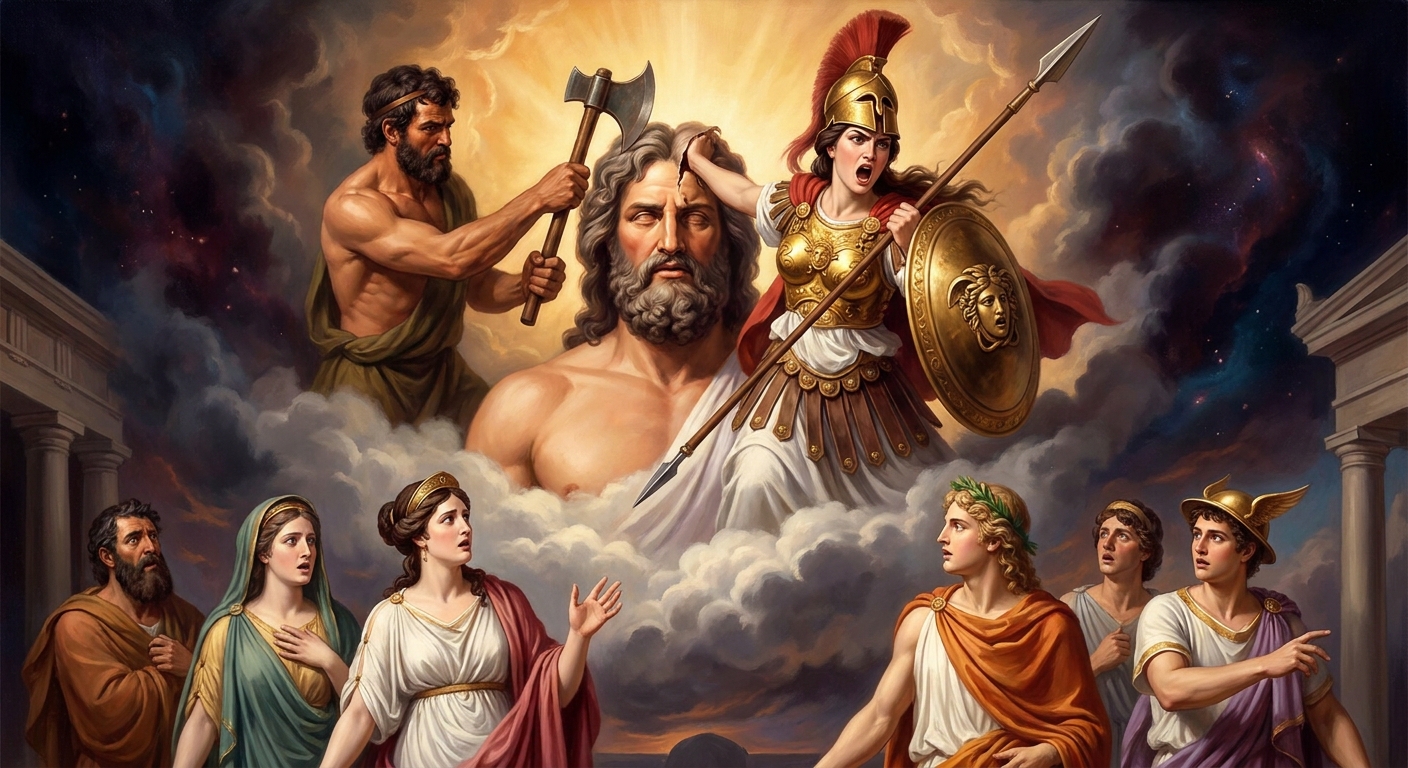
 Zeus with the unborn Dionysus sewn into his thigh: the king of the gods as a gestating mother, nursing the god of ecstasy in the only womb that could survive him — hyper-realistic mythological painting in warm gold and shadow
 Generating art…
 The birth of Dionysus from Zeus's thigh attended by the nymphs of Nysa: the twice-born god emerging into the world of gods and men, the bearer of wine and theater and the knowledge that what has been destroyed is not always destroyed
 Generating art…
 Echoes Across Traditions
Entities
- Dionysus
- Semele
- Zeus
- Hera
- Hermes
Sources
- Hesiod, *Theogony* 940-942 (8th c. BCE)
- Euripides, *Bacchae* (405 BCE, trans. Paul Woodruff)
- Ovid, *Metamorphoses* III.259-315 (8 CE)
- Apollodorus, *Library* 3.4.3
- Walter Otto, *Dionysus: Myth and Cult* (Indiana, 1965)
- Richard Seaford, *Dionysus* (Routledge, 2006)