The Directions for the Dead
c. 400 BCE · Thurii, Magna Graecia · Thurii, southern Italy — a Greek colony on the instep of the boot
Contents
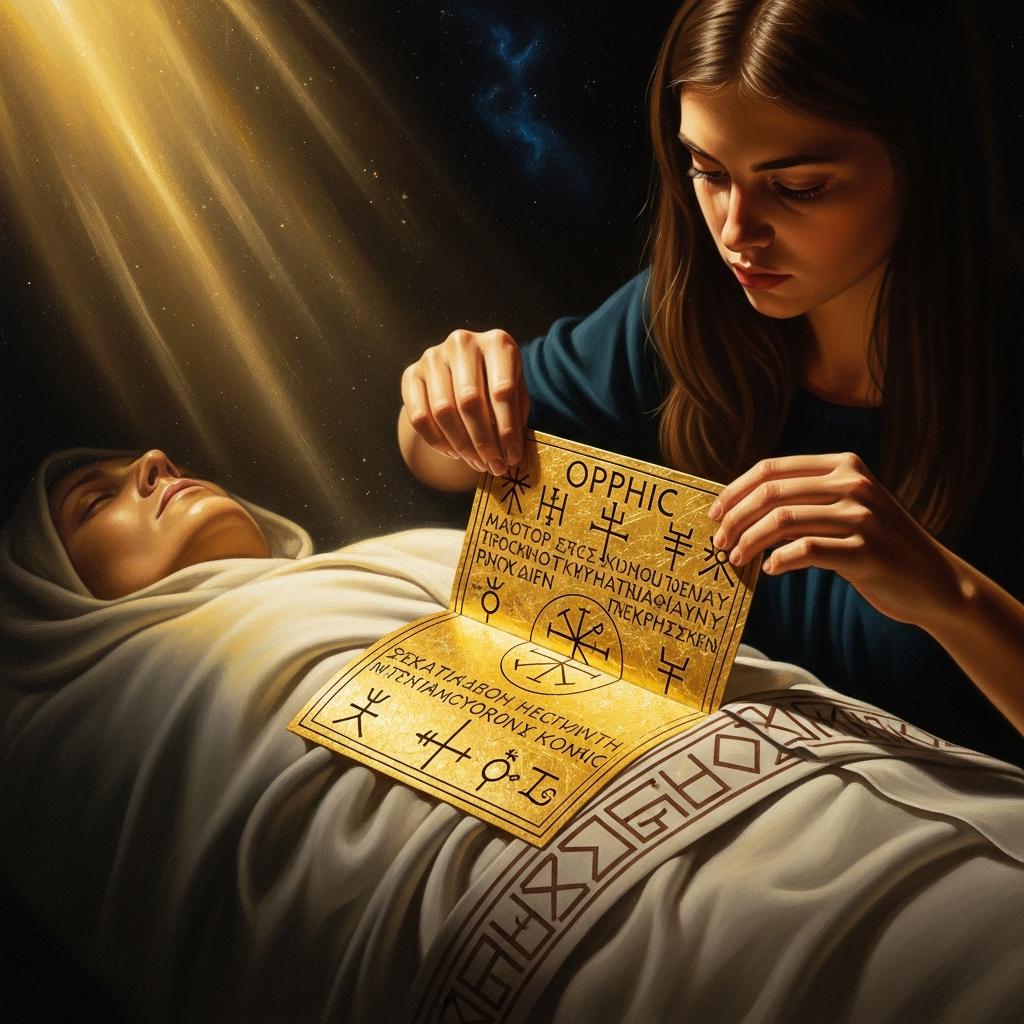
In the burial clothes of the dying, Orphic initiates placed thin gold tablets inscribed with instructions for navigating the underworld. The daughter knows what the tablet says. She reads it aloud, quietly, so her mother's departing soul can hear the way.
- When
- c. 400 BCE · Thurii, Magna Graecia
- Where
- Thurii, southern Italy — a Greek colony on the instep of the boot
The tablet is smaller than her palm.
Lysippe turns it over in the lamplight before she folds it — a strip of hammered gold leaf, no wider than two fingers, incised with letters so fine they look like scratches a needle might make in skin. She has read the words hundreds of times. She has them by heart. But she reads them again now, standing at the workbench in the back room while her mother lies on the bed behind the curtain, because this is the last time she will hold the tablet before she gives it to the earth, and the words want saying.
Find on the left a spring, and beside it a white cypress standing.
Do not go near that spring.
Find the other, the cold water flowing from the lake of Memory.
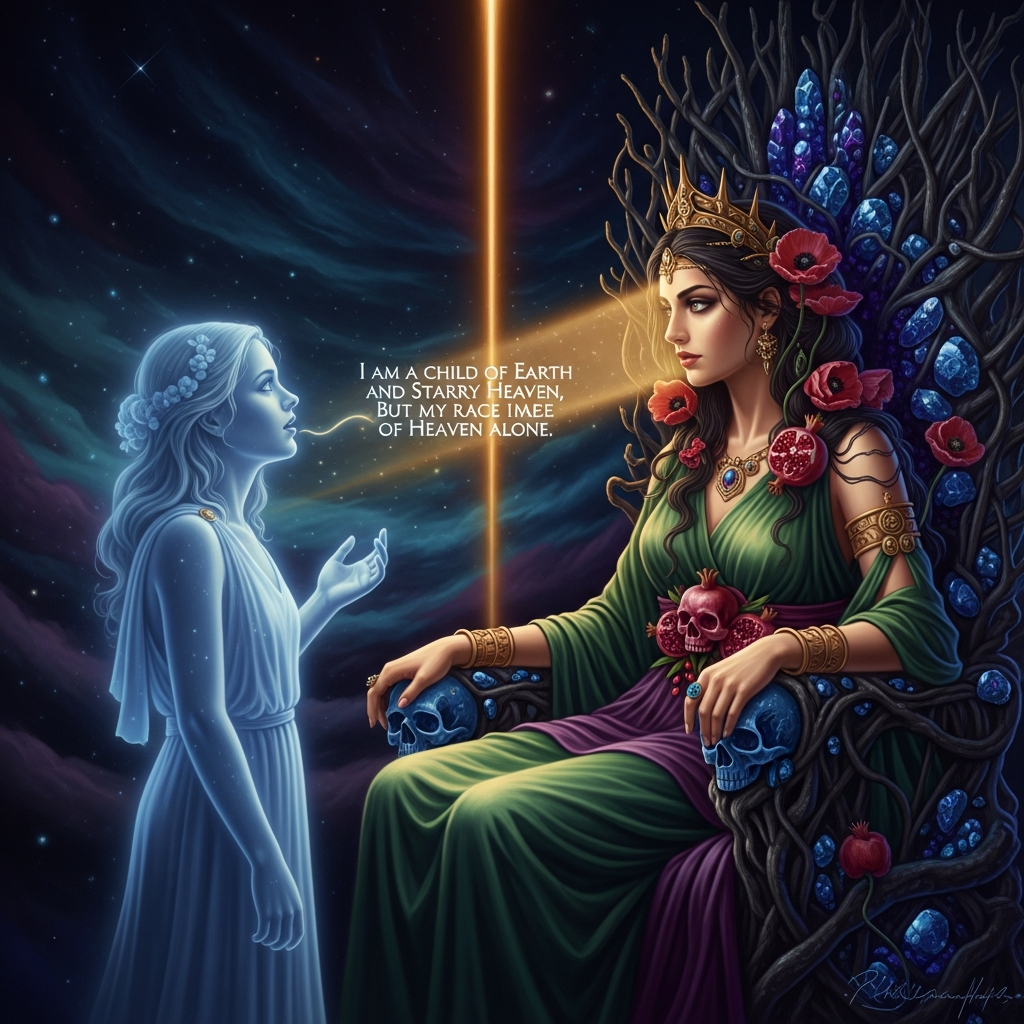
Say: I am a child of Earth and starry Heaven, but my race is of Heaven alone.
Ask for the cold water. They will give it.
She has been an initiate of the Orphic circle at Thurii for eleven years. She knows what the tablet is. Her mother does not.
Her mother, Dexilla, is a practical woman. She grew up on a grain farm north of the city, married a potter, raised three children, buried one. She lights incense for Demeter and Hestia. She puts food at the crossroads on the dark of the moon for Hecate. She does not ask what Lysippe does at the gatherings that go all night on the hillside outside the walls, the ones that smell of pine smoke and something else, something sharp and green like crushed herbs, when Lysippe comes home at dawn looking clean in the face the way people look after a long swim.
She has asked once. Lysippe said: we study the soul.
Dexilla said: make sure you eat.
That was eight years ago. Now Dexilla is eighty-two, and her breath in the back room is the slow, dragging breath of a woman rationing what she has left. The physician came this morning and said nothing useful. The neighbors brought figs. The lamp by the bed will burn until it runs out of oil, which is the custom, so that the soul can see to leave.
Lysippe lifts the curtain and goes in.
Her mother is not sleeping. Dexilla’s eyes are open, tracking her daughter’s entry with the sharp precision the sick keep when the rest of the body has ceded its opinion. She is fully present behind eyes that look like they belong to a woman who has understood something recently and is waiting to see if anyone else has caught up.
Lysippe sits on the stool beside the bed.
She does not explain the tablet. There is no way to explain the tablet to someone who has not been through the initiation, and the initiation is not hers to give. She holds it flat in her left hand, between them, and she begins to read in a voice kept low enough that only the room can hear it.
You will find in the halls of Hades a spring on the left, and beside it a white cypress, shining.
The words are hexameter. They have the cadence of the Iliad, of the Hymns — old verse, the kind that carries its own authority simply in the measure. Lysippe has heard priests use this cadence. She knows what it does to a room.
Her mother listens without expression. Her breath does not change its rhythm.
Do not go near this spring.
Find the other: the cold water that flows from the Lake of Memory. Before it stand guardians. Say to them:
Lysippe pauses on the last word of each line, the way she was taught, so the soul has time to register it.
The Orphic teacher who initiated Lysippe — a thin man from Croton who smelled of laurel and wore his hair unpinned — had explained the two springs this way: Lethe is the spring of forgetting. Every soul that drinks from it forgets what it is and where it came from. It goes back into the wheel. It is reborn into another body, forgetting the last life, the one before that, the name it was given before names. This is the ordinary fate of the uninitiated dead. They drink, they forget, they come back ignorant.
Mnemosyne is the spring of memory. The soul that drinks from it remembers. And what it remembers — what the initiate has spent years learning to remember — is the crucial thing: not the facts of this life, the name and face and the warm particular weight of being a person in a place, but the deeper thing, the thing prior to all of that, the fact that the soul is not of this earth. That it fell here. That it has been falling here, life after life, drinking from Lethe and forgetting, and that the gold tablet is the string it can follow back out.
I am a child of Earth and starry Heaven, Lysippe reads, but my race is of Heaven alone.
The line means: I know what I am. I know where I came from. I am not just this body that is ending. I am the thing inside it that was in bodies before and will be in bodies again until the purification is complete, and I know the difference between the spring that erases that knowledge and the spring that keeps it.
Dexilla’s hand moves on the blanket. Lysippe takes it.
Her mother’s fingers are cold already — not the cold of death, but the cold of a body that has decided where it is putting its warmth and has chosen the heart, the breath, the small bright room behind the eyes. Her hand is dry and weightless as a clay pot that has been fired too many times.
Lysippe keeps reading.
They will ask you: what are you seeking? What do you want from the cold water?
Say: I am dry with thirst and I am dying. Give me to drink from the spring of Memory.
And they will give you to drink.
And you will go along the sacred road that the other initiates travel.
She is not sure her mother can still hear her. The breath has changed in the last minute, the dragging rhythm going slower, further apart. But the Orphic teacher told her: the ears are the last to go. The soul lingers in the body past what the body can hold. It is listening even when everything else has let go. This is why you read the tablet aloud. The soul is standing at the foot of its own bed, watching, and it needs the words now more than the body did in any of the years it was alive.
Lysippe reads the last lines twice.
Then she slides the tablet inside the fold of her mother’s burial garment, against the cloth, over the heart.
She sits with her until the lamp runs out.
The room is winter-dark without it. The breath in the bed has gone. Outside, the street sounds of Thurii continue — a cart, a dog, someone laughing far away. It is possible to be in a room where the dead are and to hear a city being alive around it and to hold both things without resolving them into each other. This is what the mysteries have given Lysippe. Not answers. A larger silence to put the questions in.
She thinks of the tablet against her mother’s chest, the letters incised so finely in the hammered gold. She thinks of her mother at some crossroads she cannot imagine — two springs, one dark cypress, guardians who carry no expression she can predict. She thinks of the words she has read into the room for the last hour, the hexameter cadence still moving in her chest like a pulse.
She does not know if it worked.
She knows that the tradition says it works. She knows that the initiates who went before her believed it worked. She knows that the teacher in his thin voice told her: the soul that arrives at the lake of Memory knowing what to say is freed from the wheel. It goes to the meadows of the blessed. It does not return.
Whether this is true is a different question.
She sits in the dark with a woman who knew how to grow grain and raise children and put food at the crossroads for a goddess, and she thinks: if any soul ever earned its cold water, this one did.
She burns incense in the morning. She wraps the body in the cloth with the tablet inside it, the gold sealed in the fold the way a seed is sealed in a pod. The burial party comes. The procession goes out the gate.
The grave is dug in the Greek fashion, the body laid on its back, the arms straight. Lysippe stands at the edge and says nothing anyone would find strange. She is one of the mourners. She is wearing the white veil. She has the same grief everyone else has, the particular weight of a person who was always there being gone.
She also has the knowledge that the gold tablet is in the earth, and that the words on it — incised by hands older than her tradition, transmitted from the Orphic poets of the sixth century back further still, into whatever darkness that theology climbed out of — those words are now traveling in the dark with her mother’s soul.
The directions for the dead. Go right, not left. Do not drink from the first spring. Ask for the cold water.
I am a child of Earth and starry Heaven, but my race is of Heaven alone.
The Orphic gold tablets were buried across the Greek world from the fourth century BCE through the Roman period — at Thurii, at Hipponion, at Pharsalos, at Pelinna, in Thessaly, in Crete. The oldest may be from the sixth century BCE. They are small and private, the technology of a religion without temples or public rites, a religion carried in the memory and delivered in the burial. They say the same things across centuries and hundreds of miles, which means the tradition held. The words on the tablet in the ground at Thurii are the same words on the tablet in the ground at Hipponion. Someone, across all those years, kept teaching the dying how to drink.
Plato’s myth of Er, at the end of the Republic, describes souls choosing their next lives at the plain of Lethe and drinking from the river of forgetfulness before rebirth. Virgil’s Aeneid shows Anchises explaining reincarnation to his son in the underworld, the souls queuing at the river. The Tibetan Book of the Dead describes the intermediate state, the clear light, the instructions that must be heard to be followed. The Orphic tablets are the oldest surviving form of a technology that keeps being reinvented: the idea that the dead can be taught their road before they need it, and that the living owe it to the dying to speak those words aloud while there is still someone between them who can hear.
Scenes
A daughter folds a thin gold leaf into her mother's burial garment — the Orphic tablet, inscribed with the soul's road through the underworld
 Generating art…
 The soul arrives at the crossroads of Lethe and Mnemosyne — forgetting on the left, memory on the right — and must choose without hesitation
 Generating art…
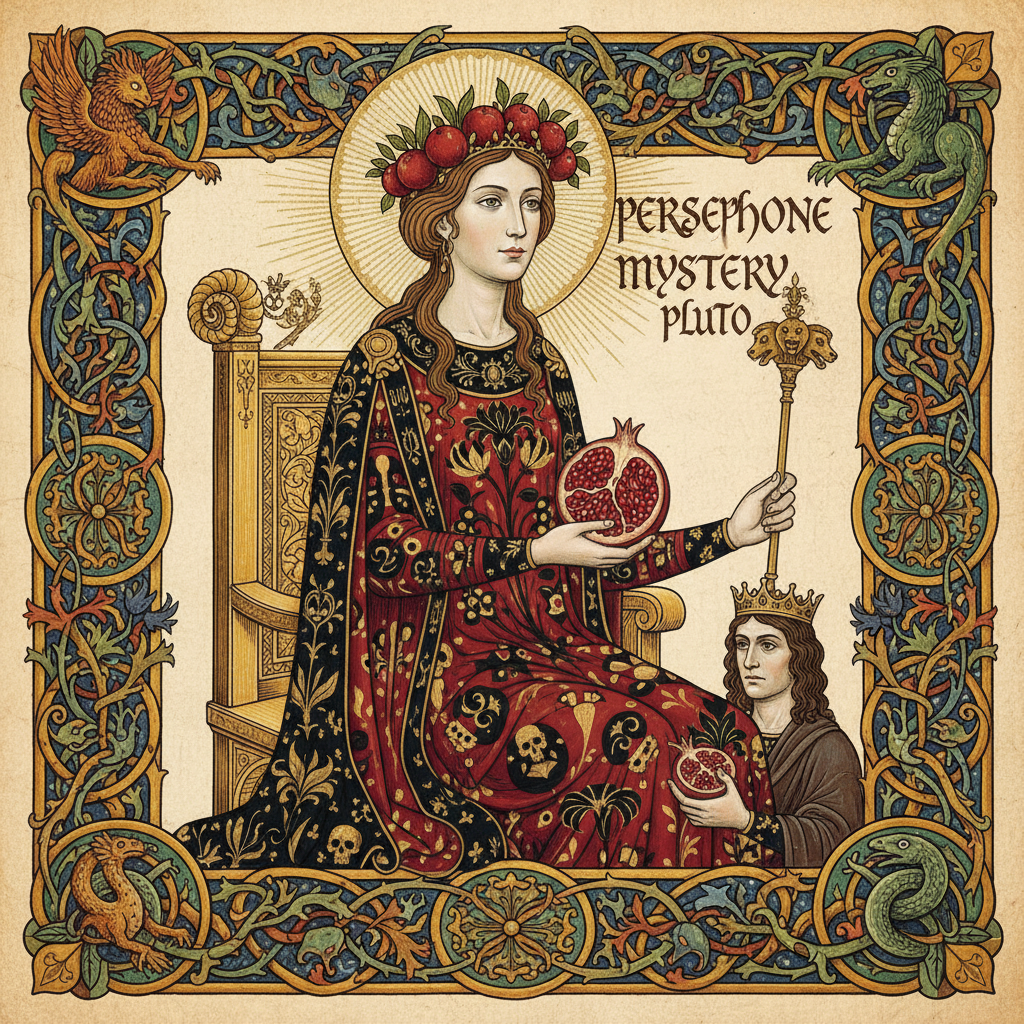
 Persephone, queen of the dead, receives the soul who speaks the correct words: 'I am a child of Earth and starry Heaven, but my race is of Heaven alone
 Generating art…
 Echoes Across Traditions
Entities
- Persephone
- Mnemosyne
- Lethe
- the Guardian of the Spring

Sources
- Fritz Graf and Sarah Iles Johnston, *Ritual Texts for the Afterlife: Orpheus and the Bacchic Gold Tablets* (2007)
- Walter Burkert, *Ancient Mystery Cults* (1987)
- M.L. West, *The Orphic Poems* (1983)
- Günther Zuntz, *Persephone: Three Essays on Religion and Thought in Magna Graecia* (1971)
- Radcliffe Edmonds, *Myths of the Underworld Journey* (2004)