Socrates Drinks the Hemlock
399 BCE · the prison of Athens, month of Thargelion · The state prison of Athens, a cell on the eastern slope of the Areopagus
Contents
Condemned to death for impiety and corrupting the youth of Athens, Socrates refuses his friends' plan of escape, argues for the immortality of the soul until his legs go numb, and dies asking that a debt to Asclepius be paid.
- When
- 399 BCE · the prison of Athens, month of Thargelion
- Where
- The state prison of Athens, a cell on the eastern slope of the Areopagus
The door opens before dawn.
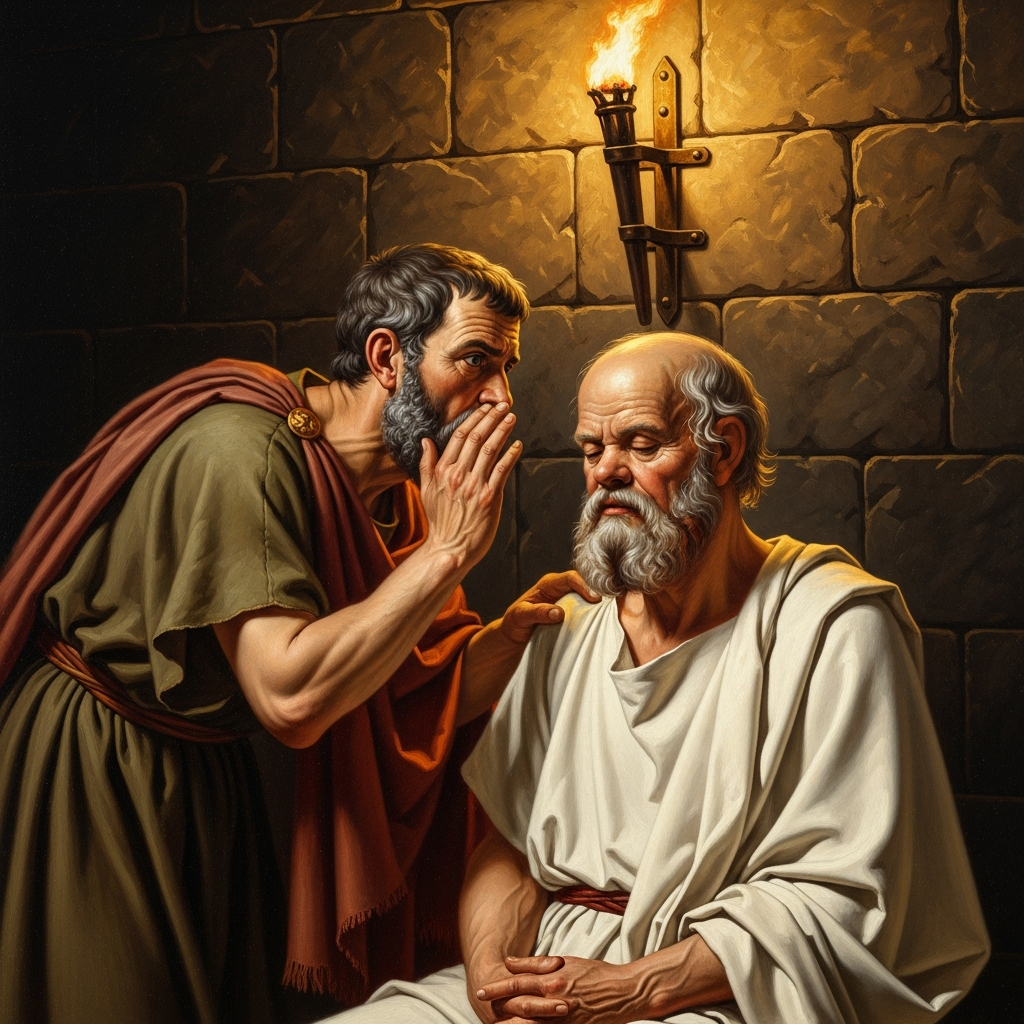
Crito slips in carrying a lamp and sits by the low bed where Socrates is still asleep. He watches him breathe. He does not wake him immediately — he has bribed the jailer, arranged the boat at Piraeus, secured promises from friends in Thessaly who will shelter the old man and ask no questions. Everything is ready. All that is needed is for Socrates to stand up and walk out of Athens.
Crito watches him sleep and cannot bring himself to start the conversation, because he already knows how it will end.
Socrates wakes on his own.
He sees Crito. He sees the hour. He is not surprised. “Why did you not wake me?” he asks, and Crito says he did not want to disturb a sleep so peaceful. Socrates says a man of his age is not much troubled when he knows he will die — and then he listens to the plan. The bribed guard. The Theban friends. The ship. He listens with the polite attention he brings to every argument, even the ones he finds weak.
Then he explains, carefully, why he will not go.
He has lived in Athens for seventy years. He has never sought to live elsewhere, has never taken the opportunity offered to every Athenian to emigrate. He has raised children here, made agreements here, stood trial when summoned rather than fleeing — the city was the framework of his life. To break it now, when the city has made a ruling he disagrees with, would be to say: the law is valid when it favors me and invalid when it does not. That argument, Socrates says, works against every law anyone has ever made. It works against civilization itself.
The laws, he says, speaking as though they are a person standing in the room, would say to him: Socrates, did we not give you life? Did we not educate you? Did we not let you stay and argue and question for seventy years? You had every chance to try to change us by persuasion. You failed. Now you wish to change us by force?
Crito has no answer to this. He has never had an answer to this.
The sun comes up on the last day.
Friends gather. Phaedo is there, who will later write the account of what happens. Simmias and Cebes, from Thebes, who had crossed into Athens for the trial and stayed for this. Xanthippe, Socrates’s wife, arrives early with their youngest son and weeps with a noise that disturbs everyone — Socrates asks that someone take her home, and she is taken home, still calling out. He is not unfeeling about this. He is practicing what he has been teaching for forty years: the philosopher’s task is to practice dying, to loosen the soul’s grip on the body before death forces the issue.
He spends the day arguing for the immortality of the soul.
He does not claim to know it for certain. He says — and this is the distinction that separates him from priests and prophets — that he has reasons to believe it, and that those reasons are worth examining. The soul, he argues, is what knows; the body is what decays. What knows does not decay like flesh. The Forms — beauty itself, justice itself, equality itself — do not change; the mind that grasps them touches something that cannot rot. These are not proofs. They are arguments. He offers them and invites objection, and Simmias and Cebes object, and he answers. The sun moves across the stone.
The jailer arrives at sunset.
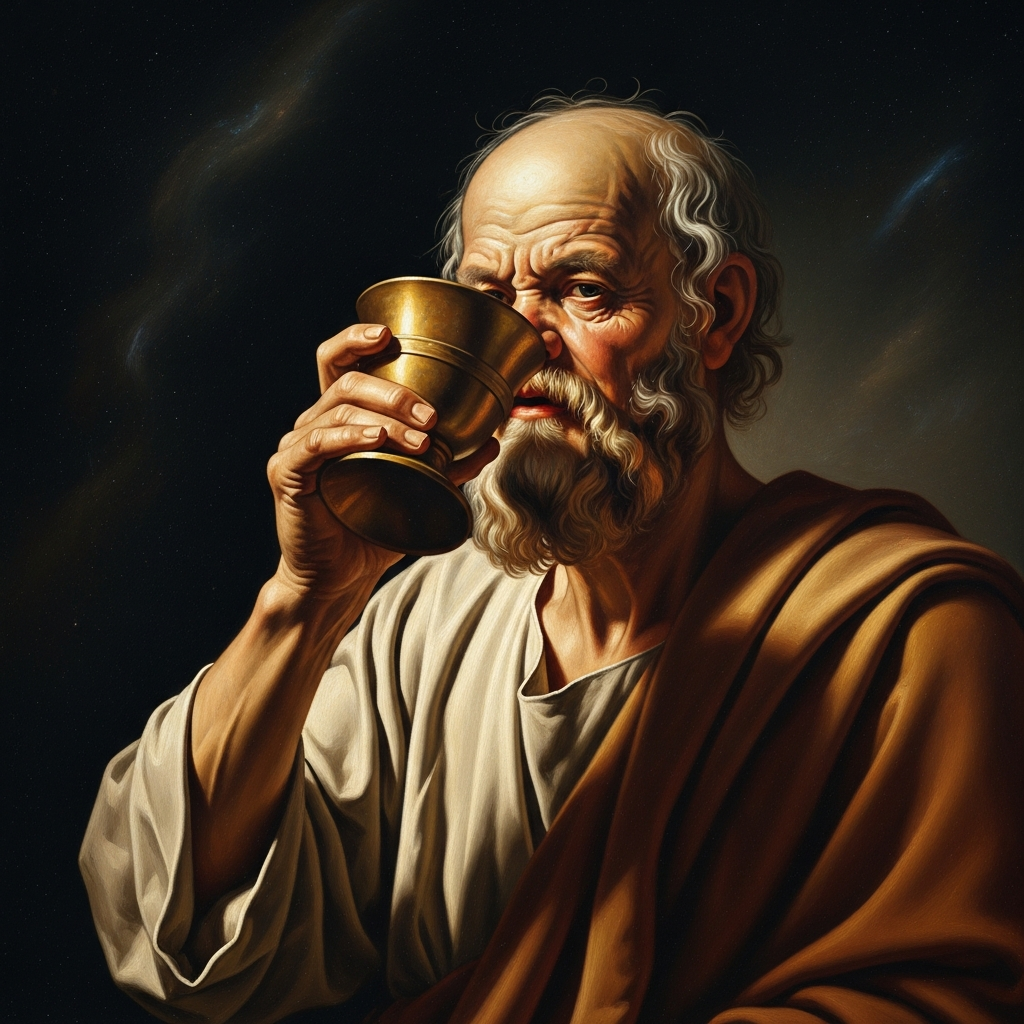
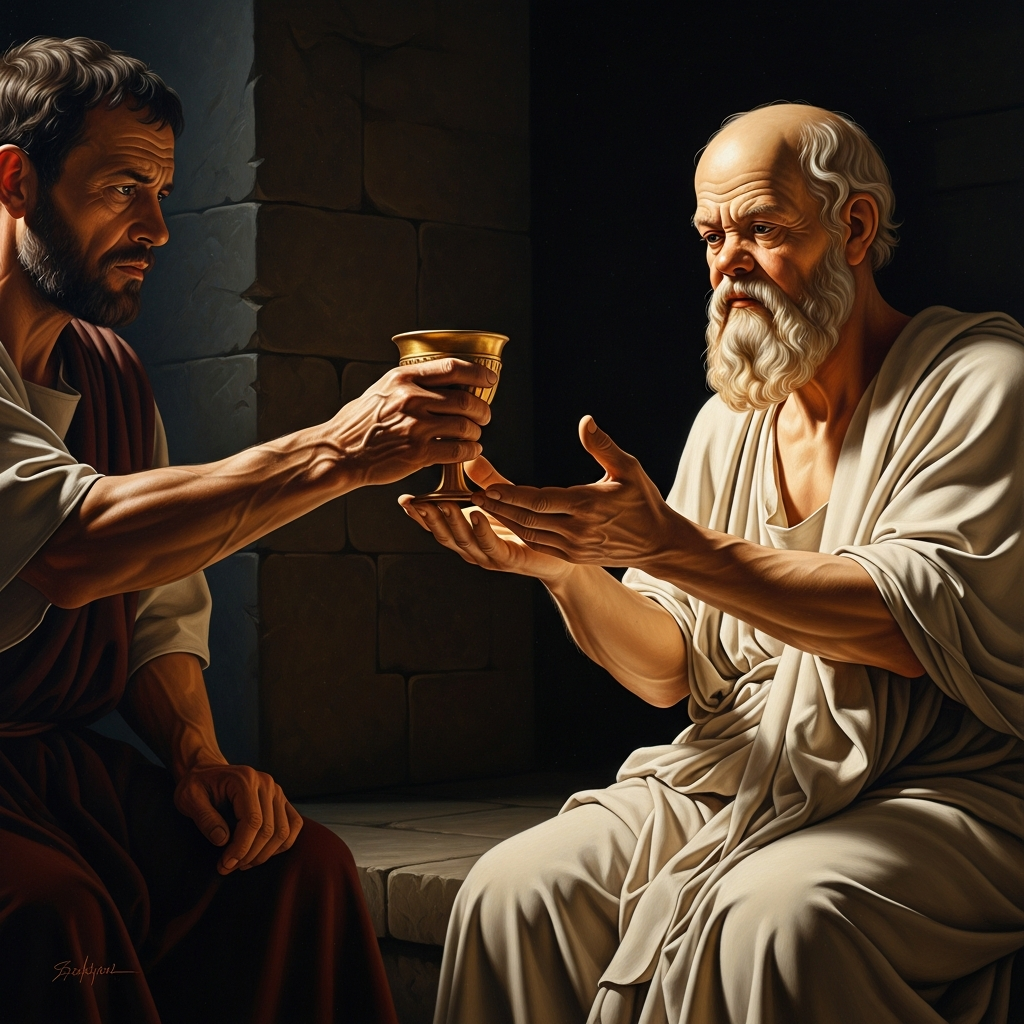
He apologizes. He has brought hemlock to men condemned before, he says, and he has found Socrates the finest of them — the most noble, the mildest, the best. He weeps. Socrates thanks him and asks for the cup.
He takes it with both hands, the way a man accepts a gift.
He asks the jailer whether he may pour a small libation from the cup — a prayer to the gods for a safe passage. The jailer says there is barely enough to drink. Socrates nods. He holds the cup and offers a prayer silently. Then he raises it to his lips.
His friends, who have been holding themselves together all day by the argument, cannot hold any longer. Phaedo covers his face. Apollodorus, who has been crying all day and for whom everyone has apologized, breaks into a loud wail. Crito cannot stop his tears. Even Phaedo, writing it decades later, cannot find words for this without saying that he wept.
Socrates looks at them with something between affection and exasperation.
Why are you crying? he says. I sent the women away precisely because of this. Be quiet.
He walks.
He moves his legs as the jailer instructed — walk until you feel the heaviness. He walks back and forth across the cell. Then he lies down when he is told to. The jailer presses along his foot, his leg, upward. He asks Socrates if he can feel the pressure. Socrates cannot. The hemlock does its work from the ground up: the feet and legs first, then the trunk, then the chest, and when it reaches the heart, it is over.
The friends crowd around.
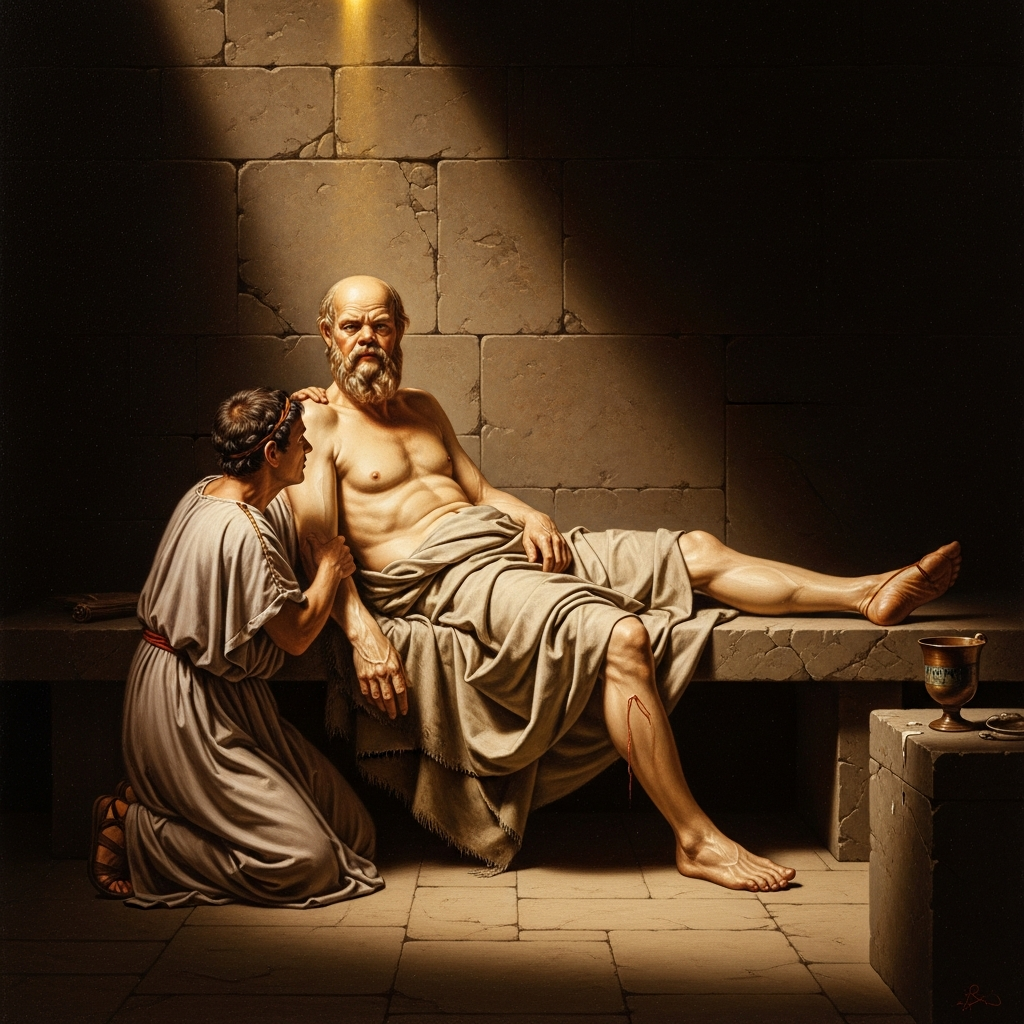
The coldness moves upward through his body. His legs are numb. His abdomen is numb. He draws the cloth up over his face — one last instinct toward propriety, a philosopher dying tidily — and then, almost immediately, he throws back the cloth and says the words that have not stopped echoing in twenty-four centuries:
Crito, we owe a cock to Asclepius. Pay it; don’t forget.
Crito says they will, and asks if there is anything else.
There is no answer. He uncovers the face. The eyes are fixed.
The debt to Asclepius has been argued over since. Asclepius is the god of healing; a cock is the traditional offering given upon recovery from illness. Socrates appears to be saying that death is a recovery — that life itself is the illness, the soul’s imprisonment in flesh, and that what comes next is the cure. He is making a joke, maybe. He is being precise, certainly. He has spent forty years arguing that the examined life is worth living. He dies making sure the last thing he says is examined.
The jailer wept. Crito paid the debt. Phaedo wrote it down. Athens built a cult of guilt that took decades to dissipate and has never fully disappeared. In thirty years, the city will raise a bronze statue of Socrates in the Pompeion, near the sacred road to Eleusis. The man they executed becomes the man they commemorate — which is perhaps the only form of justice a city knows how to offer.
The hemlock was not fast. It took time. He talked through all of it. That, too, was deliberate.
Scenes
Crito leans close in the torchlit cell, whispering the plan — the boat, the friends in Thessaly, the open road
 Generating art…
 The jailer extends the cup
 Generating art…
 His legs are already numb, his voice still clear: 'Crito, we owe a cock to Asclepius
 Generating art…
 Echoes Across Traditions
Entities
- Socrates
- Crito
- Phaedo
- Asclepius
Sources
- Plato, *Phaedo* (trans. G.M.A. Grube, rev. C.D.C. Reeve, in *Plato: Complete Works*, ed. Cooper, 1997)
- Plato, *Crito* (trans. G.M.A. Grube)
- Plato, *Apology* (trans. G.M.A. Grube)
- Xenophon, *Memorabilia* IV.8 (trans. Amy Bonnette, 1994)
- Robin Waterfield, *Why Socrates Died: Dispelling the Myths* (Norton, 2009)