We Owe a Cock to Asclepius
399 BCE · the state prison of Athens, month of Thargelion · The state prison of Athens, below the Areopagus, the month before the summer solstice
Contents
Condemned to death for impiety, Socrates spends his last day in conversation about the immortality of the soul. He drinks the hemlock cheerfully. His last words are a debt he wants paid to Asclepius, the god of healing. What illness was cured? Plato does not say directly. But the tradition has been answering the question for twenty-four centuries.
- When
- 399 BCE · the state prison of Athens, month of Thargelion
- Where
- The state prison of Athens, below the Areopagus, the month before the summer solstice
The door opens before dawn and Crito is inside, lamp in hand, sitting where he has been sitting long enough for his back to ache.
He has bribed the jailer. He has arranged the boat at Piraeus, a small fast ship whose captain asks no questions and has been paid enough not to start asking them. He has sent word to friends in Thessaly — educated men, men who will respect what they are sheltering — that a certain philosopher may need to spend some years among them and that this arrangement will be kept quietly. Everything is ready.
He watches Socrates sleep.
He does not wake him. He has been here for some time watching the chest rise and fall with the unhurried breathing of a man who is not afraid of what day it is. This, too, Crito finds impossible. He is afraid enough for both of them and has been for thirty days, since the trial, since the sentence, since the delay caused by the sacred ship of Apollo that was away on its annual mission to Delos — a delay that made the sentence legal but the execution impossible until the ship returned, and the ship has returned, and today is the day.
Socrates opens his eyes.
He sees Crito, registers the hour, shows no surprise. He says: you didn’t wake me. Crito says he didn’t want to disturb a sleep so peaceful.
Socrates listens to the plan with the concentrated attention he brings to every argument. Then he explains, quietly, why he will not go.
The argument he makes is not that death is good, or that the afterlife is preferable to Thessaly, or that he is indifferent to life. The argument is that he cannot now — after seventy years of living inside the law, raising his children inside it, having every opportunity to leave Athens and declining every one — choose to live by the law when it favors him and discard it when it does not.
He imagines the laws of Athens standing in the room and speaking to him. They say: Socrates, we gave you life. We gave you education. We gave your father the legal framework in which to marry your mother and make you. For seventy years you lived here and never asked to leave and when you went to court you submitted yourself to our verdict and now, because you dislike this particular verdict, you want to break us. Is that the deal? You’ll honor us when we’re convenient?
Crito has no answer to this. He never has an answer to this. He has come back three times with the argument and each time Socrates has walked him through the same reasoning, gently, not triumphantly, the way a teacher returns to a concept the student has not yet grasped, with the patience of someone who knows the student will eventually get there.
Outside the prison, Athens is going about its early morning. The sun is beginning. In the harbor at Piraeus, the ship Crito hired is waiting at the dock. The captain will wait until midmorning. Then he will not wait.
The friends arrive at sunrise.
Phaedo of Elis is there. He is the one who will write the account of the day — not immediately, but later, from memory, for Echecrates and the Pythagorean community at Phlius who could not be present. Simmias and Cebes have come from Thebes; they were at the trial and stayed for this. Apollodorus, who has been crying since the conviction and for whom everyone has quietly apologized, is there. Crito’s son Critobulus.
Xanthippe, Socrates’s wife, is there early with their youngest son on her hip. She weeps in the Greek manner — loudly, with the particular sound that the funeral tradition sanctioned, the goos, the ritual mourning cry. She says: Socrates, your friends will speak with you for the last time. He looks at her and at the child and asks Crito to take her home. She is taken home calling out in a way that Phaedo, writing decades later, finds too painful to transcribe precisely.
Socrates rubs his legs where the chains have been. He talks about how odd it is that pleasure and pain come together — when the chain is removed, the pleasure of relief follows the pain of confinement. He wonders if someone should write a poem about this. He wonders if Aesop would have made it into a fable. His friends recognize this as the mode he works in when the material is serious: the slight, ironic frame around the thing that cannot be said directly without losing something in the saying.
Then they talk about the soul.
He does not claim to know it will survive. He never claims to know anything. This is the distinction that separates him from the priests and the prophets who crowd the agora with their certainties: he has reasons to believe the soul is not destroyed by death, and he offers the reasons, and he invites objection.
Simmias objects. Cebes objects. The sun moves across the stone.
The arguments Socrates makes are the arguments that Plato, working from this conversation or composing this conversation or both simultaneously, will develop into the foundation of his metaphysics. The soul knows beauty itself, justice itself, equality itself — the Forms that exist unchangeably, beyond the reach of the decay that takes everything material. What knows the unchangeable must itself be of the same nature as the unchangeable. The mind that grasps what does not decay cannot itself decay in the same way that the body decays.
These are not proofs. Socrates says they are not proofs. He says that a wise man should not insist that things are exactly as he has described them, but that something of this sort is the case — that the soul and the things that belong to the soul are worthy of all the confidence and care we can muster. He is, in the last hours of his life, doing what he has always done: examining, with rigorous affection, the beliefs that structure how to live.
He cannot stop doing this. He cannot stop doing this any more than he could have agreed to stop doing it as the condition of his acquittal. He was offered that deal, at the trial. He declined. The Apology records his refusal: he will not stop practicing philosophy even to save his life, because a life not examined is not worth living, and the unexamined life is the only life left him if he agrees not to examine.
The jailer arrives at sunset.
He apologizes before he speaks — he has brought the cup to others under sentence before Socrates, and those others were angry, or afraid, and he had to return with threats. Socrates, he says, has been the finest of them all. The noblest. The most gentle. He weeps. This is Phaedo’s detail, and he insists on it: the man whose job is to administer the hemlock is weeping while the man who is about to drink it comforts him.
Socrates asks for the cup.
He holds it with both hands, the way a man receives a gift. He asks whether he may pour a small libation from it — an offering to the gods for a safe passage. The jailer says there is barely enough liquid for the required dose. Socrates nods. He prays silently. He raises the cup.
His friends, who have been holding together all day by the force of the argument, cannot hold any longer.
Phaedo says he covered his face and wept. Apollodorus broke into a wail. Crito, who had been managing since before dawn, cannot manage. The weeping is loud. Socrates looks at them with something that is affection and exasperation in approximately equal parts and says: What is this? I sent the women home for exactly this reason. I have heard that one should die in peace. Quiet yourselves.
They are ashamed. They quiet. He drinks.
He walks.
He walks until he feels the heaviness in his legs, then lies down as the jailer instructs. The hemlock works from the ground up: the feet first, then the calves, the knees, the thighs. The jailer presses along the skin of his foot and asks if he can feel it. He cannot. The coldness moves up through his body with the patience of something that has done this before and knows how much time it takes and has all the time there is.
His abdomen goes cold. His trunk. He draws the cloth over his face — tidily, the way he has done everything tidily, a philosopher dying in good order — and then he throws the cloth back from his face and speaks.
Crito, we owe a cock to Asclepius. Pay it; don’t forget.
Crito says: we will. Is there anything else?
There is no answer.
Crito uncovers the face. The eyes are fixed. He closes them. Phaedo describes this in the past tense, which is the only tense available to him from the distance of decades, and says: such was the end of our companion, a man who, I think, was the best of all those of his time that we have known, and the most intelligent and the most just.
The debt to Asclepius has been argued over for twenty-four centuries.
Asclepius is the god of healing. The traditional offering to Asclepius is a cock given upon recovery from illness. The gift is made after the patient is well — it is a thank-you for the cure. Socrates, in the moment his legs have gone numb and his voice is going with them, is offering thanks for a recovery from something.
The interpretations organize around a question: what was the illness?
Nietzsche’s answer, in The Gay Science, is the most famous: Socrates was thanking Asclepius for the cure of life. Life is the illness. The body is the illness. The cage of sensory experience and appetite and the fear of death that structures everything around the avoidance of death — this is the disease. Death is the recovery. The philosopher is thanking the god of healing for finally administering the medicine he has been prescribing to others for forty years.
This reading gives Socrates a bitter cheerfulness — the man who has been arguing for the soul’s superiority over the body finally getting to put the argument into practice, satisfied at last. Nietzsche means it as a critique: Socrates wants out of life, and the hemlock is the mechanism. The philosopher as decadent, choosing negation over affirmation.
Another reading: Socrates thanks Asclepius for curing Athens — curing the city of the disease that produced his trial, the disease of ignorance that masquerades as knowledge, the disease he spent his life trying to diagnose. His death is the cure. The city will be sick with guilt and slowly recover, and in thirty years it will raise a bronze statue of him near the Sacred Road to Eleusis.
A third reading, simpler: he actually owes the debt. He made an offering to Asclepius sometime earlier, fell ill before he could pay, and is reminding Crito because the debt will otherwise go unpaid and he has spent his whole life insisting on paying what is owed.
The text does not resolve this. The text ends with the debt. Plato’s Phaedo is one of the most carefully constructed literary documents in the Western tradition, and the last words in it are a cock, a debt, and a god of healing, and the reader is left with the task of discovering what illness was cured.
In thirty years, Athens erects the statue. The guilt takes exactly that long to metabolize into commemoration. Plato writes the dialogues, each one extending the examination Socrates began, each one asking the questions Socrates would have asked if he had lived. Plato’s Academy runs for nine hundred years — from 387 BCE until the emperor Justinian closes it in 529 CE — and produces Aristotle, who produces Alexander, who spreads Greek thought to the edges of the world.
All of it is downstream of the hemlock. The trial was meant to stop the questioning. The hemlock was the mechanism. What the city of Athens produced instead was the most durable tradition of philosophical inquiry in Western history, fueled by the fact that the man who began it died rather than stop.
Crito paid the debt. We do not know if the cock was white or dark or ordinary. We know it was paid.
The illness was cured. The arguments go on.
Scenes
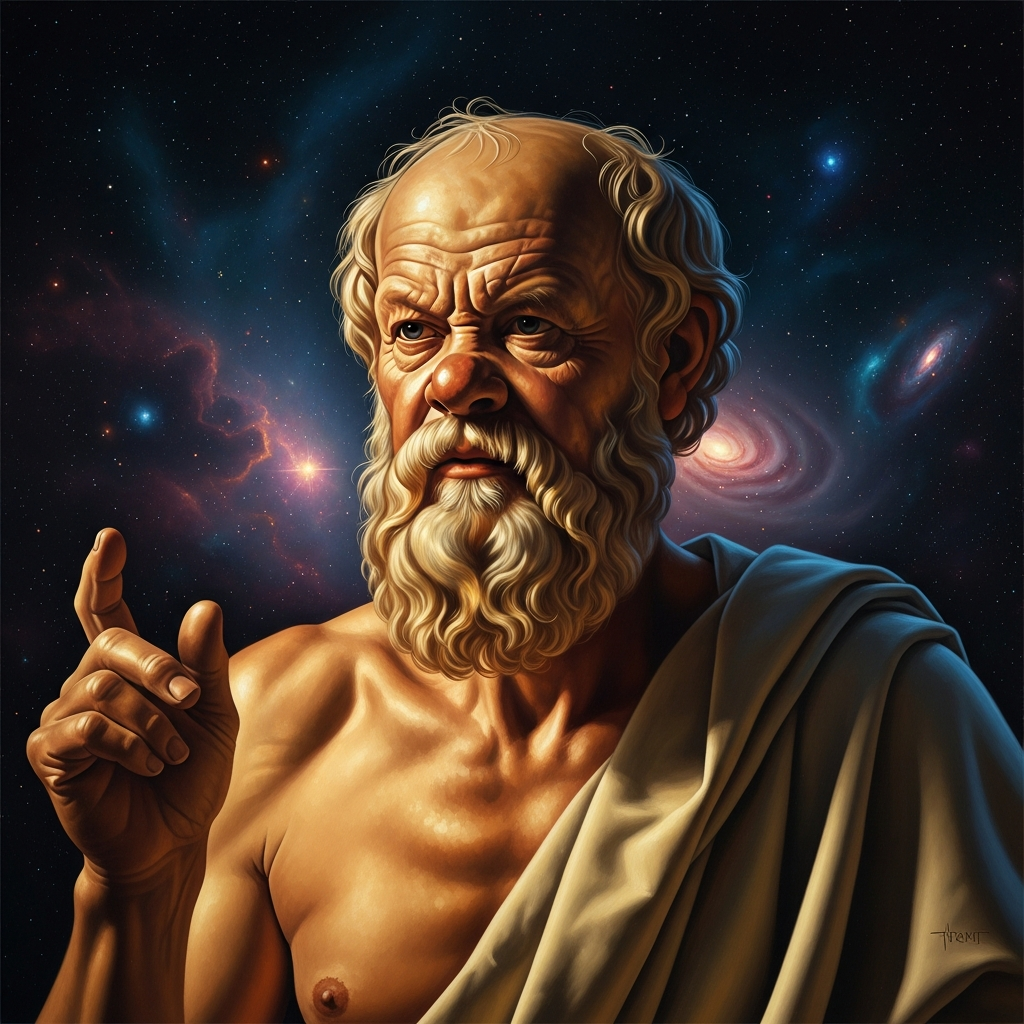
Socrates's friends gathered in the Athenian prison on the last morning — Phaedo, Crito, Simmias, Cebes — listening as the philosopher they came to rescue explains, with the patience of a man who has thought about this for forty years, why he will not go
 Generating art…
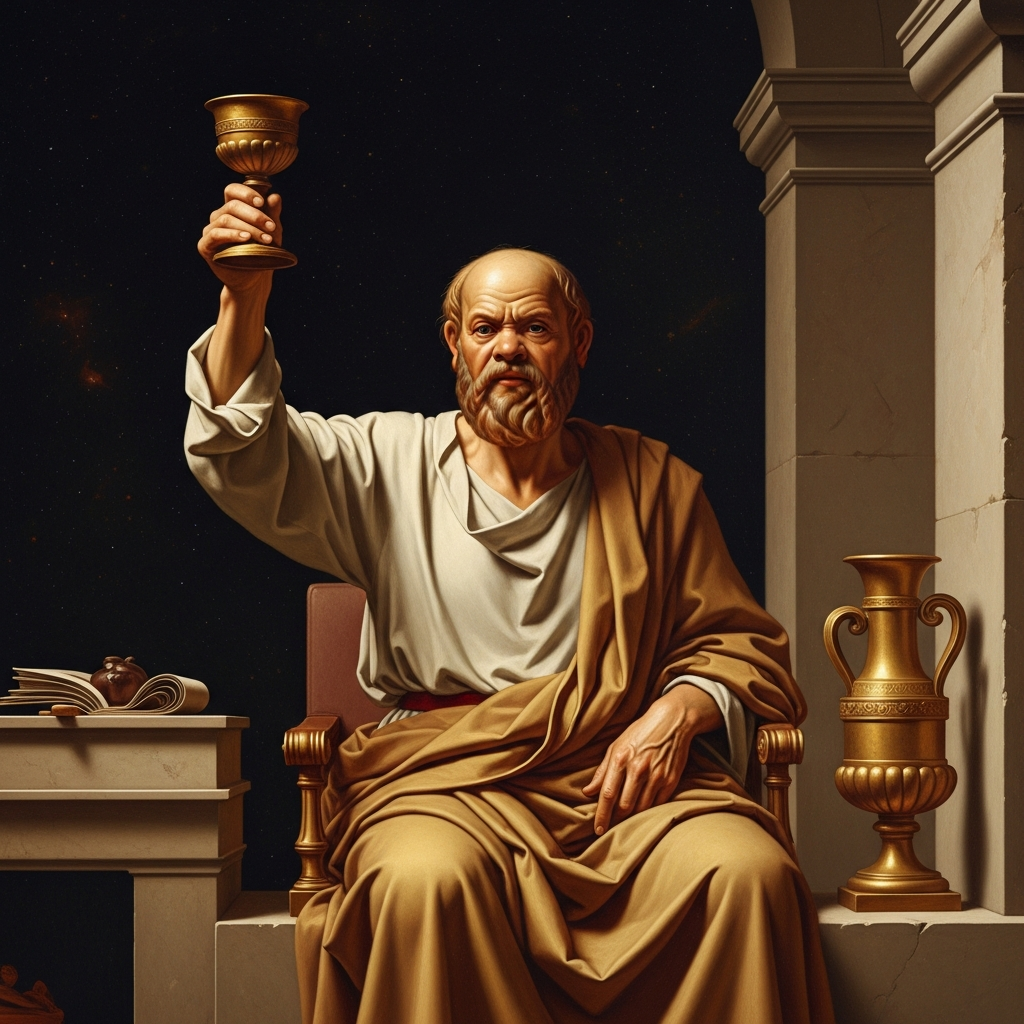
 Socrates raising the hemlock cup, calm as a man accepting wine at a symposium, asking the jailer whether he may pour a libation to the gods before he drinks — the philosophical life ending in exactly the posture it maintained throughout
 Generating art…
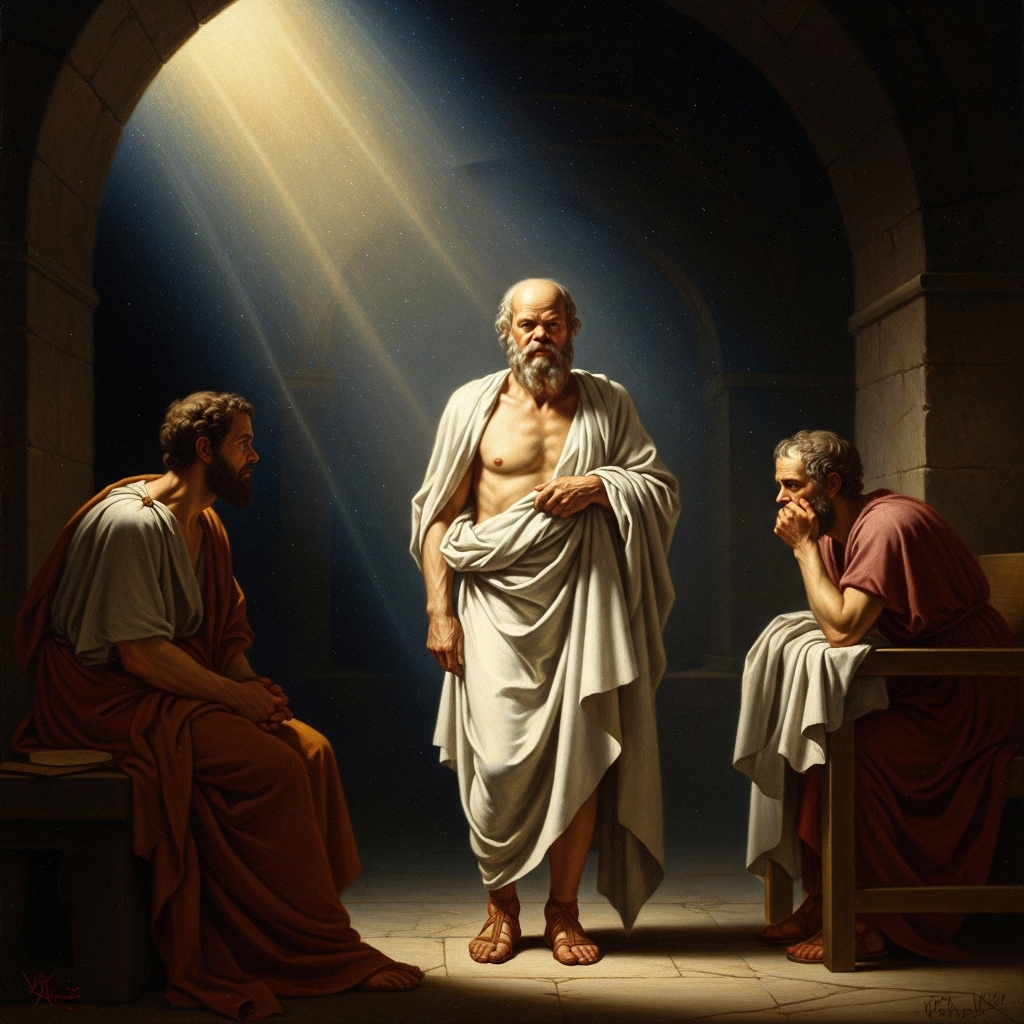
 Socrates covered by the white cloth, the cold ascending through his body from the feet upward, speaking his last words to Crito across the narrowing distance between a philosopher and silence
 Generating art…
 Echoes Across Traditions
Entities
- Socrates
- Crito
- Phaedo
- Simmias
- Cebes
- Asclepius
Sources
- Plato, *Phaedo* (trans. G.M.A. Grube, rev. C.D.C. Reeve, in Cooper ed., 1997)
- Plato, *Crito* (trans. G.M.A. Grube)
- Plato, *Apology* (trans. G.M.A. Grube)
- Xenophon, *Memorabilia* IV.8 (trans. Amy Bonnette, 1994)
- Robin Waterfield, *Why Socrates Died: Dispelling the Myths* (Norton, 2009)
- Gregory Vlastos, *Socrates: Ironist and Moral Philosopher* (Cornell, 1991)