Plato's Allegory of the Cave
c. 380 BCE · composed in the *Republic*, Book VII · Athens — a conversation, probably the Piraeus, though the cave is everywhere
Contents
Socrates asks Glaucon to imagine prisoners chained in a cave, seeing only shadows. One escapes, sees the sun, and returns to free the others — who try to kill him. This, Plato says, is the life of the philosopher.
- When
- c. 380 BCE · composed in the *Republic*, Book VII
- Where
- Athens — a conversation, probably the Piraeus, though the cave is everywhere
Begin with the dark.
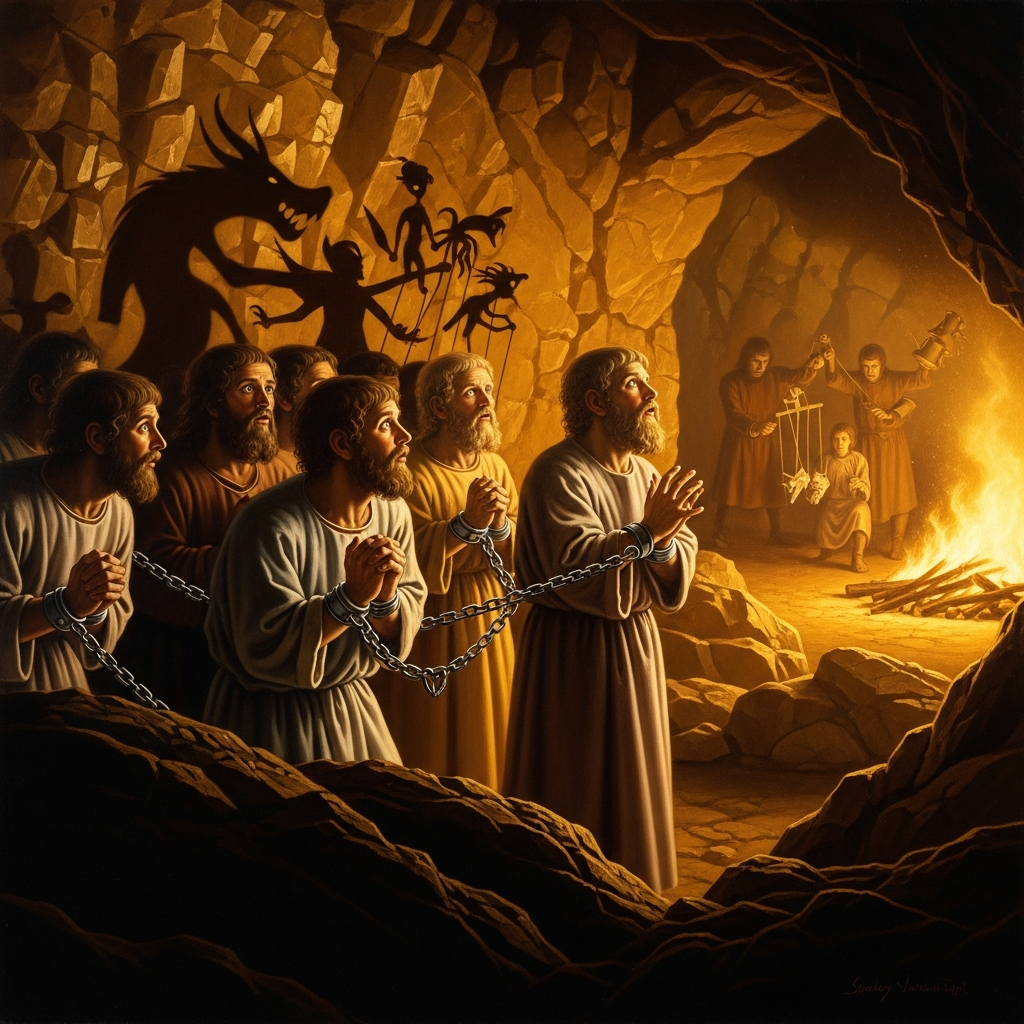
Socrates says: imagine a cave. Not a metaphor — work the image precisely, he tells Glaucon. Prisoners inside since childhood. Chained so they cannot turn their heads. Facing the cave wall. Behind them, higher up, a fire. Between the fire and the prisoners, a low wall, and behind that wall, people carrying objects — statues, carvings, figures — past the fire so that their shadows fall on the cave wall in front of the prisoners.
The prisoners see only shadows. They hear only echoes. They have been here since before memory. They believe the shadows are the world.
Glaucon says he sees a strange image.
Socrates says: they are us.
Now free one.
Socrates does not say how or why — the allegory permits a passive construction, a sudden loosening of chains. One prisoner is freed. He turns. This is already agony: the neck that has never been turned, the joints that have been fixed since childhood. He turns and sees the fire for the first time. The fire is blinding. He wants to look back at the shadows — the shadows he knows, the shadows he has spent his life naming and categorizing and arguing about with the other prisoners. The fire is too bright. The shadows were easier.
Someone — and here Socrates introduces a guide, a teacher, though he does not name the teacher — pulls him toward the opening of the cave, up the steep and rough ascent. The prisoner stumbles. His eyes stream. The light increases with every step and at the top there is the sun and he cannot see it at all. He can only look at reflections: water, shadows of things, the things themselves at dusk. Gradually his eyes adjust. He looks at the night sky. He looks at the moon. Then, finally — and this is the moment everything turns on — he looks at the sun.
He sees it. The sun that makes all other light possible. The source of seasons, years, the administration of the visible realm. And he understands, looking at it, that everything he spent his life in the cave arguing about was a shadow of a shadow.
He goes back down.
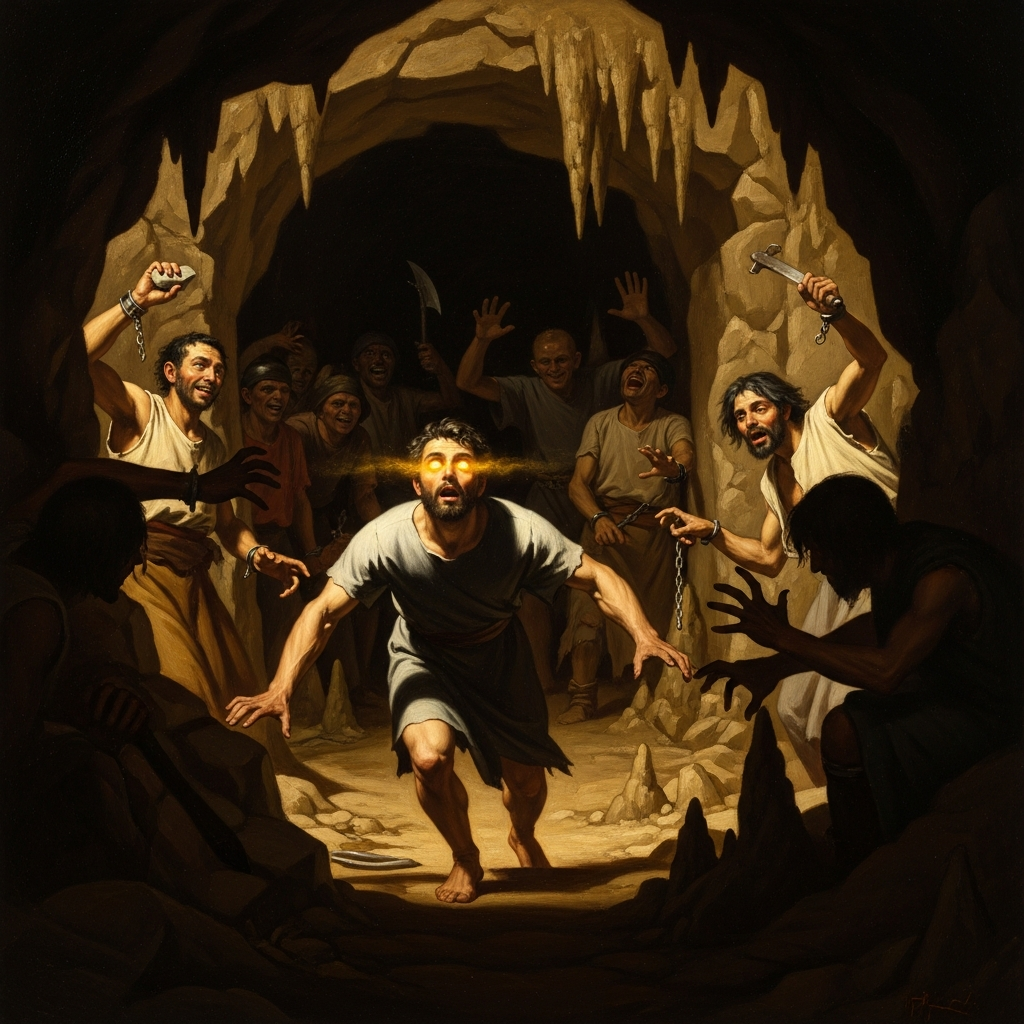
This is the move that Plato says no philosopher wants to make. After the sun, the cave is darkness. The man who has seen real things stumbles in the dim. His eyes are useless here now — they were adapted for the underworld and then re-adapted for the light, and the cave is neither. He cannot see the shadows properly. He cannot argue about them as the prisoners argue. He makes mistakes about the shadows that the prisoners — who have never left — do not make.
The prisoners conclude that going up the passage ruins your eyes.
They say: anyone who tries to free us and lead us up should be caught and killed.
Socrates asks: would they not kill him? Glaucon says: certainly. Socrates nods. He has been thinking about Socrates the man while inventing Socrates the philosopher. The cave is Athens. The returned prisoner is Socrates. The year is 380 BCE, nineteen years after the execution.
The Form of the Good.
Plato does not call what the prisoner sees in the sun merely “the truth” or “reality,” though it is both. He calls it the Form of the Good — to agathon — the highest of the Forms, the thing that makes all other Forms intelligible the way the sun makes all other things visible. Justice is a Form. Beauty is a Form. Equality is a Form. These things exist fully and permanently, not like their flickering copies in the world of change. But above them all is the Good, which is not merely one Form among others but the ground of all intelligibility, the source of all being.
To philosophize — really philosophize, not just argue — is to turn toward this light. To stop looking at what others are looking at and ask what makes them look.
Most people never turn.
The philosopher’s dilemma.
Socrates, speaking to Glaucon in the Republic, is trying to justify something that seems impossible: why would anyone who had seen the sun return to the cave? The answer is not that they want to. The answer is that the city — the just city Socrates is designing across the nine books of the Republic — must compel them. The philosopher-rulers must take turns in the cave, governing, because if they refuse, worse people will govern. It is not a pleasure. It is an obligation. Seeing the truth incurs a debt to the people who have not seen it.
Plato is describing the life he has been trying to live since Socrates died.
He went to Sicily three times to try to make a philosopher-king of Dionysius and then of Dionysius II. He failed each time — was nearly sold into slavery on the first trip. He came back to Athens and founded the Academy, the first university, and wrote dialogues for forty years. He could not stop going back into the cave. He could not stop believing that seeing the sun obligated you to descend.
The prisoners still argue.
In the cave, without the freed prisoner, the argument about shadows continues. The prisoners rank each other by skill at predicting which shadow comes next. They have honor, prizes, power organized around this skill. Anyone who comes back from the blinding passage and claims there is a fire up there — a fire that casts the shadows — is a threat not just to the argument but to the entire social order. The social order of the cave is built on the premise that shadows are all there is.
This is not stupidity, Plato says. It is the structure of all human societies. Every society mistakes the shadows it projects for the real thing — its gods, its customs, its coin, its art, its calendar. Questioning the shadows is not merely impolite. It is revolutionary. It is, historically, a capital offense.
Socrates drank the hemlock for it. Plato spent the rest of his life not quite drinking the hemlock, circling the cave entrance, arguing, writing, descending, ascending, never fully in and never fully out.
The cave has not emptied. This is the allegory’s unflinching wager: most people, given the choice, prefer the shadows. Not from stupidity or malice — the shadows are familiar, the light is painful, the passage is steep, and the person who comes back from it stumbles around uselessly and makes the other prisoners look bad.
Every wisdom tradition has its own version of this story. The Buddhist calls the shadow-world samsara and offers a path out through the eight-fold road. The Sufi calls it the veil of hijab and offers union with the divine light through love and annihilation of the self. The Hindu calls it maya and offers the recognition that Atman is Brahman — that the prisoner and the sun are the same thing. The Christian calls it sin and offers redemption through the Word made flesh, descending into the cave himself.
Plato’s version is the coldest. There is no grace, no bhakti, no guru’s touch. There is only the steep passage, the blinding light, and the obligation to go back down.
The shadows are still moving on the wall. The argument about them is still going. The passage is still there, if you know where to look, and it is still blinding at the top, and the people at the bottom still have weapons.
Scenes
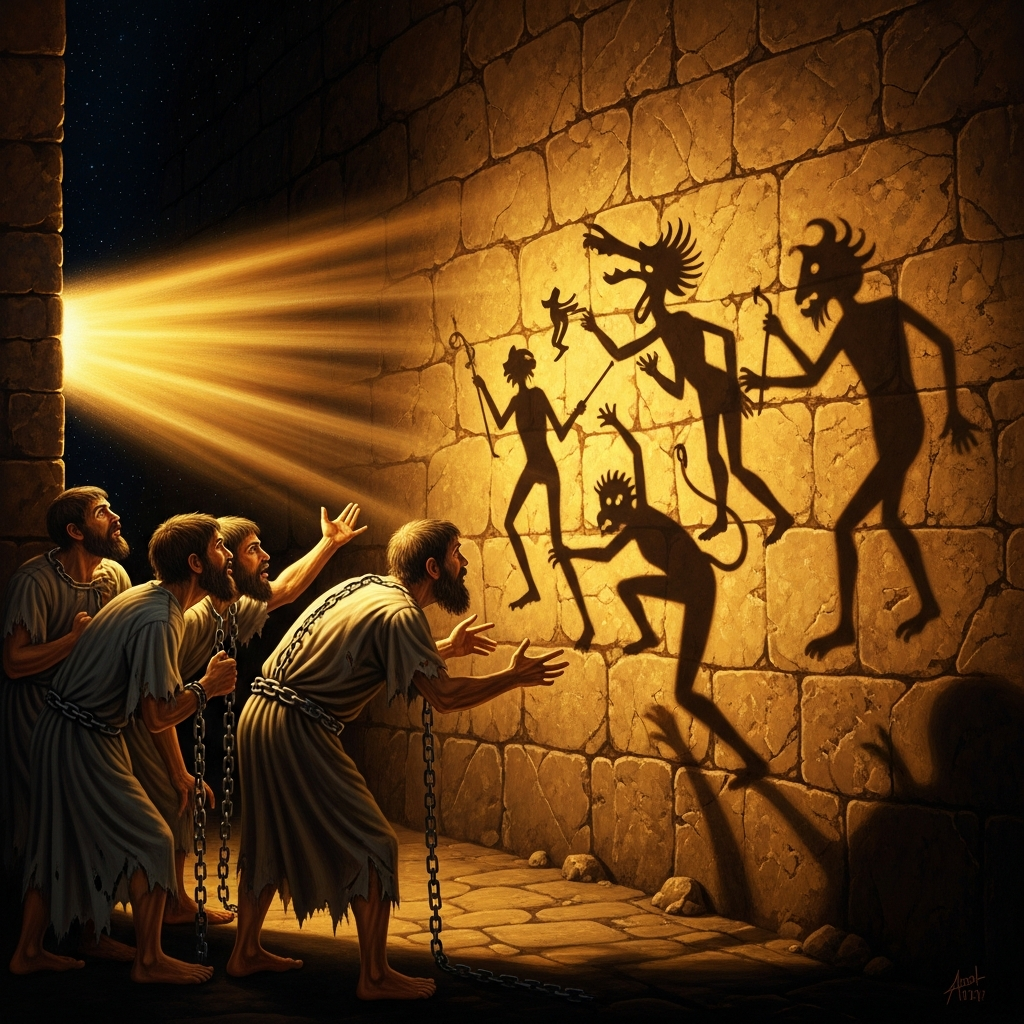
The chained prisoners face the wall, watching the shadows move — firelight through puppets — and argue passionately about what the shadows mean
 Generating art…
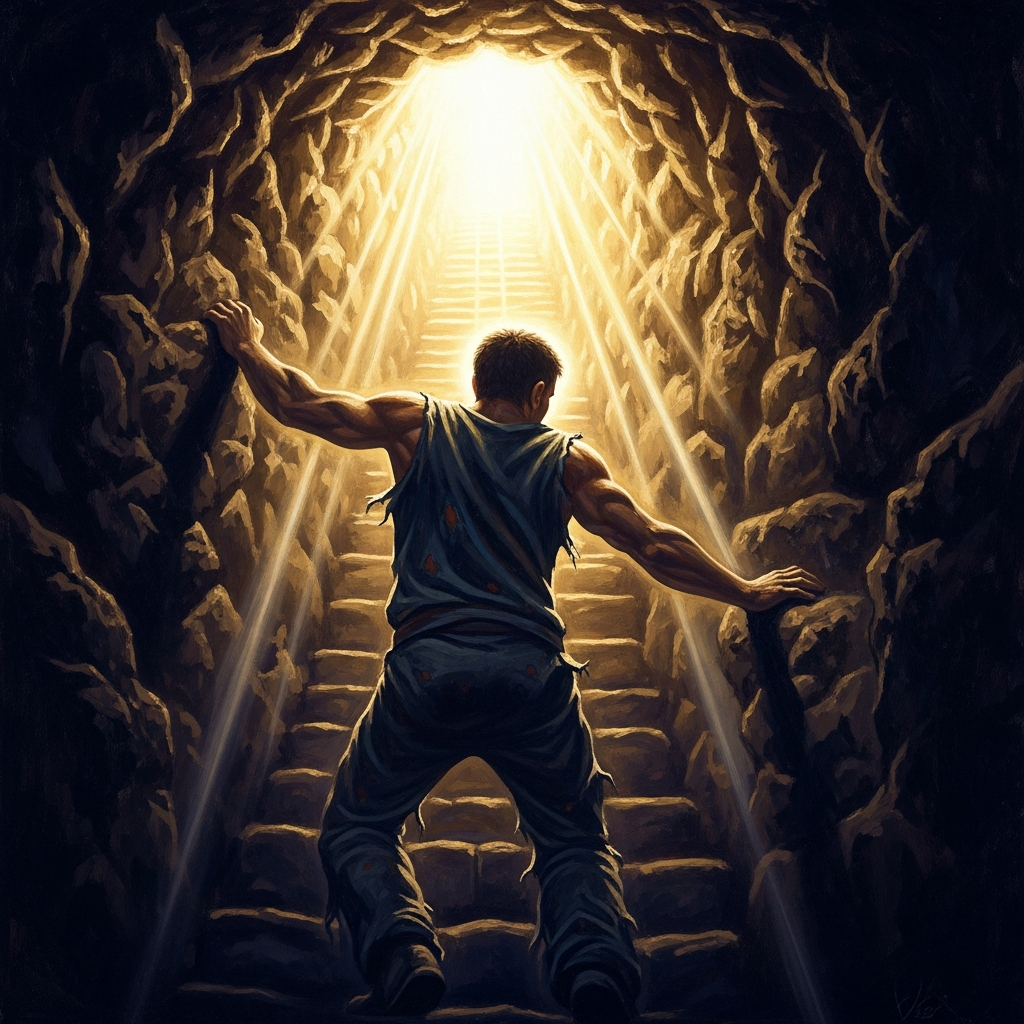
 The freed prisoner climbs the steep tunnel toward a light so intense he cannot look at it — the sun that casts all other light
 Generating art…
 He descends again into the cave
 Generating art…
 Echoes Across Traditions
Entities
- Plato
- Socrates
- Glaucon
- the Prisoner
- the Sun
Sources
- Plato, *Republic* VII, 514a–521b (trans. G.M.A. Grube, rev. C.D.C. Reeve, 1992)
- Plato, *Republic* VI, 505a–511e (the Form of the Good)
- Plato, *Seventh Letter* 341c–d (philosophy cannot be written down)
- Francis Cornford, *The Republic of Plato* (Oxford, 1941)
- Julia Annas, *An Introduction to Plato's Republic* (Oxford, 1981)