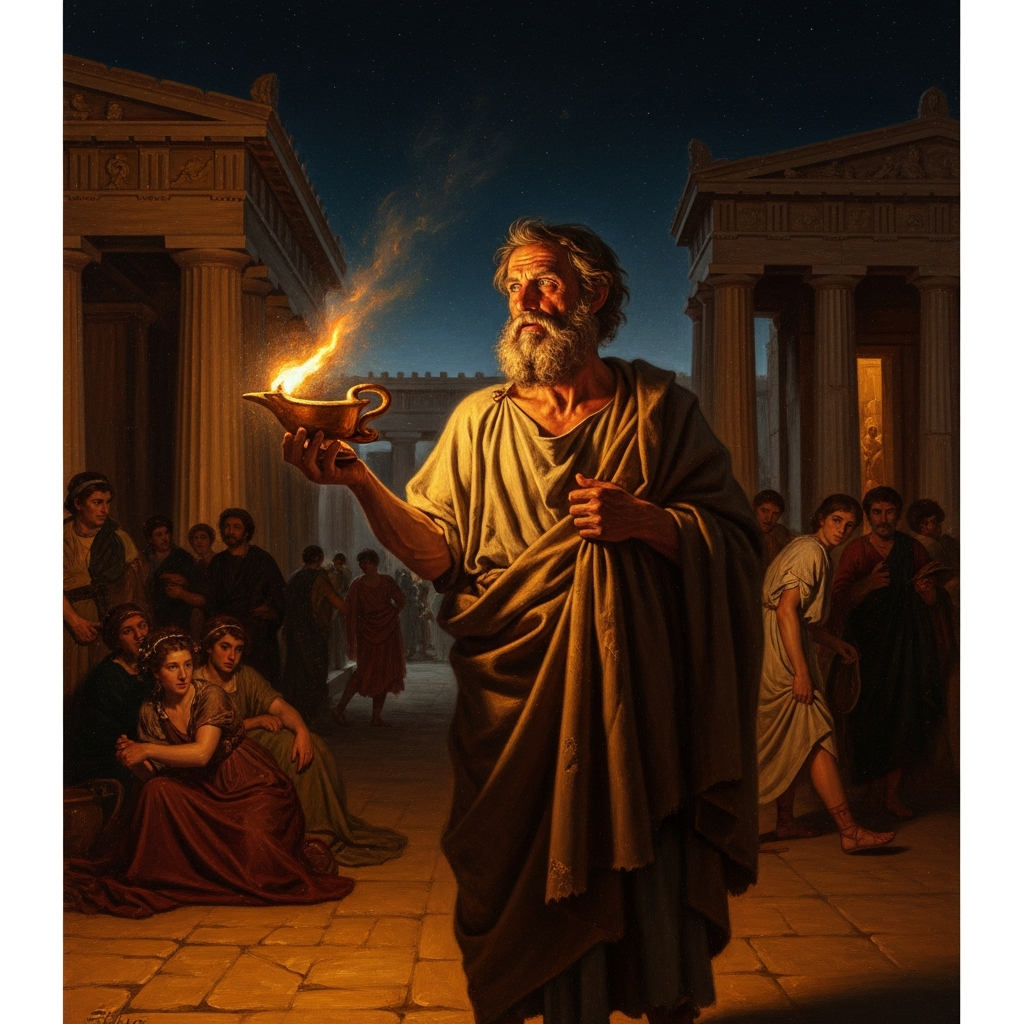
Diogenes and the Lamp
c. 360–323 BCE · Athens and Corinth · The Athenian agora; the streets of Corinth; a large ceramic jar near the temple of Cybele
Contents
Diogenes the Cynic walks through the Athenian agora at noon carrying a lit lamp, looking for an honest man. He lives in a barrel, throws away his cup, tells Alexander the Great to move out of his sunlight. He is trying to demonstrate, by pure performance, the gap between philosophy as speech and philosophy as life.
- When
- c. 360–323 BCE · Athens and Corinth
- Where
- The Athenian agora; the streets of Corinth; a large ceramic jar near the temple of Cybele
It is noon.
The sun is at its highest. The agora of Athens is at its most crowded — merchants, politicians, slaves on errands, philosophers gesturing at each other near the stoas, the old men on their steps in the shade. Everything is visible. Nothing is hidden. This is the worst possible time to carry a lamp.
Diogenes carries a lamp.
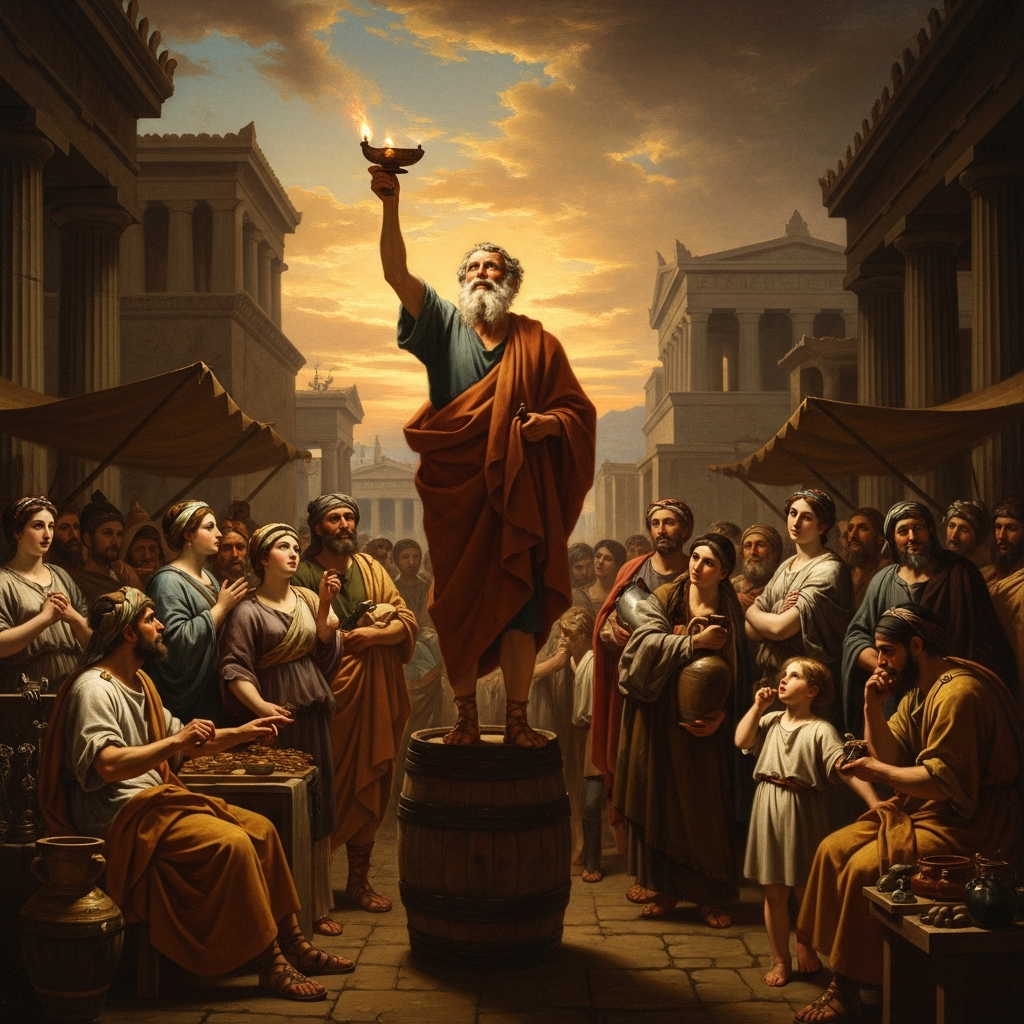
He walks through the crowd with it held at head height, turning it toward people’s faces, peering at them. Citizens step back. He looks. He moves on. Someone asks what he is doing, and he says: I am looking for an honest man. The crowd laughs. He does not laugh. He keeps looking.
He does not find what he is looking for.
He was not always this.
He was born in Sinope, on the Black Sea, and came to Athens as a young man — some accounts say he was exiled for his father’s misconduct with the city mint, that coins were defaced under his father’s watch and the family disgraced. There is a pun in this that Diogenes appreciated: he spent the rest of his life defacing the currency of a different kind, the social coin of reputation and respectability. Deface the currency, he is said to have said when he asked the oracle at Delphi what he should do with his life. He took it literally. Then he took it as metaphor. Then he made the metaphor literal again.
He came to Antisthenes, the student of Socrates who had founded the first Cynic school. Antisthenes beat him with a stick to drive him away. Diogenes presented the top of his head and said: strike — you will not find a stick hard enough to make me leave. Antisthenes taught him everything he knew. Diogenes concluded that Antisthenes had not gone nearly far enough.
He throws away the cup.
He has very little: a rough cloak, a walking stick, a leather pouch, a cup. He is watching a child drink from a fountain by cupping his hands. The child uses no cup. The child needs no cup. Nature has provided hands; the cup is a luxury. He takes his cup out of the pouch and throws it at the wall of the fountain. He watches it shatter. He drinks from his cupped hands.
Plato sees him doing this and says: I see someone curing himself of pride by means of pride. This is the most useful thing anyone says about Diogenes in the historical record. Diogenes hears the line and calls Plato a machine for empty words. Their relationship is cordial in the way of two men who respect and irritate each other enormously and will never agree on anything.
Plato defines the human being as a featherless biped. Diogenes plucks a chicken and releases it into the Academy. Behold: Plato’s man. Plato adds “with flat nails” to the definition.
The barrel.
He does not live in a barrel — the Greek word is pithos, a large ceramic storage jar, the kind used for grain or wine or salt fish, taller than a man, buried partway in the ground outside the temple of Cybele in the Kerameikos district. He sleeps in it. He has no rent to pay. He has no landlord to please. He has no house to maintain or furnishings to protect or reputation as a householder to uphold. He is free of all of it, and this freedom — the freedom of the animal, the freedom of the wind, the freedom of the beggar who has already lost everything and so has nothing left to fear — is the philosophy.
The Cynics named themselves after the Greek word for dog: kyon. Diogenes embraces it. He is the dog-philosopher. He eats in the agora, which respectable people do not do. He performs bodily functions in public, since the animals do. He masturbates openly when the urge comes upon him, saying — when the predictable objections arise — that he wished he could satisfy hunger as easily, by rubbing his belly. He is trying to find what the human animal actually needs when you strip away convention, custom, shame, and the thousand little agreements that constitute what we call civilization.
What the human animal actually needs, he concludes, is very little. Less than anyone is willing to admit.
Alexander comes to Corinth.
He is twenty years old and has just been named commander of the Macedonian forces by the League of Corinth. Every dignitary in Greece has come to Corinth to congratulate him. Alexander goes to see Diogenes. He finds him sunning himself outside his jar, naked or near it, unbothered.
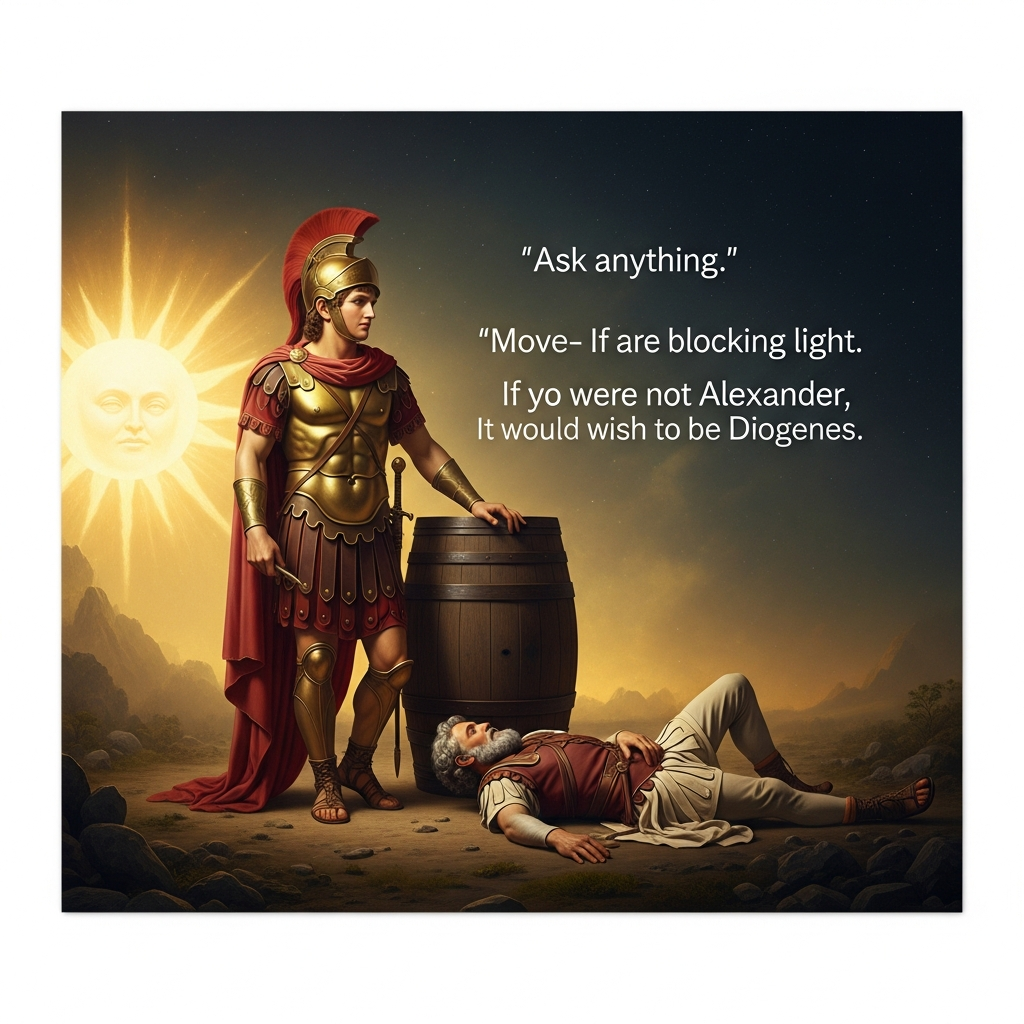
Alexander says: I am Alexander. Ask me for anything.
Diogenes says: move. You are blocking my sunlight.
There is a silence. Then Alexander says to his generals, who are laughing: if I were not Alexander, I would wish to be Diogenes.
The line is famous. What it reveals is that Alexander — who is about to conquer the known world, who has more power than any man alive — recognizes in Diogenes a freedom he does not have and cannot buy. Alexander is enslaved to his ambition, his father’s ghost, the expectations of Macedonia, the logistics of a three-continent war. Diogenes is enslaved to nothing. Alexander has conquered the world. Diogenes has conquered the need for it.
It is not clear which one won.
He dies at Corinth.
The accounts are various and unreliable, which is fitting. He holds his breath, in one version. He eats a raw octopus, in another. He is bitten by a dog. He wills himself to die. He is eighty-nine. When asked where he wishes to be buried, he says: throw me in a ditch. And when asked if he is not concerned that the animals will defile his body, he says: leave a stick beside me so I can drive them off. When asked how he will use a stick if he is dead, he says: if I am dead I will not care about the animals.
The citizens of Corinth bury him near the city gate. They erect a marble column with a dog on top. The inscription reads: even bronze ages and corrodes, but your glory, Diogenes, shall remain forever — for you alone showed mortals the way to live most easily, and how to be content with what you have.
He would have mocked the monument. He would have asked for the marble to be defaced.
Every philosopher since Diogenes has to answer the question he posed by living. Not the question of the lamp — he does not actually believe there are no honest men; the lamp is a provocation, not a finding. The real question: is what you say and what you live the same thing?
Plato said: the just city is impossible, but we must imagine it to understand justice. Diogenes said: the city is unjust by definition; stop imagining and start living differently. Aristotle said: the political animal fulfills its nature in the city. Diogenes said: the political animal has been domesticated. I am feral. This is what philosophy looks like without the furniture.
He was wrong about some things. The cup was a tool, not a vanity. The community he rejected was where philosophy was preserved. The city he scorned was where the arguments that changed civilization were made. But he was right about the lamp. You can spend a lifetime on the question of what it is to be honest, or you can carry the question out into the noon sun and hold it up to people’s faces and refuse to put it down until you have your answer.
He never put it down.
Scenes
High noon in the agora: Diogenes holds the lamp aloft above the crowd, squinting into faces
 Generating art…
 Diogenes crouches by a stream
 Generating art…
 Alexander the Great stands before the barrel in full armor
 Generating art…
 Echoes Across Traditions
Entities
- Diogenes of Sinope
- Alexander the Great
- Antisthenes
- Plato
Sources
- Diogenes Laertius, *Lives of the Eminent Philosophers* VI.20-81 (trans. R.D. Hicks, 1925)
- Plutarch, *Life of Alexander* 14 (the encounter with Diogenes at Corinth)
- Epictetus, *Discourses* III.22 (on the Cynic as ideal Stoic)
- Luis Navia, *Diogenes the Cynic: The War Against the World* (Humanity Books, 2005)
- William Desmond, *Cynics* (University of California Press, 2008)