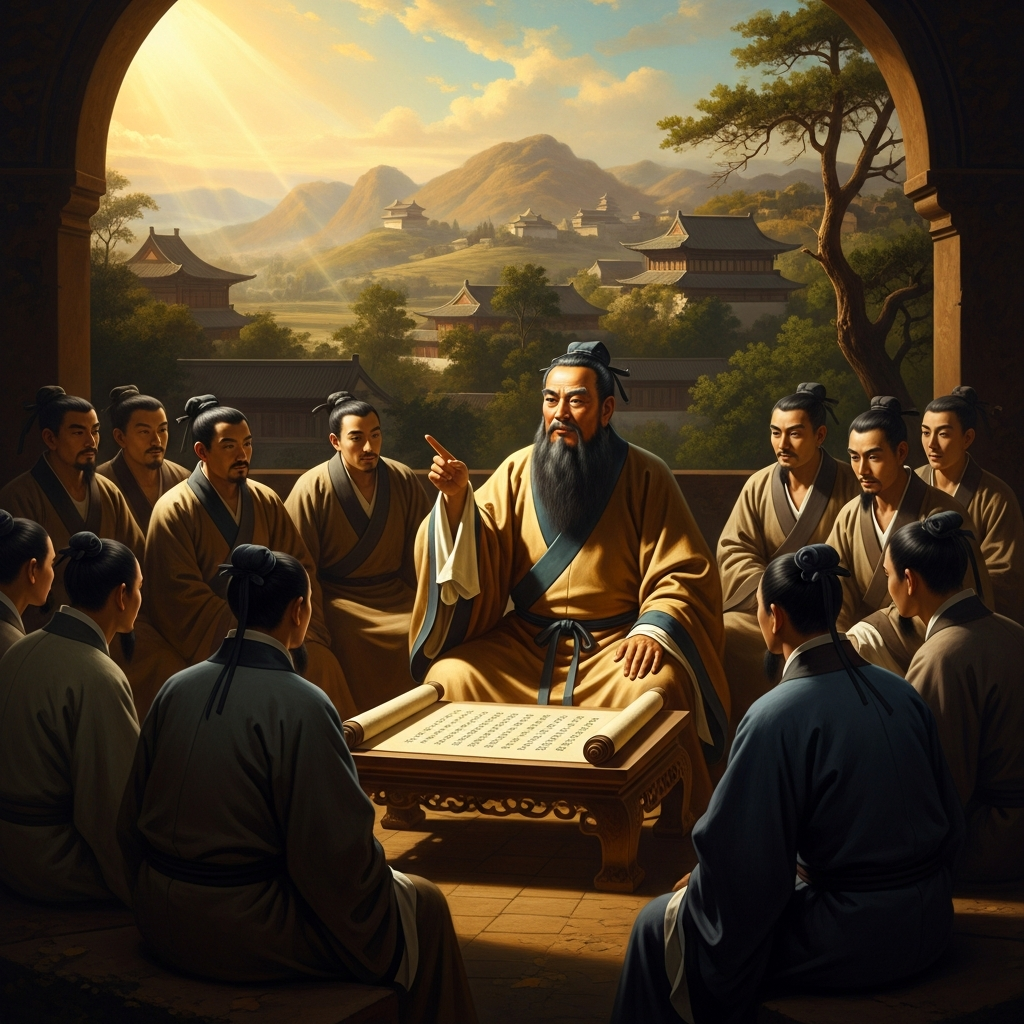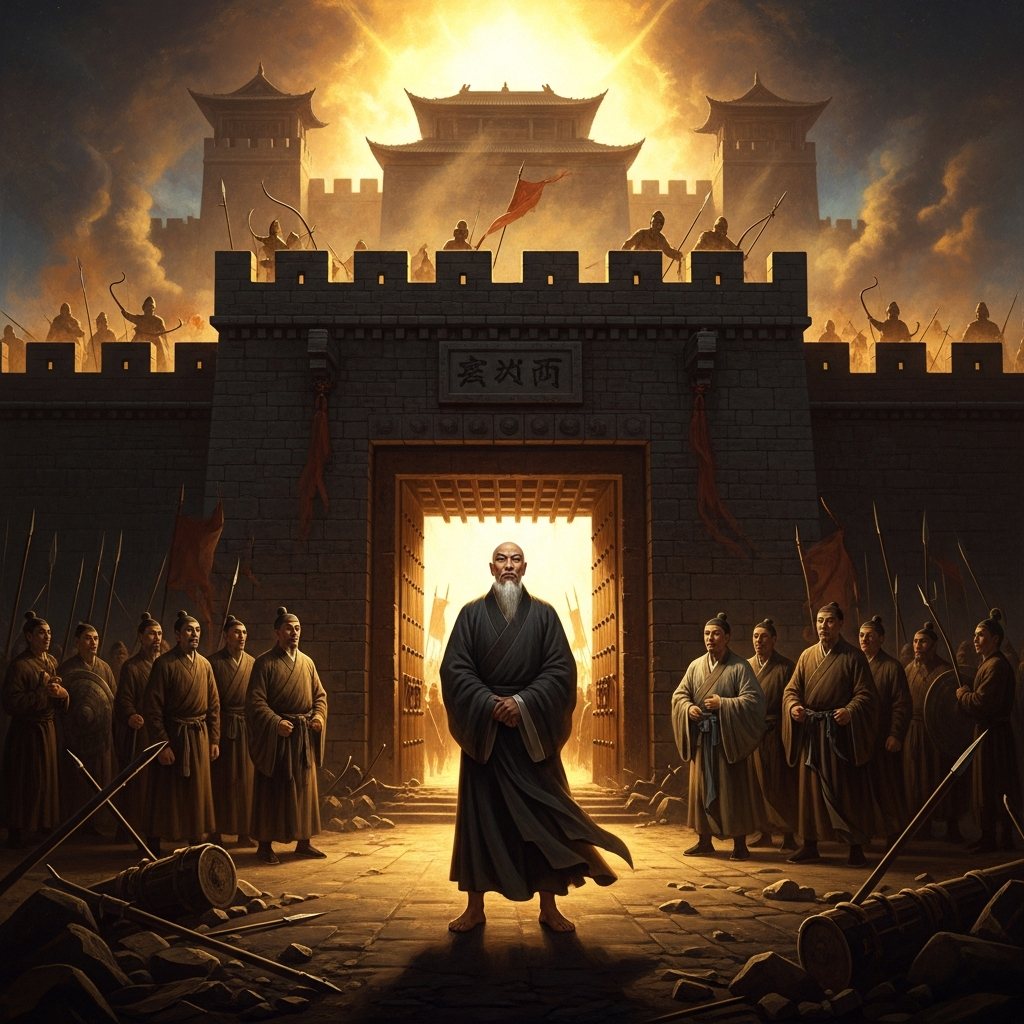
Mencius Before the King
~320 BCE · Mencius at the court of Liang (Wei) · The royal palace of Liang, state of Wei, Central Plains of China
Contents
King Hui of Liang asks what profit Mencius brings from his long journey. Mencius replies: only benevolence and righteousness. He then unfolds the most radical claim in Chinese philosophy — that human nature is fundamentally good, and that government's only task is to stop extinguishing it.
- When
- ~320 BCE · Mencius at the court of Liang (Wei)
- Where
- The royal palace of Liang, state of Wei, Central Plains of China
The king asks the question before Mencius has fully entered the hall.
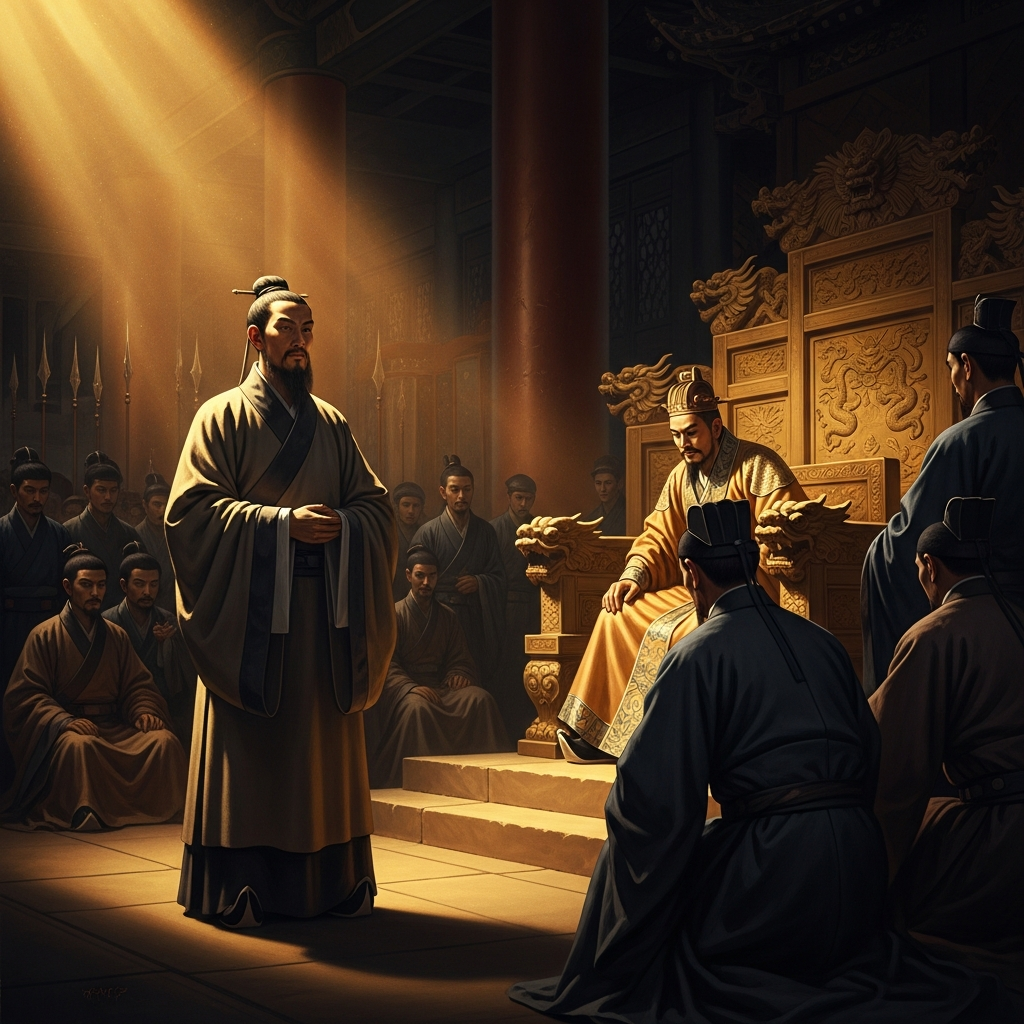
King Hui of Liang is old and tired of being old and tired. He has been fighting wars for decades — wars of necessity, wars of humiliation, wars that produced nothing but smaller borders and larger graveyards. He has heard of Mencius, the scholar from the state of Zou who travels from court to court arguing that benevolence is not only a moral virtue but a political strategy, that rulers who love their people do not need large armies. The king has heard arguments like this before. They are usually made by men who have never paid for an army. He leans forward on his throne and addresses the philosopher directly: You have come from a thousand li away. What profit do you bring my kingdom?
Mencius does not hesitate.
Why must Your Majesty speak of profit? I have only benevolence and righteousness.
The court is very quiet.
Mencius uses the silence. If the king speaks of profit, he explains, the ministers will speak of profit, the officers will speak of profit, the common people will speak of profit, and everyone will be taking from everyone else — and when everyone is taking, the kingdom tears itself apart from within. History does not lack examples. What Mencius is offering instead is not sentiment. It is a claim about political physics: kingdoms that govern by righteousness are internally coherent, and kingdoms that govern by profit are internally combustible. He has visited enough courts in enough states to know which kind survives.
The king says nothing. He is listening in spite of himself.
Mencius has watched this happen before. He is not an elegant speaker — he lacks Confucius’s lapidary compression, his ability to say everything in eight characters and leave the student to unfold it for the rest of his life. Mencius argues. He builds. He uses examples the way a mason uses stone: one on top of the next until the structure is undeniable or the student is buried. He is about to place the first stone.
He tells the king about a different king.
King Xuan of Qi, he says, was seated in his hall one day when an ox was led past on its way to the consecration of a new bell — the animal to be sacrificed, as the rite required, so that the bell could be sanctified with blood. The king saw the ox trembling and ordered it spared. He said he could not bear its frightened look. He substituted a sheep, which he had not seen and therefore could not pity.
Some of his subjects mocked him for this as cheapness. Mencius says: they were wrong. That response — the lurch in the chest at the sight of a frightened animal — is not weakness. It is the sprout of benevolence. It is the beginning of something real. The king already has what it takes to govern well; he has simply not recognized it in himself, and has never been helped to extend it from the ox he saw to the people he cannot see.
King Hui leans back.
This is not the argument he expected.
Mencius opens the argument fully now.
Human nature, he says, is fundamentally good — as water naturally flows downhill. This is not optimism. It is a structural claim. Gaozi, the philosopher he has been arguing with for years, says that human nature is neither good nor bad, that it can be channeled either way like water through a cut. Mencius replies: yes, water can be splashed uphill, but that is not where it goes on its own. You can beat a person into cruelty. You can starve them into desperation. You can arrange their circumstances so that the worst in them rises to meet the worst in what surrounds them. But you have done something to them to produce this result — you have interfered with a nature that was not moving in that direction.
Every human being is born with four sprouts, Mencius continues, pressing the argument deeper. The sprout of compassion, which becomes benevolence. The sprout of shame, which becomes righteousness. The sprout of modesty, which becomes propriety. The sprout of moral judgment, which becomes wisdom. These are not virtues to be installed by education and social pressure. They are seeds already present. The task of education — and government — is not to create them. It is to stop suppressing them.
He turns to the king directly now.
Your people are hungry, he says. Not because heaven has withheld rain or the soil has failed, but because the grain that should feed them is rotting in the royal granaries while your horses and dogs eat more than your poorest subjects. They die in the streets in winter while the palace is warm. They go to war for territories that could feed twenty thousand families if left in peace. This is not nature. This is policy. And policy can be changed.
The benevolent government Mencius describes does not require sainthood in the ruler. It requires only this: that the king extend to his people the same response he felt at the sight of the trembling ox. Not sentiment — he is clear that feeling is not enough, that the sprout must be cultivated into the full tree. But the feeling is real. It is in him. It is in everyone. The man who genuinely cannot feel the suffering of others has not failed to develop a virtue; he has suffered an injury. He is incomplete. He is the saddest figure in Mencius’s political universe: the ruler so enclosed in appetite and power that the sprouts in him have been trampled before they could break the soil.
The king can still be something else.
Mencius stays at the court of Liang for a while, and then moves on.
He will go to Qi next, and argue with King Xuan directly — the king of the spared ox — and come closer there than anywhere to something that might be implemented. King Xuan is curious, occasionally moved, unwilling to give up the gratifications of power for the disciplines of virtue. I have a weakness for wealth, he admits to Mencius once. I have a weakness for women. Mencius replies: so did the great kings of antiquity — and they shared that wealth, arranged those marriages, ensured that no one under their rule lacked what they themselves enjoyed. The weakness is not the problem. The enclosure is the problem.
He dies without ever seeing a king govern the way he described. His students compile his arguments into the Mencius, the most combative and expansive of the Confucian classics — a text that argues back, that builds cases, that refuses to let a royal interlocutor off with a nod. In 1190 CE, Zhu Xi elevates it to one of the Four Books, the core curriculum of Chinese education. For the next seven hundred years, every scholar who wants to pass the imperial examinations must master it.
The argument that began before a tired king in a hall in Liang — I have only benevolence and righteousness — becomes the operating premise of the largest bureaucratic examination system in human history. The good king Mencius described is never born. The standard he set outlasts every king who ignored it.
The sprout metaphor is the hinge on which Mencius’s entire system turns: goodness is not a height to be climbed but a root already planted, needing only to not be pulled up. The political implication is radical. If nature is good, then suffering is always a policy choice — someone decided to stop protecting the sprouts. Mencius lived two millennia before the vocabulary of human rights existed, but he built the argument from the ground up: government is accountable to the people not because people are powerful, but because people carry something original that power has no right to extinguish.
Scenes
Mencius stands before the throne of King Hui of Liang — calm where the court is tense, his argument already forming before anyone asks
Generating art… A child at the edge of a well, tipping forward — and every person nearby feels the lurch in the chest that Mencius calls the first sprout of benevolence
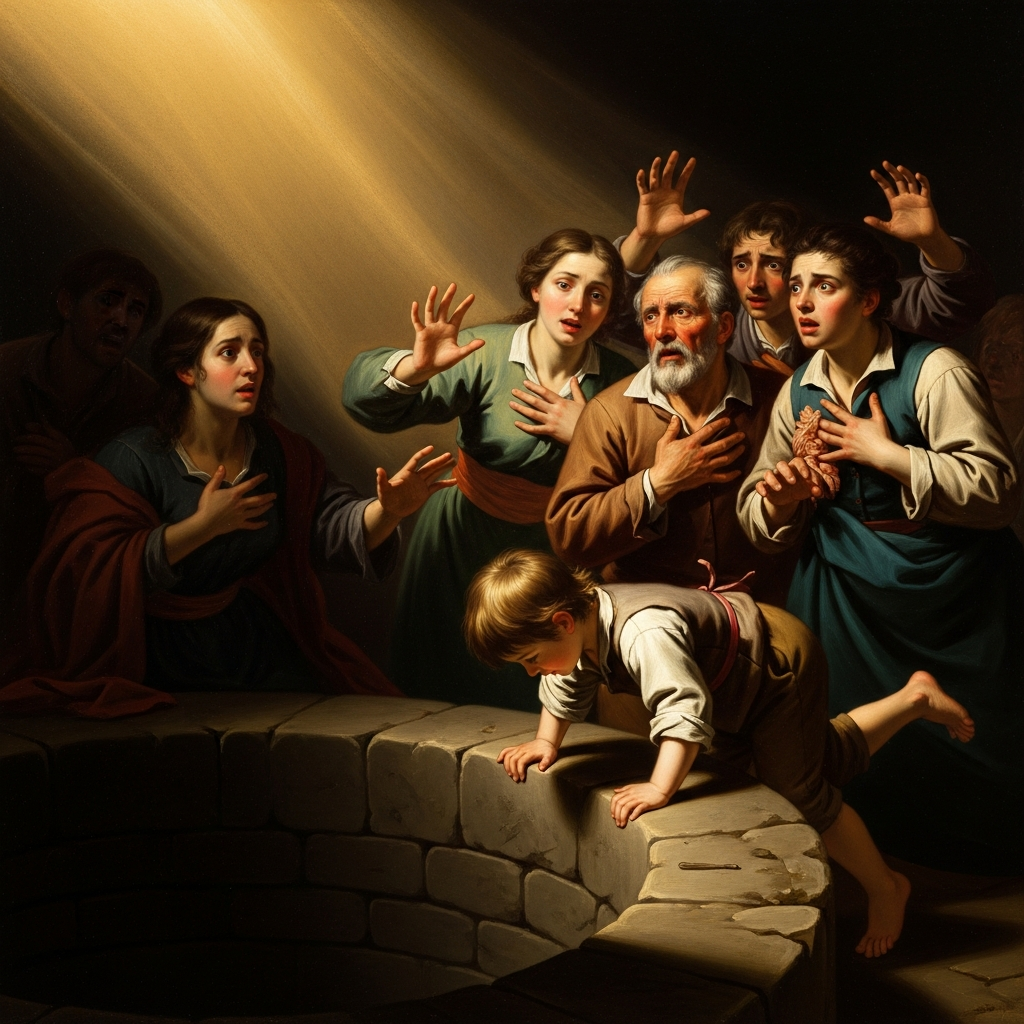 Generating art…
 River water divides around a rock and rejoins below it, flowing always toward the low ground — the image Mencius uses to describe a nature that cannot help being good
 Generating art…
 Echoes Across Traditions
Entities
- Mencius
- King Hui of Liang
- King Xuan of Qi
Sources
- *Mencius* 1A:1 — 'Why must Your Majesty speak of profit? I have only benevolence and righteousness'
- *Mencius* 2A:6 — the four sprouts: compassion, shame, modesty, moral judgment
- *Mencius* 6A:2 — human nature is good as water flows downhill; Gaozi's counter-argument and Mencius's reply
- *Mencius* 1A:7 — King Xuan of Qi and the ox spared from sacrifice: the sprout of compassion in action
- Bryan Van Norden, *Mencius* (Hackett, 2008) — translation and commentary