Epicurus and the Garden
306 BCE (founding of the Garden) · A garden outside the walls of Athens
Contents
In 306 BCE, Epicurus buys a garden outside Athens and builds a school where slaves and women sit beside free men as equals. He teaches that the gods don't care, death is nothing, and the highest pleasure is bread. A former slave named Mys asks him why.
- When
- 306 BCE (founding of the Garden)
- Where
- A garden outside the walls of Athens
The gate has an inscription.
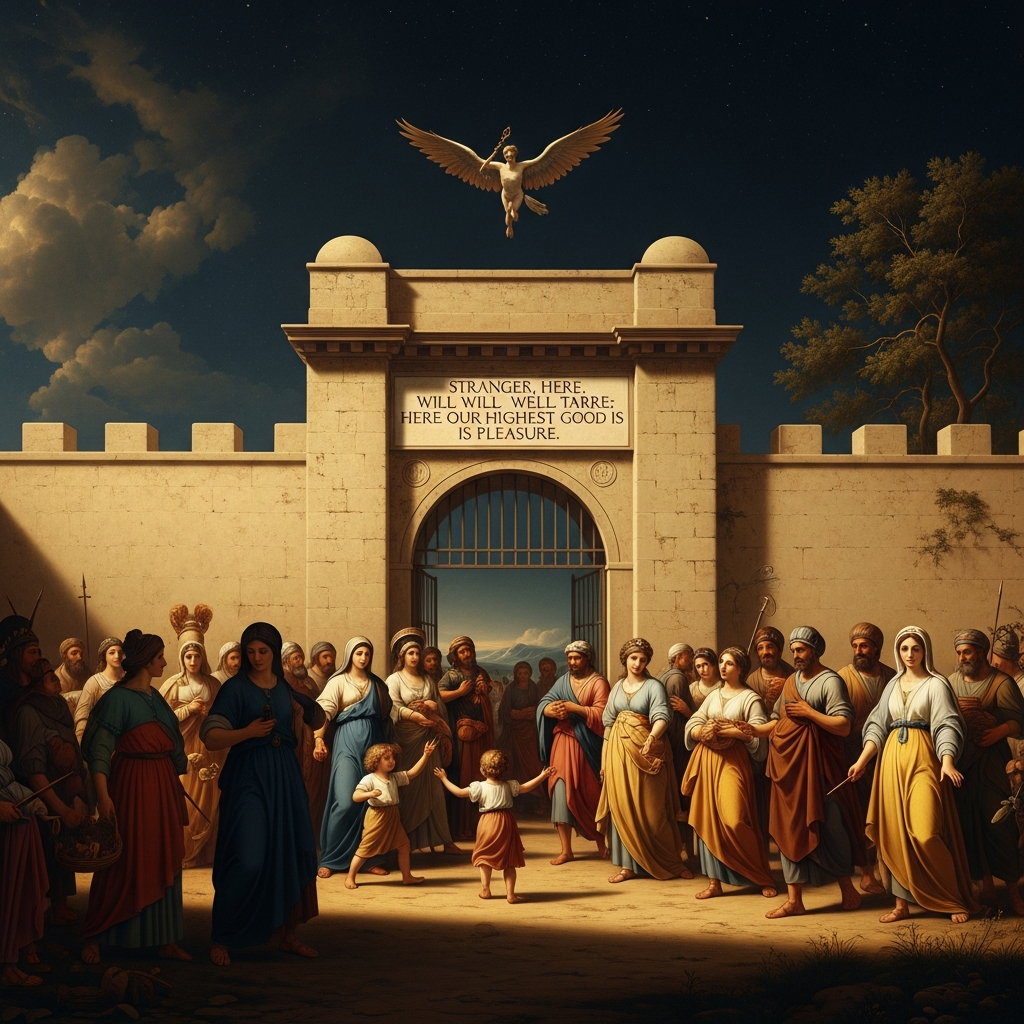
Stranger, here you will do well to tarry; here our highest good is pleasure. This is a provocation. In 306 BCE, in a city where pleasure is associated with the Cyrenaics — who teach that intense bodily pleasure is the goal and that the past and future are irrelevant — the word pleasure on a school’s gate is a challenge, an announcement, a deliberate misidentification that Epicurus expects and accepts and intends to correct one student at a time.
He buys the garden with his own money, or with money raised by his friends, the sources are vague. It is outside the city walls, which means it is outside the ordinary social and economic structure of Athens — outside the agora, the law courts, the political assembly, the hierarchies of citizen and slave and metic and freedman that organize life inside the walls. Outside the walls, in a garden, those categories are less binding. Not absent — Epicurus is not running a utopia; he is running a philosophy school — but less binding, available for modification.
He admits women. He admits slaves. He admits his friend Metrodorus, who is a genius. He admits Mys, who is a former slave, who will ask the question that crystallizes the teaching.
The philosophy begins with the body.
This is its scandal. Plato began with the Forms — the eternal, unchanging archetypes of which material things are shadows. Aristotle began with logic and teleology — things are defined by what they are aiming toward. Both of them, in their different ways, were suspicious of the body: it deceives, it distracts, it anchors the soul to the mutable world when the soul wants to ascend.
Epicurus begins with sensation. Sensation is the only direct contact we have with reality. The pleasure of warmth, the pain of cold, the satisfaction of hunger relieved — these are not illusions or distractions; they are the data, the raw material from which any honest account of human life must begin. The good life is not one that escapes the body but one that correctly understands what the body is telling it.
What the body is telling it is: ataraxia and aponia. Ataraxia: undisturbedness, the tranquility of the soul that has freed itself from fear and anxiety. Aponia: the absence of bodily pain. These are not moments of ecstasy or peak experience; they are the condition of the body and soul when nothing bad is happening, when you are neither hurting nor afraid. This is not glamorous. It is, according to Epicurus, the highest available human state.
He writes: It is not possible to live pleasantly without living prudently and honorably and justly, nor again to live prudently and honorably and justly without living pleasantly.
The Cyrenaics, reading this, are baffled. Where is the intense physical pleasure they have been promising? Where is the wine, the expensive food, the elaborate entertainment? Epicurus says: all of that adds anxiety to the mix. You want the next cup when you finish this one. You compare your dinner to a richer man’s dinner and find yours lacking. The more elaborate your pleasures, the more elaborate your dependence on the conditions that produce them, and dependence is the enemy of ataraxia.
He eats bread and olives.
The gods exist but they are not watching.
This is the claim that will follow Epicurus into every era — the charge of impiety, the association with atheism, which is not quite accurate. He is not an atheist. The gods exist; they are blissful, perfect, undisturbed, dwelling in the spaces between the worlds in a state of permanent ataraxia. They are the best available model of the good life. They are also completely indifferent to human affairs, because concern for human affairs would disturb their bliss, which is incompatible with perfection.
Therefore: they do not punish. They do not reward. They do not answer prayers. They did not create the world. They did not create you. The fear of divine punishment, which is one of the great engines of human anxiety in every culture he has observed, has no rational basis. The gods are not angry at you. The gods are not anything toward you. You are not a concern of the gods.
He is careful about how he presents this in public. The charge of impiety in Athens can end badly — Socrates is the demonstration, still recent enough to be a living warning. Epicurus is scrupulously polite about religious observance; he attends the festivals, he does not encourage his students to disrupt the civic religious calendar. He is teaching a private philosophy, not staging a public challenge. The distinction matters.
What he says in the garden, carefully, to students who have been prepared for it: death is nothing to us. When we exist, death is not present; when death is present, we no longer exist. It is nothing to the living and nothing to the dead.
This is not consolation. This is argument. The fear of death, he says, rests on a misunderstanding — you imagine being dead from the inside, experiencing the darkness and silence and nothing, and finding that experience terrible. But there is no inside. There is no you to experience the darkness. The nothing after death is exactly like the nothing before your birth, which did not trouble you.
Nothing to us. He says this repeatedly, in different formulations, and it is the most radical thing he teaches, more radical than the gods’ indifference, more radical than the admission of slaves to the school.
Mys asks about the bread.
Mys was born in slavery — the name itself is the kind of name given to slaves: it means mouse in Greek. He was freed at some point, the sources do not say by whom or under what circumstances, and he came to the Garden and stayed. He is a serious student, methodical, he has absorbed the arguments carefully. One morning in the early years, before the community is fully established and the routines are still being worked out, he finds Epicurus sitting alone with bread and water and a cup of olive oil and asks — genuinely, not as a test — why there is nothing else.
He frames it in the vocabulary he has learned: if pleasure is the good, and the absence of pain is the goal, why not maximize pleasure? More sauce, better wine, richer oil? The teacher teaches that sensory experience is the starting point. Sensory experience says the sauce is better. Why bread?
Epicurus says: sit down.
He tears the bread and gives Mys half. He says: taste it. Not relative to anything else. Not compared to sauce or honey or the memory of a rich man’s table. Taste the bread.
Mys eats the bread. He says: it tastes like bread.
Epicurus says: yes. It tastes like bread. Not like bread-plus-the-disappointment-that-it-is-not-better-bread. Not like bread-plus-the-anxiety-about-running-out-of-sauce. It tastes like bread, which is precisely itself, which requires no supplement, which asks nothing of you after you have eaten it.
He says: when I add sauce, I add the desire for sauce. I am no longer tasting the bread; I am tasting the difference between bread and the sauce I wanted. And now I want more sauce. And the more I have, the more I can lose, and loss is the shadow that follows every complicated pleasure until the shadow is larger than the pleasure.
He says: the bread is enough. The bread has always been enough. Most of what we call suffering is the distance between what we have and what we believe we should have, and most of that distance is invented.
Mys is quiet for a while. Then he says: the masters eat sauce.
Epicurus says: yes. And what do the masters have that you don’t?
Mys, who grew up in slavery, who has seen what power does to the people who hold it, thinks about this for a long time.
He says: less bread.
He dies in 270 BCE, the same year as Plotinus, though Plotinus will not be born for another five hundred years — the coincidence means nothing; it is the kind of numerical pattern Pythagoreans would have called meaningful and Epicurus would have called noise.
He dies of kidney stones. He is in severe pain. He writes a letter to his friend Idomeneus on the day he dies: I write this to you on a happy day to me, which is also the last day of my life. For I have been attacked by a painful inability to urinate, and also dysentery, so violent that nothing can be added to the violence of my sufferings. But the cheerfulness of my mind, which comes from the recollection of all my philosophical contemplation, counterbalances all these afflictions.
This is either the most perfectly Epicurean death in history or a philosophy that fails exactly when you need it most. Or both, which is probably the honest answer. The recollection of philosophical contemplation does not stop the pain. It is present alongside the pain, not instead of it, and what Epicurus is reporting is not the absence of suffering but its coexistence with something that he prefers to call happiness.
He had said: the wise man, though in pain, is happy. He is performing this claim on his own body, in his last hours, in writing, for the record.
The Garden outlasts him by five hundred years.
The inscription at the gate is still there, in the memory of everyone who read it, which is everyone who read Diogenes Laertius in the third century CE, which is how the inscription survived while the gate itself did not. “Stranger, here you will do well to tarry.” Most people who passed it kept walking.
The ones who stopped found a school where a former slave could sit beside a senator and ask the same questions and receive the same answers, which was not the world, but was a version of the world that Epicurus was willing to maintain, daily, at the cost of bread and olives and a garden outside the walls.
Epicureanism became a synonym for luxury in the centuries after his death, which is the exact opposite of what he taught. History does this to philosophers who are too subtle — it keeps the word and loses the argument.
The argument was: enough. The argument was that the distance between what you have and what would satisfy you is mostly invented, and that the invention is costing you the bread you already have. He ate the bread. He meant it as proof.
Scenes
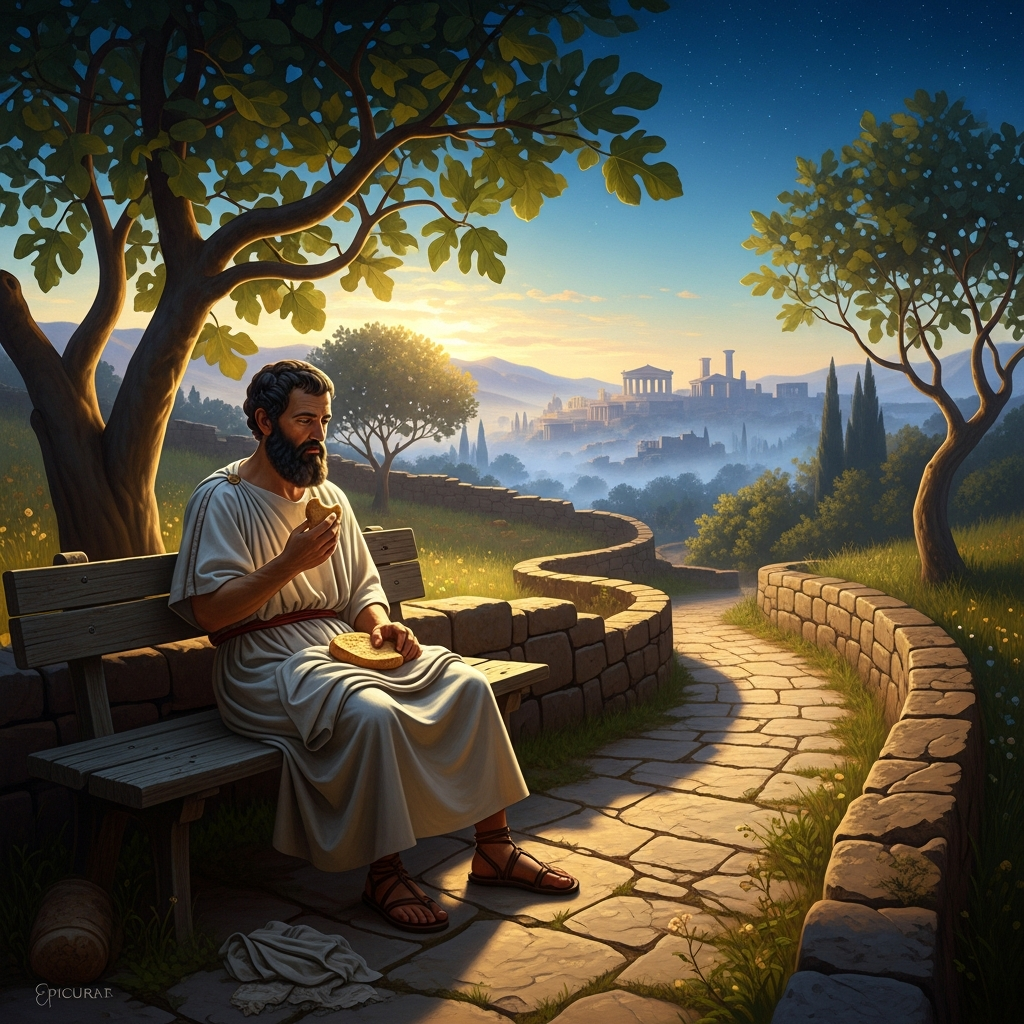
The Garden at dawn — fig trees, a path between low walls, the city visible in the distance
 Generating art…
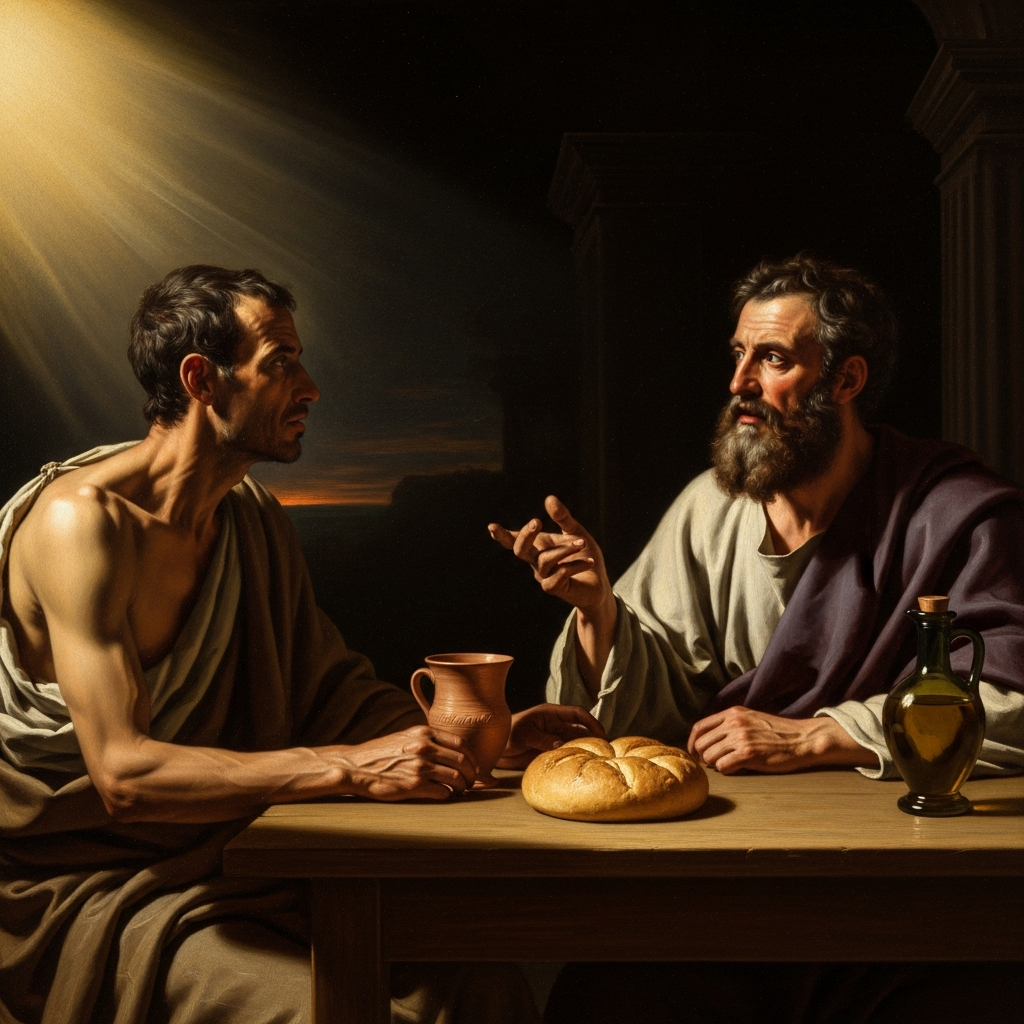
 Mys, a former slave, sits across the table from Epicurus
 Generating art…
 The full community at midday — men, women, free and freed, a child playing near the wall
 Generating art…
 Echoes Across Traditions
Entities
- Epicurus
- Metrodorus
- Mys
- the Gods
Sources
- Diogenes Laërtius, *Lives of the Eminent Philosophers*, Book X (c. 230 CE)
- Epicurus, *Letter to Menoeceus* and *Principal Doctrines*
- Martha Nussbaum, *The Therapy of Desire* (1994)