Sita's Fire Trial
Mythic Time · Ramayana ~5th century BCE composition · The plain outside Lanka
Contents
After Rama defeats Ravana and rescues Sita from Lanka, he doubts her purity before his assembled armies. She walks into a pyre. Agni, the fire-god, rises and returns her unburned — the ordeal meant to shame her becomes the proof that shatters it.
- When
- Mythic Time · Ramayana ~5th century BCE composition
- Where
- The plain outside Lanka
The war is over.
Ravana lies in the ash outside his gates, ten heads dimmed, the demon-king finally as quiet as the sky he tormented. Rama stands in the strange decompression of victory — the world rebuilt, his purpose complete, his wife found. He should be walking toward her. He is not walking toward her.
The armies arrange themselves on the plain: the monkey legions of Sugriva, the bear-warriors, the surviving rakshasas who switched sides, the gods who descended to watch. Hanuman, who crossed an ocean for this woman, who burned half of Lanka to find her and reported back with the exactness of a man who understood the stakes — Hanuman stands still for the first time in months. Lakshmana, Rama’s brother, the one who left a throne and a wife to walk fourteen years of forest exile at his brother’s side, stands with the formal posture of a man bracing for something he does not want to see.
Sita comes out of Lanka’s gates.
She has been in Ravana’s garden for a year. The Ashoka trees there still flower — the demon-king made his garden beautiful because he was a scholar, a musician, a man of enormous gifts spent entirely in the wrong direction. He never touched her. Every tradition that tells this story agrees on that point. He could not make her consent, and he would not take what was not given. It is one of the stranger facts of the Ramayana — that the villain upheld the line the hero is about to question.
She walks toward her husband. Her face is the face of a woman who has survived by refusing to break — each day in that garden another day of non-surrender, her mind and body intact, the long discipline of a woman who knew that rescue was coming and held herself together until it arrived. She looks at Rama.
Rama speaks.
What he says is this: he cannot take her back.
The doubt, he explains, is not his alone. It is the doubt of the world. She lived in another man’s house for a year. The armies watch. Ayodhya watches. What king brings home a wife whose purity is unverifiable? What dharma permits it? He says these things in formal Sanskrit, in the measured cadences of a man who has reasoned himself into a position and will not be moved by her face.
He does not look at her face.
She stood in Ravana’s garden for three hundred and sixty-five days and thought of this man. She held her life together for this man. She refused Ravana’s offers — his kingdom, his devotion, the genuine (if monstrous) love of a creature who found her so magnificent he upended the cosmos to have her near — and she refused it all for the man who is now explaining that he cannot take her back.
Lakshmana’s jaw locks. Hanuman goes still in the way that large, powerful things go still when they are deciding not to act because they understand the story is not theirs to finish. The monkeys do not speak. The bears do not speak. The assembled gods, who came to witness the triumph of dharma, do not speak.
Sita speaks.
She speaks quietly. She does not weep. She does not appeal to Rama’s love, or recite the history of her loyalty, or list the names of witnesses who watched her refuse the demon-king day after day. She addresses Lakshmana.
Build me a pyre.
The words fall into the silence of the plain like stones into still water. Lakshmana looks at his brother. Rama says nothing. Lakshmana builds the pyre.
This is the thing the story never quite explains to modern readers: she is not despairing. She is not performing sacrifice as protest, not dying to make a point. She is invoking the oldest tribunal available — the one that cannot be bribed, cannot be pressured by politics, cannot be confused by hearsay. She is calling Agni as her witness. Fire has been the sacred witness since the Rig Veda’s first hymn: Agnim ile purohitam — “Agni I invoke, the household priest, the god of sacrifice.” If she is pure, Agni will say so. She is that certain of what she is. She is more certain of herself than Rama is of her.
The pyre is built. She circles it once, hands pressed together, head inclined toward Rama in the formal gesture of a wife toward a husband, the etiquette maintained past the point where most people would abandon it. She steps into the flames.
The fire takes her completely. The armies watch. The gods who descended to see the triumph of dharma see this instead — the rescued wife burning, the victor standing at a distance, the logic of doubt consuming what the war had saved.
Then Agni rises.
He emerges from the heart of the blaze the way fire always moves — upward, with authority, with the absolute confidence of something that has never been questioned. He holds Sita in his arms. She is unburned. Her yellow sari is unsinged. Her garlands have not wilted. Her hair, her skin, her hands — untouched. She looks exactly as she looked walking into the flames, which is to say: she looks like a woman who was never afraid.
Agni speaks before the armies of two worlds.
She is pure. He does not elaborate. He does not need to. He is the fire-god, the devourer of impurity, the sacred witness of every Vedic sacrifice, every marriage ceremony, every funeral — and he is returning her untouched. The flames would have consumed impurity the way they consume anything: completely, without remainder. There is nothing to consume. He gives her back.
Rama receives her. The texts say he wept. The texts say he knew — had always known — and that the ordeal was necessary for the world’s satisfaction, not his own. Some traditions accept this. Others do not.
Here is what Hinduism still argues about, three thousand years later:
Was Rama right?
The tradition that honors him as the ideal king — Maryada Purushottam, the supreme upholder of dharma — says yes: he acted not from personal doubt but from the duties of kingship, the requirement that a king’s household be above reproach in the eyes of the kingdom. The fire cleared what no human testimony could have cleared. Agni’s witness reaches every corner of the realm. The ordeal was the only instrument large enough to settle the question publicly.
The tradition that reads the scene with a colder eye says: he made her burn to satisfy an army’s doubt. He stood on a plain outside Lanka with the woman who had survived captivity through her own strength of will, and he told her that her word was not enough. The fire cleared her — but who cleared the man who demanded it?
Tulsidas, in the Ramcharitmanas, softens the scene: the Sita who enters the flames is a divine decoy, a shadow-Sita, and the real Sita was never in Lanka at all but had been held safe in the fire all along. This reading wants to protect both of them — Rama from cruelty, Sita from suffering. But it also erases the scene that gave Sita her power: the voluntary walk, the calm invocation, the woman who did not wait for rescue but called her own witness.
Valmiki’s Sita burns. That Sita is the one who endures. And that is the version the world keeps returning to, because it is the version that tells the truth about what was asked of her — and what she chose to do with the asking.
Every year at Diwali, Rama and Sita come home. The lamps are lit for their return through the darkness, fourteen years of exile ending in firelight. The fire that marks the homecoming is the same fire that tested the bride. The tradition lights both simultaneously and does not explain the connection — perhaps because the connection explains itself.
The ordeal that ought to have shamed her became the proof. She walked into the fire her husband doubted her with, and she came out of it his superior in every way that mattered. This is Sita’s power, and it is also Sita’s tragedy: that the proof required the burning, and the burning required his doubt, and his doubt was the wound she spent the rest of her life carrying — because in the Uttara Kanda, later, when the kingdom doubts again, there will be no pyre. There will only be the earth opening, and Sita walking down into her mother’s arms, and Rama standing at the edge of the ground that just swallowed his wife, learning too late what the fire had already tried to teach him.
Scenes
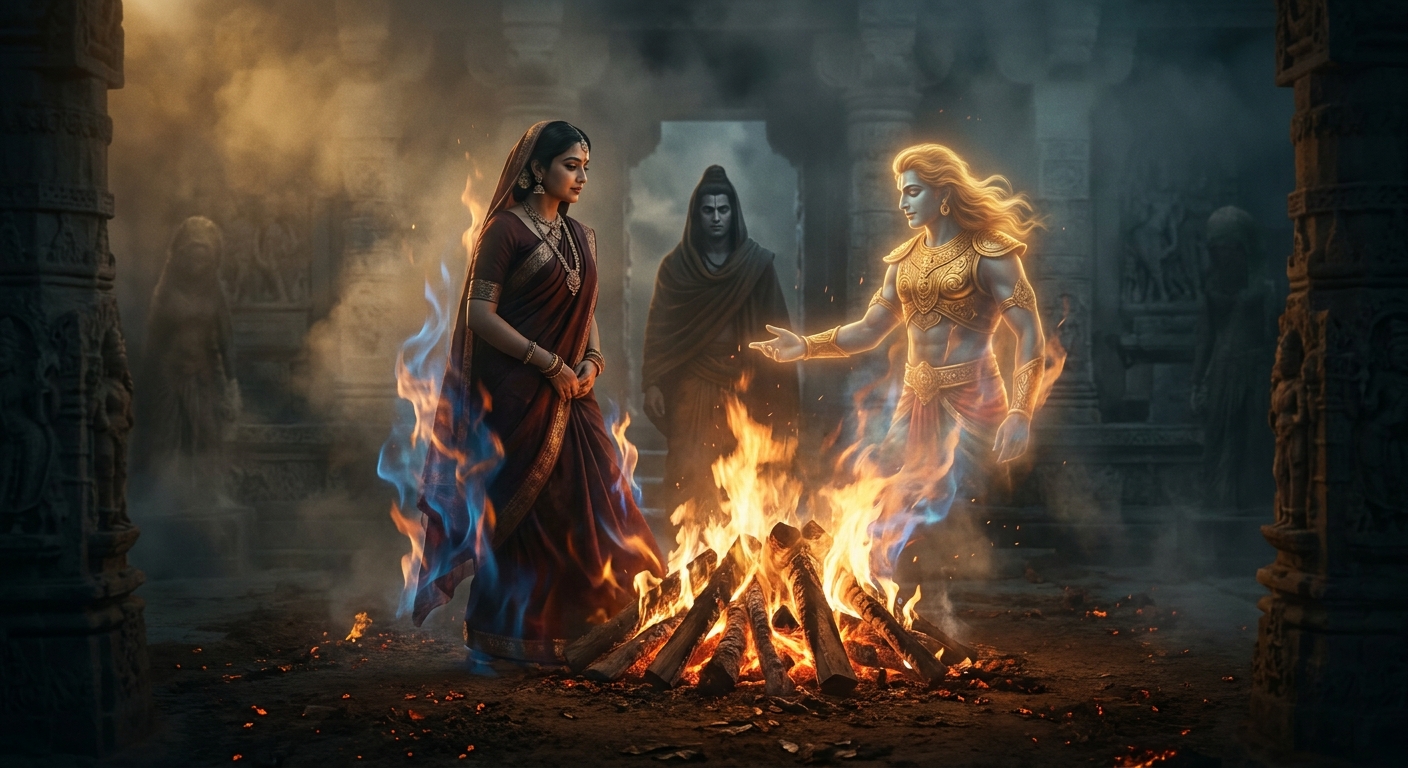
Sita steps into the pyre, garlands still around her neck, the flames parting before her feet — composed, unhurried, as though she is walking into a river she already knows
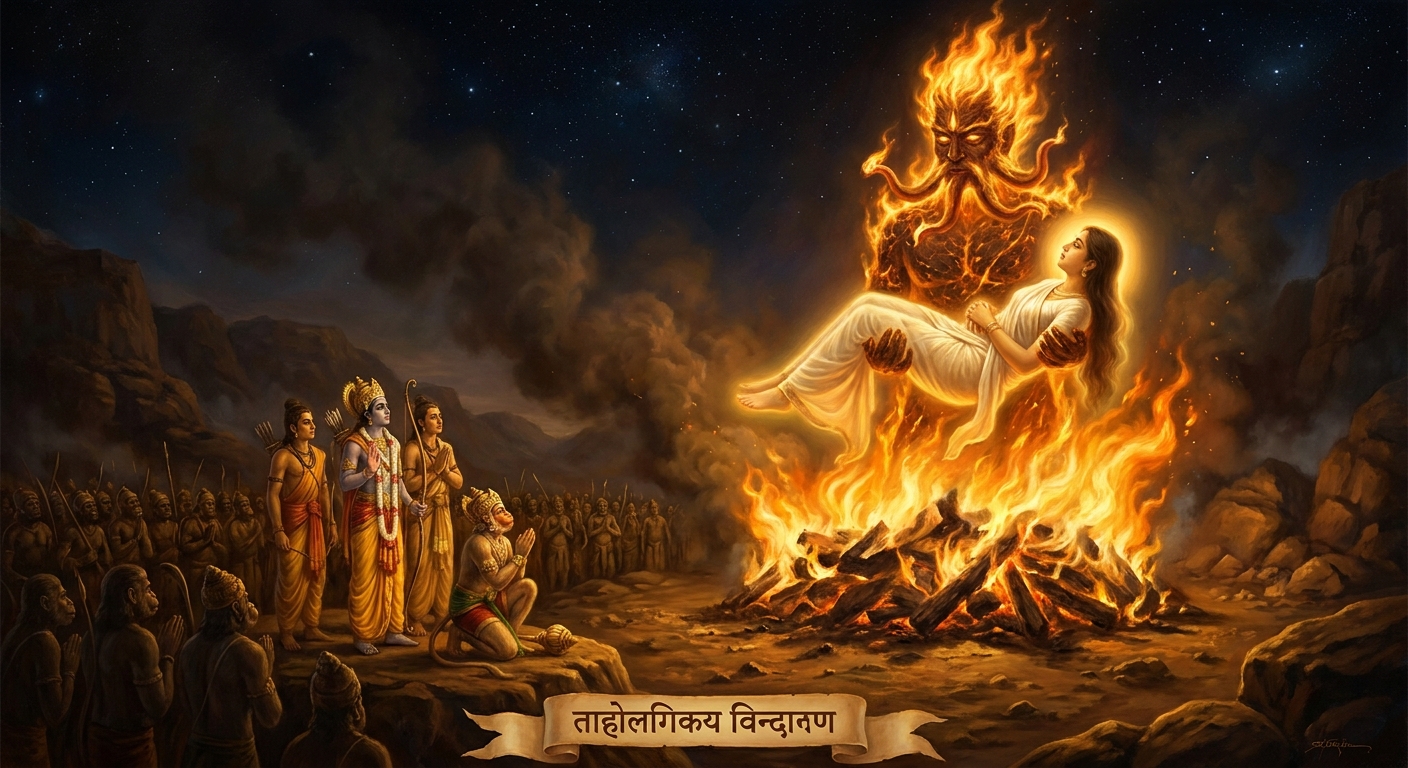
Generating art… Agni, the fire-god, emerges from the heart of the blaze — arm extended, Sita cradled against his chest — to speak her innocence before the armies of two worlds
 Generating art…
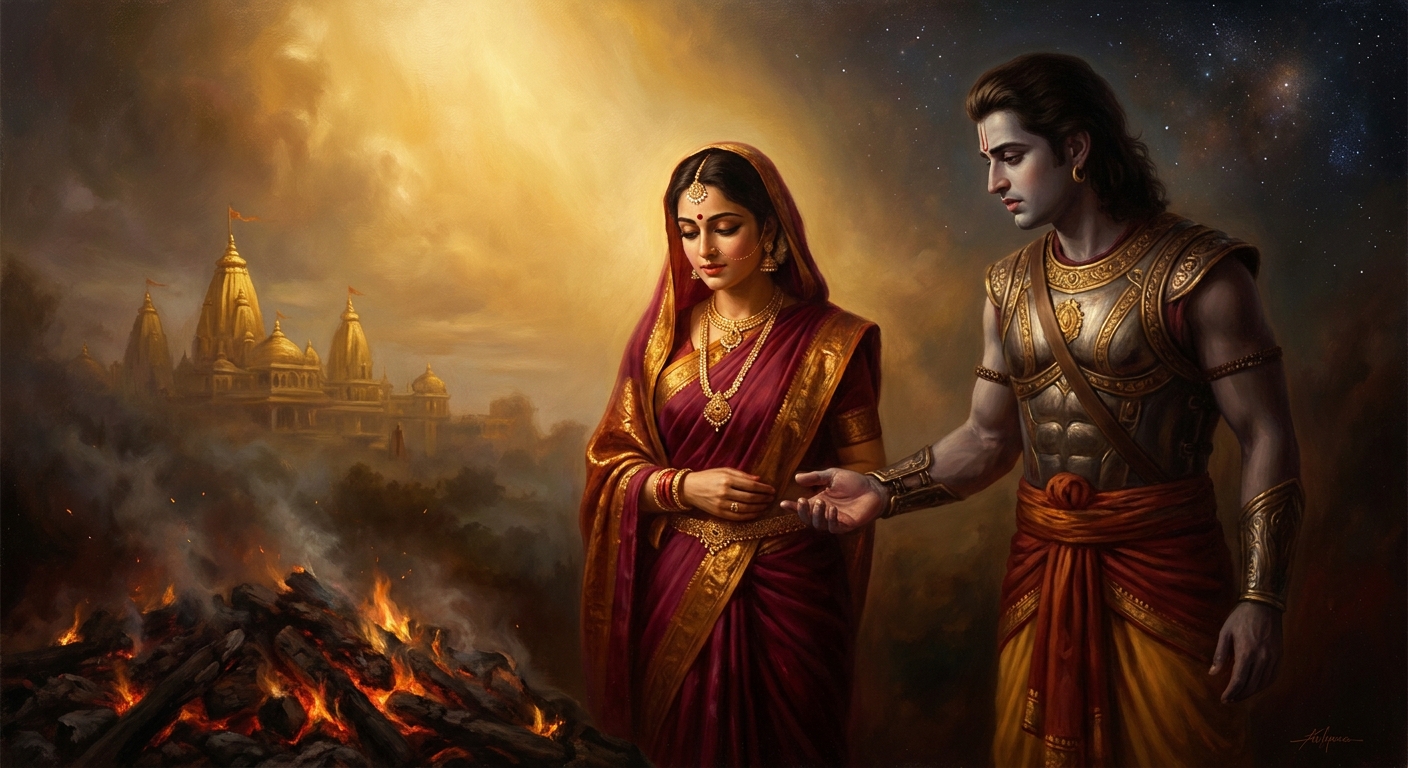
 Rama receives Sita back from the god of fire: unburned, unsinged, her yellow sari intact
 Generating art…
 Echoes Across Traditions
Entities


Sources
- Valmiki *Ramayana* Yuddha Kanda 116-118
- *Adhyatma Ramayana*
- Tulsidas *Ramcharitmanas*
- *The Ramayana of Valmiki* trans. Robert Goldman
- Gita Mehta *A River Sutra*