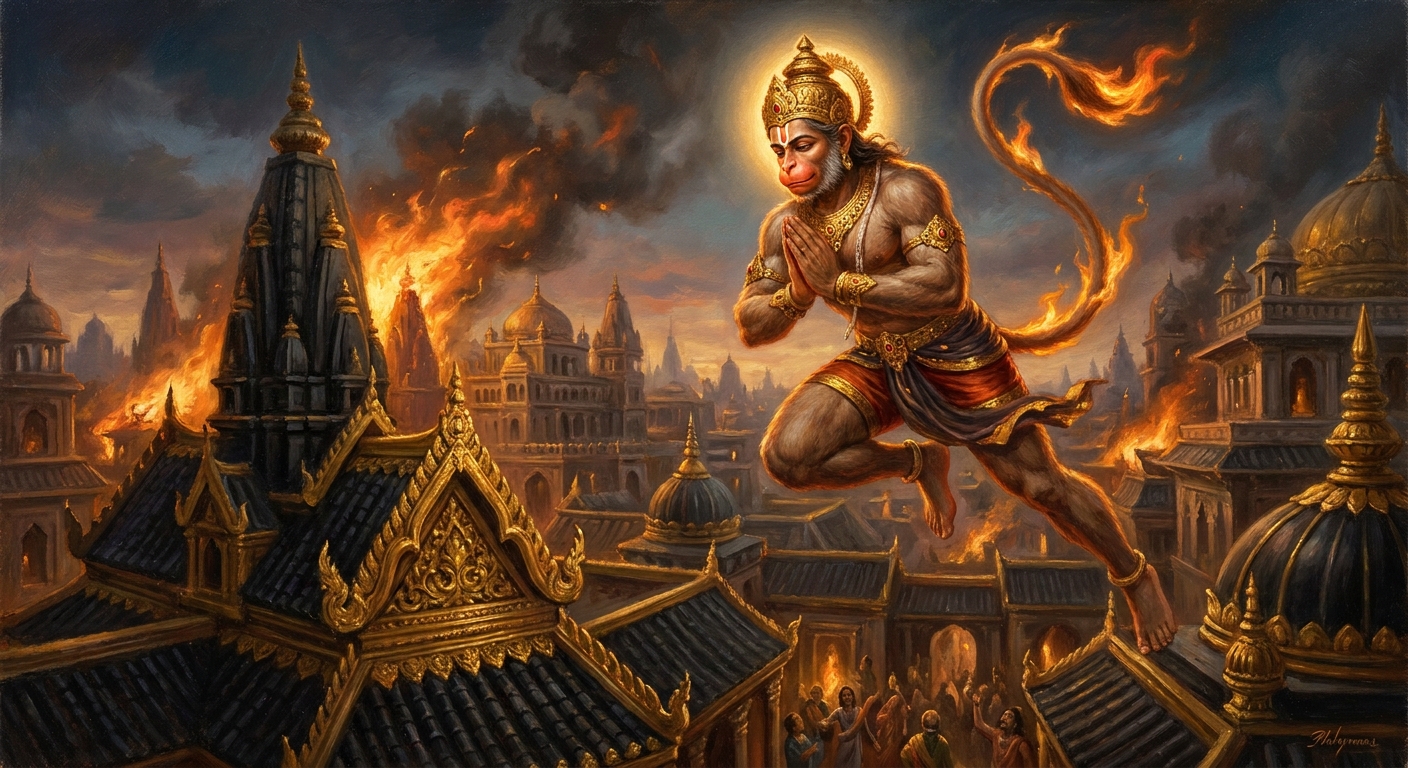
Hanuman Burns Lanka
Mythic Time · Valmiki Ramayana ~5th century BCE · Lanka — Ravana's golden city
Contents
The monkey-warrior Hanuman leaps the ocean, finds Sita captive in Ravana's ashoka grove, delivers Rama's ring — then lets himself be captured, wears a flaming tail across Ravana's golden city, and returns home across the sea.
- When
- Mythic Time · Valmiki Ramayana ~5th century BCE
- Where
- Lanka — Ravana's golden city
He stands at the southern tip of the world and the ocean fills everything.
Hanuman, son of Vayu the wind-god, measures the gap with his eyes — one hundred yojanas of open sea between the shore of Bharata and the island fortress of Lanka. The other monkey-warriors have given up. They stand behind him, brilliant and capable and utterly certain this crossing cannot be done. Hanuman has not spoken. He is thinking about Rama.
He breathes in. He remembers who he is.
Then he explodes into the sky.
The leap is not a metaphor. His body expands as he runs toward the cliff’s edge — muscle and bone answering the devotion that is his deepest nature — and he launches upward with a crack like thunder, the trees flattening behind him, the sea churning in his wake. Clouds part. Mountains on the sea floor shudder. He flies south through storm and starlight, and Lanka rises from the water like a wound of gold.
He lands at dusk, shrinks himself to a cat’s size, and slips through the walls.
Ravana’s city is magnificent. The streets are paved with gems. The palaces rise in tiers of polished copper and hammered gold, lit by torches that never gutter, guarded by rakshasas who never sleep. Hanuman moves through it all like a whisper, cataloguing, grieving. This beauty serves a tyrant. Every tower is a monument to the one wrong decision — the abduction of Sita, Rama’s wife, Dharma’s wife, the woman whose absence has cracked the cosmic order in half.
He finds her in the ashoka grove.
She sits beneath the shimshapa tree, small and still and incandescent with suffering. Rakshasa women circle her like vultures. Ravana comes to her each day with his ten heads and his magnificent voice and his bottomless certainty that she will eventually choose him. She does not choose him. She sits under the shimshapa tree and thinks about Rama.
Hanuman watches for a long time. He is not sure how to announce himself. He has crossed an ocean in a single bound and infiltrated the most fortified city in the world, and now he is afraid that he will frighten her.
He begins to sing, softly, in the branches above her head — the story of Rama, from the beginning, every detail true. She looks up. Her eyes, ruined by weeping, search the leaves. He descends and shows her the ring.
She recognizes it. She takes it in both hands as if it still holds warmth from Rama’s finger.
She has no ring to send back. She gives him a jewel from her hair and a message made entirely of grief and faith: Tell him I will survive exactly one month more. Hanuman folds the words into his chest and prepares to go.
Then he decides not to go yet.
He is the son of the wind. He does not have to leave quietly.
He begins to destroy the ashoka grove — methodically, with his bare hands, uprooting trees, scattering rakshasa guards, dismantling Ravana’s favorite pleasure garden stone by stone. The noise is extraordinary. Armies come. He kills them. More armies come. He kills those too, with a gatepost he has pulled from the wall. He tears through every force Ravana sends until Ravana sends his son Indrajit, who binds Hanuman with Brahma’s own serpent-cord.
Hanuman could break the cord. He knows he could break it. He lets it hold him, because he wants to look Ravana in the eyes.
Ravana is exactly what Hanuman expected: ten crowned heads, twenty arms, the stolen radiance of a thousand ascetics poured into one magnificent, corrupted form. He sits on his throne and looks at the monkey they have dragged before him, and he is not afraid, because he cannot imagine that he should be.
“Bind his tail,” Ravana says, “and set it on fire.”
They wrap the tail in cloth. They pour oil. They bring the torch.
Hanuman expands.
It is not fast — it is deliberate, patient, deeply pleasurable. He lets his body grow, fills the great hall with his presence, watches their faces change as the cloth they’re wrapping runs out and they bring more cloth and it still runs out, more cloth, more oil, more panic, his tail now longer than the hall, now longer than the palace wing, now coiled through three courtyards while they pour oil and wrap and wrap. He is smiling. He is thinking about Rama. Devotion, it turns out, is the one thing that cannot be measured or contained.
They light the tail anyway.
He lets them.
The fire takes hold and Hanuman is on his feet and through the roof before any of them can move. He lands on the first tower. The wood catches. He leaps to the second. The thatch catches. He leaps to the third and the fourth and the fifth, a monkey made of fire moving across Ravana’s golden city like a comet that has decided to stay low, street by street, palace by palace, garrison by garrison. The gold melts. The gems crack in the heat. The screaming is immense and he moves through it without cruelty — this is not rage, it is verdict, it is the cosmic settling of an account — until Lanka’s skyline is one continuous flame reflected on the sea below.
Then he thinks of Sita.
He stops. In the middle of the burning city, the fire goes out on his tail. There are stories that say Vayu the wind-god reached down and cooled it; stories that say his devotion itself was the barrier. Either way, Hanuman stands unburned in a burning city and checks, methodically, that the ashoka grove is intact, that Sita is unharmed, that Dharma has preserved what Dharma needed to preserve.
It has. She is.
He climbs to Lanka’s highest tower, looks north across one hundred yojanas of ocean, and jumps.
He hits the water on the far shore like a god arriving, because that is what he is. The monkey-army crowds around him, shouting questions. He gives them Sita’s jewel. He gives them her words. He gives them the one piece of intelligence that matters: She is alive. She is holding. The city is burning.
Later, when the war is won and Rama stands in Lanka’s rubble and Sita is returned, there will be elaborate ceremonies and the formal restoration of Dharma to the world. Hanuman will be there for all of it, smaller than he was in the burning city, quiet the way the ocean is quiet after a storm.
Rama will offer him a gift — anything, any boon in the world.
Hanuman will fold his hands and ask for nothing except to remain in devotion for as long as Rama’s name is spoken on the earth.
It is the only request in the Ramayana that requires no negotiation. Rama simply says yes.
The Sundara Kanda — the “Beautiful Chapter” — is considered the most auspicious section of the Ramayana. Reciting it is believed to remove obstacles and bring courage. Hanuman’s combination of impossible physical power and total self-effacement before the divine is the theological point: bhakti does not diminish the devotee. It expands them. The flaming tail is not humiliation. It is the moment Ravana accidentally gave Hanuman a torch.
The leap across the ocean is recalled in the Hanuman Chalisa — composed by Tulsidas in the 16th century — as proof that devotion can cross any impossible distance. The gap between the devotee and the divine is exactly one hundred yojanas. It always has been. The crossing is always available.
Echoes Across Traditions
Entities


Sources
- Valmiki *Ramayana*, Sundara Kanda, Robert P. Goldman (trans.)
- *Hanuman Chalisa*, Tulsidas
- Tulsidas, *Ramcharitmanas*, Sundara Kanda