An Ear of Wheat in Silence
c. 1500 BCE - 392 CE · two millennia of unbroken initiation · Eleusis, fourteen miles west of Athens, on the road from the city to the sea
Contents
For nearly two thousand years, the initiates of Eleusis kept the secret of what the hierophant lifted from the sacred chest in the torchlight — and the silence held.
- When
- c. 1500 BCE - 392 CE · two millennia of unbroken initiation
- Where
- Eleusis, fourteen miles west of Athens, on the road from the city to the sea
In the ninth month of the Athenian year — Boedromion, late September, the heat finally breaking — the city empties.
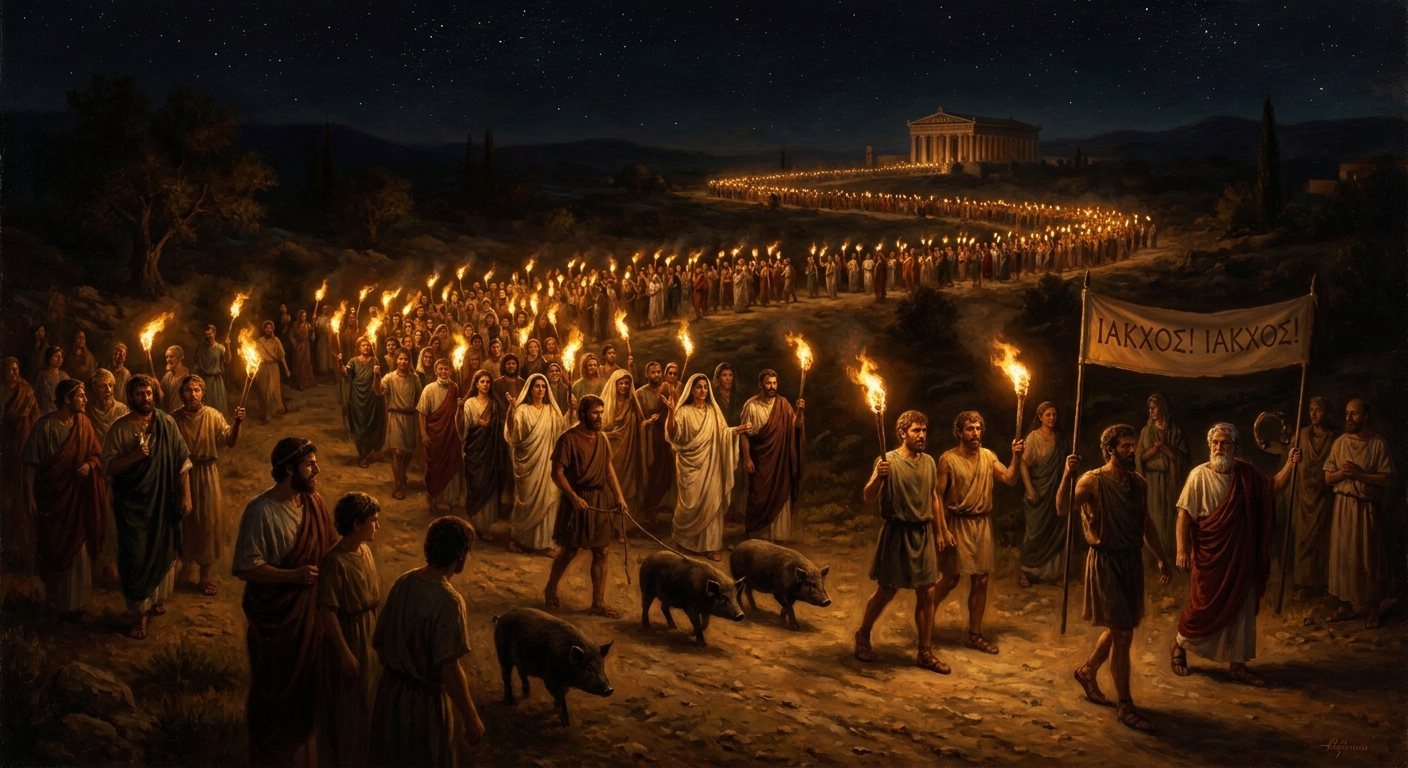
Tens of thousands walk west along the Sacred Way. The road runs from the Eleusinion at the foot of the Acropolis, through the Kerameikos, out the Sacred Gate, across the salt flats by the bay, over the pass at Daphni, and down at last to the small coastal sanctuary at Eleusis. Fourteen miles. The procession leaves at dawn and arrives by torchlight. They carry sacred objects in baskets covered in purple cloth. They shout the name Iacchos until their throats are raw. They cross a bridge over a small river where masked men lean down from the parapet and shout obscene insults at the marchers — the gephyrismoi, the bridge-jests — and the marchers laugh, because the goddess herself laughed once, in her grief, at exactly this kind of joke.
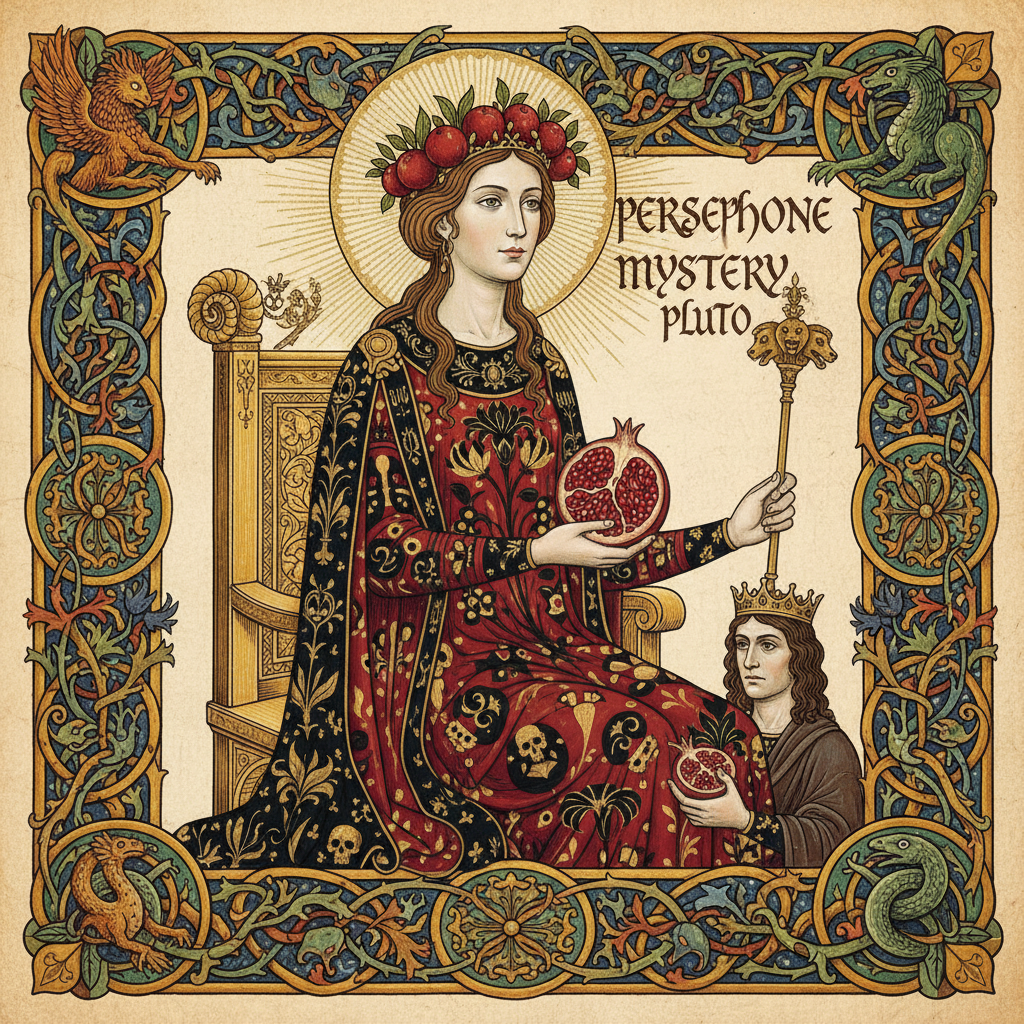
Demeter, the Homeric Hymn says, was wandering the earth searching for her stolen daughter. She would not eat. She would not drink. An old woman named Iambe made her a coarse joke. The goddess, surprising herself, laughed.
Grief breaks. The fields can be sown again.
The marchers are walking, in their feet, the goddess’s own road back from despair.
They arrive at sunset.
Eleusis is small — a sanctuary tucked between the mountain and the sea, no more than a few hundred meters across. At its center stands the Telesterion: a square hall, fifty meters on a side, supported by forty-two stone columns, big enough to hold three thousand people standing. There are no benches. There is no altar in the middle. There is only a small structure called the Anaktoron — the palace — on a raised platform near one wall, where only the hierophant may enter, and from which he will emerge, at the climactic moment, carrying something.
What that something is, no one alive is permitted to say.
The new initiates — the mystai — gather in the courtyard outside. They have already passed the Lesser Mysteries six months earlier in Athens, in the spring; that was the preparation. Now they will see the Greater. They have purified themselves in the sea at Phaleron — Hade mystai, the priests cried, to the sea, initiates — washing salt water into their mouths and over their heads. They have sacrificed a piglet each. They have fasted, since dawn, the same fast Demeter kept while she searched for her daughter.
When the sun goes down, they file into the Telesterion.
The hall is dark.
Not torchlit dark — dark dark, the columns swallowed in it, the only light a few oil lamps far at the front. Three thousand people stand in silence on a stone floor still warm from the day. The smell of incense and unwashed bodies and the sea. Somewhere, slow, a drum.
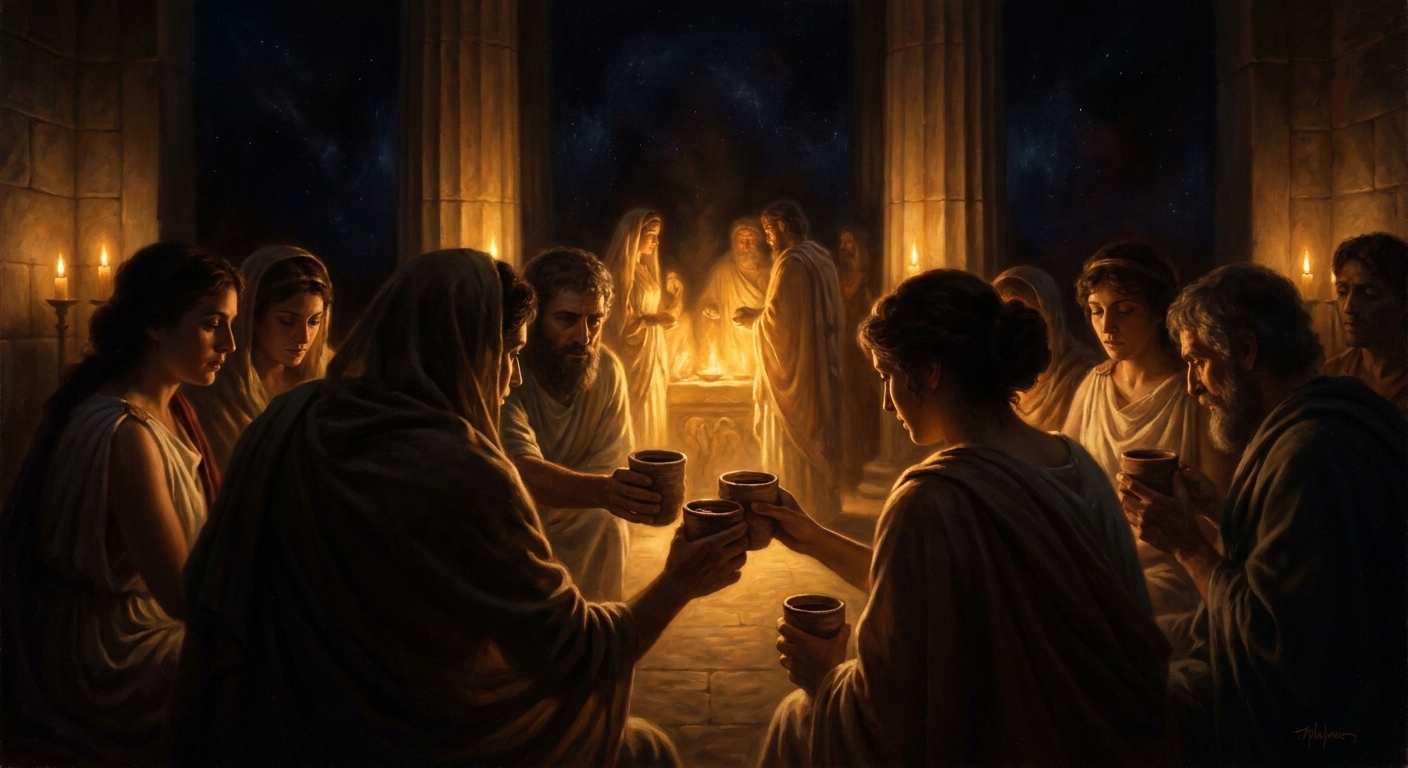
A priestess steps forward with a great krater of dark liquid. She speaks the formula: I have fasted. I have drunk the kykeon. I have taken from the chest, and after working, I have placed in the basket, and from the basket into the chest.
The cup goes around. Each initiate drinks.
The kykeon is barley meal, water, and a few crushed leaves of pennyroyal — Demeter’s own drink in the hymn, the cup the goddess took from old Metanira’s hand at Eleusis when she would accept nothing else. Barley and water and a bitter herb. A peasant’s drink. A drink for the road.
But the barley is a particular barley. It has been stored in a particular way. It may, almost certainly does, host the dark fungus Claviceps purpurea — ergot — whose alkaloids are chemical cousins to LSD. R. Gordon Wasson and Albert Hofmann argued the case in 1978; the ancient sources cannot confirm it, but they cannot rule it out, and what happens in the next hour is not what happens to people who have drunk barley water.
The drum changes tempo.
The hierophant appears.
He is an old man, in robes of saffron and white, his hair long, his face painted. He stands on the platform of the Anaktoron, the small inner shrine. He raises his arms.
The torches are lit.
Three thousand people gasp at once.
The Telesterion floods with fire — not slow, but all at once, a thousand torches pulled from the sand pits at the walls and lifted overhead, the columns leaping out of darkness into a cathedral of orange flame, the ceiling beams glowing, the smoke rising through the louvered hole in the roof. The drum stops. The hierophant cries out a single phrase — the legomena, the things-said — in a voice trained for forty years to fill the hall.
We do not know the phrase. The mystai never wrote it down.
The Christian church father Hippolytus, writing centuries later from hostile hearsay, claims the cry was: “Holy Brimo has borne the holy child Brimos! The strong one has borne the strong one!” He may have been right. He may have been making it up. He was not initiated. The men who were initiated died with their mouths shut.
Then the deiknymena. The things-shown.
The hierophant turns to the Anaktoron. The small inner door opens. He goes in. He comes out.
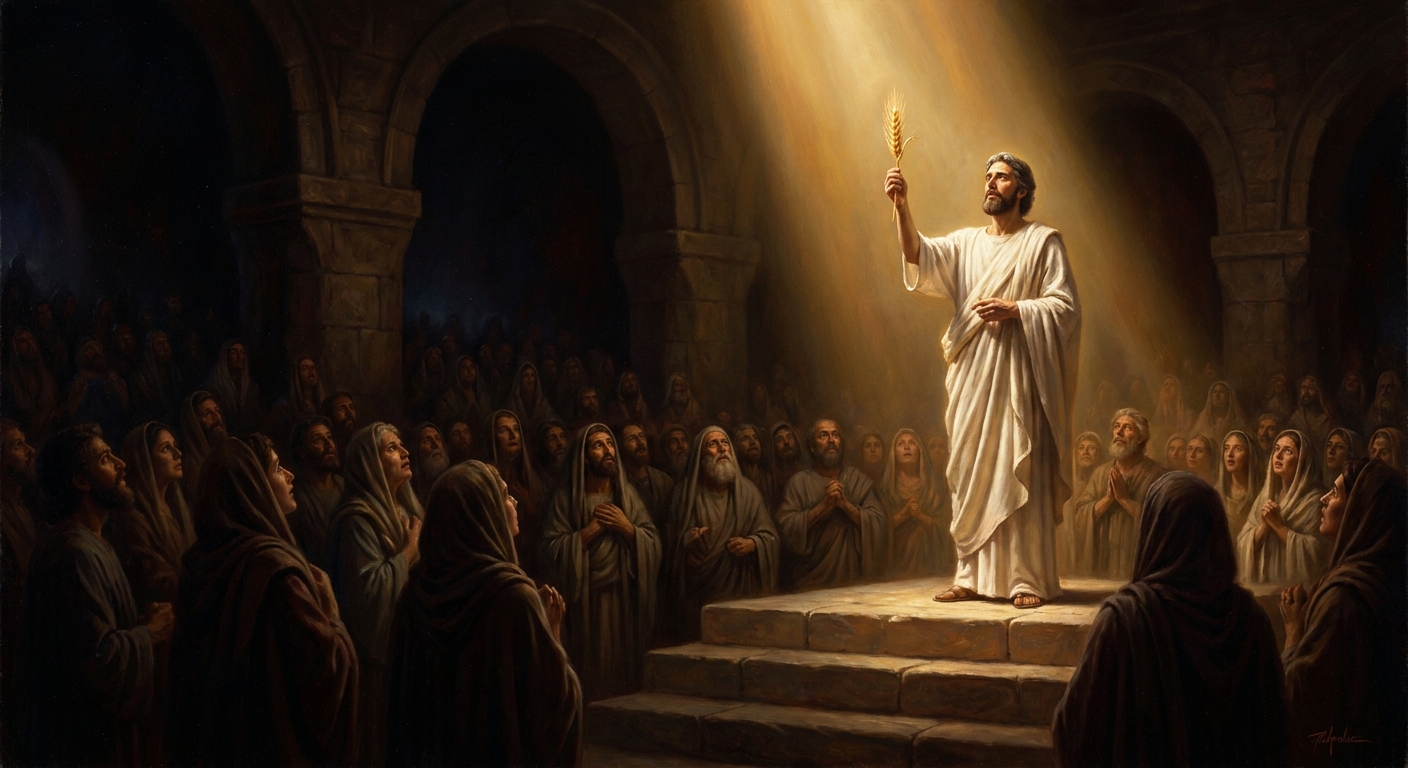
He is holding, in absolute silence, a single ear of wheat.
He lifts it above his head.
That is what they see. That is the climax of the two-thousand-year-old mystery. After the fourteen-mile walk, after the fasting and the kykeon and the dark and the sudden firestorm of torchlight, after the cry Brimos! Brimos! — a single, cut, ripe ear of grain, raised in silence, in a cathedral of flame, by an old man in saffron robes.
The mystai see it and know.
They know — though no one has told them, because no one is allowed to tell them — that the grain is the goddess’s daughter. Persephone. Stolen by Hades into the underworld; restored, partly, each spring; cut down each summer; planted again into the dark; rising again. They know that the grain is also themselves. The seed that has to die into the dirt to become bread. The body that has to be lowered into the earth to be raised. They know — and this is the part Plato meant when he said the mysteries gave him better hopes for the end — that they will not be destroyed. That they, like the grain, like the goddess, will be brought back.
It is not an argument. It is a seeing.
Aristotle wrote of Eleusis: the initiates do not learn anything; they suffer something, and are put into a certain condition.
A certain condition. He could not say more. None of them could.
The mystery is performed every year for nearly two thousand years.
The Pisistratids enlarge the Telesterion in the sixth century BCE. Pericles enlarges it again. The Romans rebuild after the Costobocii burn it in 170 CE — Marcus Aurelius himself comes from his frontier campaigns to Eleusis to be initiated and to fund the restoration. Cicero is initiated. Plutarch is initiated. Augustus, Hadrian, Antoninus Pius, Lucius Verus, Commodus, Septimius Severus — emperor after emperor walks the Sacred Way and stands in the dark Telesterion and sees the wheat lifted in the firelight.
The death penalty for revealing the rite is not theoretical. Aeschylus, the playwright, was nearly stoned for putting something on stage — perhaps unintentionally — that came too close to the Mysteries; he was acquitted only by claiming he had never been initiated and could not have known. Alcibiades, the brilliant general, was charged in absentia with mocking the rites at a drunken party in 415 BCE; the charge cost him his command and changed the Peloponnesian War.
The silence held.
In 392 CE, the Christian emperor Theodosius I forbids all pagan worship by edict.
Three years later, in 395, a Visigothic war-band under Alaric burns Eleusis on its way south through Greece. The Telesterion is sacked. The hierophant — a man named Nestorius, the last in a hereditary line that traced itself to the goddess’s first priest — survives the burning but never performs the rite again. He dies a few years later. The succession ends.
The wheat is not lifted again.
The phrase the hierophant cried in the firelight goes with him into the silence. The contents of the sacred chest, whatever they were — figurines, tools, relics — go into the rubble. Two thousand years of initiates carried what they had seen to their graves. None of them ever quite said.
We have, today, the ruins. We have the Homeric Hymn. We have inscriptions and pottery and the outline of a stone hall by the sea. We do not have the secret.
That is the secret. The secret is that the secret is kept.
The mystery cults of the ancient world all worked this way: the initiate suffered something, saw something, and could not afterward explain it to anyone who had not also suffered and seen. Eleusis is the longest-running, the most prestigious, the deepest example. Plato built half his philosophy around the grammar of initiation — the cave, the soul rising into the light, the things-said and things-done.
When Christ told his disciples that a grain of wheat must fall into the earth and die before it can bear fruit, he was speaking, in their own Greek, the language of Eleusis. When Paul wrote I die daily to the Corinthians, he was speaking it. When the church called its central rite the mysterion — Latin sacramentum — it was speaking it. The mysteries were dismantled by the empire that became Christian, and they survived, half-hidden, inside the Christianity that dismantled them.
The wheat in the firelight was the seed that had to be buried. The initiates who saw it were the seeds. We are.
That is what they could not say, and what, in the end, they did not have to.
Scenes
The fourteen-mile procession from Athens along the Sacred Way, torches lit, the cry *Iacchos! Iacchos!* rising from thousands of throats
 Generating art…
 Inside the Telesterion: the kykeon — barley, water, pennyroyal, possibly ergot — passed cup to cup in the dark before the great revelation
 Generating art…
 The hierophant lifts a single ear of wheat in absolute silence
Generating art… Echoes Across Traditions
Entities
- Demeter
- Persephone
- the Hierophant
- the kykeon
- the Telesterion

Sources
- George E. Mylonas, *Eleusis and the Eleusinian Mysteries* (1961) — the standard archaeological account
- Carl Kerényi, *Eleusis: Archetypal Image of Mother and Daughter* (1967)
- R. Gordon Wasson, Albert Hofmann, and Carl A. P. Ruck, *The Road to Eleusis* (1978) — the ergot hypothesis
- Walter Burkert, *Ancient Mystery Cults* (1987)
- *Homeric Hymn to Demeter* (~7th c. BCE) — the founding myth