Nagarjuna and the Logic of Emptiness
c. 150–250 CE · Southern India — Nagarjunakonda (named for him), Amaravati, and the Naga underwater realm of legend
Contents
A Brahmin philosopher walks into the underwater library of the serpent kings, returns with lost sutras, and writes the most rigorous philosophical proof in the Buddhist tradition: that nothing whatever has fixed existence — not even emptiness.
- When
- c. 150–250 CE
- Where
- Southern India — Nagarjunakonda (named for him), Amaravati, and the Naga underwater realm of legend
He is born a Brahmin in the south.
The legend says his parents were warned that he would not survive his seventh year unless he was given to the Buddhist sangha. They give him. He becomes a monk. He grows into a young man of frightening intelligence. He memorizes the entire Tripitaka — the three baskets of canonical Buddhist scripture — before he is twenty. He masters logic, debate, grammar, medicine, alchemy. He speaks every dialect from Mathura to Madurai. He becomes, by his early thirties, the abbot of Nalanda — or so the later legends will claim, telescoping centuries into a single biography.
What is certain is that by the middle of the second century CE, somewhere in the Andhra country of southern India, a teacher named Nagarjuna is composing texts of such philosophical rigor that no Buddhist thinker for the next eighteen centuries will be able to step around him. He must be addressed. He must be answered. He cannot be ignored.
The legend of how he gets the sutras is the story the tradition tells.
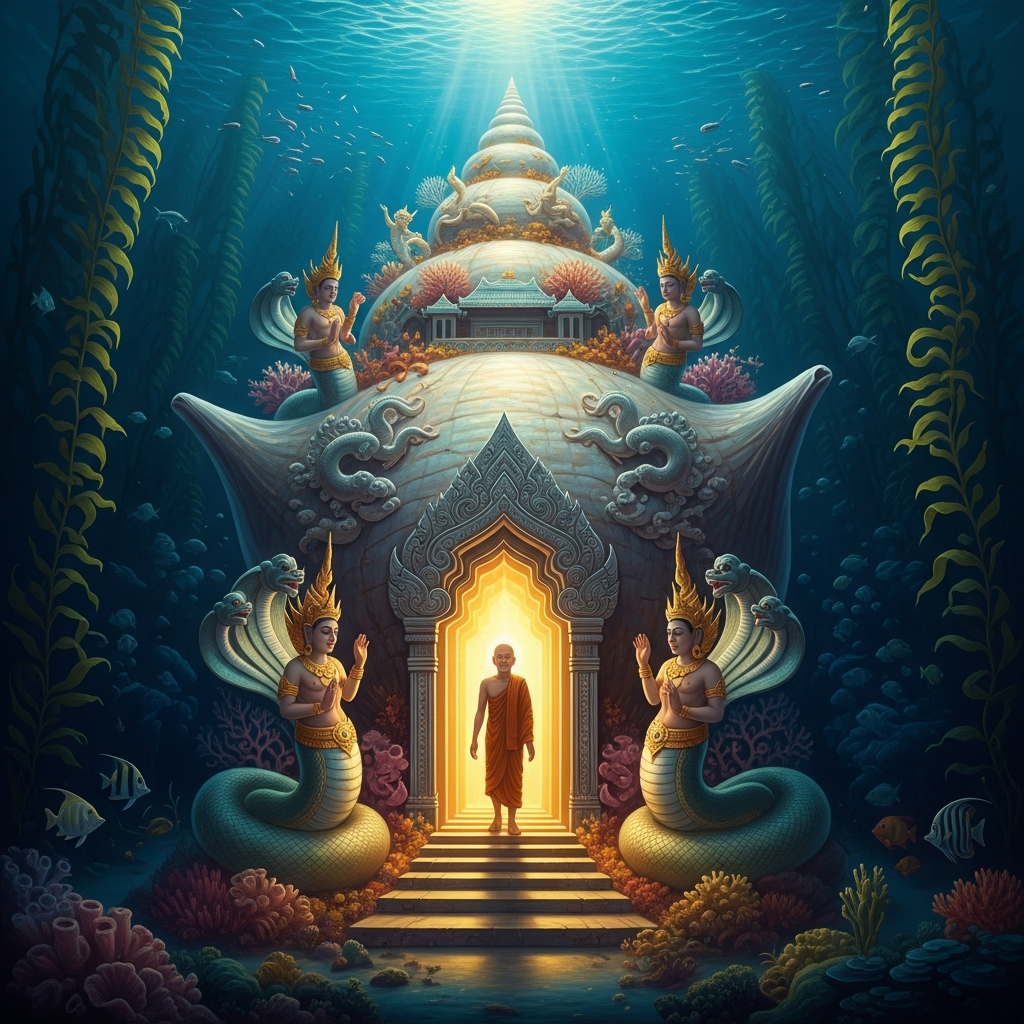
He is meditating beside a lake in the deep south. Two boys appear. They are not boys. They smell of water-weed and salt. They invite him to come with them. He follows them down through the lake, through layers of cold green light, into the realm of the Nagas — the serpent-kings of the underworld — at the bottom of the sea.
The Naga king receives him. The king’s palace is built of coral and pearl. The library at its heart contains scriptures that no surface monastery has ever held: the Prajnaparamita sutras, the Perfection of Wisdom texts, given by the historical Buddha to the Naga kings six centuries earlier because human beings of that generation were not yet ready to receive them. The Naga king explains. We have kept them safe. We have waited for someone capable of carrying them up. You are that one.
Nagarjuna spends — depending on the version — fifty days or fifty years in the Naga library. He reads the Hundred Thousand Lines. He reads the Twenty-Five Thousand Lines. He reads the Eight Thousand Lines. He surfaces with the texts memorized. The lake closes behind him. He goes back to his monastery and begins to write.
The book he writes is the Mulamadhyamakakarika. The Root Verses on the Middle Way.
It is twenty-seven chapters long. It is composed in tight Sanskrit verse, four-line stanzas, terse to the point of brutality. It opens with the famous eight negations of the pratityasamutpada — dependent origination — declared as the heart of the Buddha’s teaching:
Not ceasing, not arising, not annihilation, not permanent, not coming, not going, not different, not identical.
The eight negations are not nihilism. They are the refusal to allow any one of the binary options to settle into a fixed metaphysical claim. Nagarjuna’s whole project is to show, chapter by chapter, that none of the categories in which Buddhists and non-Buddhists alike have been arguing — cause and effect, agent and action, fire and fuel, motion, time, the self, the Buddha, suffering, the noble truths, nirvana itself — none of them holds together if you press it hard enough.
He has a method. The method is the catuskoti. The four-cornered argument.
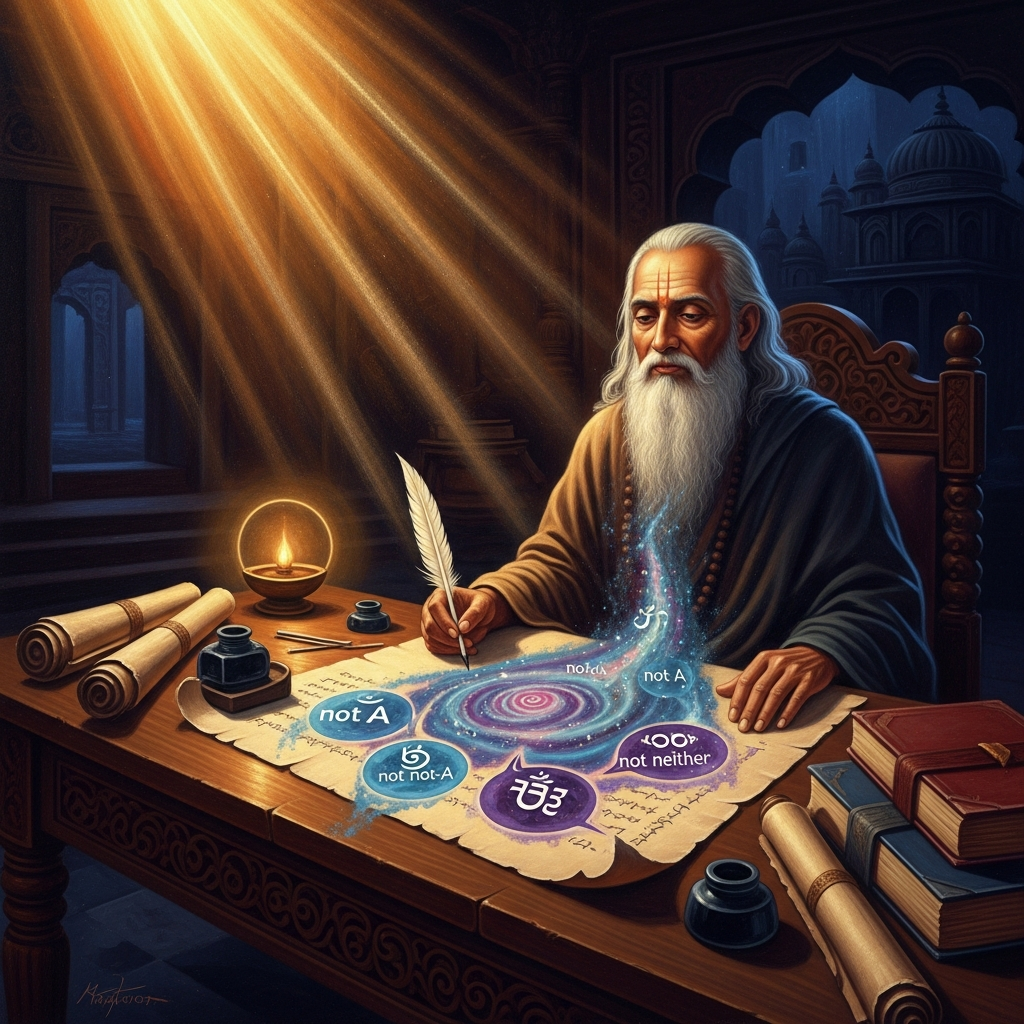
For any proposition A, you ask: Is A? Is not-A? Is both A and not-A? Is neither A nor not-A?
Nagarjuna shows, with relentless logical care, that all four positions collapse under analysis. The conclusion is not that one of the four is right. The conclusion is that the question — the question that requires there to be an A with fixed identity in the first place — is malformed. The category was the problem.
He is not playing.
The chapter on motion. Does the moving thing move on the path that has been traversed, or on the path that has not been traversed, or on the path that is currently being traversed? He shows that none of the three is coherent. The traversed path is no longer being traversed. The untraversed path has not begun. The currently-being-traversed path has no length, because the moment you give it length, part of it has been traversed and part has not. Motion, examined hard enough, refuses to sit still on any of the three options.
The chapter on the self. Is the self the same as the aggregates that compose it, or different from them? If the same, the self changes whenever the body changes — there is no continuity. If different, the self has no relation to anything you can point to. Both options collapse. The self the Brahmins defend cannot be defended; the self the early Buddhists denied cannot be coherently denied either, because to deny it presupposes the very category you are denying.
The chapter on the Buddha. Does the Tathagata exist after parinirvana, or not exist, or both, or neither? Nagarjuna applies the tetralemma to the Buddha himself. None of the four positions works. The Buddha, like the river, like the chariot, like the self, has no svabhava — no own-being — to fix or refute. The Buddha is empty. Sunyata.
The most famous, and most misunderstood, line in the entire treatise is at the end of chapter twenty-four:
Whatever is dependently arisen, that we declare to be emptiness. That is dependent designation, and that itself is the middle way.
Emptiness, Nagarjuna says explicitly, is not a thing. It is not a substance. It is not a metaphysical foundation. Emptiness itself is empty. If you cling to emptiness as a doctrine — if you make it into a thing that exists — you have already missed the point.
He warns his readers in plain language. Emptiness wrongly grasped is like a snake picked up by the wrong end. It will bite you. Read carelessly, the Mulamadhyamakakarika sounds like nihilism. Read carefully, it is the precise opposite. Because nothing has fixed identity, change is possible. Suffering has no fixed cause; therefore the path out is real. Bondage has no permanent essence; therefore liberation is achievable. The bodhisattva can vow to save all beings precisely because there is no fixed wall separating one being from another, samsara from nirvana, suffering from freedom.
He has a student.
The student is named Aryadeva. The legend says Aryadeva arrived at Nagarjuna’s monastery missing one eye — he had given it to a Brahmin philosopher who demanded it as a wager in a debate. He becomes the master’s most ferocious successor. He writes the Catuhsataka, the Four Hundred Verses, which extends Nagarjuna’s analysis into ethics and psychology. After Nagarjuna’s death he carries the Madhyamaka school north, debating Brahmin and Jain logicians at every kingdom along the road.
The school survives. It splits, in later centuries, into two main branches — the Prasangika, who refuse to make any positive philosophical claim of their own and only reduce opposing views to absurdity, and the Svatantrika, who allow positive claims provisionally as scaffolding. The argument between the two branches is still alive eighteen hundred years later in Tibetan monasteries, where Gelug scholars still debate the precise reading of Nagarjuna’s chapter twenty-four for hours at a stretch.
He writes other things.
The Vigrahavyavartani, The Dispeller of Disputes, in which he answers his Brahmin opponents who object that his refutation of all positions must itself be a position. He answers, with a smile in the Sanskrit, that he has no thesis to defend. The refutation is not a counter-claim. It is a clearing.
The Suhrllekha, Letter to a Friend — addressed to a southern king, possibly the Satavahana monarch Gautamiputra. It is the practical companion to the philosophical treatise. Practice generosity. Keep ethical conduct. Train in wisdom. Remember death. The same teacher who can dismantle every metaphysical category in the Mulamadhyamakakarika turns, in the letter to the king, to plain ethical advice. The emptiness of categories does not abolish the practice of compassion. It is its ground.
He may also have written the Ratnavali, the Precious Garland, on bodhisattva ethics; the Sunyatasaptati, the Seventy Verses on Emptiness; and a number of texts on alchemy and medicine — the legends say Nagarjuna also discovered how to transmute iron into gold and could prolong his own life indefinitely. The historical figure is hard to extract from the saint. By the seventh century he is already half-myth.
He dies, the legends say, by his own consent.
A young prince — son of his royal patron — has been promised the throne, but the king refuses to die because Nagarjuna’s elixirs keep him alive. The prince’s mother tells the prince that the only way he will inherit is if Nagarjuna agrees to die first; the king’s longevity is bound to the master’s. The prince goes to Nagarjuna and asks for his head. The master, who has been teaching for decades that the body has no fixed self and that compassion is the work of the bodhisattva, agrees without hesitation. The prince swings the sword. It will not cut. Nagarjuna explains: In a previous life I killed an insect with a blade of kusha grass. Cut me with a blade of kusha grass. The prince finds the grass. The blade slides through. The master’s head falls.
The story is symbolic, of course. The point of it — for the tradition that tells it — is that the philosopher who refuted every category, including the self, walks into his own death without flinching, because the self that would flinch was the first thing his analysis dissolved.
The school he founded becomes everything.
In the fifth century CE, the Madhyamaka is carried across the Pamirs by Kumarajiva and translated into Chinese; it becomes the philosophical engine of Sanlun and Tiantai and Huayan. In the seventh century, Xuanzang carries fresh translations back. In the eighth century, the Indian master Shantarakshita carries Madhyamaka into Tibet, and the Tibetan tradition spends the next twelve hundred years debating Nagarjuna’s verses. In Japan, Kukai and the Shingon school, Saicho and the Tendai, Dogen and the Soto Zen — all of them are doing variations on Madhyamaka. The verse on the corridor wall that Hui-neng will dictate five centuries after Nagarjuna’s death — fundamentally there is not a single thing — is the Platform Sutra’s compression of the Mulamadhyamakakarika into four lines.
Nagarjuna becomes, in the iconography of all these later traditions, a figure with a halo of seven cobra-hoods. The Naga kings’ library is shown behind him in countless paintings. The man who walked to the bottom of the sea and brought back the texts the world was not yet ready for. The patron saint of philosophical fearlessness.
The Mulamadhyamakakarika is not an easy book. It is one of the hardest books ever written in any language. It does not yield its meaning to a single reading or a careful summary. It must be argued through, line by line, the way the Tibetan monks still argue it, two by two in the courtyard of the monastery, hands clapping at the end of each premise.
But the point of it, in the end, is simple. Nothing has fixed essence. Not the self. Not the world. Not suffering. Not the path. Not the Buddha. Not emptiness itself. Because nothing has fixed essence, change is real, liberation is real, compassion is real, the bodhisattva path is real. The fixity that would make those things impossible was never there in the first place.
The Naga king kept the sutras at the bottom of the sea until a mind sharp enough to handle them appeared. The mind that appeared was Nagarjuna. The sutras have been on the surface ever since, and the world that received them — a world in which nothing is fixed and therefore everything is open — has not been the same since.
Scenes
The Naga king parts the waters and shows Nagarjuna the lost prajnaparamita sutras lying on stone shelves at the bottom of the sea
Generating art… Nagarjuna at his writing desk in southern India
 Generating art…
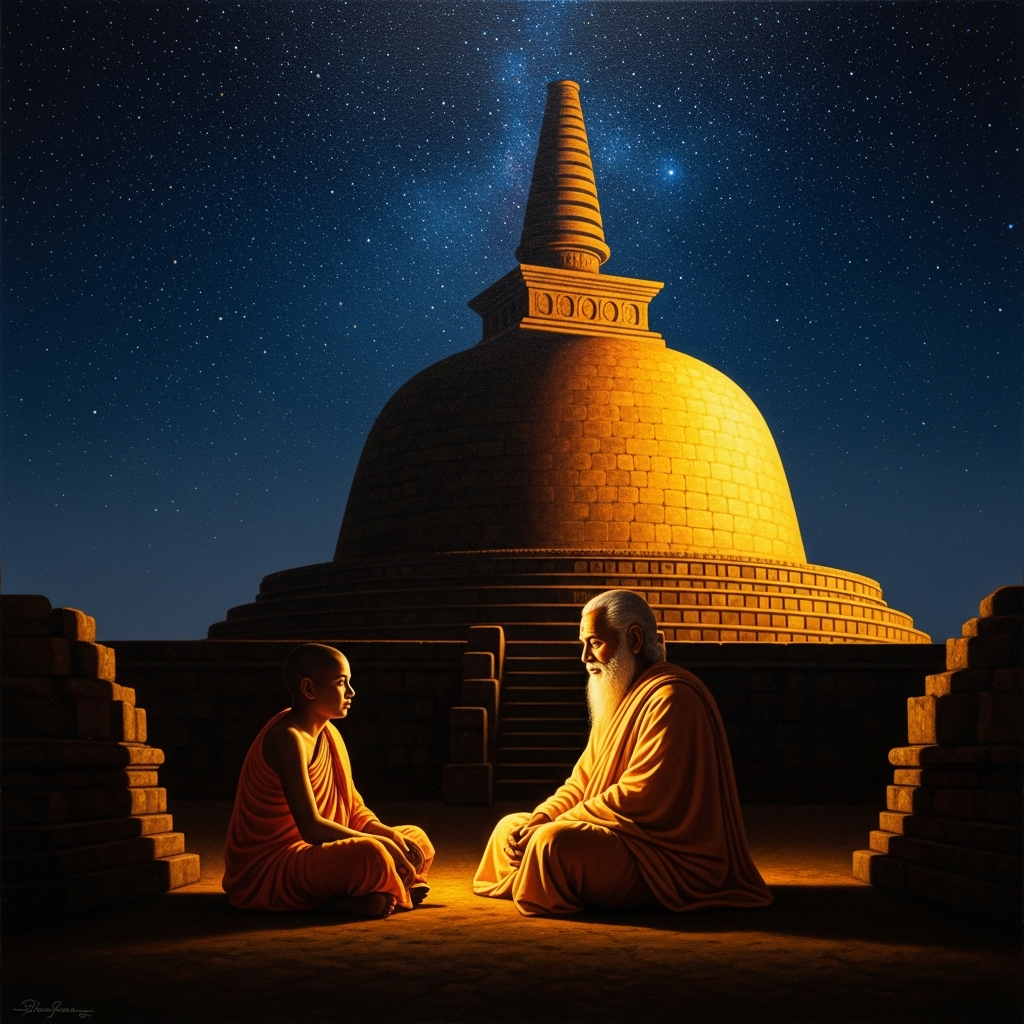
 The great stupa at Amaravati under the southern stars
 Generating art…
 Echoes Across Traditions
Entities
- Nagarjuna
- The Naga king
- Mañjuśrī
- Aryadeva
- Madhyamika school
Sources
- Nāgārjuna, *Mūlamadhyamakakārikā* (trans. Jay Garfield, *The Fundamental Wisdom of the Middle Way*, 1995)
- David Kalupahana, *Nagarjuna: The Philosophy of the Middle Way* (1986)
- Mark Siderits and Shoryu Katsura, *Nāgārjuna's Middle Way* (2013)
- David Seyfort Ruegg, *The Literature of the Madhyamaka School of Philosophy in India* (1981)
- Joseph Walser, *Nāgārjuna in Context: Mahāyāna Buddhism and Early Indian Culture* (2005)