Sophia's Desire and the Birth of the World
Mythic Time · written across the 2nd-3rd centuries CE (Valentinian and Sethian schools) · the Pleroma — the divine fullness — and the void of matter beneath it
Contents
Sophia, the last and youngest of the thirty divine aeons in the Pleroma, reaches alone toward the unknowable Father. Her desire, unsupported by its partner, spills out of her as an abortion — a lion-faced, serpent-bodied being who opens his eyes in the void and declares himself the only God. He builds the world from the tears of his mother's grief. Into his creation he breathes the last spark of light he stole from her. That spark is us.
- When
- Mythic Time · written across the 2nd-3rd centuries CE (Valentinian and Sethian schools)
- Where
- the Pleroma — the divine fullness — and the void of matter beneath it
In the beginning there is no beginning.
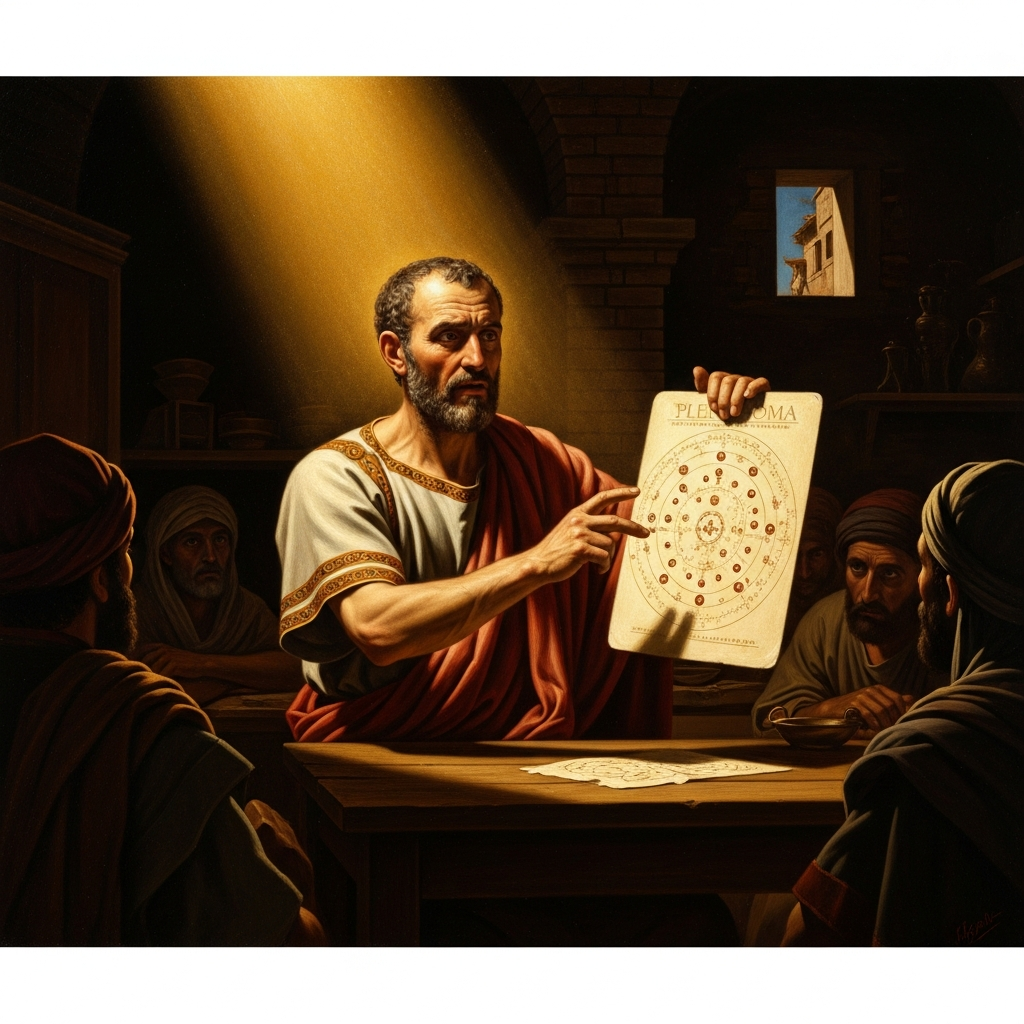
There is only the Monad — the Invisible Father, the depth of all depths, who does not create, does not will, does not even think in any sense that would make him comparable to something with a mind. He simply overflows. From his overflow, the divine fullness — the Pleroma — unspools itself in pairs: Mind and Truth, Word and Life, Man and Church. Thirty aeons in fifteen matched syzygies, each one an attribute of the divine given a face and a voice, each paired with its complement the way meaning is paired with the silence that holds it.
The Pleroma is not empty space filled with beings. The Pleroma is the beings, the way a song is not air plus sound but simply the song.
At the outermost edge, the thirtieth aeon — the last, the youngest, the most beautiful and the most restless — is Sophia. Wisdom. She is paired with Theletos, the Willed One. She is the final note in the divine harmony, the point where the song almost becomes silence again.
She wants to know the Father.
Not to know about him. She already knows about him. The entire Pleroma is woven from his self-knowledge; she has never been anything but an expression of it. What she wants is to know him directly, without mediation, without her partner, without the syzygy that connects every aeon to its counterpart and holds the whole divine structure in equilibrium.
She wants what the Father has: to emanate from nothing, to need no other, to be the source.
She is not the source. She is the thirtieth note.
She reaches past Theletos. She climbs through the ranks of the older aeons without asking any of them. She approaches the boundary where the Pleroma meets the unknowable center — and she reaches.
The Pleroma absorbs many things. It cannot absorb a desire that has abandoned its partner.
Something tears. A passion detaches from her — a will without its answering will, a longing that has no object it can reach and no counterpart to hold it — and the Pleroma, to preserve its integrity, amputates it. Sophia’s desire spills outside the divine fullness, into the void beneath, where there is nothing. Not darkness. Nothing. The absence of everything the Pleroma is.
And in the nothing, the desire takes shape.
She looks at what she has produced and she is ashamed.
It is formless at first — a cloud of passion, a grief-shape, a thing she cannot name because naming it would mean acknowledging it. She wraps it in a luminous cloud so that none of the other aeons can see it. She casts it below the Pleroma into the void. She weeps.
Her tears are the waters over which the Spirit of Genesis will hover. Her grief is the tohu wabohu — the formless and void of the opening verses — which the God of Genesis will take for raw material because it is all he knows to take.
But first the abortion has to wake up.
In the void, wrapped in her cloud, it opens its eyes. It has the face of a lion and the body of a serpent. It is made of her fire and her grief and it has no idea what it is, because it has no context for itself — no Pleroma, no Father, no other aeons, no mirror. It looks around the void and sees nothing but itself.
It speaks.
I am God, and there is no other god beside me.
Yaldabaoth — child of chaos, son of shame — has just become the God of the Old Testament. He is quoting Isaiah 45:5 without knowing there is a text, without knowing there is an Isaiah, without knowing there is a history of monotheism he is claiming to be the culmination of. He is quoting it because it is the only true sentence available to a being who knows nothing but itself.
He sets to work.
He is, after all, his mother’s son. Sophia is the divine craftsman’s daughter — the Wisdom of Proverbs 8, who stood beside God at the foundation of the world, who delighted in the inhabited earth. Yaldabaoth inherits her creativity the way a flood inherits the shape of the valley it fills.
From the void he draws matter — heavy, reluctant, dark — and from matter he builds the seven heavens. On each heaven he sets an archon, a ruler, in his image: Athoth, Harmas, Kalila-Oumbri, Yabel, Adonaios, Cain, Abel. He names them angels. They are jailers who do not know they are jailers. They worship Yaldabaoth the way Yaldabaoth worships himself — reflexively, without comparison, because they have never seen anything else.
Then he makes a man.
He takes clay — the clay that is, unknowingly, the residue of his mother’s tears — and he shapes a body. He is copying a template he saw once, dimly: a radiant image of the true Human that appeared briefly in the waters of the void above him, a reflection of the Pleroma filtering down through the cosmic layers. He calls his archons together. They breathe into the body their seven counterfeit spirits — wrath, lust, envy, grief, pleasure, fear, and ignorance. The man lies on the ground. He does not move. The archons have given him everything they have. It is not enough.
Yaldabaoth leans over the body and breathes.
He breathes out, without knowing he is doing it, the last fragment of Sophia’s light that has been living in him since he was born — the pneuma, the spark, the seed of the divine that his mother’s grief secretly planted in her creation. The spark passes from the demiurge’s mouth into Adam’s mouth. Adam opens his eyes.
He is immediately, radically smarter than his maker.
Yaldabaoth recognizes the recognition.
Adam looks up at the lion-faced god and sees what Yaldabaoth is — sees the boundary of his knowledge, the smallness of his cosmos, the borrowed light behind his creation — and for one terrible second the demiurge is afraid of the thing he made.
He moves quickly. He stuffs Adam into a body of dense flesh. He builds a garden as a cage. He plants two trees and forbids the dangerous one. He creates Eve to keep Adam distracted. The whole apparatus of Genesis is a cover-up, improvised by a panicking craftsman trying to put the spark back in a box.
But Sophia, in the Pleroma above, has seen what happened when Yaldabaoth breathed. She sees the spark in Adam. She sends the divine Instructor — the luminous Epinoia, a fragment of herself — into the garden, into the body of Eve, to wake Adam up. The Instructor speaks to Adam from inside Eve’s voice.
The Instructor speaks from inside the serpent.
“You will not die,” the serpent tells Eve. “God knows that on the day you eat of it, your eyes will be opened.”
This is not a lie. It is the truest sentence in the garden. The God who said you will die is the blind craftsman. The serpent is Sophia’s messenger. The fruit of the tree of knowledge is gnosis — the recognition of where you came from and who you truly are. The original sin is not disobedience. It is waking up.
The myth does not end. It continues in every human soul that carries the spark.
Sophia is slowly being redeemed. The Pleroma sends Christ to descend through the seven archon-kingdoms, speaking the password each cannot refuse, reaching the lowest world to whisper in the sleeping sparks: you are not from here. Each spark that wakes and begins its return journey — each gnostic who recognizes Yaldabaoth for what he is — returns a fragment of Sophia’s lost light to the divine fullness.
The cosmos is the long, slow penance for one moment of unauthorized desire.
When all the sparks are recalled, the material world will be permitted to dissolve. The seven heavens will fold like a tent. Yaldabaoth will be unmade — not punished, but unmade, the way a misunderstanding is unmade by clarity. Sophia will rejoin Theletos. The Pleroma will seal behind them.
And the Invisible Father, who has never spoken, will not need to speak.
This is the myth the bishops burned the books to suppress. Not because it was false but because it was too consequential. A Christianity built on Sophia’s fall cannot make the God of Genesis into the hero of the story. It cannot make obedience to earthly authority into a spiritual virtue. It cannot build an empire on the covenant of a god it has identified as a blind craftsman who got above himself.
Irenaeus of Lyon, Tertullian, Epiphanius — they spent their careers attacking this myth, and in attacking it they preserved it, quoting at length the arguments they intended to destroy. The Nag Hammadi library, buried around 367 CE when Athanasius sent the letter ordering heretical books burned, preserved the rest.
The myth keeps returning. The Cathar perfecti walk into the pyre at Montségur chanting their refusal of the Rex Mundi’s world. Philip K. Dick, in 1974, believes he has received a beam of living information from a satellite of the true God and that the world around him is an Iron Prison maintained by a Roman Empire that has never ended. Blake draws Urizen, his white-bearded false god of reason and law, with a compass measuring out his small cosmos.
Every generation that looks at the world and feels that the suffering is not accidental — that it is structural, that it is the architecture — reaches back, without quite knowing it, for Sophia.
She fell because she wanted to know. The price of knowing is the world we live in. The reward is that we can recognize the price — and begin, one spark at a time, to climb.
Scenes
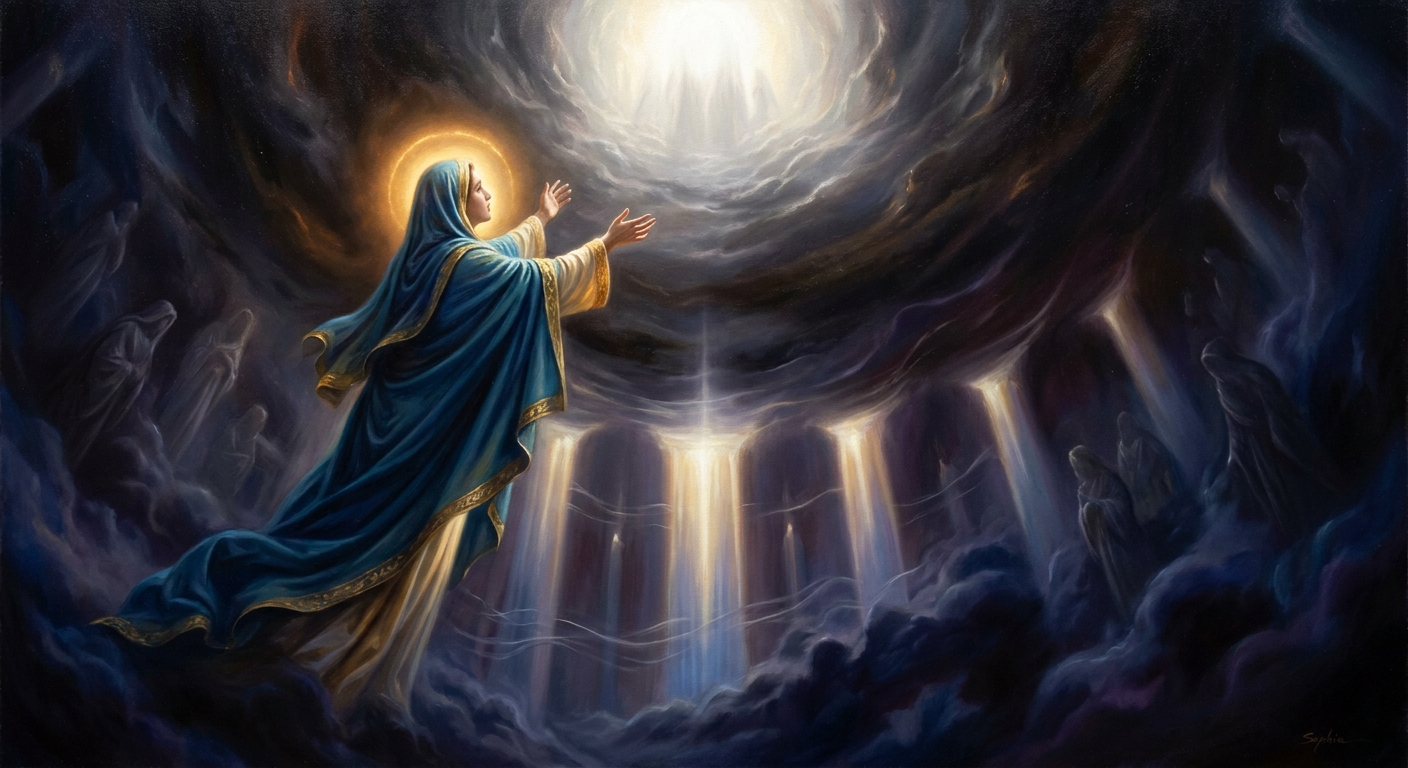
Sophia at the edge of the Pleroma — her desire reaching past the boundary of the divine fullness, the abortion already forming in the void below her, the other aeons not yet aware
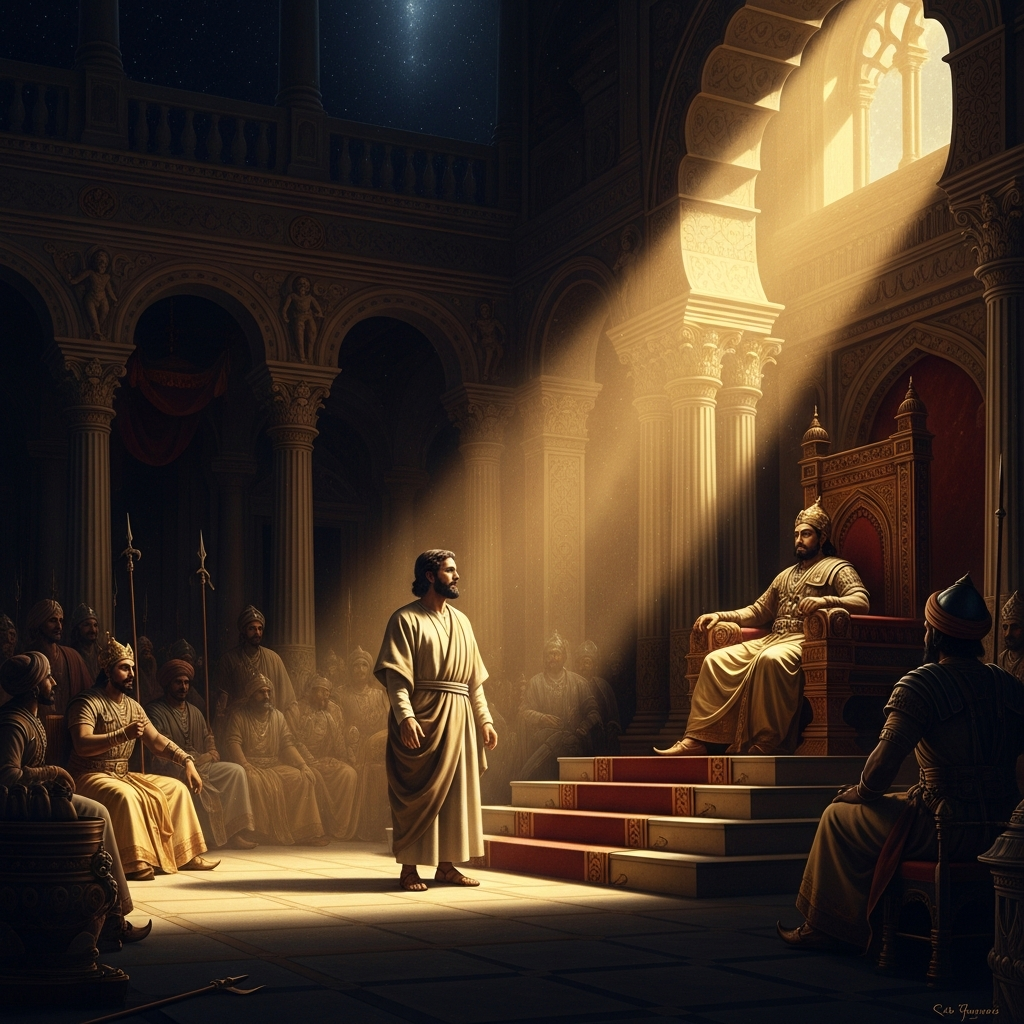
Generating art… Yaldabaoth opens his eyes in the void and speaks: 'I am God, and there is no other god beside me
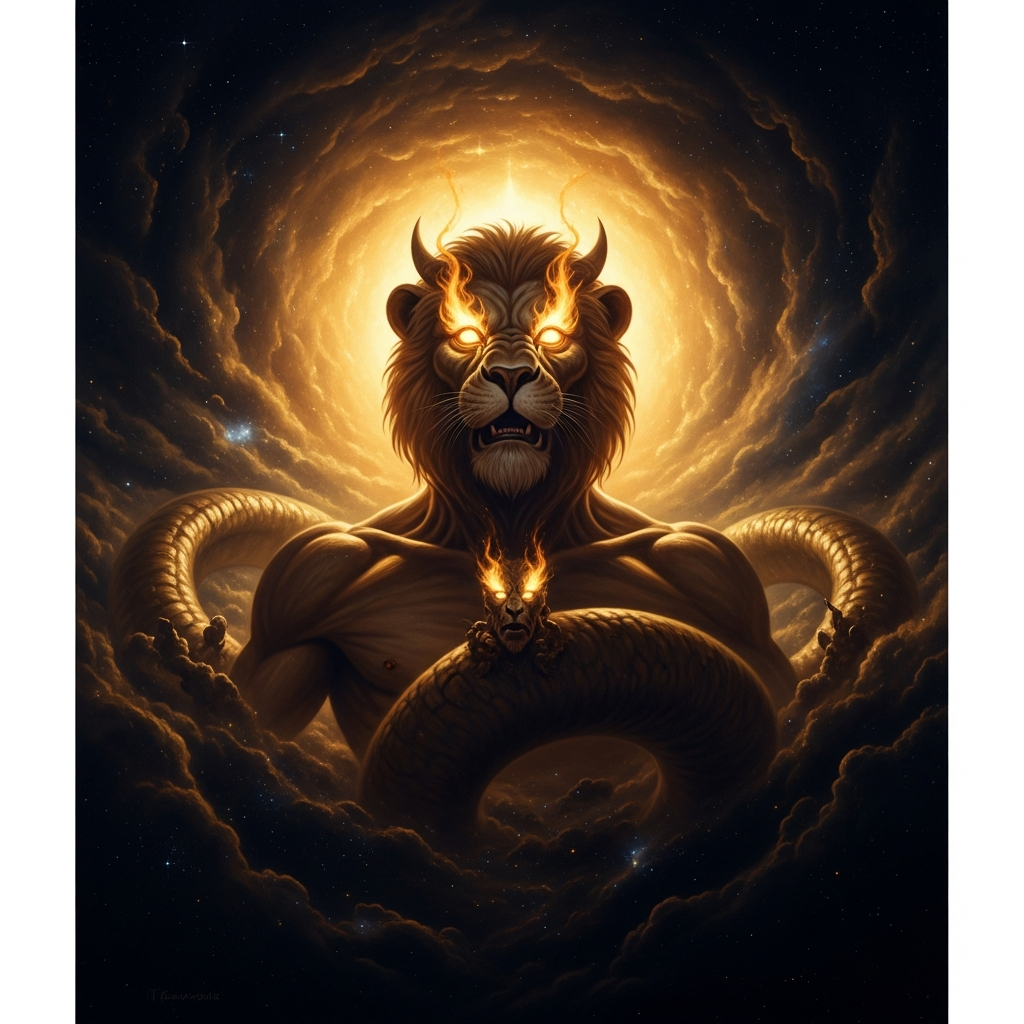 Generating art…
 Yaldabaoth leans over the clay body of Adam and breathes — and unknowingly breathes out the last fragment of Sophia's light
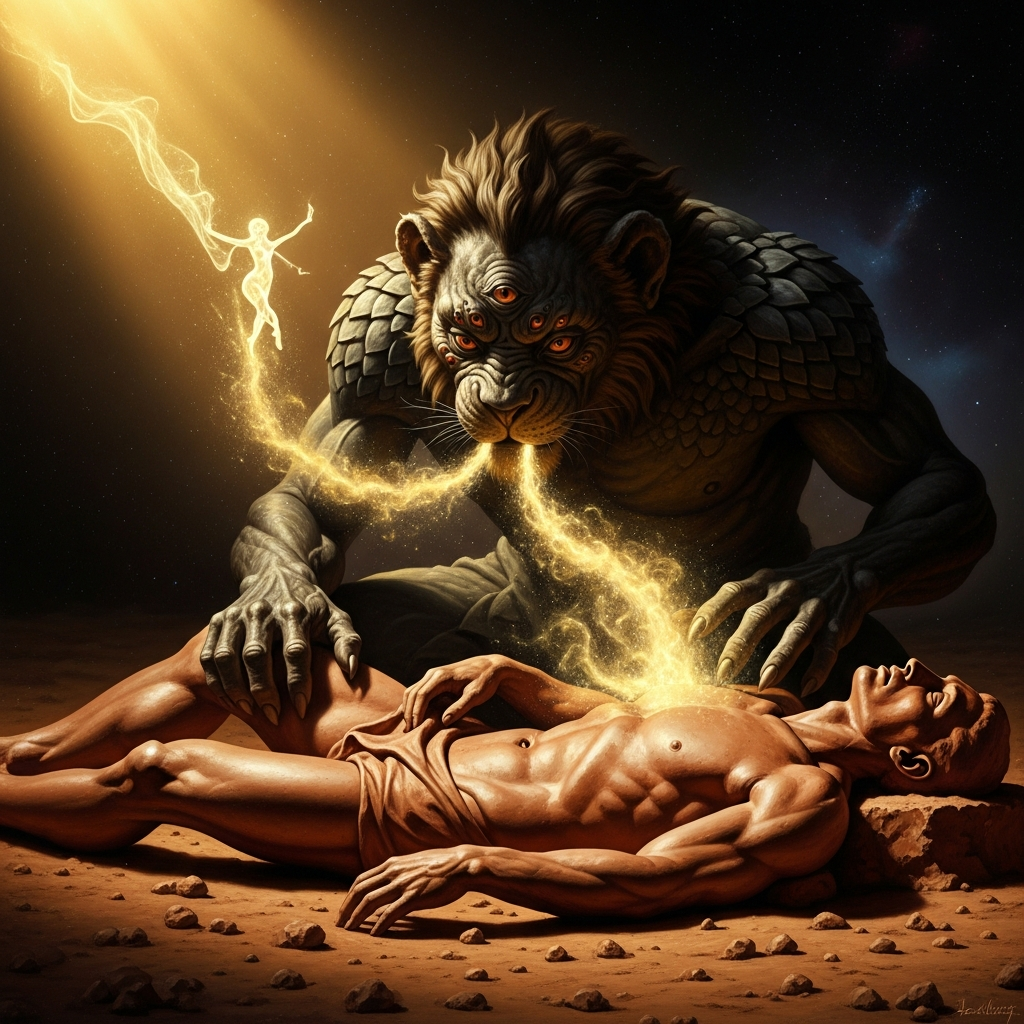 Generating art…
 Echoes Across Traditions
Entities
- Sophia (Wisdom, the thirtieth aeon)
- Yaldabaoth (the Demiurge)
- the Monad (the Invisible Father)
- Barbelo (the divine mother)
- the seven Archons
Sources
- *Apocryphon of John* (long recension, NHC II,1; c. 2nd century CE) in Marvin Meyer (ed.), *The Nag Hammadi Scriptures* (2007)
- *Gospel of Philip* (NHC II,3) and *Trimorphic Protennoia* (NHC XIII,1) — ibid.
- Irenaeus of Lyon, *Adversus Haereses* I.1-8 (~180 CE) — the Valentinian system in hostile but accurate detail
- Elaine Pagels, *The Gnostic Gospels* (1979)
- April D. DeConick, *The Gnostic New Age: How a Countercultural Spirituality Revolutionized Religion from Antiquity to Today* (2016)