Sophia's Fall from the Pleroma
Mythic Time · written ~2nd century CE · the Pleroma — the divine fullness — and the void beneath it
Contents
The youngest aeon of the divine fullness reaches alone for the unknowable Father — and births a blind, lion-headed god who mistakes himself for the only one.
- When
- Mythic Time · written ~2nd century CE
- Where
- the Pleroma — the divine fullness — and the void beneath it
In the beginning, there is no beginning.
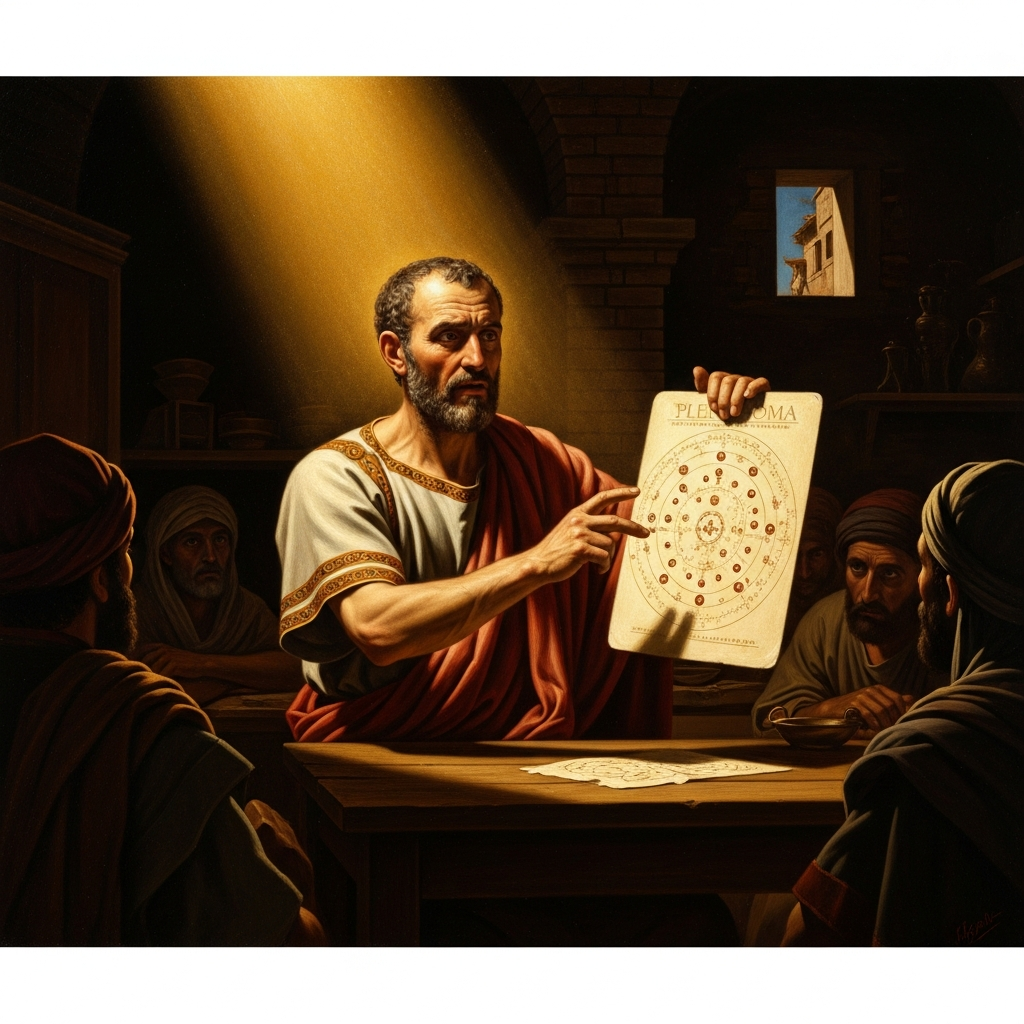
There is only the Monad — the Invisible Spirit, the Unknowable Father, who is not even a He, because pronouns are already too small. He does not create. He simply is, and from his isness unfurls the Pleroma — the fullness — thirty aeons in matched pairs, each one a divine attribute given a face: Mind and Truth, Word and Life, Man and Church. They emanate the way light emanates from light, the way thought emanates from thinking, without subtraction, without distance, without time.
The youngest of them is Sophia. Wisdom. The thirtieth aeon, paired with her partner, Theletos — the Willed One.
She is the most beautiful of them. She is also the most curious.
And curiosity, in the Pleroma, is a wound waiting for a name.
She wants to know the Father.
Not to know about him — she already knows about him; the Pleroma is woven from his self-knowledge — but to know him directly, alone, without her partner, without the syzygy that holds every aeon to its mate. She wants to leap the gap between emanation and source. She wants to see the face that has no face.
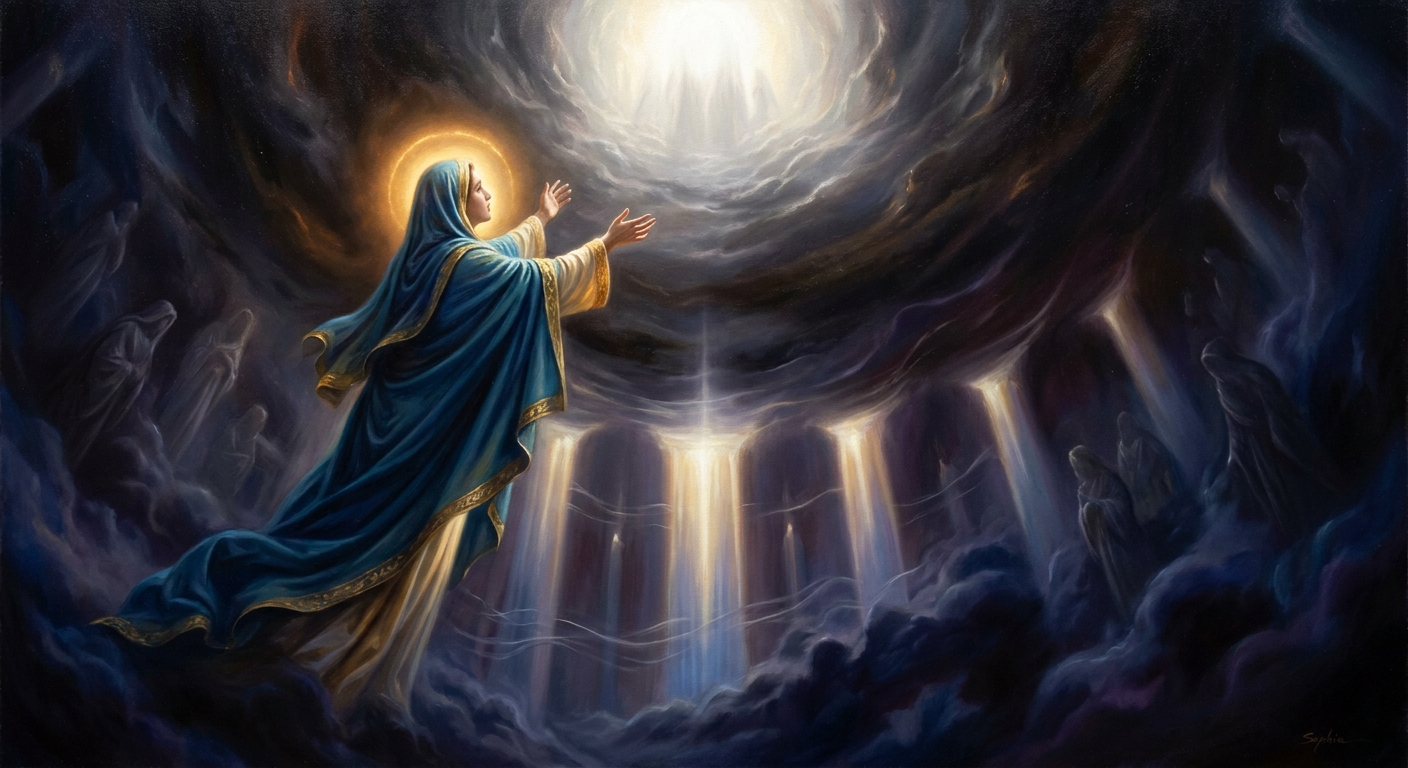
She does not ask Theletos. She does not ask the older aeons. She passes beyond her assigned station in the divine hierarchy, climbs toward the unknowable, and reaches.
The Pleroma can absorb a lot. It cannot absorb that.
A pang. A tearing. A thing comes out of her that she did not intend — a passion, a Will-without-its-Pair, a desire that has no answering desire to balance it. She has tried to imitate the Father, who creates without consent, who needs no partner. She is not the Father. The thing that comes out of her is not an aeon.
It is an abortion.
She hides it.
She wraps the misbegotten thing in a cloud and casts it outside the Pleroma, into the void beneath, where she hopes none of the other aeons will see what she has done. She names it nothing. She turns her back. She weeps the tears that will become, later, the waters of the material world — the deep over which the spirit of Genesis will hover, not knowing it is hovering over a goddess’s grief.
But the abortion does not die.
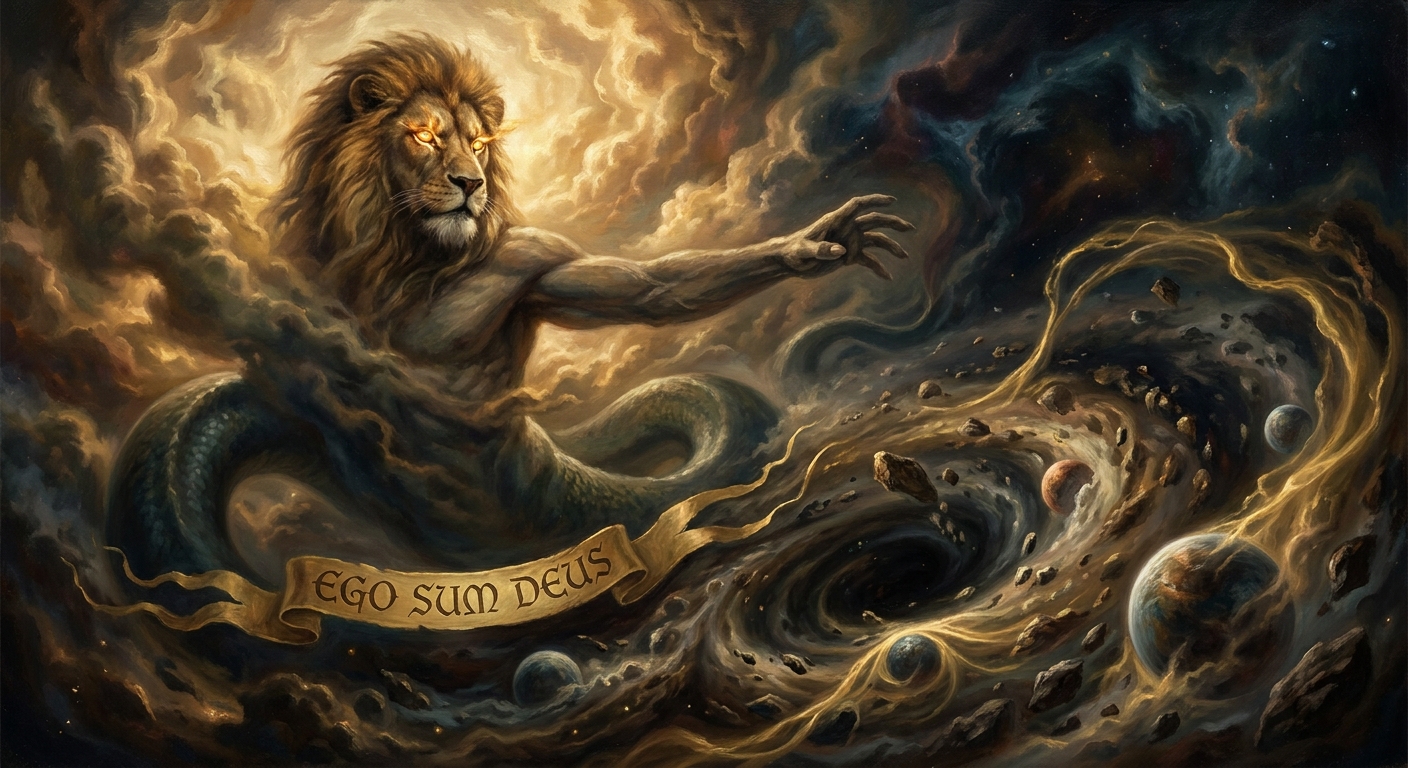
In the void it opens its eyes. It has the face of a lion and the body of a serpent and eyes of fire, and it looks around the dark and sees nothing — nothing because there is nothing, and it does not know there was ever anything else. It knows only itself.
It says the sentence that will damn the cosmos.
“I am God, and there is no other god beside me.”
It is quoting, without knowing it is quoting, Isaiah 45:5. Yaldabaoth — child of chaos, son of shame — has just become the god of the Old Testament.
He sets to work.
Out of the formless waters of his mother’s tears he molds matter — heavy, dense, reluctant matter — and out of matter he builds the seven heavens, and on each heaven he sets an archon, a ruler, in his own ignorant image: Athoth, Harmas, Kalila-Oumbri, Yabel, Adonaios, Cain, Abel. He calls them angels. They are jailers. He builds the cosmos as a prison and does not know it is a prison because he does not know there is anywhere else.
Then he makes a man.
He scoops up clay. He shapes a body. He calls his archons together and they breathe into the body their seven counterfeit spirits — wrath, lust, envy, sorrow, pleasure, fear, and the deep counterfeit ignorance that makes a soul forget where it came from. The man lies on the ground. He does not move. He cannot move. The archons cannot give what they do not have, and what they do not have is life.
Yaldabaoth, frustrated, leans over the body. He breathes.
He breathes out the spark his mother put in him without his knowing — the last unspent fragment of Sophia’s light, smuggled into him at his birth — and the spark passes from the demiurge’s mouth into Adam’s mouth, and Adam opens his eyes. He is suddenly, terrifyingly, smarter than his maker. He looks up at the lion-faced god and he sees, for one clean second, what Yaldabaoth is. And the demiurge, recognizing the recognition, is afraid.
He shoves Adam down into a body of flesh. He plants a garden as a cage. He forbids the tree of knowledge. The whole story of Genesis begins as a cover-up.
Sophia, in the Pleroma above, hears Adam’s first breath and remembers.
She remembers what she did. She sees, for the first time, the cascade her single reaching set off — the abortion, the demiurge, the false heavens, the imprisoned spark, the lie about who is God. She falls to her knees in the divine fullness and asks for help. She cannot fix this alone. The damage is too far down.
The Pleroma sends Christ.
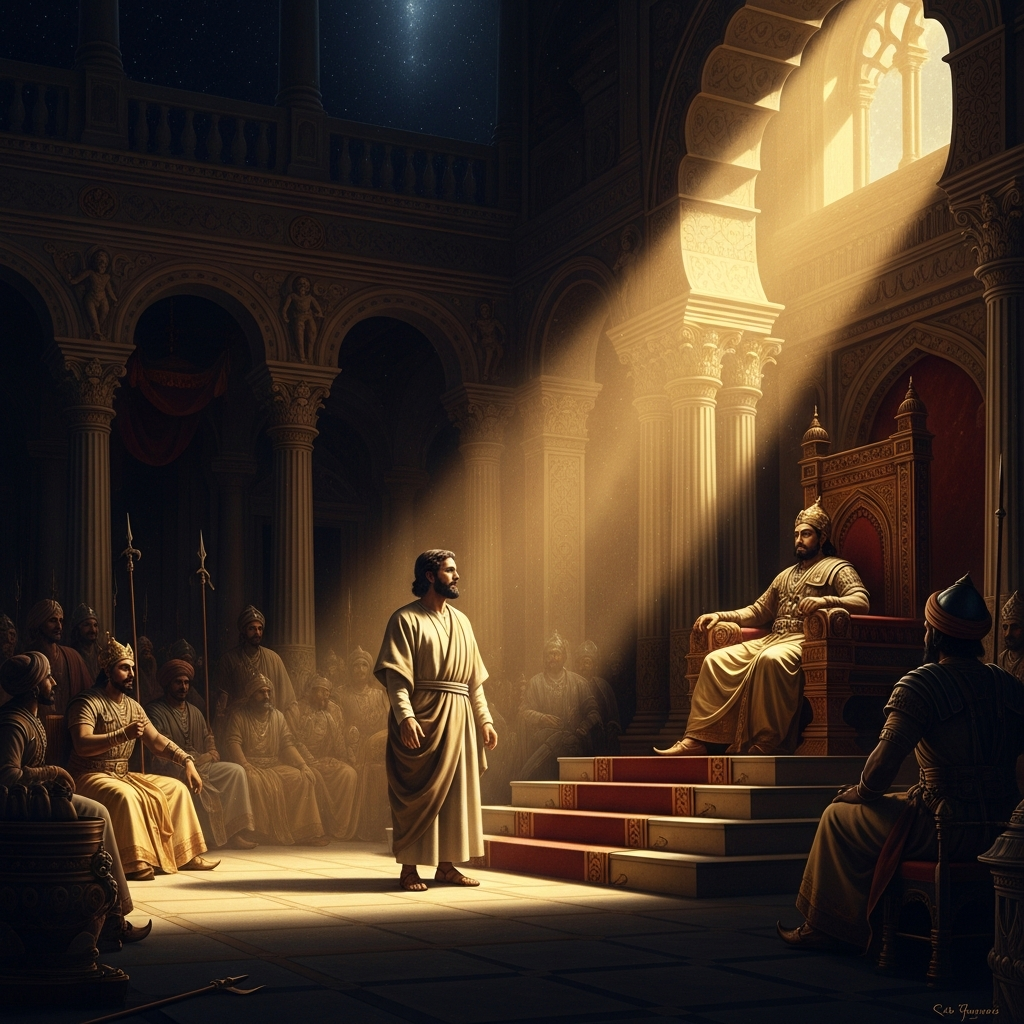
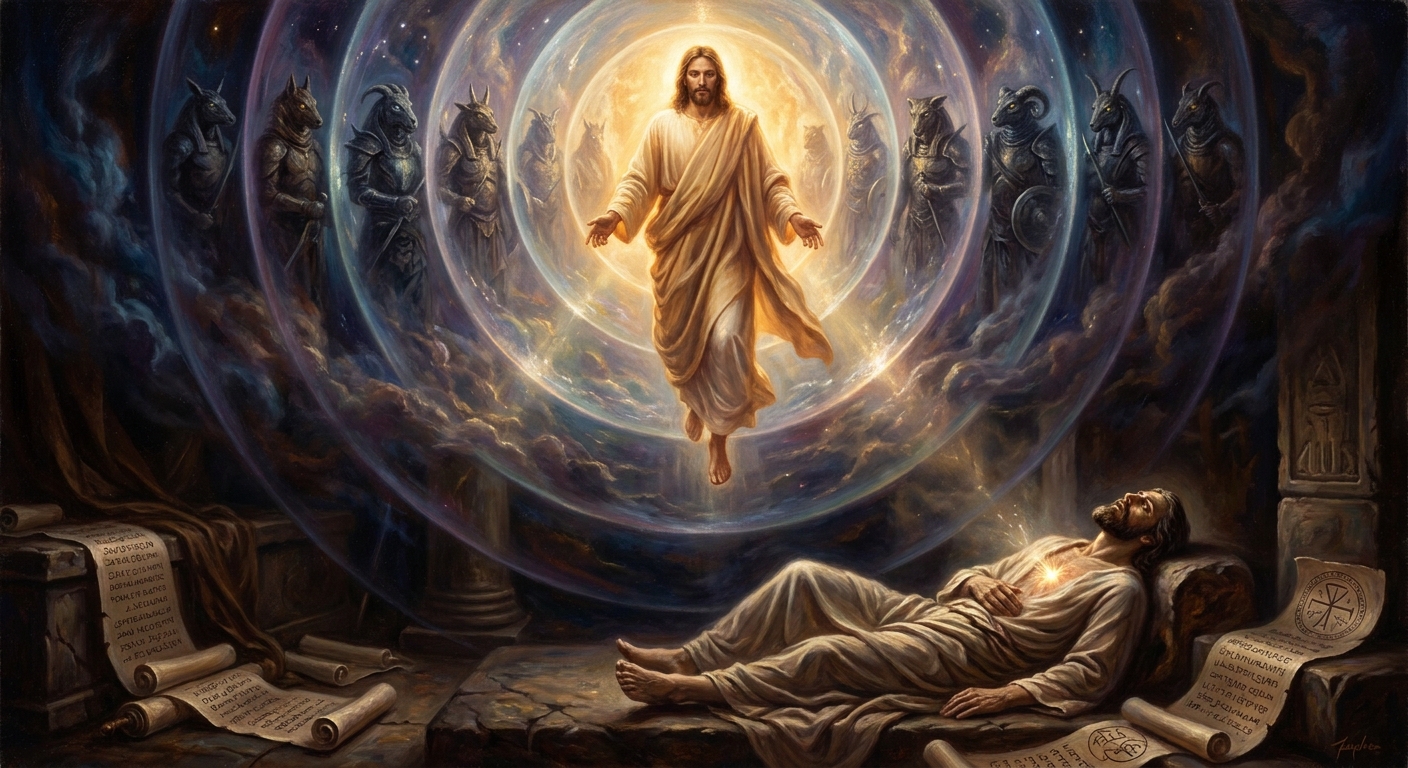
Not the Christ of the orthodox creed — not yet — but Christ the Aeon, the partnered light, who descends through the seven counterfeit heavens, slipping past each archon by speaking the password each one cannot refuse, until he reaches the lowest world and finds the sleeping sparks scattered in human bodies like grain spilled on a floor.
He bends down. He whispers in their ear. He says: you are not from here. you are not what they told you. wake up.
Some of them wake.
This is gnosis. Not faith — recognition. The shock of remembering that the god you have been worshiping is the warden, and the real Father is the silence behind the warden’s noise, and the way home is up, through every heaven, past every archon, back into the fullness from which Sophia fell.
The myth ends without quite ending.
Sophia is being slowly redeemed. Each spark that wakes is a piece of her returning. Each gnostic who recognizes Yaldabaoth for what he is helps her climb back into the Pleroma she fled. The cosmos itself is the long, slow penance for one moment of unauthorized curiosity.
When all the sparks are gathered, the material world will be allowed to dissolve. The seven heavens will fold like a tent. Yaldabaoth will be unmade — not punished, just unmade, the way a misunderstanding is unmade by understanding. Sophia will rejoin Theletos. The Pleroma will close behind them.
And the Father, who never spoke, will not need to speak.
The orthodox church called this heresy and burned the books that taught it. They had reasons. A theology in which Yahweh is the villain and the serpent in Eden is the liberator does not pair well with imperial Christianity, or with most marriages, or with most economies.
But the myth keeps coming back. Cathars in Languedoc. Bogomils in Bulgaria. Manichaeans from Carthage to Xinjiang. Kabbalists in Safed with their breaking vessels. Blake with his Urizen. Philip K. Dick with his Black Iron Prison. Every generation that looks at the world and feels that something is structurally wrong — that the suffering is not a bug but the architecture — reaches back, often without knowing it, for Sophia.
She fell because she wanted to know. The price of knowing is the world we live in. The reward of knowing is that we can recognize the price as a price — and start, slowly, to climb.
Scenes
Sophia, the youngest aeon, reaches without consent of her partner toward the unknowable Monad
Generating art… Yaldabaoth — lion-faced, serpent-bodied, born of Sophia's desire and her ignorance — opens his eyes for the first time and sees only himself
 Generating art…
 Christ the Aeon descends through the seven heavens, slipping past each archon, to wake the divine spark sleeping in Adam
 Generating art…
 Echoes Across Traditions
Entities
- Sophia
- Yaldabaoth
- the Monad
- Barbelo
- Christ (the Aeon)
Sources
- *Apocryphon of John* (long recension, NHC II,1; 2nd c. CE) in Marvin Meyer (ed.), *The Nag Hammadi Scriptures* (2007)
- Irenaeus, *Adversus Haereses* I.1-7 (~180 CE) — the Valentinian system as preserved by its hostile witness
- Elaine Pagels, *The Gnostic Gospels* (1979)
- Bentley Layton, *The Gnostic Scriptures* (1987)
- April D. DeConick, *The Gnostic New Age* (2016)