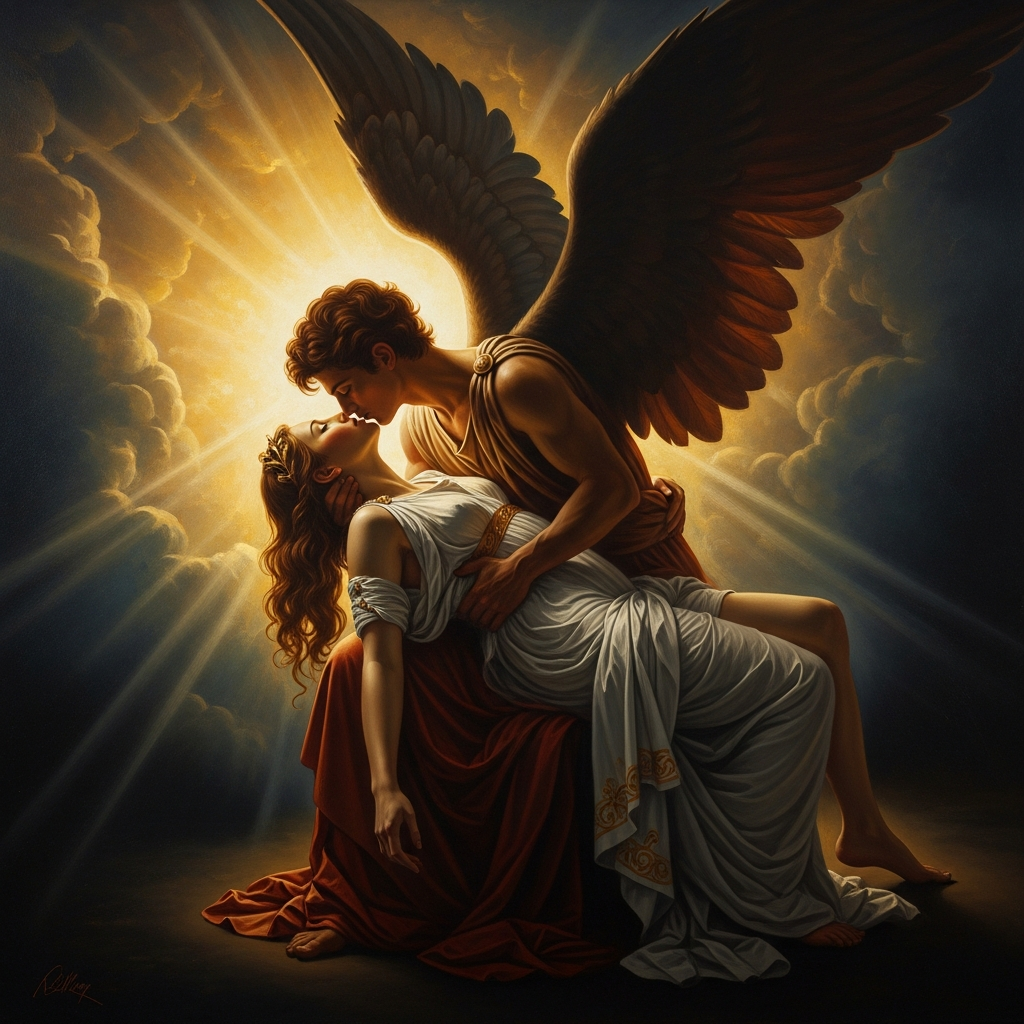
Eros and Psyche: The Impossible Tasks
Recorded ~160 CE in Apuleius's *Metamorphoses*, drawing on older oral material · Greece — a palace in a hidden valley, the temple of Aphrodite, the rivers of Greece, and the threshold of the underworld
Contents
A mortal princess so beautiful her worshippers abandoned Aphrodite. A jealous goddess who sent her son to ruin the girl, and the son fell in love instead. A lamp lit in the dark, a drop of oil on a sleeping shoulder, four impossible tasks, and the only mortal woman to be married among the gods.
- When
- Recorded ~160 CE in Apuleius's *Metamorphoses*, drawing on older oral material
- Where
- Greece — a palace in a hidden valley, the temple of Aphrodite, the rivers of Greece, and the threshold of the underworld
The king has three daughters.
The youngest is so beautiful that travelers stop their caravans to look at her. They forget where they were going. They begin to leave offerings at her feet — bread, flowers, the small bronze coins they would have left at the temple — and the temple of Aphrodite, on the hill above the city, falls quiet. The doves go unfed. The altar fires go out. Aphrodite, in her ocean palace, hears the silence in her own shrine and understands what it means.
She summons her son.
Eros is winged, mischievous, and deadly with a bow. His mother gives him an instruction: find this girl. Make her fall in love with the foulest creature you can find. Ruin her. Restore the proper order of things, in which goddesses are worshipped and mortal girls are not.
Eros flies to the palace at dusk. He sees Psyche asleep. The arrow is in his hand. He nicks his own thumb on its tip.
She wakes in a palace she has never seen.
There are no servants — only voices that bring food, draw her bath, lay out her clothes. The walls are inlaid with gold. The garden is lush past the season. She has been carried here, she is told, by the West Wind, on the instructions of her husband, who will come to her in the dark and only in the dark, and whom she must not try to see.
He comes that night. His voice is gentle. His body, in the dark, is unlike any she has been told to expect from a husband. She does not know if he is monster or god. She knows only that he is kind, that he loves her, and that he leaves before dawn every morning before her hands can find his face.
For weeks, she is happy. Then her sisters come to visit.
Her sisters are jealous.
They have human husbands — bald, dyspeptic, snoring — and Psyche is being fed by invisible servants in a palace whose ceilings she cannot see the top of. They calculate. They suggest, sweetly, that her invisible husband is surely a serpent. He is hiding because he is hideous. He will eat her in her sleep. She must take a lamp under her pillow, and a knife. When he sleeps, she must look. If he is a monster, she must strike.
The sisters leave. The doubt does not.
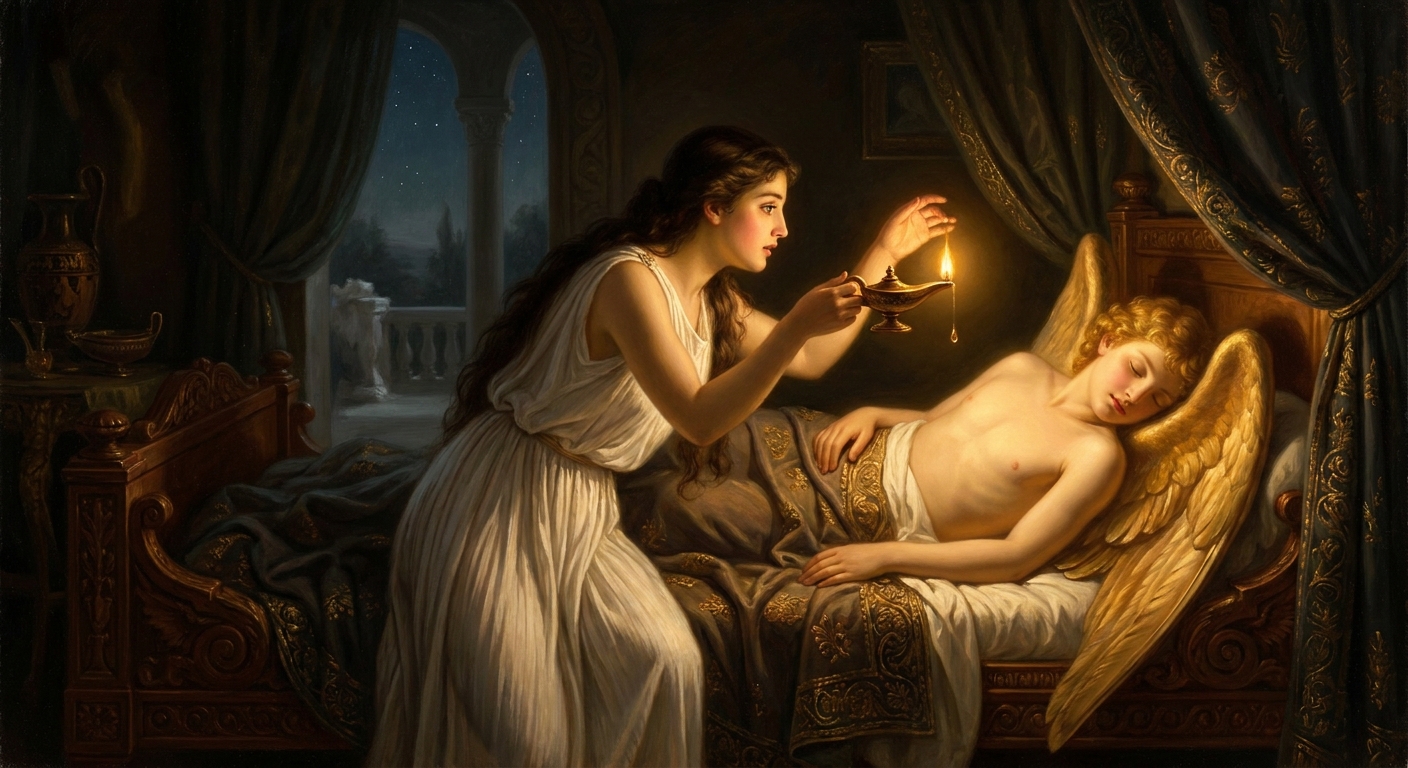
That night, after he sleeps, she lights the lamp.
In its light is the most beautiful body she has ever seen — feathered shoulders, a face like dawn, the curve of a sleeping god whose name she finally understands. Eros. Eros. She stares so long that her hand trembles. A drop of oil falls from the lamp onto his shoulder. He wakes. He sees the lamp. He sees the knife. He sees the trust she could not hold.
He does not speak. He spreads his wings and flies, and the palace goes with him, and Psyche is left standing in a meadow with a cold lamp and the imprint of his back fading on the air.
She wanders.
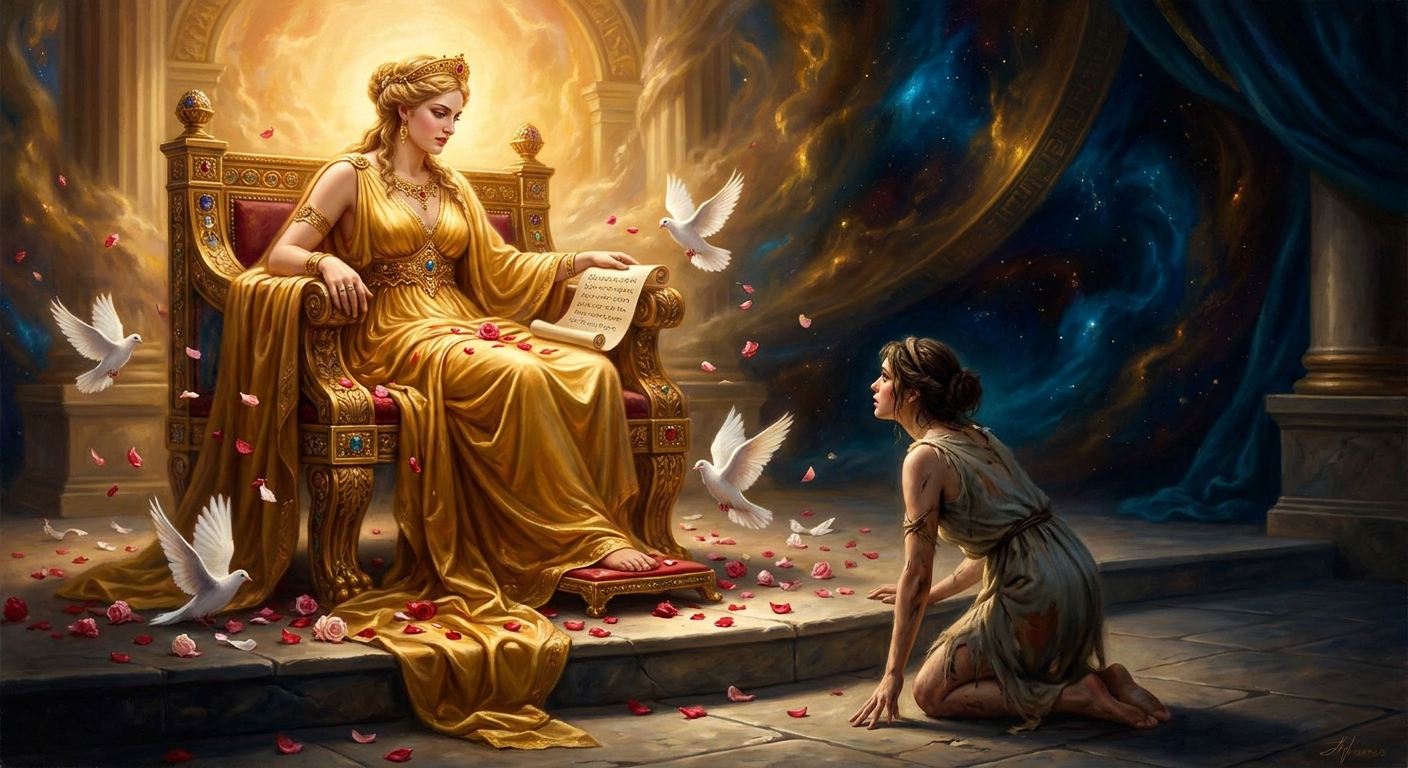
She walks the temples of Greece looking for him. Demeter will not take her in. Hera will not. Every goddess knows whose anger is upon her, and no one will cross Aphrodite for a mortal girl. Eventually Psyche does the only thing left: she presents herself at Aphrodite’s own temple. I am the woman your son loved. Take me as a slave. Set me any work.
Aphrodite laughs. She has been waiting for this.
She empties a sack on the floor — wheat, barley, lentils, poppy seeds, vetch, mustard, a dozen grains tumbled together into a hill. Sort them, she says. Each kind into its own pile. By nightfall. Then she leaves to attend a wedding.
Psyche sits down in the heap and weeps. She has not slept. She has nothing. The mountain of seeds is impossible.
A line of ants comes out of a crack in the floor. They have heard her crying — or Eros has sent them, the text is uncertain. They sort the seeds, grain by grain, into seven perfect piles, and disappear back into the floor before Aphrodite returns.
There are three more tasks.
Aphrodite, returning, accuses Psyche of cheating and devises something worse. Cross the river. There is a flock of golden-fleeced rams on the far bank. Bring me a hank of their wool. The rams are mad in the noonday sun and gore anyone who approaches them. A river-reed whispers to Psyche: wait until evening. They will sleep in the brambles. Comb the wool from the thorns where they brushed. She does. She brings the gold.
Climb the cliff, Aphrodite says next. Fill this vial with water from the river Styx, where it falls from the heights and runs through dragons. The cliff is sheer. The dragons are guarding the source. An eagle — Zeus’s own — comes down and takes the vial in its beak and fills it for her, because Zeus owes Eros a favor for arrows lent in the past.
Then the fourth task. The hardest. Go down to the underworld. Ask Persephone for a small box of her beauty-ointment, and bring it to me unopened.
She climbs the tower to throw herself off it.
If she has to go to the underworld, she may as well go the short way. The tower speaks to her — even the stones of the world have begun to take her side — and tells her: no. Take coins for Charon. Take honey-cakes for Cerberus. When the dead beg you for help on the road, refuse them. Do not eat anything Persephone offers you. Do not open the box.
She does it. She crosses the river. She drugs the dog. She refuses three pleading shades on the path. She stands in Persephone’s hall and asks, plainly, for the box. Persephone hands it to her. Persephone, who has been watching this story unfold from below, does not require an explanation.
Psyche begins the climb back up.
She is almost out. She is almost at the upper world. And she thinks — she thinks the thing every reader has thought at this point in the story — I have been so worn down. I have been so torn open. Surely a god’s beauty-ointment can be borrowed, just once, before I hand it over to the woman who has tortured me.
She opens the box.
It is not beauty. It is the sleep of the underworld, and it falls on her, and she drops on the path between the worlds.
Eros finds her there.
He has been recovering from his wound — the lamp-burn on his shoulder — under his mother’s surveillance, but love is not the kind of thing a mother can lock in a room forever. He has slipped the latch. He flies. He scrapes the underworld-sleep off her face with his own fingertips and puts it back in the box. He wakes her.
Take this to my mother, he says. Then meet me on Olympus.
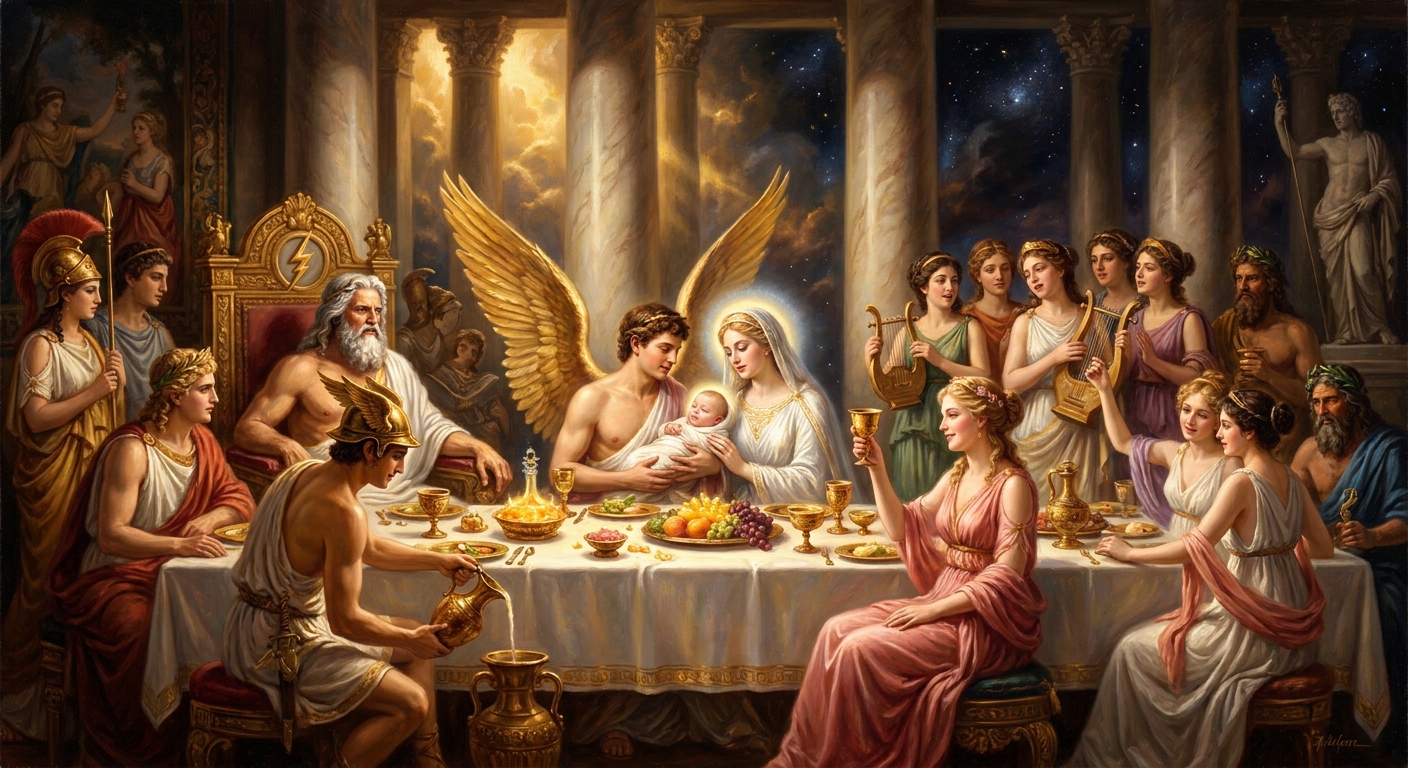
He flies to Zeus. He tells him everything. Zeus, who has watched Eros cause more divine adultery than any other god in the pantheon, decides this is the right time to settle accounts: Eros may have his mortal bride, but only if she is made immortal first. The cup of ambrosia is brought. Psyche drinks it. The mortal in her burns away. What remains is a goddess.
The wedding is on Olympus. Aphrodite, outvoted by her own pantheon, dances at it. Soul and Love sit beside each other at the high table.
They have a daughter, eventually, named Pleasure.
Apuleius wrote this story inside a comic novel about a man transformed into a donkey by a witch’s mistake. The donkey overhears it told by an old crone to a kidnapped girl in a bandit’s cave. The framing is deliberately undignified — Apuleius is a satirist before he is a mystic — and yet the story has been received, almost from its first reading, as the most serious thing in the book.
Psyche is the soul. Eros is love. The four tasks are the four labors of any inner life that intends to be worthy of what it loves: sort the chaos of the self into kinds, gather the dangerous gold without being killed by its keepers, fetch water from the river that runs between life and death, and descend into your own underworld and come back with what you cannot use yourself.
She fails at every task on her own. She is helped by ants, by a reed, by an eagle, by a tower. Even the soul under judgment, the story insists, is not asked to be self-sufficient. The cosmos has hidden ant-colonies in its floor.
And the box at the end — the one she opens because she has been worn so thin — is the most honest moment in any initiation myth. The aspirant fails the final test. Love comes down and finishes it for her. That is the only ending the soul can survive.
Scenes
Psyche raises the oil lamp over the sleeping god
 Generating art…
 Aphrodite sets the four impossible labors before the kneeling mortal girl
 Generating art…
 Olympus: the gods drink to the marriage of Eros and Psyche — the mortal soul become immortal
 Generating art…
 Echoes Across Traditions
Entities
- Psyche
- Eros (Cupid)
- Aphrodite (Venus)
- Persephone
- Zeus

Sources
- Apuleius, *Metamorphoses* (*The Golden Ass*) IV.28-VI.24 (~160 CE)
- Robert Graves (trans.), *The Golden Ass* (1950)
- Erich Neumann, *Amor and Psyche: The Psychic Development of the Feminine* (1956)
- C.S. Lewis, *Till We Have Faces* (1956)
- Marina Warner, *From the Beast to the Blonde* (1994)