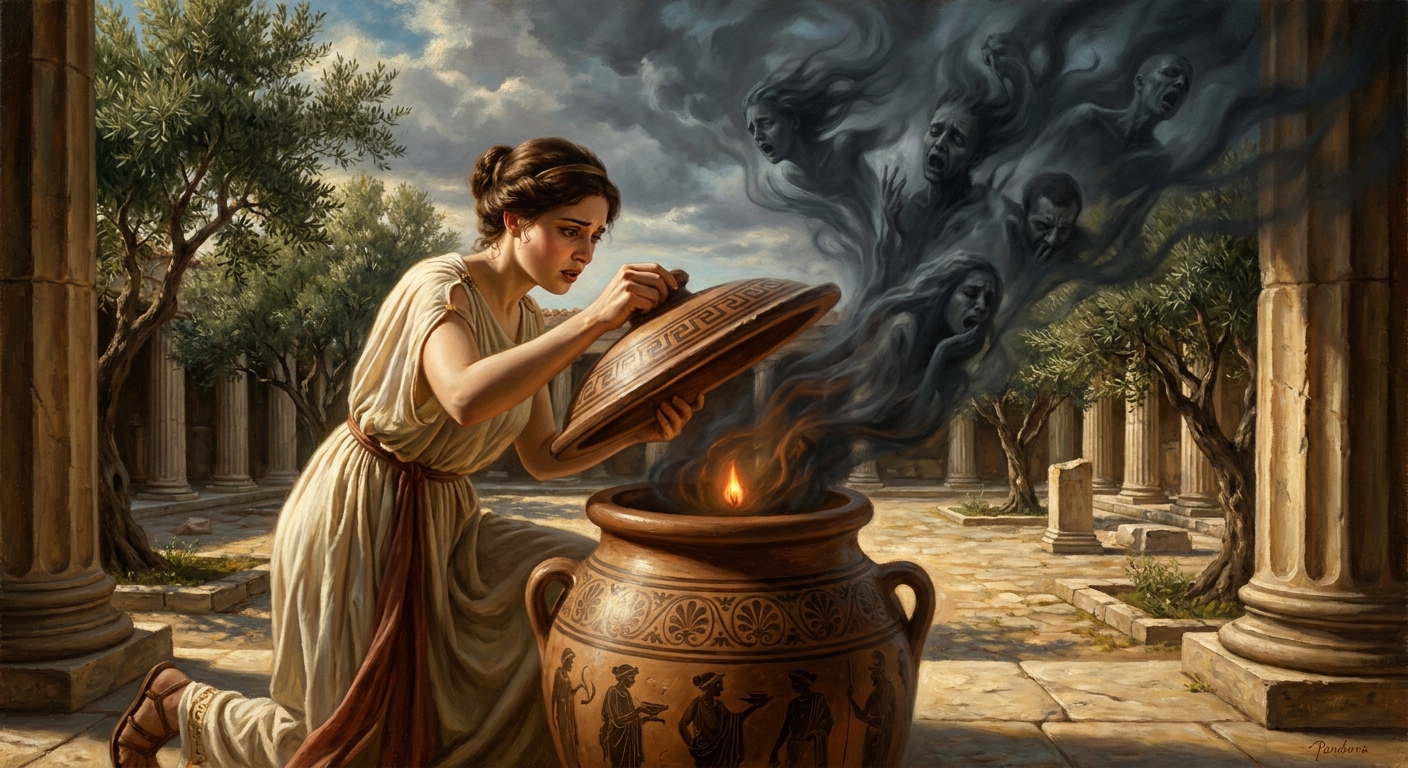
Marcus Aurelius on the Danube
c. 172 CE (Marcomannic Wars) · Roman military camp on the Danube frontier, Pannonia
Contents
On a winter night during the Marcomannic Wars, the emperor Marcus Aurelius opens his notebook beside the Danube and writes private instructions to himself about how to live. He is the most powerful man in the world. He writes as though he is barely holding himself together.
- When
- c. 172 CE (Marcomannic Wars)
- Where
- Roman military camp on the Danube frontier, Pannonia
The soldier is dead by the time Marcus Aurelius sits down to write.
He was executed at the third hour — a young man from Pannonia, a spear-carrier in the XIV Gemina, who broke at the treeline and ran. The tribunal was brief. The witnesses were consistent. The law is old. Marcus confirmed the sentence from his tribunal seat wrapped in a general’s cloak, because the cloak is what the men need to see, and he confirmed it without expression, because expression in these moments is theater and theater is a lie. The young man from Pannonia died in the mud outside the camp fortifications while the rest of his century watched, and by the fourth hour the camp had absorbed the event and was going about the work of war again.
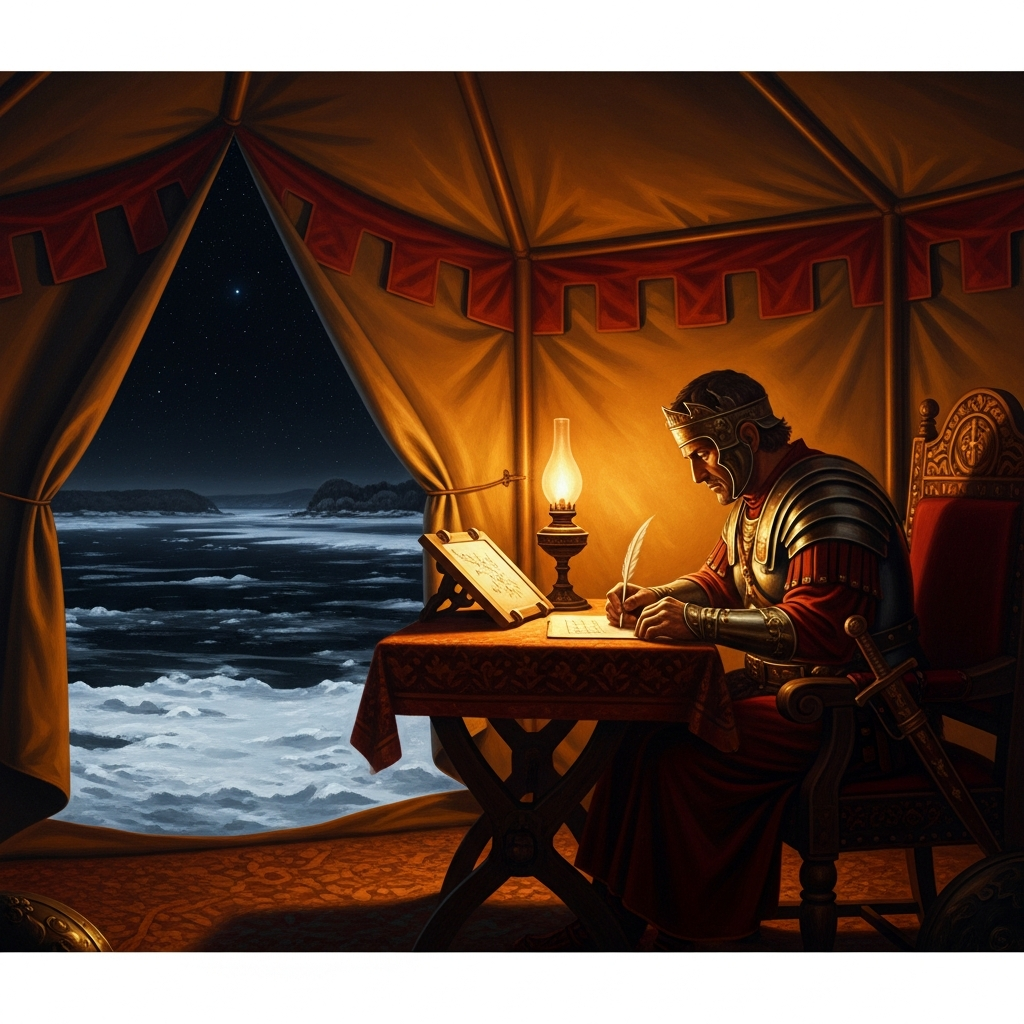
Now it is the middle of the night, and the Danube is frozen solid, or nearly solid, which means the Quadi can cross anywhere and the sentries must triple their vigilance, which Marcus has ordered, and he sits at the field desk in his tent with a wax tablet and a stylus and he writes: Begin the morning by saying to yourself: I shall meet with meddling, ungrateful, violent, treacherous, envious, uncharitable men. All these things happen to them by reason of their ignorance of what is good and evil.
He does not publish this. He never publishes any of it. These are his private notes, addressed to himself in the second person — you, Marcus, be patient, try again tomorrow — a running argument with his own weakness that began perhaps ten years ago and will not stop until he dies of plague on this same frontier in a different year. The Meditations is the wrong title; they are not meditations. They are instructions. They are a man instructing himself on how to be the thing he was taught to be, because the lesson apparently never took, or never took completely, or needs daily re-learning in the face of a world that is not a philosophy seminar.
He came to Stoicism the long way around.
His father died when he was three. The emperor Hadrian adopted him at six and arranged his education with the care a collector devotes to a rare object — rhetoricians, jurists, philosophers from every school, Latin and Greek both, the works of Epictetus read aloud in the afternoons. Epictetus was a freed slave from Phrygia who walked with a permanent limp, probably from a master who twisted his leg to demonstrate that a Stoic could remain unperturbed even by broken bones. Epictetus’s point, which Marcus absorbed completely and spent sixty years failing to embody, was this: there are things in your power and things not in your power. Your judgments, your desires, your aversions — these are in your power. Your body, your reputation, your empire — these are not. The wise person is free because the wise person wants only what is in their power. Everything else is scenery.
Marcus Aurelius rules an empire from Britain to Mesopotamia. He has more things not in his power than any person alive. He writes: You have power over your mind, not outside events. Realize this, and you will find strength.
He writes it down because writing it down is the work, because knowing it and believing it and living it are three different achievements and he is not certain he has managed even the second, and the young man from Pannonia died this afternoon and grief is not in his power but the judgment he places on that grief might be, if he can find the angle.
The war itself is not the problem he was trained for.
The problem he was trained for is the seat of power, the corrupting proximity of adulation, the flatterers in the antechamber who tell you that your every judgment is correct and your every mood is wisdom. Epictetus spent thirty pages on this. Marcus was ready for this. What he was not ready for was the north — the wet and the cold, the endless gray above the Danube, the Quadi and Marcomanni pressing from the forests that go on without apparent end, the disease that moves through the legions in waves, the sense that the frontier is not a line but a conversation between inside and outside that the empire is losing. He was not trained for this because this is not a philosophical problem. This is a logistics problem that happens to require a philosopher to solve it, and philosophers are not primarily useful on the Danube.
He writes: Confine yourself to the present. He writes this in a military camp in 172 CE surrounded by evidence that the present is the worst possible place to confine yourself. He writes it anyway. He writes it because the alternative — the backward reach toward the Rome he left, or the forward fear toward the plague that is already moving through the auxiliary units in the south — is the thing Epictetus warned against. The only moment available to him is the one he occupies. The cold. The dead young man. The lamp. The stylus.
He draws a small circle in the wax and inside it he writes a single word: now.
His son Commodus is fifteen years old and sleeping three tents away.
Marcus brought him north because heirs must learn war, and because Rome is not a safe place for an heir when the emperor is absent, and because Marcus believes — has chosen to believe, is currently failing to not believe — that the example of a father is worth something. Commodus is beautiful in the way a weapon is beautiful: all surface and edge, with no apparent interior. He is not cruel, not yet. He is indifferent, which in a fifteen-year-old prince is sometimes worse. He sat through the execution this afternoon with the face of a young man watching weather — waiting for it to be over so that he can return to whatever occupies him, which is not philosophy.
Marcus writes: A man’s worth is no greater than the worth of his ambitions. He writes it and then looks at the sentence for a long time. He knows what he is thinking about. He has known for several years what Commodus is and what Commodus will do once the empire passes into his hands, and he has also known, longer, that the Stoic position on this is clear: the son is not in his power. The empire, after his death, is not in his power. He can educate, model, instruct. He cannot compel. The rest is fate, logos, the ratio of kindling and going-out, which does not adjust itself to imperial dynasties or philosophical hopes.
He adopted Commodus as his heir in 166 CE. He has never revised this decision in public. He revises it nightly, alone, and then he does not revise it, because the alternatives are worse, because a disputed succession is an invitation to civil war, because he is trying to hold the logic of his responsibility even when the logic is leading toward grief.
He writes until the lamp runs low.
He writes about the emperor Vespasian, who died saying I think I am becoming a god — Vespasian’s joke, Vespasian’s contempt for the machinery of deification that would follow. Marcus does not want to become a god. He wants to complete the morning without lapsing into anger, which he does not always manage. He wants to sit across from a colleague who is wrong and not signal that the colleague is wrong until there is a private moment. He wants to read the dispatches from the eastern frontier without his stomach tightening. He wants Commodus to be something other than what he is, which is outside his power, which is the work he is apparently here to practice.
Think of yourself as dead, he writes. You have lived your life. Now take what’s left and live it properly.
Outside, the sentries change and the river moves under its ice and the barbarians are or are not crossing somewhere in the dark and the XIV Legion sleeps in its rows in the cold. The young man from Pannonia is finished. Marcus Aurelius, fifty years old, emperor of Rome, private student of a dead slave philosopher from Phrygia, writes one more sentence: Do not indulge in such thoughts as, What will it profit me? or, What will people think of me? — for such thoughts only pollute the stream.
He closes the tablet. He blows out the lamp. He sleeps, or tries to.
In eight years he will die on this frontier, of plague, and the tablet will pass to his secretaries and eventually to a copyist who will not know what he is copying or for whom, and the pages will survive for eighteen hundred years in a manuscript tradition no one expected to preserve them, and the sentence about the mind and the outside events will be printed on ten million motivational posters in offices and gyms and dormitory rooms, and none of those rooms will be a military tent on the Danube in winter with a dead soldier outside and a son sleeping three tents away with an empire he is about to ruin.
Marcus Aurelius never revised the Meditations. They were not for revision. They were a daily reckoning — the score he kept with himself, the debt he tried to pay each morning to the philosophy that had claimed him since childhood. He failed and he wrote about failing and he tried again. This is the book.
The Stoics believed the Logos — the rational order of the universe — was not a distant principle but the substance of the self, the part of us that is capable of judgment and therefore capable of virtue. Marcus believed this. On many nights, writing by lamplight in a camp full of dying men, believing it was the hardest thing he did all day.
Commodus became emperor in 180 CE. He renamed Rome after himself. He fought as a gladiator in the Colosseum. He was strangled in his bath in 192 CE by his wrestling partner, after a conspiracy involving his mistress and his chamberlain. The empire survived.
Marcus Aurelius, in his private notebook, had predicted none of this and all of it.
Scenes
The emperor alone at a field desk in his tent, lamplight on the wax tablet, the Danube black and frozen beyond the canvas
 Generating art…
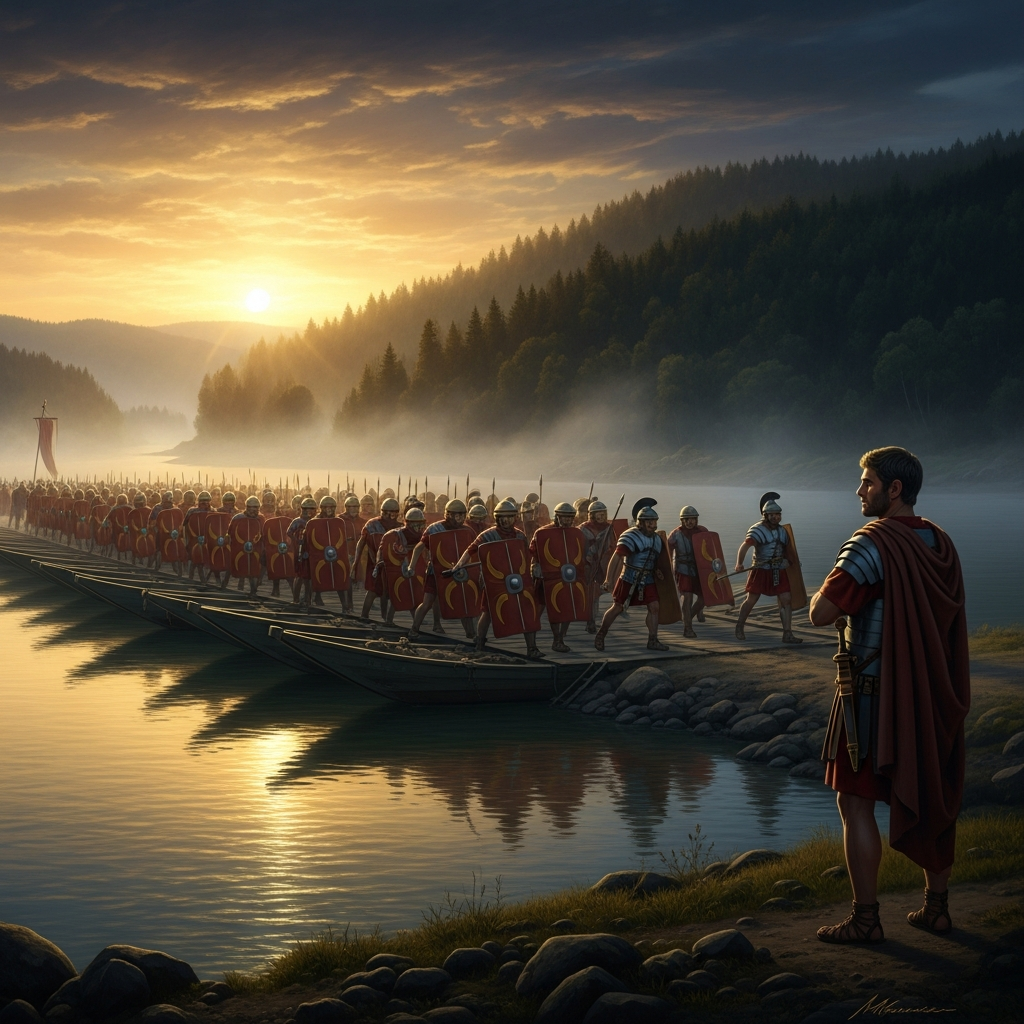
 The XIV Legion crosses the Danube on a pontoon bridge at dawn, shields locked, stepping into barbarian territory
 Generating art…
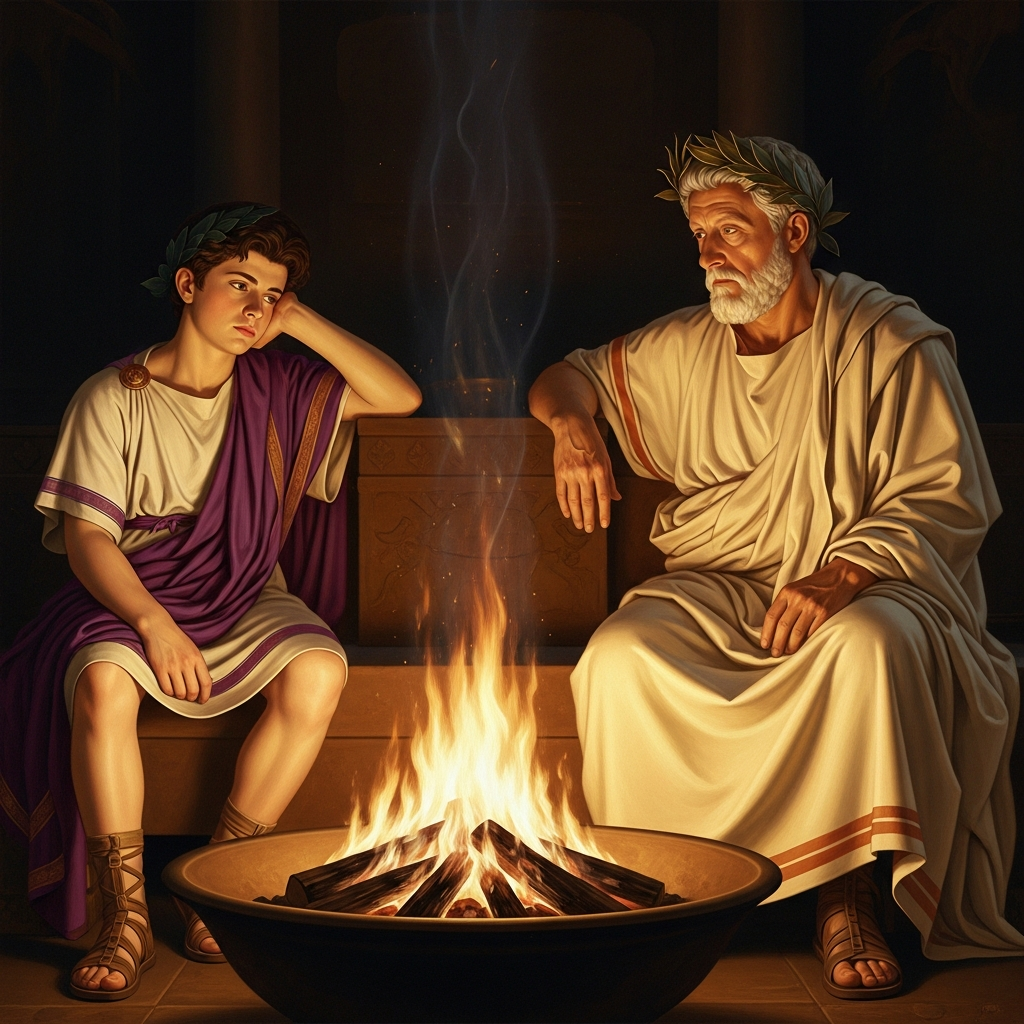
 Commodus at fifteen sits across the fire from his father — handsome, bored, utterly indifferent to philosophy
 Generating art…
 Echoes Across Traditions
Entities
- Marcus Aurelius
- the Logos
- Epictetus
- Commodus
Sources
- Marcus Aurelius, *Meditations* (trans. Gregory Hays, 2002)
- Anthony Birley, *Marcus Aurelius: A Biography* (1987)
- Pierre Hadot, *The Inner Citadel* (1998)