The Bull in the Cave
c. 200 CE · the height of the cult under the Severan emperors · a mithraeum beneath the streets of Ostia (or Carnuntum, or Londinium, or any of 400 known sites from Hadrian's Wall to the Euphrates)
Contents
A Roman soldier descends a stone stair into a windowless cave-temple, kneels in torchlight beneath a god slaying a cosmic bull, and is reborn through seven grades into a mystery the empire never wrote down.
- When
- c. 200 CE · the height of the cult under the Severan emperors
- Where
- a mithraeum beneath the streets of Ostia (or Carnuntum, or Londinium, or any of 400 known sites from Hadrian's Wall to the Euphrates)
He goes down at dusk.
The stair is narrow, cut into stone, lit by a single torch in a sconce at the bottom. The soldier — twenty-six years old, two campaigns on the Danube, a scar above the left eye that he tells women he got from a German axe and got, in fact, from a fall off a wagon at fifteen — has been told to wear nothing but a white linen tunic and to leave his sword at the door. He has been fasting since dawn. The barley cake in his belt is for after.
The mithraeum is below the street. No windows. No skylight. The Romans built their temples to the sun in caves on purpose: a god who slew the bull at the dawn of time should be met where the dawn cannot reach.
The door at the bottom of the stair is iron. He knocks three times.
It opens.
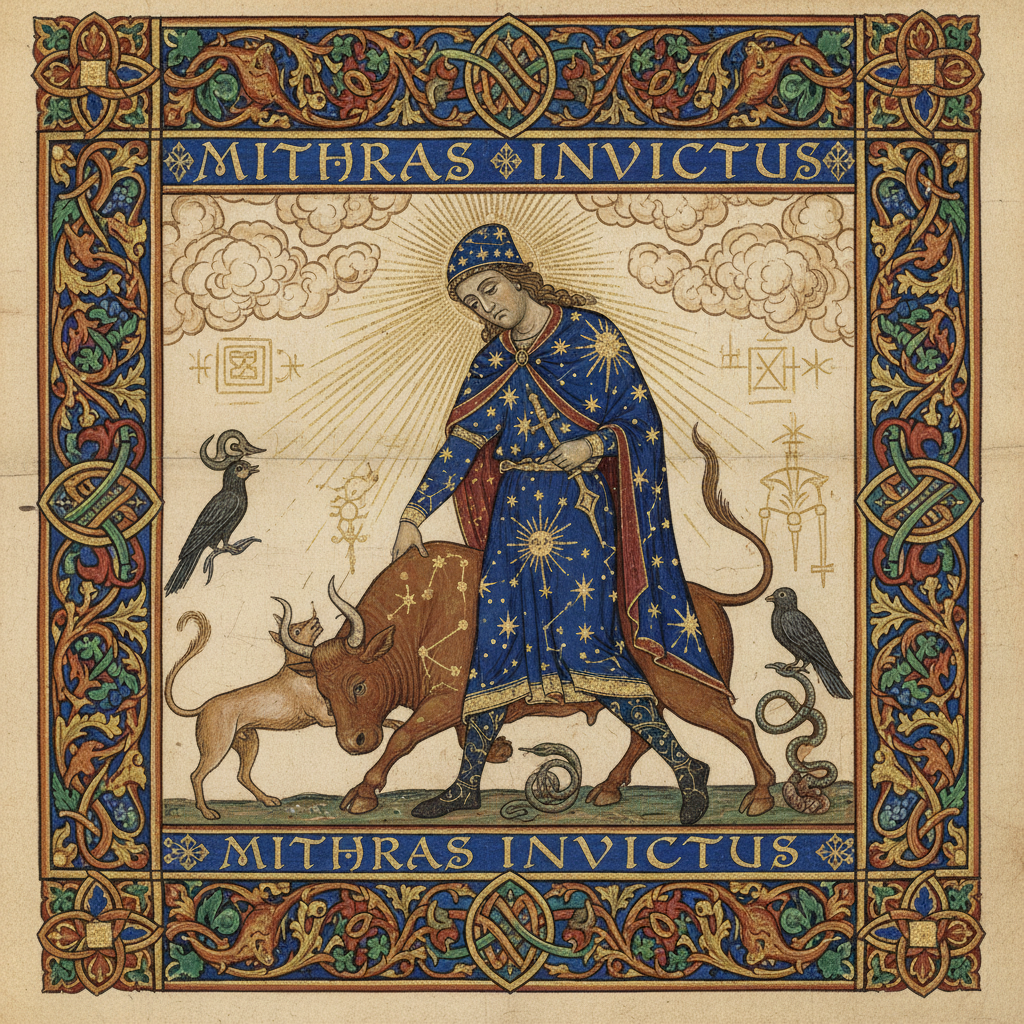
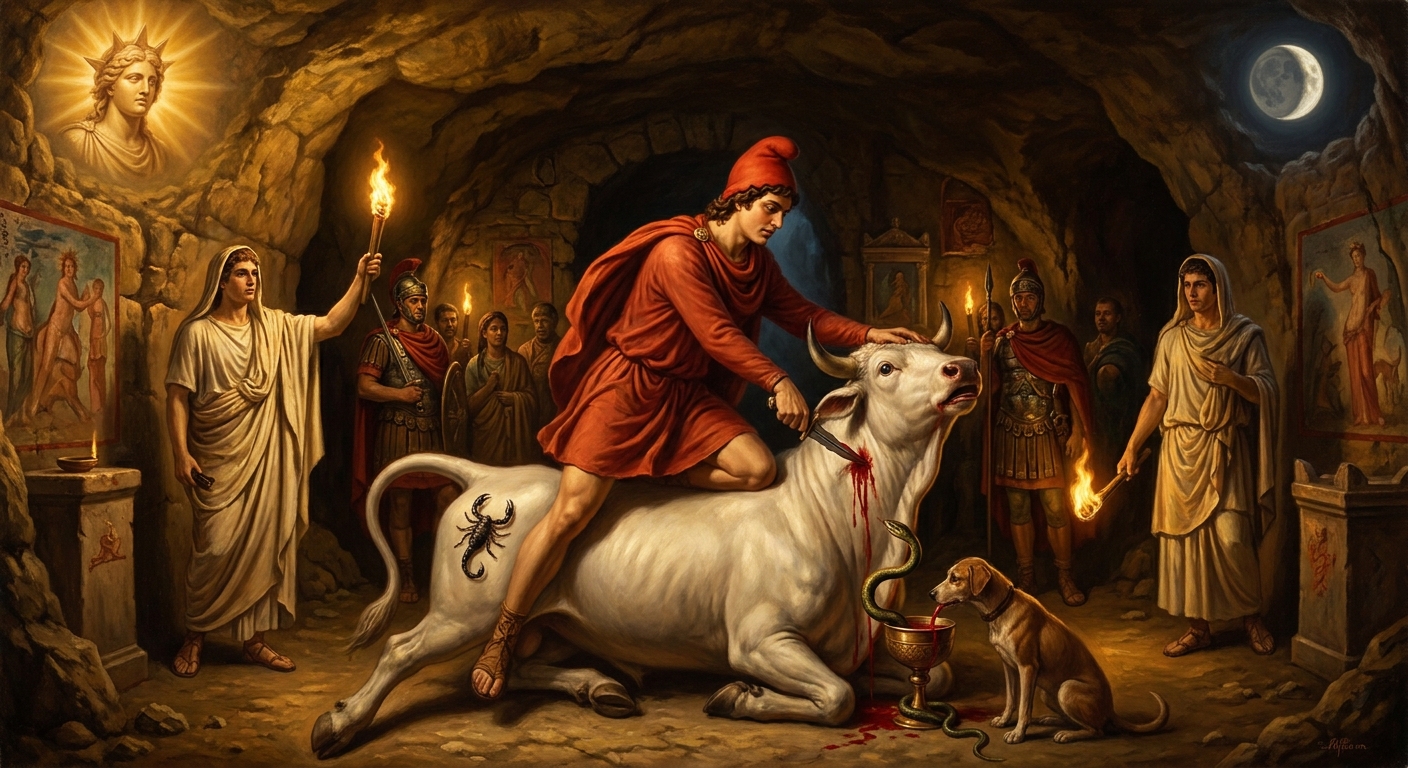
The room is long and low, vaulted, the ceiling painted with stars. Stone benches run along both walls — that is where the brothers eat — and at the far end, in the apse, the cult relief glows in torchlight: a young god in a Phrygian cap kneels on the back of an enormous bull, head turned away, knife in the bull’s throat. A scorpion grips the bull’s testicles. A dog and a snake lap at the wound in the neck. A raven sits on the bull’s flank, head cocked, eye on the god’s shoulder.
The Father — the Pater, the highest of the seven grades — stands beside the relief in a red mantle and a Phrygian cap of his own. He does not smile. He never smiles in here.
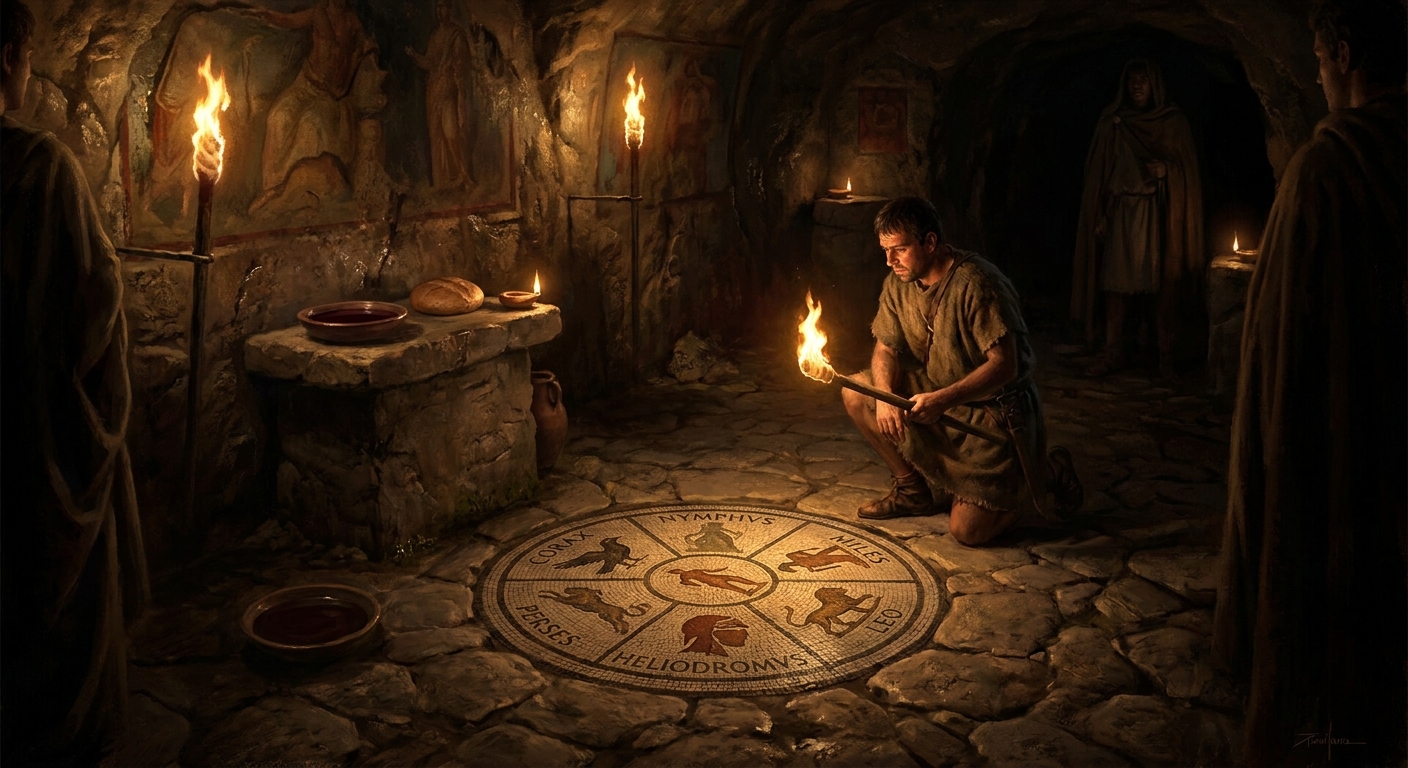
The new man is led to the center of the floor. The mosaic beneath his bare feet is laid out as a ladder: seven rungs, seven grades, each marked with a symbol. Raven. Bridegroom. Soldier. Lion. Persian. Sun-Runner. Father. He will climb them, the Pater says, in the years to come, if he is worthy. Tonight he begins at the bottom.
He lies down on the stone.
They blindfold him.
Hands he cannot see strip the linen tunic. Cold water is poured over his head — purification by water, the Pater intones, in a Latin so old the soldier barely follows. A torch is passed close enough to his ribs that he flinches — purification by fire. Then a sword is laid against his chest, point to the breastbone, and held there. He does not breathe. He does not breathe for what feels like a year.
A voice in his ear, very close. “You die now. The man you were is finished.”
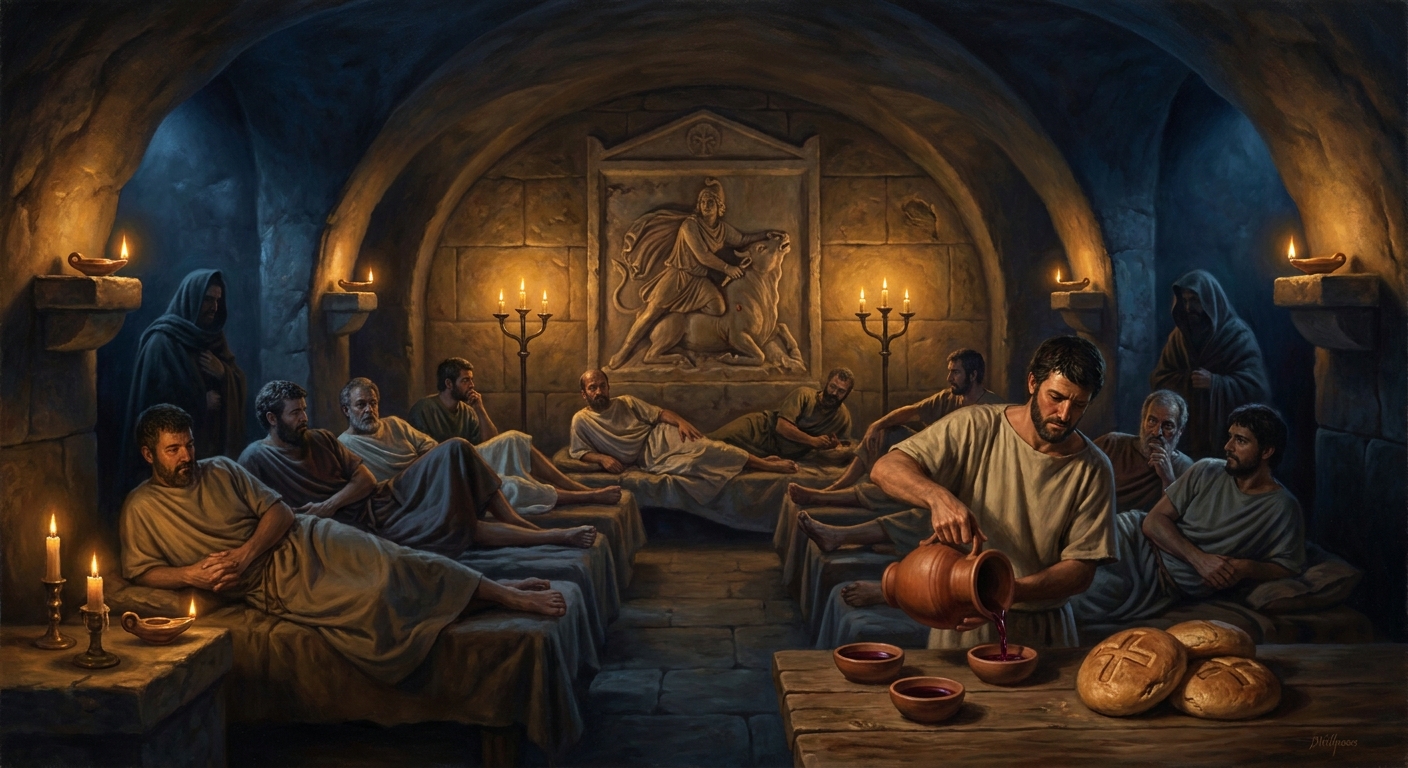
The blade lifts. He is hauled to his feet. The blindfold comes off. The Pater is in front of him holding a small clay cup of something dark — wine, mostly, with something else in it, something herbal, something that will make the next three hours slightly luminous — and a piece of bread stamped with a cross. Take and eat. Take and drink. The body of the bull. The blood of the bull. The god slew him so that you could.
He eats. He drinks. The wine is sour. The bread is gritty with stone-dust from the mill.
The brothers, ranged on the benches, hum a low note in unison. The note rises. The cave hums.
The Pater turns him to face the relief.
“Look,” he says.
The soldier looks.
The bull. The knife. The scorpion. The dog. The snake. The raven. The Pater’s voice in his ear — slow, deliberate, the voice of a man explaining the architecture of the universe to a child.
The bull is the sky. The bull is the constellation Taurus, where the spring equinox once stood and stands no more. The scorpion is Scorpio. The dog is Canis. The snake is Hydra. The raven is Corvus. Every animal on this stone is a constellation, and the line they trace across the bull’s body is the celestial equator at the moment of the Great Year, when the equinoxes shifted out of the Bull and into the Ram, and a new age began.
Mithras is the god who moved the cosmos.
Who turned the wheel of the heavens and dragged the stars themselves into a new alignment, and we, who eat his bull, eat his victory.
The soldier does not understand all of it. He understands enough.
The grades will take him years.
Corax — Raven — is tonight. Mercury’s grade, the messenger, the lowest. He will serve the meals and clean the cave and be addressed as little brother by men he outranks in the legion. Nymphus — Bridegroom — comes next, under Venus, when he will wear a veil and a lamp. Then Miles — Soldier, under Mars, when he is offered a crown on the point of a sword and must refuse it, saying Mithras is my crown, and never wear a soldier’s wreath again, even at triumphs. Then Leo — Lion, under Jupiter, when he no longer washes with water but with honey, because the lion is a creature of fire and water is its enemy. Then Perses — Persian, under the Moon. Then Heliodromus — Sun-Runner, under the Sun, who sits beside the Pater at the banquet. Then, at the top, Pater himself — under Saturn — the man in the red mantle and the Phrygian cap, who will one day initiate the next twenty-six-year-old to come down the stair.
The legions carry the cult. Mithras goes where the army goes. Mithraea spring up under the streets of Londinium, on the cliffs of Hadrian’s Wall, in the limes forts of the Rhine, in the harbor warehouses of Ostia, in the bedrock of Rome itself. Four hundred sites. Tens of thousands of brothers. No women. No scripture. No central authority. Just the same stone bull, the same seven grades, the same shared meal, in cave after cave after cave.
He does not tell.
That is the first vow. He does not tell his wife. He does not tell his commanding officer, unless the officer is also a brother, in which case nothing needs telling. He does not write it down. There are no Mithraic gospels. The cult will leave behind only its caves and its cult-images and a few graffiti — Nama Mithrae, Hail to Mithras, scratched into plaster by men whose names are otherwise lost.
When Christianity wins, in the fourth century, the mithraea will be desecrated. Christian mobs will smash the bull-reliefs and pile rubble on the altars. In some sites — San Clemente in Rome, most famously — they will build a church directly on top of the cave, the basilica’s floor resting on the cult-image of the rival god, the new mystery standing on the back of the old.
Centuries later, archaeologists will dig down through the basilicas and find the bulls again, under the Christian churches, like a memory the empire could not finish forgetting.
Christianity and Mithraism grew up side by side in the same Roman barracks. They borrowed from each other. They competed for the same converts. Both promised salvation through a god who died for the cosmos. Both shared a sacred meal of bread and wine. Both initiated through ritual death and rebirth. Both worshipped on the day of the sun.
One won. One lost. The winner wrote the histories.
But every Easter morning, when a Christian priest lifts bread and wine and says this is my body, this is my blood — he is performing, in unbroken descent or in stubborn parallel, the gesture a Roman soldier learned in a windowless cave from a Pater in a red mantle, beneath a god slaying a bull whose blood was the wine of a new age.
The cave is empty now. The constellations have moved on again. But the meal remains.
Scenes
The cult image carved into the apse of every mithraeum: Mithras, knee on the bull, knife in the neck, scorpion at the testicles, dog and snake at the wound, raven at the shoulder
Generating art… A Roman soldier on his knees in the dark, the seven grades — Raven, Bridegroom, Soldier, Lion, Persian, Sun-Runner, Father — marked on the floor in mosaic
 Generating art…
 The shared meal: bread stamped with a cross, wine poured from a krater, the brothers reclining beneath the god who slew the bull so they could eat
 Generating art…
 Echoes Across Traditions
Entities
- Mithras
- the Cosmic Bull
- Sol Invictus
- Cautes and Cautopates
- the seven initiatory grades

Sources
- Manfred Clauss, *The Roman Cult of Mithras: The God and His Mysteries* (English ed. 2000)
- Roger Beck, *The Religion of the Mithras Cult in the Roman Empire* (2006)
- Franz Cumont, *The Mysteries of Mithra* (1903) — foundational, partly superseded
- David Ulansey, *The Origins of the Mithraic Mysteries* (1989) — the precession-of-the-equinoxes hypothesis
- Richard Gordon, articles in *Journal of Mithraic Studies* and *Religion in the Roman Empire*