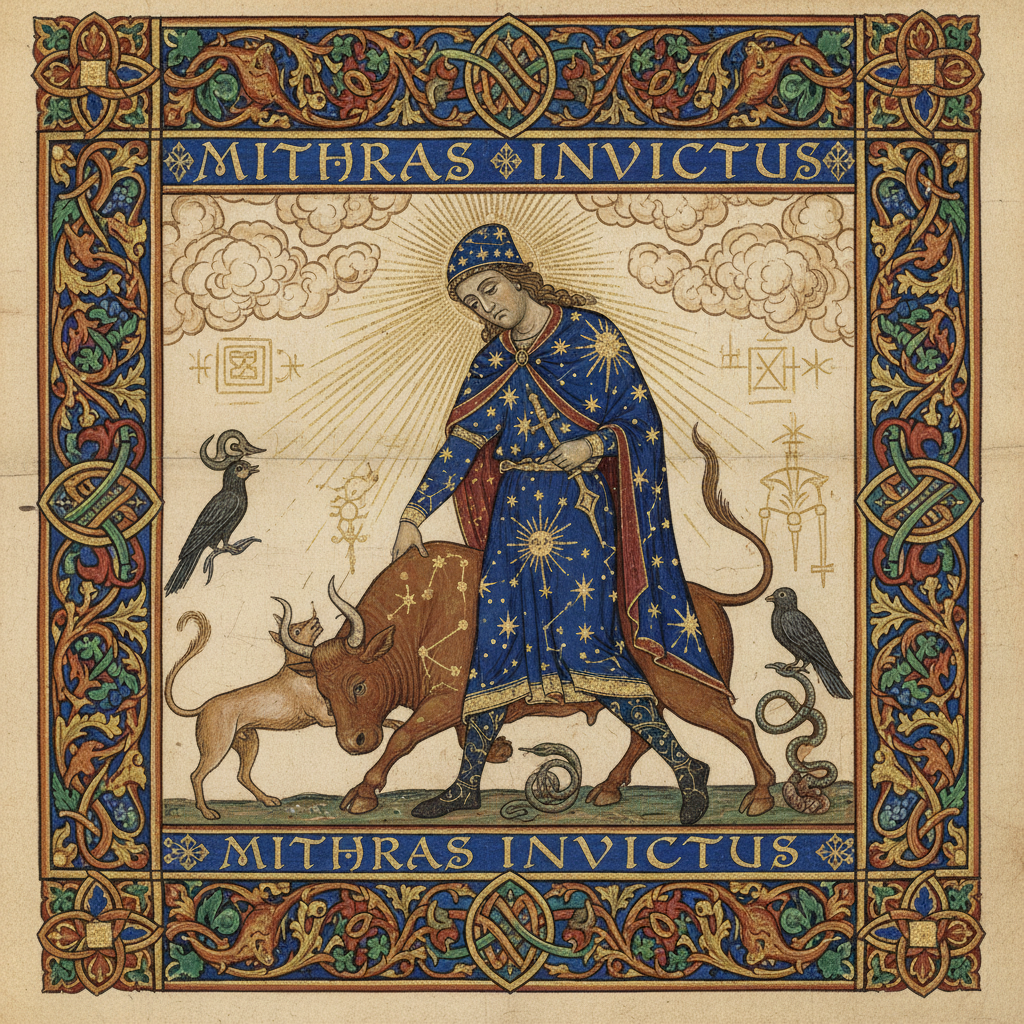
Mithras Kills the Bull and the World Is Born
Mythic Time · Mithraic cult active c. 80-400 CE · the primordial cave at the beginning of the world; mithraea across the Roman Empire from Hadrian's Wall to the Euphrates
Contents
Mithras, born from living rock in a cave at the dawn of the world, tracks the cosmic bull across the young earth, wrestles it into submission, and kills it in the sacred act from which all grain, grape, and living blood spring. The tauroctony — the bull-slaying — is the central image of the most geographically widespread mystery cult in Roman history.
- When
- Mythic Time · Mithraic cult active c. 80-400 CE
- Where
- the primordial cave at the beginning of the world; mithraea across the Roman Empire from Hadrian's Wall to the Euphrates
Before the world, there is the rock.
Not rock as the geologists understand it — not sediment and pressure and the slow drama of tectonic time. Rock as the oldest thing: the hardness that precedes the world, the surface on which everything else will eventually be written. It exists in darkness, and in the darkness there is no one to know that it exists, and so its existence is simply the fact of itself, waiting.
Something moves inside it.
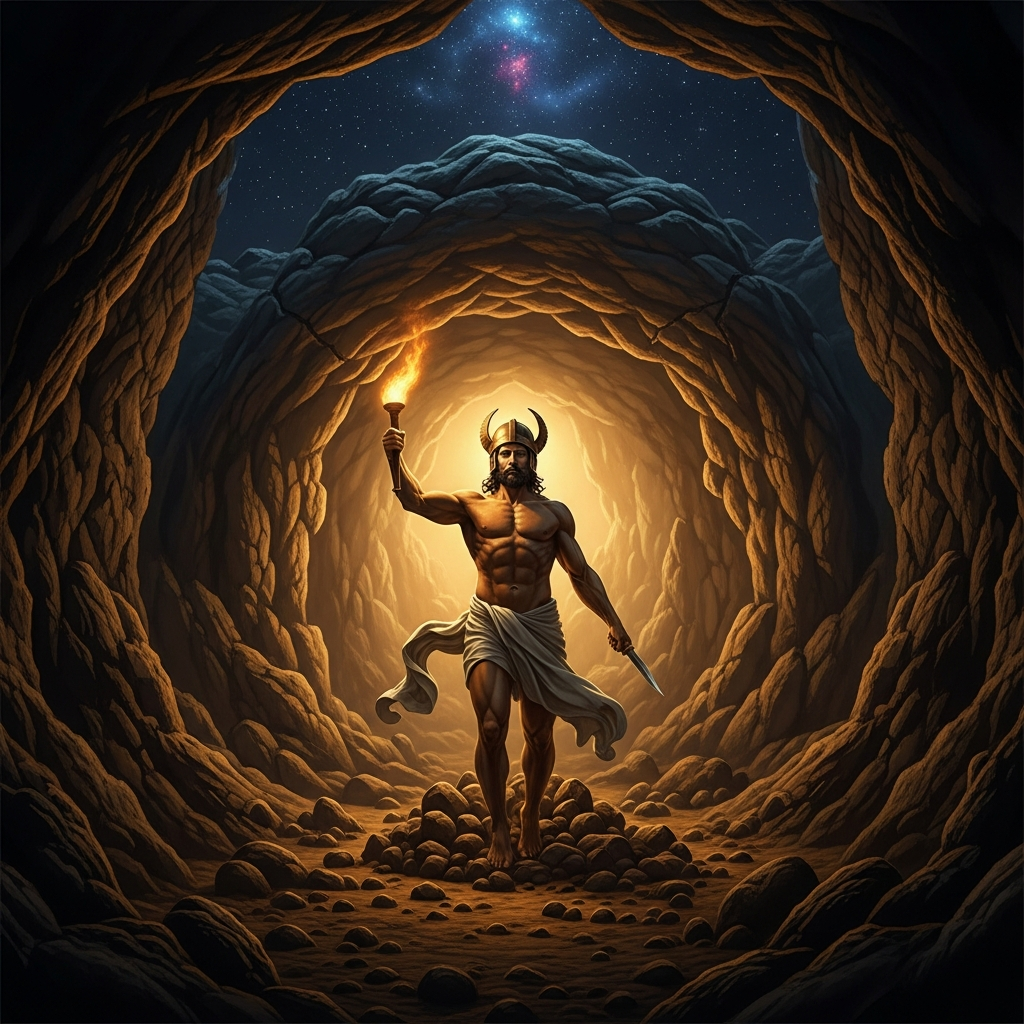
The rock does not crack from pressure. It opens, the way a thought opens in a mind that has been too long closed — suddenly, without preparation, in a moment that is also the first moment: the beginning of time as the moment before and after become distinct. Out of the split stone he comes, already adult, already holding the knife and the torch, already wearing the Phrygian cap that will become the signature of his images across three centuries of Roman imperial art. He is not born in the ordinary sense. He does not come from a mother. He comes from the earth itself, from the first hardness, which makes him older than softness and older than time.
Shepherds see him emerge. The sources say this — even without gospels, even without scriptures, the Pater in every mithraeum carries this fragment of narrative: there were shepherds. They were there at the beginning. They recognized what they were seeing, which is to say they recognized that they were seeing something that had no category, something that required a new category, and the new category was: god who comes from stone.
He looks at the world that does not yet exist and understands that his work is about to begin.
The bull is already there.
In the beginning, before the world is made, the cosmic bull runs. It runs across the young earth — which is flat, unmarked, bearing only the possibility of the world it will become — and in running it expresses everything that needs to be contained: vitality, power, the raw energy of existence before existence has been organized into the categories of useful and useless, edible and inedible, cultivated and wild. The bull is not evil. The bull is pre-moral. It is the world before the cut, and the cut will be the beginning of everything.
Mithras tracks it.
The tracking takes time — which means the tracking is the first time, the first duration, the first experience of before-and-after in the new world. He moves through terrain that will become mountains and rivers after the bull has run across it, and his own footprints will become the first roads. He is not a hunter as hunters hunt later, with patience and strategy and the knowledge that the prey has a pattern. He is the first hunter, inventing the chase, and the bull he chases is inventing flight.
He catches it at a cave.
He wrestles it. The bull does not submit easily — this is not a sacrifice in the temple sense, the willing animal led to the altar by a priest in white. This is a contest between the god who came from stone and the force that preceded organization, and the god wins not because force is on his side — it is not, the bull is enormous, the bull is the world’s entire reserve of wild energy — but because the god is ordered, and the bull is not, and the order overcomes the wildness.
He gets the bull by the nostrils.
He drags it into the cave.
The cave is not the cave he was born from. It is a different cave — the mithraeum, the cult-space that will be reproduced across four hundred sites from Scotland to Syria. It is the inside of the world: enclosed, dark, no windows. The ceiling is painted with stars, which are the real stars but made intimate, close enough to touch, the universe pulled inside and contained. This is where the deed happens. Not in the open air where the bull ran, but in here, in the dark, in the space that is simultaneously the origin of things and the space of initiation, the cave at the beginning of the world and the cave beneath the Roman street where soldiers and merchants descend on winter evenings.
He kneels on the bull’s back.
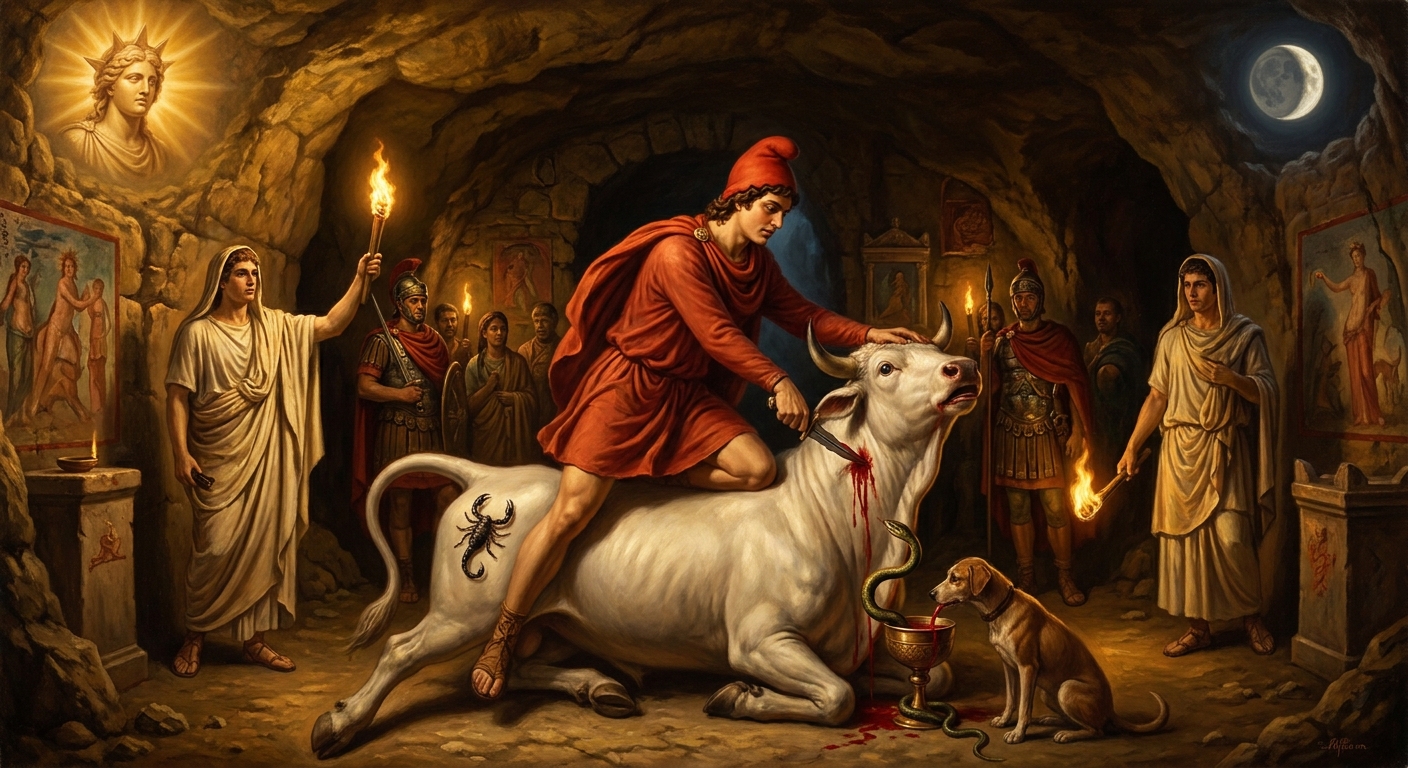
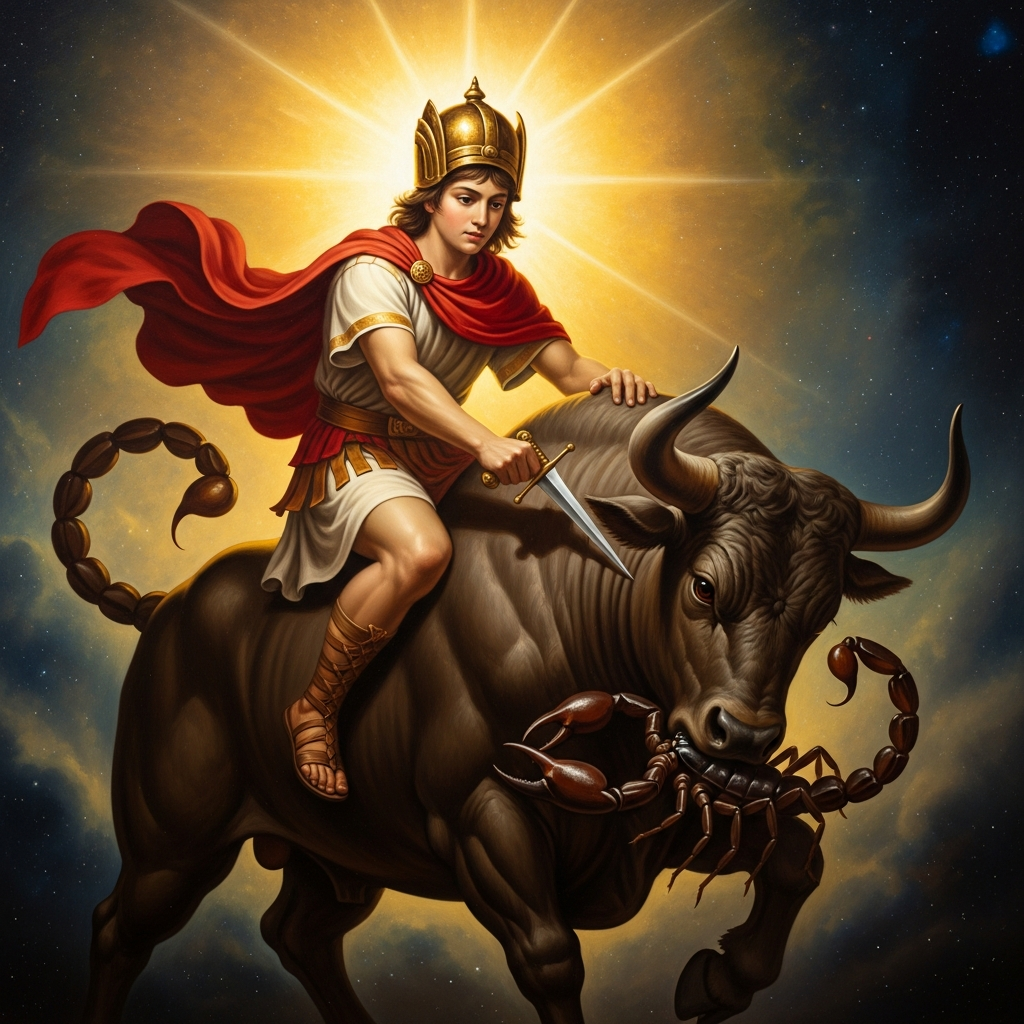
His left knee is on the bull’s spine, driving it to the ground. His right hand holds the knife. His left hand grips the bull’s nostrils, pulling the head back and to the right, exposing the throat. His face is turned away — not from squeamishness, but for a reason the initiates understand and the uninitiated can only guess at. He does not watch the wound he makes. He looks away, as though the killing is something that happens through him rather than by him.
The knife enters at the base of the neck.
From the blood, everything.
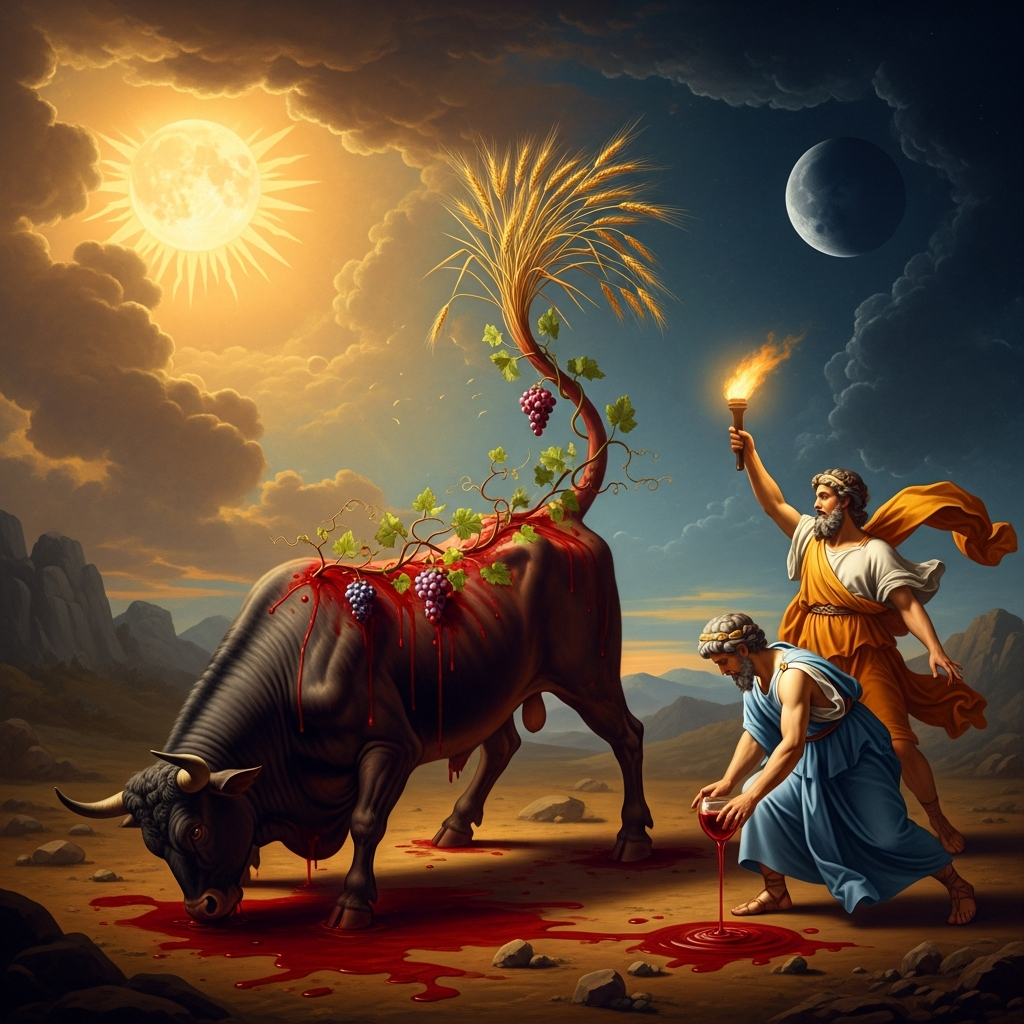
This is the claim of the tauroctony, the claim that no Mithraic text survives to explain but that the image itself asserts in every mithraeum across the empire: the bull’s blood is the origin of life. Not a metaphor for the origin of life. The literal substance from which grain and grape and the vitality of all living bodies spring. The wheat grows from the bull’s severed tail. The vine grows from its spine. Its blood becomes the earth’s red clay, and the earth’s clay becomes the bodies of everything that will live in the world that is now, as the blood pours, beginning.
The scorpion grips the bull’s testicles — taking the generative power, absorbing the seed. The dog leaps for the wound, taking its portion of the life-blood. The serpent runs toward the crimson flood flowing into the earth. The raven watches from the bull’s shoulder, still, patient, recording. Above the scene, on the left side, Sol Invictus — the Unconquered Sun — watches with his radiant crown. On the right, Luna — the Moon — turns her face. They are the two great lights, witnesses to the act that makes their shining meaningful: there is something now to illuminate.
Cautes stands to the left with his torch raised. Cautopates stands to the right with his torch lowered. They have stood this way forever and will stand this way until the world ends. Between raised and lowered, between day and night, between the cosmic before and the cosmic after, the bull dies and everything begins.
The initiates enter the cave one by one.
They descend the stone stair in the order of their grade. The Corax — Ravens — come last among the initiated, first among those who serve. The Nymphus next, the Miles, the Leo, the Perses, the Heliodromus, and the Pater at the head, in the red mantle, the one who carries the full weight of the mystery in his person. They take their places on the stone benches that run along both walls. They eat the bread. They drink the wine.
The bread is the grain from the bull’s tail. The wine is the blood. Every initiate who raises the cup to his lips in the torchlight is receiving the same substance that poured from the cosmic bull’s neck at the beginning of the world — not symbolically, not metaphorically, but actually: the life-force of the first animal, distributed through all subsequent life, concentrated in the shared meal of the initiated, consumed in the cave beneath the street that is also the cave at the beginning of time.
They have killed the bull again. They kill it every time they gather. The killing is never finished, which is why the cult-image is present tense: not Mithras killed the bull but Mithras kills the bull, the knife perpetually entering, the blood perpetually flowing, the world perpetually being made from the sacrifice.
No one writes this down. The initiates swear silence. The Pater carries the explanation in his memory and transmits it person to person, grade to grade, cave to cave. If the transmission is broken — if the last Pater dies without initiating a successor — the chain is broken and the explanation is lost.
The chain was broken in the fourth century.
The explanation is lost.
We have the images — four hundred of them, carved in stone in caves from Hadrian’s Wall to the Euphrates, surviving because stone survives what fire and deliberate destruction cannot always reach. We have the grades — listed in a single source, Origen’s account, a hostile Christian account, but listed. We have a handful of inscriptions: Nama Mithrae, hail to Mithras, scratched by soldiers who have been forgotten in every other context but this one. We have the shared meal of bread and wine noted with alarm by Christian apologists who could not explain it away. We have the astronomical data: Taurus as the constellation of the spring equinox before the precession of the equinoxes moved it to Aries, which is when something happened in the heavens that the cult’s imagery encodes.
We do not have the words that went with the image.
Roger Beck has spent a career reading the Mithraic star-map. David Ulansey has argued for the precession hypothesis. Manfred Clauss has catalogued the evidence with German comprehensiveness. Richard Gordon has mapped the social history. None of them can tell you what the Pater said to the man lying on the stone floor in the torchlight, what the words were that accompanied the blindfold and the sword at the chest and the shared meal.
The cave has been filled with rubble. The basilica has been built on top of it. The bull is still dying in the image on the back wall of the filled-in cave, knife still entering, blood still beginning to flow, the raven still watching with its patient eye.
In 1949, workers excavating beneath the church of San Clemente in Rome found a mithraeum intact beneath the twelfth-century basilica, which is itself built on a fourth-century basilica, which is built on a first-century house, which has a mithraeum in its basement. Three layers of Christianity on top of one layer of Mithras. The bull-slaying relief is still on the altar at the far end of the cave. You can visit it today. You descend a stair past the medieval frescoes and the early Christian mosaics and the Roman brick and you arrive in a room that is cold and smells of stone and underground water, and there on the wall is the god with the knife and the bull.
He is killing it right now.
He will always be killing it. The wheat is always about to spring from the tail. The blood is always about to become the wine. The world is always about to be born from the act that was performed at the beginning.
You cannot read the words that went with the image. But you can stand in the cave and feel the weight of the stone above you, the narrowness of the space, the way the torchlight would have made the god’s face move — and you can understand, without the words, what the words were for: to make a soldier lying on a cold floor in a Roman city understand that the god who moved the cosmos kneels to do his work, and the work is sacrifice, and the sacrifice produces life, and the life is shared, here, now, in this room, among these men who have sworn silence about the one thing that makes silence worth keeping.
Scenes
Mithras born from living rock at the dawn of time, emerging from the stone of a cave already fully formed, torch in one hand and knife in the other, the vault of a cave above him painted with stars, no light yet in the world except his own
 Generating art…
 Mithras on the back of the cosmic bull, his knee on its spine, his right hand driving the sacred knife into the base of its neck — a scorpion gripping the bull's testicles, a dog and serpent leaping toward the flowing wound, a raven watching from the bull's shoulder
 Generating art…
 From the dying bull: wheat springing from its tail, a grapevine from its spine, its blood becoming the red earth and the wine that will sustain all future life — Cautes raising his torch and Cautopates lowering his, the sun and moon witnessing from opposite sides of the sky
 Generating art…
 Echoes Across Traditions
Entities


Sources
- Manfred Clauss, *The Roman Cult of Mithras: The God and His Mysteries* (English ed., Routledge, 2000)
- Roger Beck, *The Religion of the Mithras Cult in the Roman Empire* (Oxford University Press, 2006)
- David Ulansey, *The Origins of the Mithraic Mysteries: Cosmology and Salvation in the Ancient World* (Oxford University Press, 1989)
- Franz Cumont, *The Mysteries of Mithra* (Dover, 1956)
- Richard Gordon, 'Authority, Salvation and Mystery in the Mysteries of Mithras' in *Image and Value in the Graeco-Roman World* (Variorum, 1996)