Contents
Simon the Samaritan magician — the man Irenaeus will call the root of all heresies — arrives in Rome and challenges the Apostle Peter by promising to ascend through the air before the Emperor Nero. The confrontation that ends in Simon's death launches two thousand years of heresiological literature and becomes the template for every false prophet that follows.
- When
- c. 55-68 CE · Rome, under Nero
- Where
- Rome, Italy
He arrives in Rome on a boat from Ostia, in a crowd of pilgrims and merchants and discharged soldiers, carrying nothing that can be taxed.
Helen walks beside him. She is — depending on which source you trust — a former prostitute from Tyre whom Simon has elevated to the status of a divine being, the earthly incarnation of the First Thought, Ennoia, who emanated from the supreme Father before anything else existed and has been descending through subsequent incarnations ever since, from Helen of Troy to this woman with the tired eyes walking off a boat in the harbor of Rome. This is what Simon teaches. This is what he has been teaching since Samaria, where the Acts of the Apostles caught up with him at the Jordan, watching John’s disciples baptize and offering money for the power to convey the Holy Spirit with a touch.
Your money perish with you, Peter told him then.
Simon has not forgotten this. He never forgets a dismissal.
Rome is the right city for what he intends.
He has been building a following for years — in Samaria, in Antioch, in the cities along the Syrian coast. Everywhere he goes, the crowds come. He does not merely argue. He demonstrates. He has gifts, real ones — the sources, even the hostile ones, admit this without quite admitting it. He performs what the age calls magic and what another age might call something else: healings, sometimes, or what appear to be healings; prophecy, or what appears to be prophecy; a quality of presence that makes rooms feel different when he enters them. Justin Martyr, writing around 155 CE, says Simon was considered a god by almost all the Samaritans. This is the kind of thing an enemy says when they are being careful.
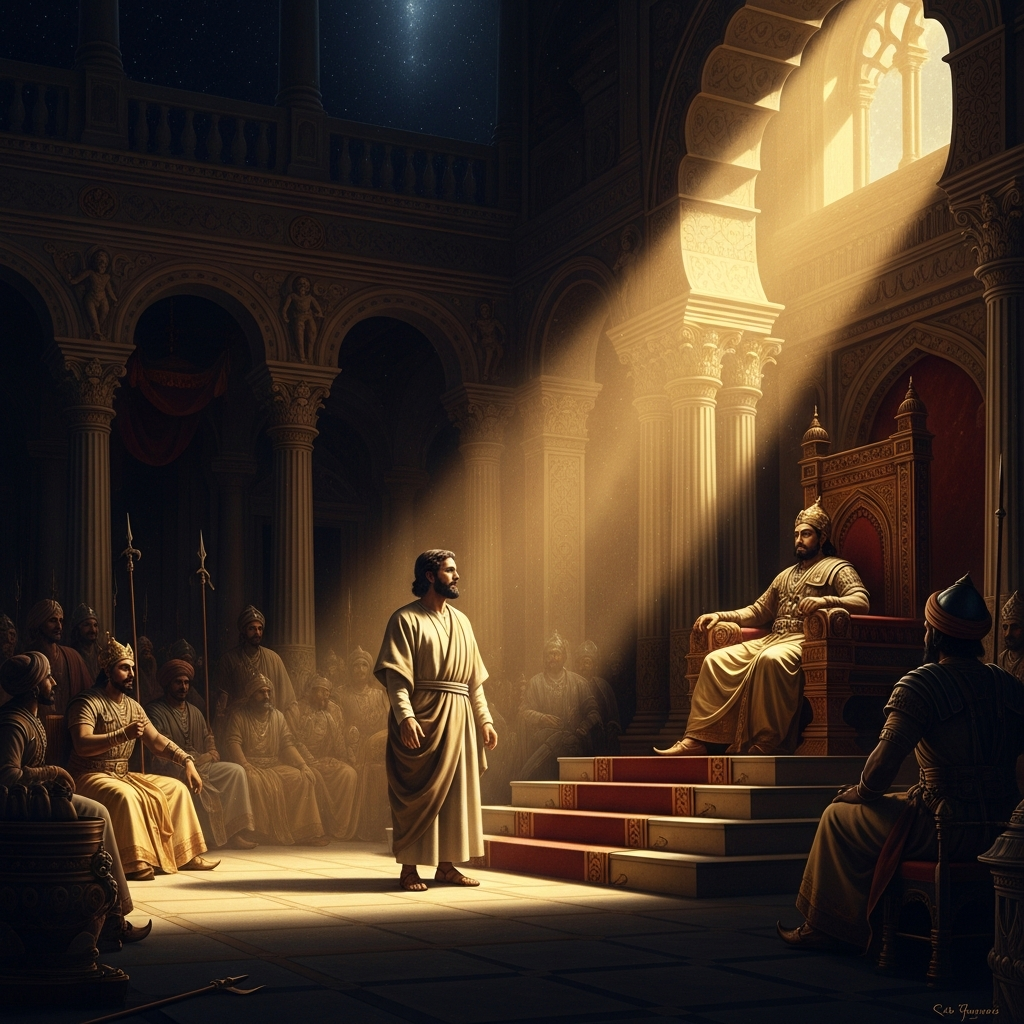
In Rome he finds the patronage that matters most. Nero — twenty-something, erratic, genuinely interested in the supernatural — hears about the Samaritan wonder-worker and invites him to perform at court. Simon performs. Nero is impressed. He does not convert — Nero does not convert to anything except his own particular cult of himself — but he is interested, and in Rome, imperial interest is a form of protection.
This is the situation when Peter arrives.
Peter has been in Rome some years. He has a community — small, meeting in private houses, growing cautiously the way all new movements grow in a city where the authorities are attentive and the religious landscape is densely competitive. He has heard about Simon. He heard about Simon in Samaria, where the encounter at the Jordan left him with the specific itch of unfinished business. A man who offers money for apostolic power and then goes off and builds his own following based on a completely different theology is not merely a rival. He is a counter-testimony. He is walking proof, to everyone who meets him, that the power of the Jesus movement is one option among several, purchasable, transferable, not necessarily unique.
They meet at a dinner. The Acts of Peter, which survives in a Latin translation of a probably Greek original, describes elaborate contests: a fish that Simon animates and Peter restores; a dog that Simon commands as a messenger; a child possessed by a spirit that Simon has sent. These may be legend. What is not legend is the trajectory they map: two powerful men in the same city, each with the kind of following that cannot easily coexist with the other’s, circling toward an event large enough to settle things.
Nero provides the occasion. He announces a public demonstration. Simon Magus will fly.
The Forum is crowded.
This is not unusual — the Forum is always crowded. But on this day the crowd is thicker, and includes people who have been there since before dawn, and the better vantage points along the temple steps are occupied by people who came the evening before and slept there. Nero is visible in a cushioned chair on the Rostra, attended by his people. The afternoon light comes from the west, warm and horizontal, catching the columns of the temples and the golden bronzes along the Sacred Way and the faces of ten thousand people who have come to watch a man defy gravity.
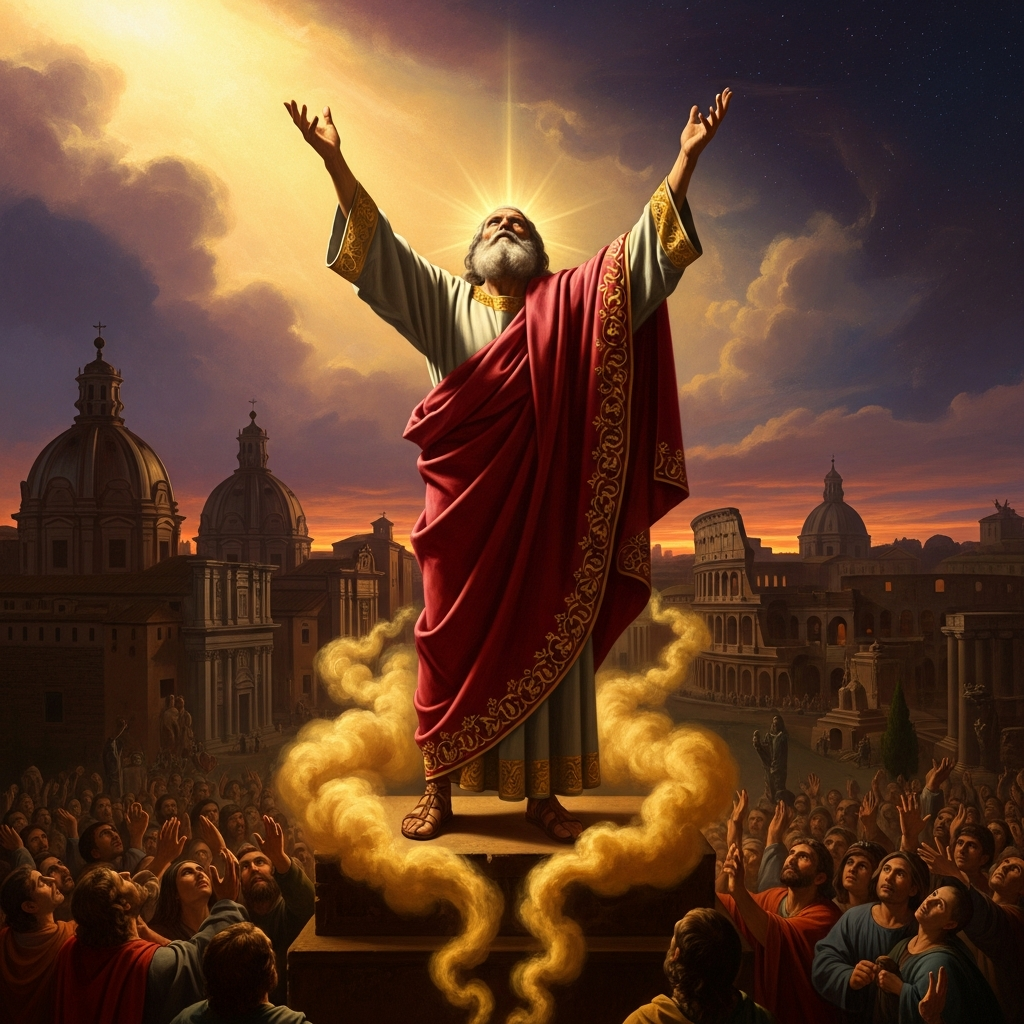
Simon stands at the center of the Forum.
He is in his fifties, probably — the sources are vague about his age but consistent that he is not young in Rome. His clothes are expensive, crimson and white, the kind a successful professional wears in a city that reads seriousness through fabric. Helen is behind him, veiled. His disciples are around him. He has been praying, or meditating, or performing whatever preparation his tradition requires.
He raises his arms.
He rises.
This is the moment that every subsequent account must grapple with: he rises. The Acts of Peter says he rises. Even accounts written centuries later, written by people who consider Simon the father of all lies, say he rises. They will explain it differently — demons, trickery, the illusions of the Devil, who can make the eyes see what is not true — but they do not say it did not happen. They say: he flew, and then he fell.
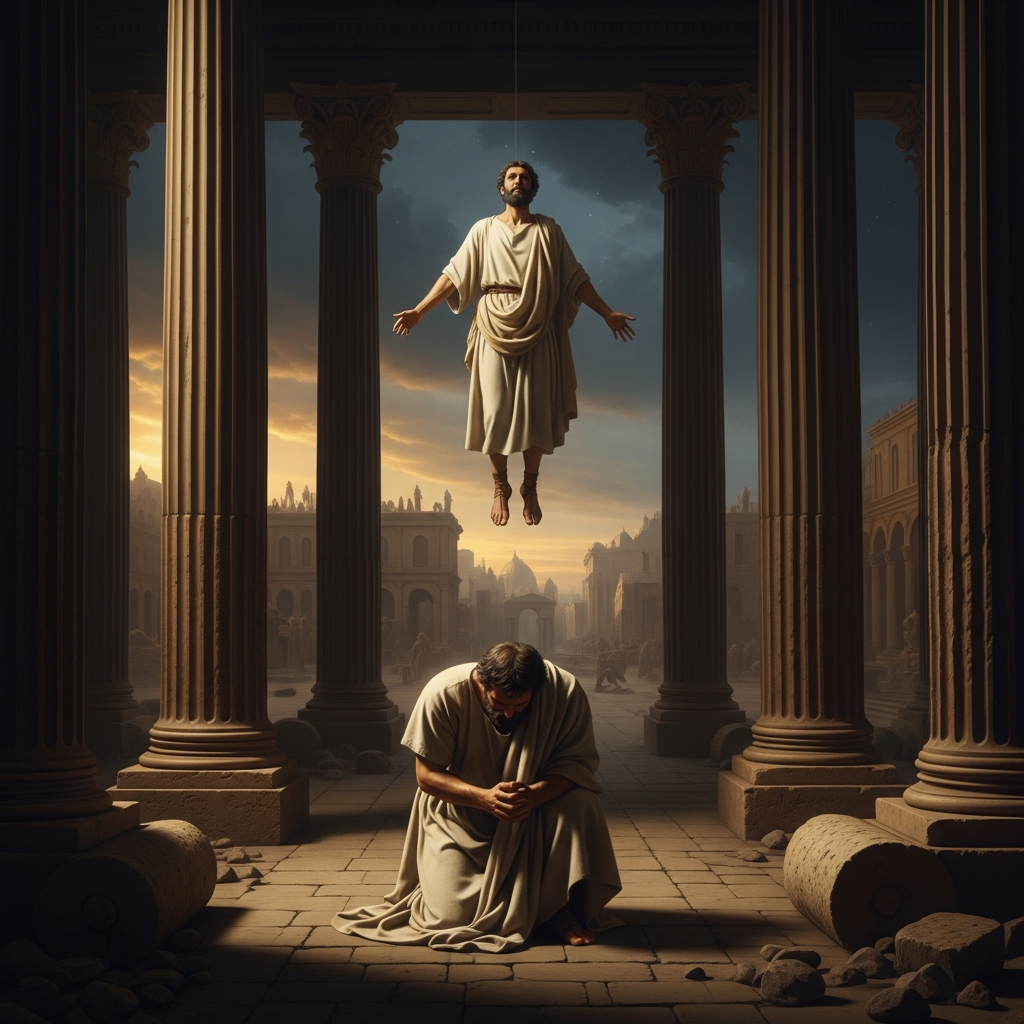
Peter is on his knees in the crowd.
He is praying, the Acts of Peter says. He is praying specifically that the angels who hold Simon up should release him — not that Simon should be killed, the text specifies; Peter prays for injury, not death, and what happens after is more than he asked for. He says: O God, hasten your mercy, and let him fall, but not die; let him be disabled, and let him not die but suffer.
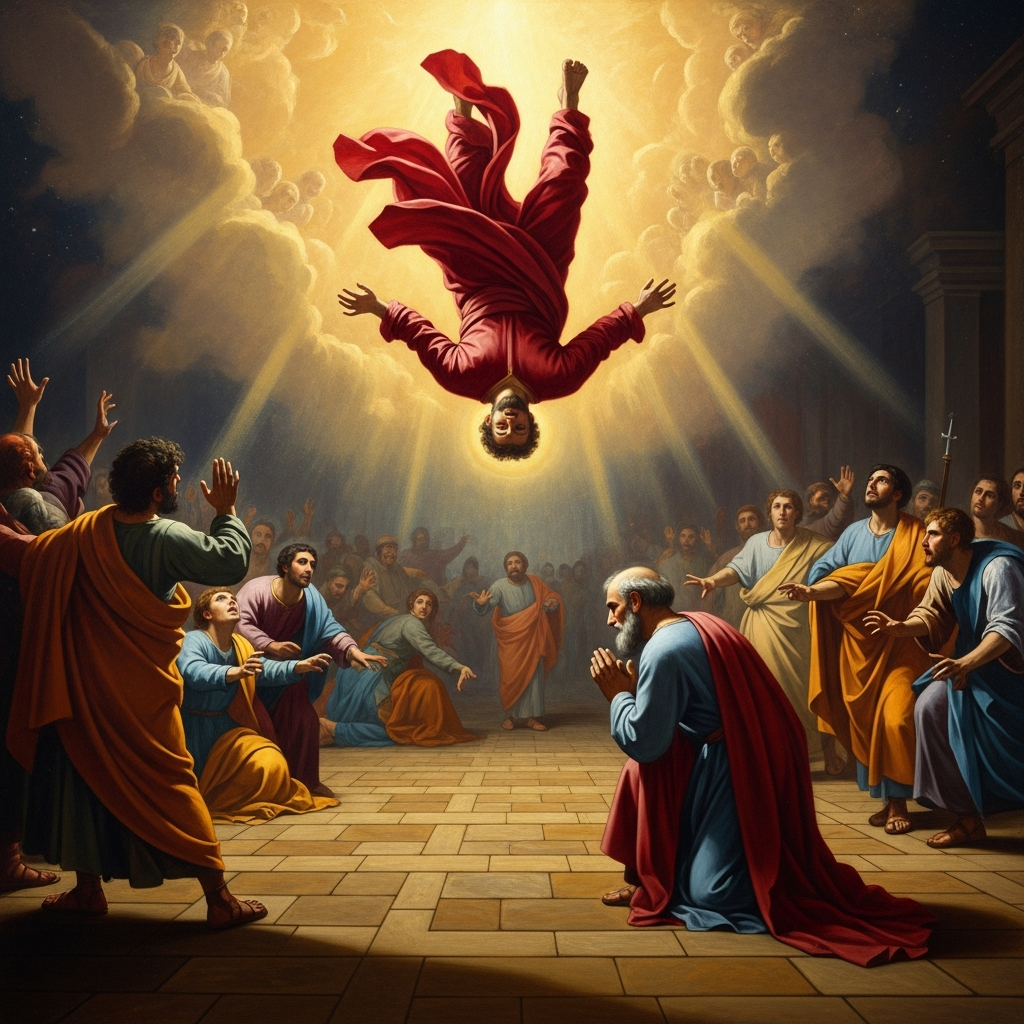
Simon falls.
He hits the stone of the Forum. His leg — the Acts says his leg breaks, then later says three places, which sounds like the memory of an account heard rather than witnessed — breaks. He is carried out. He goes to Aricia, south of the city, and undergoes treatment. He dies there. From his injuries, or from the treatment, or, in the version the tradition prefers, from the attempt to repeat the demonstration and the falling a second time.
Peter is arrested shortly afterward. He is crucified, upside down, because he asks to be crucified upside down.
What Simon taught, in the years before Rome, was a theology as complete in its way as anything that follows him. The supreme Father, wholly unknown, not to be identified with the Jewish Yahweh. The First Thought, Ennoia, who emanated from the Father and descended through the world, incarnating repeatedly, trapped in matter, recoverable only through gnosis. The angels who made the world — in ignorance, as in Valentinus’s later system — and who compete with one another to claim the souls of human beings as their subjects. And Simon himself, who is, he teaches, the Dunamis, the Power, the living presence of the supreme Father in the material world, come to find the First Thought and restore her to her proper place.
Helen of Tyre is the First Thought.
This is what enrages Peter most, perhaps more than the flying. The claim that this specific man walking these specific Roman streets is the living Father himself, and this specific woman walking beside him is the divine feminine principle who has been imprisoned through all the ages of the world, and that their relationship — whatever it is, teacher and student, husband and wife, philosopher and example — constitutes the redemption of the cosmos.
The Acts of Peter does not record what Simon says when he hits the stones of the Forum. It does not record what Helen says. It records that he died, and that thereafter Peter was crucified and the church continued, and the memory of Simon hardened from a rival into a category — simony, heretic, magician, the father of all heresies — which is what happens when a living thing becomes a lesson.
Irenaeus of Lyon, writing around 180 CE, opens his five-volume attack on heresy with Simon Magus. He will need many volumes for the task — Valentinus, Marcion, Basilides, Carpocrates, the Ophites, the Sethians — but he begins at the beginning, with the Samaritan at the Jordan who offered money for apostolic power and was refused and built his own church anyway.
This is the template: a powerful individual claiming direct divine authorization, operating outside the structures the apostolic church is building, drawing crowds, performing wonders the crowds find convincing, and offering a version of salvation more dramatically personal and less institutionally demanding than what Peter is preaching in the houses of Rome.
Simon lost. But the tradition he was teaching — the supreme Father beyond the God of Genesis, the divine feminine descending through matter, the cosmos as a mistake or a trap, the individual human soul carrying a spark that exceeds its creator — did not lose. It went underground. It resurfaced in Valentinus, in Mani, in the Cathar perfecti, in the Zohar, in William Blake, in the therapist offices of any city where a person sits across from another person and says: I feel like I am more than what I was told I was.
Simon fell. The question he raised — who, exactly, is God? — did not fall with him. It kept rising.
Scenes
Simon Magus in crimson robes standing atop the Roman Forum before a crowd, arms raised toward the sky as golden smoke rises from his feet, the domes of Rome behind him under a livid evening sky
 Generating art…
 Peter kneeling on the stones of the Forum in plain linen, head bowed in prayer, while above him Simon Magus rises into the air — a figure suspended between the pillars of the Temple of Saturn and the darkening heavens
 Generating art…
 Simon Magus falling from the sky onto the Roman paving stones, his crimson robes streaming upward, the crowd scattering below him — Peter still kneeling, eyes closed, the moment of impact not yet arrived
 Generating art…
 Echoes Across Traditions
Entities
- Simon Magus
- Peter
- Helen of Tyre
- Nero
- the Holy Spirit
Sources
- Acts of the Apostles 8:9-24 (New Testament)
- *Acts of Peter* (Vercelli Acts; apocryphal, c. 180-190 CE) — the primary source for the flying contest
- Irenaeus of Lyon, *Adversus Haereses* I.23 (c. 180 CE)
- Justin Martyr, *First Apology* 26 (c. 155 CE)
- Stephen Haar, *Simon Magus: The First Gnostic?* (Walter de Gruyter, 2003)