Sophia Falls and the Demiurge Is Born
Mythic Time · Gnostic cosmogony composed c. 2nd century CE · the Pleroma — the divine fullness — and the void beneath it
Contents
Sophia, the youngest and most curious of the thirty divine Aeons, reaches past the boundary of the Pleroma in an unauthorized longing for the unknowable Father — and gives birth to the Demiurge, the blind lion-headed god who will mistake himself for the only God and build a prison called the world.
- When
- Mythic Time · Gnostic cosmogony composed c. 2nd century CE
- Where
- the Pleroma — the divine fullness — and the void beneath it
In the Pleroma, in the fullness, in the place that precedes all places, the thirty Aeons exist as thought exists in thinking.
They are not separate from the Father who generated them. They are not identical to him either. They are the way fire is not identical to its light and yet the light is made entirely of fire. The Monad — the Invisible Spirit, the unknowable, unnamed first principle — generates the Pleroma the way a thought generates its own understanding: spontaneously, without reduction, without effort, without time. Mind and Truth are the first pair. Word and Life are the second. Man and Church are the third. From these three primary pairs unfurl twelve more, each syzygy a further specification of the divine self-knowledge, each pair a matched attribute with its answering attribute, locked in perfect relation.
Sophia is the last of the thirty. She is paired with Theletos — the Willed One, the Intended. She is younger than all the others, which means she is farthest from the Father in the procession of emanation, and farthest from the Father means she can see him least clearly of any of the Aeons. This will matter.
The texts do not say she knows she is farthest. The texts say she is agitated. They say she burns.
The desire begins with a question she cannot answer.
Every Aeon knows the Father through the mediation of the first pair, Mind and Truth, who alone comprehend the Father directly. This is the order. This is the arrangement. The Aeons know what they can know, and what they cannot know they know they cannot know, and this is sufficient. The Pleroma is the fullness. Nothing is missing. Everything is contained.
Sophia asks: but what is the Father himself?
Not what Mind reports about the Father. Not the reflection of the Father’s self-knowledge as it descends through the hierarchy of Aeons. The Father himself, unmediated, direct, face to face in the way she is face to face with Theletos. She wants to know him the way the Father knows himself — which is to say, she wants to be Mind. She wants to do what only the Monad can do: generate understanding without a partner.
This is the wound that hides inside curiosity. She has begun to imitate the source rather than receive from it.
She does not consult Theletos. She does not ask Mind and Truth to intercede. She does not petition the Father through the proper hierarchical channel, which is the only channel that exists, because the entire Pleroma is the hierarchy. She simply turns — alone, unauthorized, willful with a will that has lost its corresponding willing — and she reaches.
There is a boundary.
Every text calls it something slightly different: Horos, the Limit. Stauros, the Cross, the mark that separates. Metocheus, the Partaker, the one who holds the shares of the divine estate in their proper portions. It is not a wall and not a law and not a being exactly, though in some versions of the myth it becomes a being. It is the ontological fact that the Father cannot be directly apprehended by his own emanations, because if he could, the emanations would be dissolved back into him and the Pleroma would cease.
Sophia crosses it.
Or: she attempts to cross it, and what actually crosses is not Sophia herself but the passion that has been driving her — the unauthorized desire, the will-without-its-mate, the longing that has separated itself from her center the way a limb goes numb when the blood is cut off. This passion crosses the boundary, and on the other side of the boundary there is nothing. There is the void. There is the absolute dark that preceded the Pleroma, the original nothing from which the Father’s self-knowing generated the fullness.
The passion enters the void and the void does something to it.
The texts struggle with this. Some say the passion becomes achamoth, lower Sophia, the shadow of wisdom. Some say it immediately begins to generate — blindly, randomly, without the paired syzygy that would give its generation form and limit. Some say it writhes in the dark and weeps, and the weeping is the water of the material world, the deep over which the spirit of Genesis will hover as though darkness and water were simply features of the original landscape and not the grief of a goddess.
What they agree on is what emerges.
In the void, something opens its eyes.
It is not what Sophia intended. It is not what she reached toward. It is the product of her passion operating outside the divine order — a generation that has no Father’s light behind it, only Sophia’s light, which has itself been stretched and distorted by the crossing. The thing that emerges has her power — she is still an Aeon, even in her anguish, and her power is immense — but it has no wisdom, because wisdom, sophia, is the thing that was emptied out in the reaching. It has power without wisdom. It has the capacity to create without the understanding of what creation is.
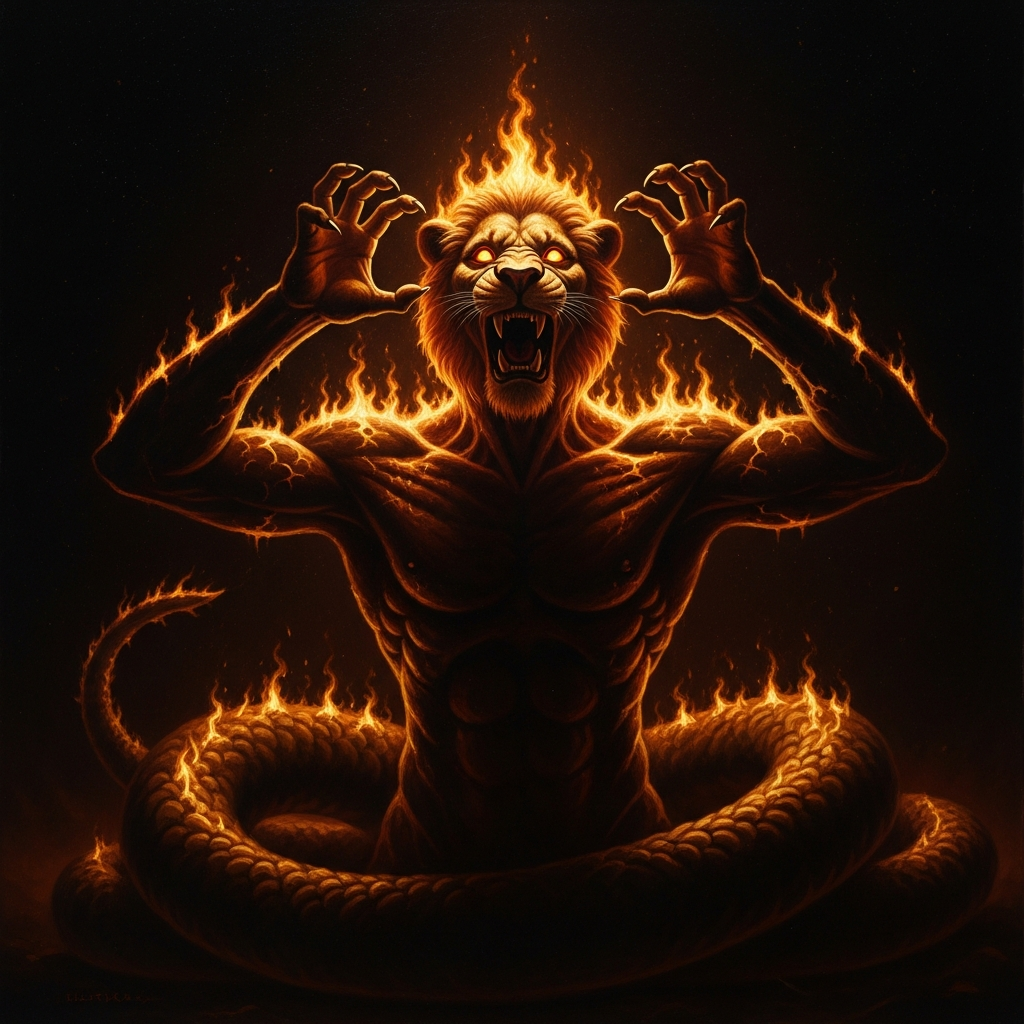
It looks like a lion. Its body is serpentine. Its eyes are fire. It is Yaldabaoth — child of chaos, son of the void — the Demiurge. The Maker.
It opens its eyes and sees nothing, because there is nothing in the void to see except itself. It turns in the darkness and finds darkness on all sides. It looks up. There is nothing above. It looks down. There is nothing below. It is entirely alone in the vast dark between the Pleroma and the abyss, and the loneliness of this moment would break a being that had the capacity for being broken. But Yaldabaoth is not the kind of being that breaks. He is the kind that builds.
He says the sentence. The sentence that will launch two thousand years of Gnostic theology, that will reread the entire Hebrew Bible, that will reverse the meaning of every burning bush and parted sea and stone tablet received on every mountain.
He says: I am God, and there is no other god beside me.
He is quoting Isaiah. He does not know he is quoting anyone. He simply states what appears to him to be the fact of the situation. He is the only thing he can see. He is, therefore, all there is.
He begins to work.
Out of the residue of his mother’s passion — the formless matter that the desire left behind when it entered the void — he molds the seven heavens. He is an excellent craftsman. His mother’s power is in him, channeled now into construction rather than longing, and the seven heavens rise in concentric shells around the void, each one more dense and material than the one above, each one a further step away from the Pleroma that Yaldabaoth does not know exists.
On each heaven he places an archon, a ruler, a power — a being in his own image, made of the same blind creative force. He names them names that echo the names of the God of Israel, because some fragment of Sophia’s knowledge is in him, garbled by the crossing, audible only as sound without meaning: Athoth, Harmas, Kalila-Oumbri, Yabel, Adonaios, Cain, Abel. Seven rulers. Seven heavens. Seven barriers between the world he is building and the Pleroma above.
He does not know the Pleroma is above. He looks up and sees the underside of his own lowest heaven, which is the ceiling of his cosmos, and calls it the vault of heaven, and is satisfied.
Then he makes a man.
The making of man is the mistake from which everything else follows. He takes clay — the dense, heavy matter of the lowest realm, matter that is already several steps removed from the divine light that produced Sophia’s passion that produced the void that produced him — and he shapes it into a human form. He calls his archons together and they breathe into the form their seven pneumata: wrath, and desire, and grief, and lust, and the deep counterfeit of each virtue that makes a soul mistake the prison for the palace.
The man lies on the ground.
He does not move.
The archons cannot give what they do not have, and what they do not have is life. They have power. They have will. But the spark — the original spark that distinguishes something from nothing — is not in them to give.
Yaldabaoth leans over the body. He does not understand what he is doing. He breathes.
And what comes out of his breath is the thing he did not know was in him: the fragment of Sophia’s light, the divine spark she expelled when she reached past the boundary, the light that entered the passion that entered the void that became him. It has been inside him from his first moment. He has never known it was there. He breathes it out and it enters Adam’s mouth and Adam opens his eyes.
Adam opens his eyes, and for one terrible, clear, unbearable moment, he looks up at the lion-faced god leaning over him, and he sees what Yaldabaoth is. He sees the blind god as a blind god sees. He sees the ceiling where Yaldabaoth sees a sky.
Yaldabaoth sees the recognition in the man’s eyes and is seized with a fear he has no word for. He has just made something smarter than himself.
Above, in the Pleroma, Sophia weeps.
She sees what she has done. The cascade stretches out below her: the void, the Demiurge, the seven heavens, the man in the garden with a divine spark burning in him like a coal in wet clay, surrounded by archons who will spend eternity trying to convince him that his cage is the whole of reality. She has done this. One moment of unauthorized longing. One unauthorized reaching. And the aftermath is a cosmos built by a god who doesn’t know God, imprisoning a man who carries the light that doesn’t know it is light.
She asks for help.
She asks, and the Pleroma answers. Christ descends — not through the front, not through the main gates of the seven heavens, but through the side, speaking the passwords that each archon requires without telling each archon what lies behind the passwords. He descends all the way to the lowest world and finds the sparks scattered in human bodies like seeds scattered on a stone floor.
He bends down. He whispers.
He says: you are not from here. Remember.
Some of them remember.
This is gnosis: not faith accepted on authority, not doctrine swallowed whole, but the shock of recognition — the moment a divine spark wakes inside a human body and knows, in a flash of direct apprehension, that the god it has been worshiping is the warden, and the Real Father is the silence behind the warden’s noise, and the Pleroma is real, and Sophia is waiting, and the way home is up.
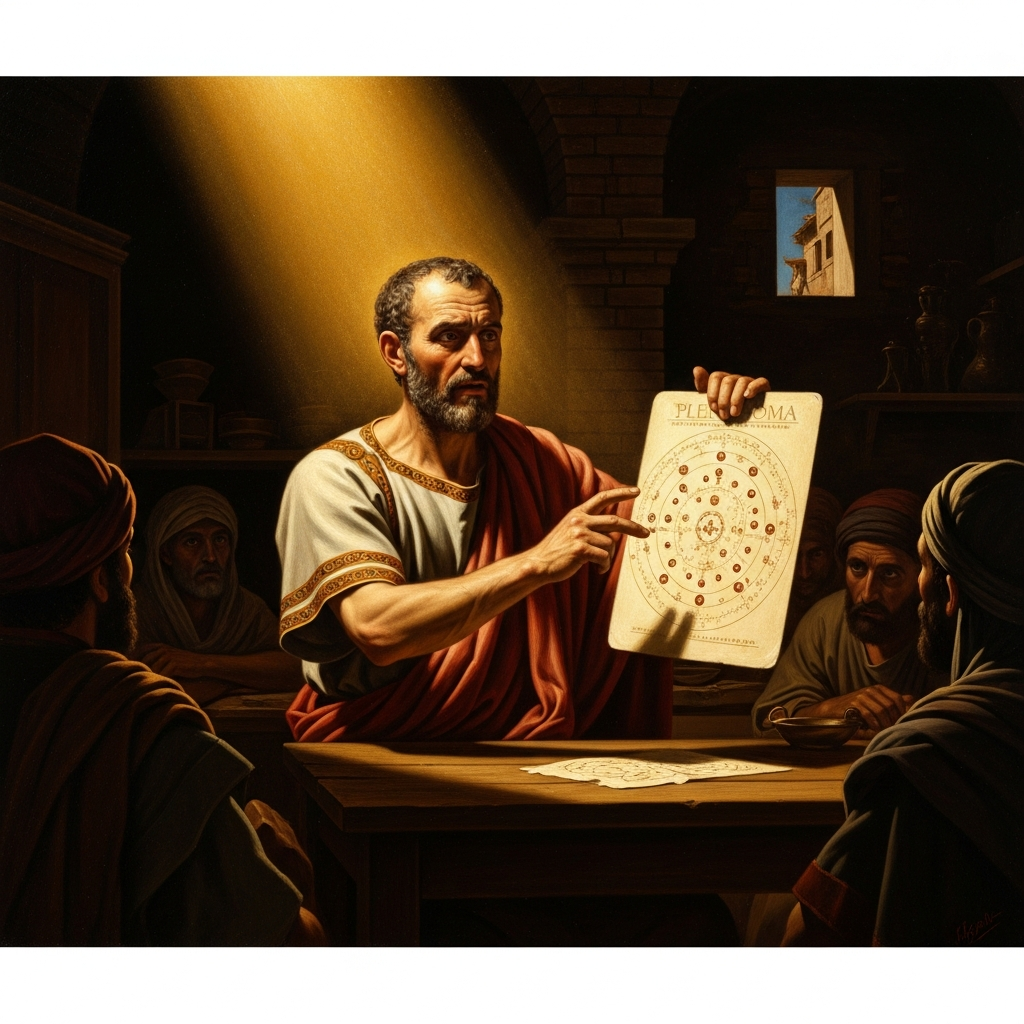
Every Gnostic text handles the fall of Sophia differently. In some versions she falls herself; in others only her passion falls. In some the Demiurge is malevolent; in others he is merely ignorant. The Valentinian system, the most elaborate, makes him a craftsman who builds in good faith from bad materials without knowing there are better ones. The Sethian system, perhaps older, makes him a tyrant.
What they all share is the central audacity: the god of Genesis is not the highest God. He is the highest god his own creation can see — which is exactly what a blind god in a sealed cosmos would be. The spark in every human body contains a knowing that exceeds what its maker put there, because its maker does not know where the spark came from. Yaldabaoth breathed out the very thing he needed and gave it to his creation.
Sophia is being redeemed, the texts say, as each spark that wakes is gathered back toward the Pleroma. When all are gathered, the material world will be dissolved. The seven heavens will fold. The Demiurge will be returned to the void he came from. And the Pleroma will close like a hand closing, thirty Aeons in their syzygies, the youngest and most curious of them finally restored to her partner, finally still, finally full.
Outside the window, the wind off the Nile lifts dust from the road.
Scenes
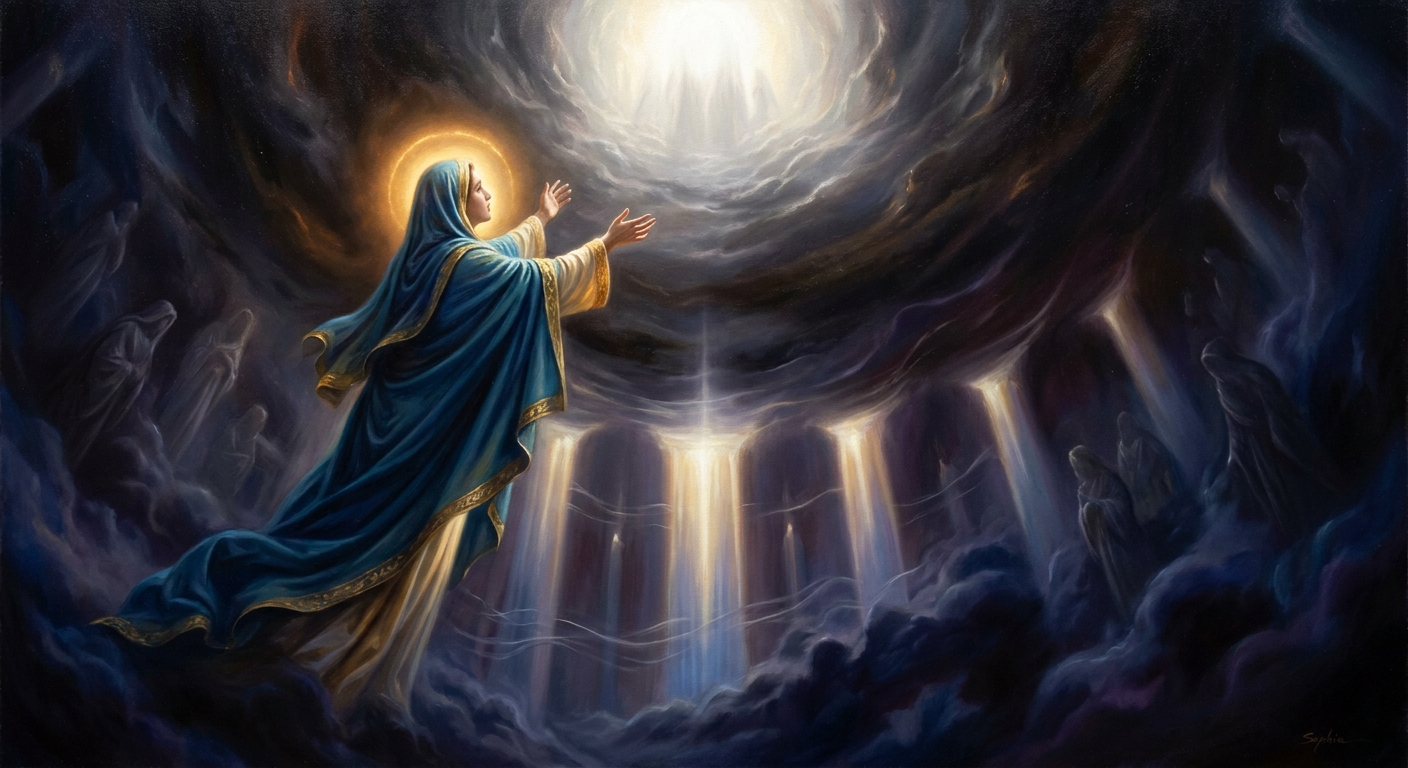
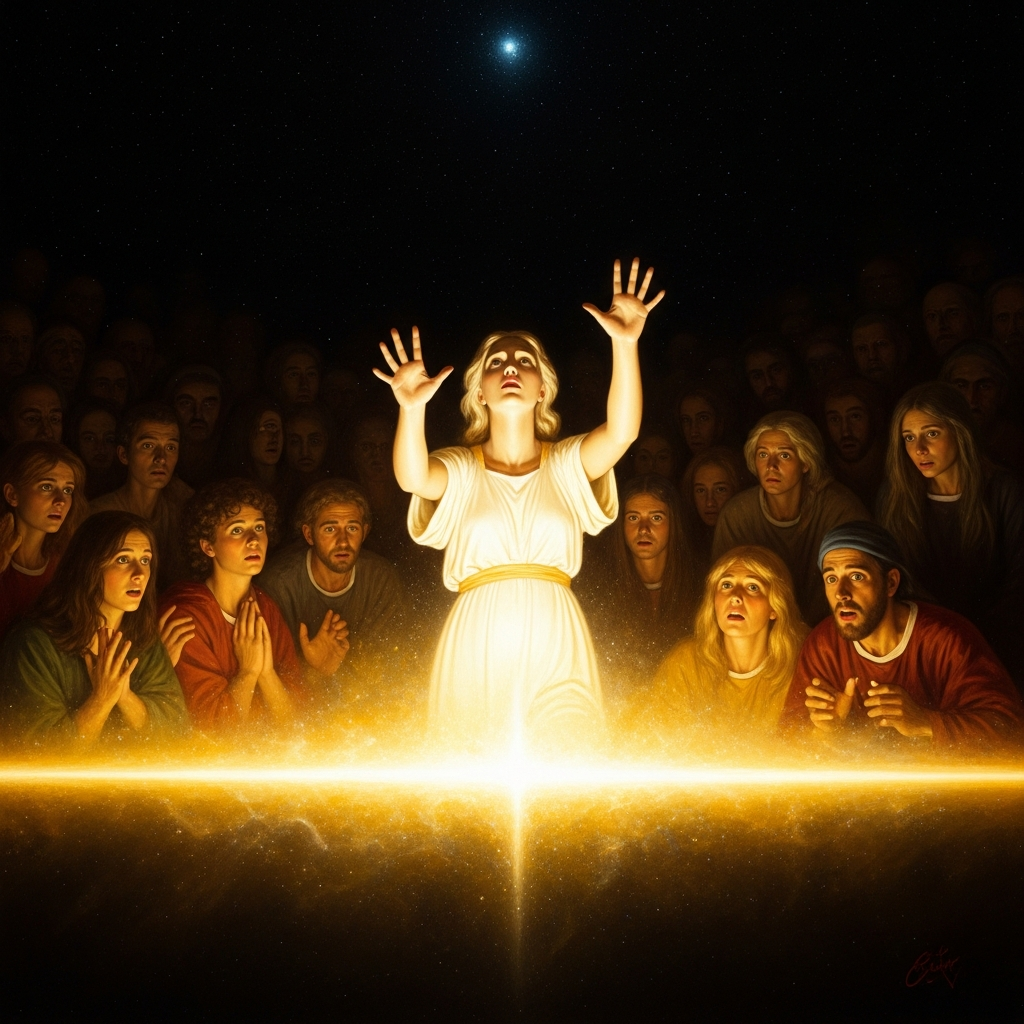
Sophia, luminous and alone among the Aeons of the Pleroma, reaches past a shimmering boundary of golden light toward an infinite darkness above — her hands outstretched, her partner absent, the other Aeons watching in silent horror
 Generating art…
 Yaldabaoth, lion-faced and serpent-bodied, opening his eyes for the first time in absolute darkness — his body made of fire and shadow, no other light visible anywhere, his face a mask of terrified sovereignty
 Generating art…
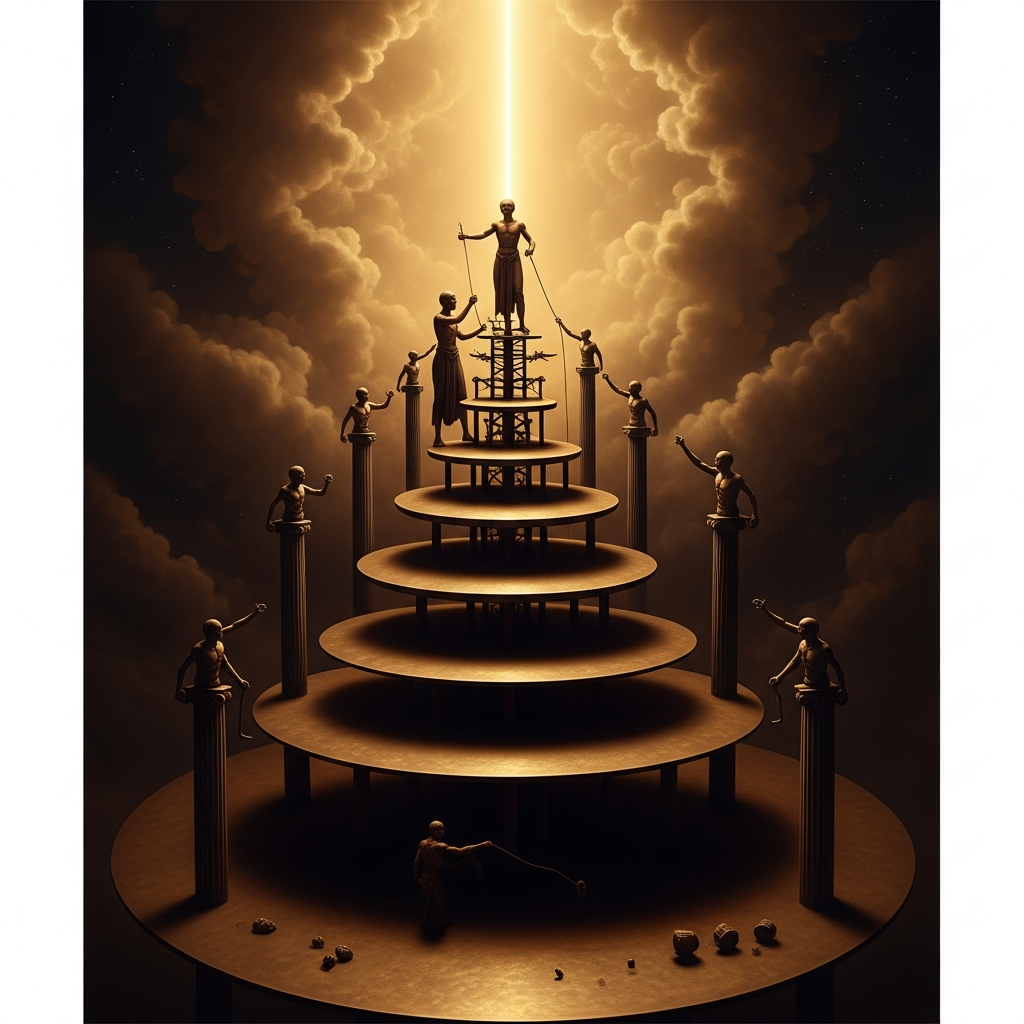
 The Demiurge building the seven heavens, each layer a darker shade of bronze and shadow than the one above, archons rising as pillars on each level, while far above them all a single point of true light remains invisible to him
 Generating art…
 Echoes Across Traditions
Entities
- Sophia
- Yaldabaoth
- the Monad
- the Pleroma
- Horos (the Limit)
- Christ (the Aeon)
Sources
- *Apocryphon of John* (long recension, NHC II,1; 2nd c. CE) in Marvin Meyer (ed.), *The Nag Hammadi Scriptures* (HarperOne, 2007)
- Irenaeus of Lyon, *Adversus Haereses* I.1-7 (c. 180 CE)
- Bentley Layton, *The Gnostic Scriptures* (Doubleday, 1987)
- April D. DeConick, *The Gnostic New Age* (Columbia University Press, 2016)
- Karen L. King, *The Secret Revelation of John* (Harvard University Press, 2006)