Shimon bar Yochai in the Cave
Roman Palestine · c. 135–160 CE, during the Antonine administration following the Bar Kokhba revolt · The cave of Peki'in in the Galilee, then a carob grove near Tiberias — a landscape of limestone hills, olive groves, and the long shadow of Roman garrisons
Contents
Condemned to death by Rome for a careless word against empire, Rabbi Shimon bar Yochai and his son Elazar bury themselves in sand for twelve years and emerge too holy for the world — burning everything they look at.
- When
- Roman Palestine · c. 135–160 CE, during the Antonine administration following the Bar Kokhba revolt
- Where
- The cave of Peki'in in the Galilee, then a carob grove near Tiberias — a landscape of limestone hills, olive groves, and the long shadow of Roman garrisons
The death sentence arrives, as Roman death sentences do, through a third party.
Rabbi Yehuda praised the Romans. Rabbi Yose was silent. Rabbi Shimon bar Yochai said: Everything they have built, they built for themselves. The marketplaces for prostitutes. The bridges to collect tolls. The bath-houses for their own pleasure. The remark travels, the way dangerous remarks always travel in occupied provinces — repeated by the wrong mouth in the wrong room — until it reaches a Roman official who writes a sentence in official Latin and sends it out.
Yehuda, who praised, is promoted. Yose, who was silent, is exiled to Sepphoris. Shimon, who told the truth, is condemned to death.
He takes his son Elazar. They have an hour before the soldiers arrive at his door.
The cave at Peki’in is limestone, narrow, cold even in July.
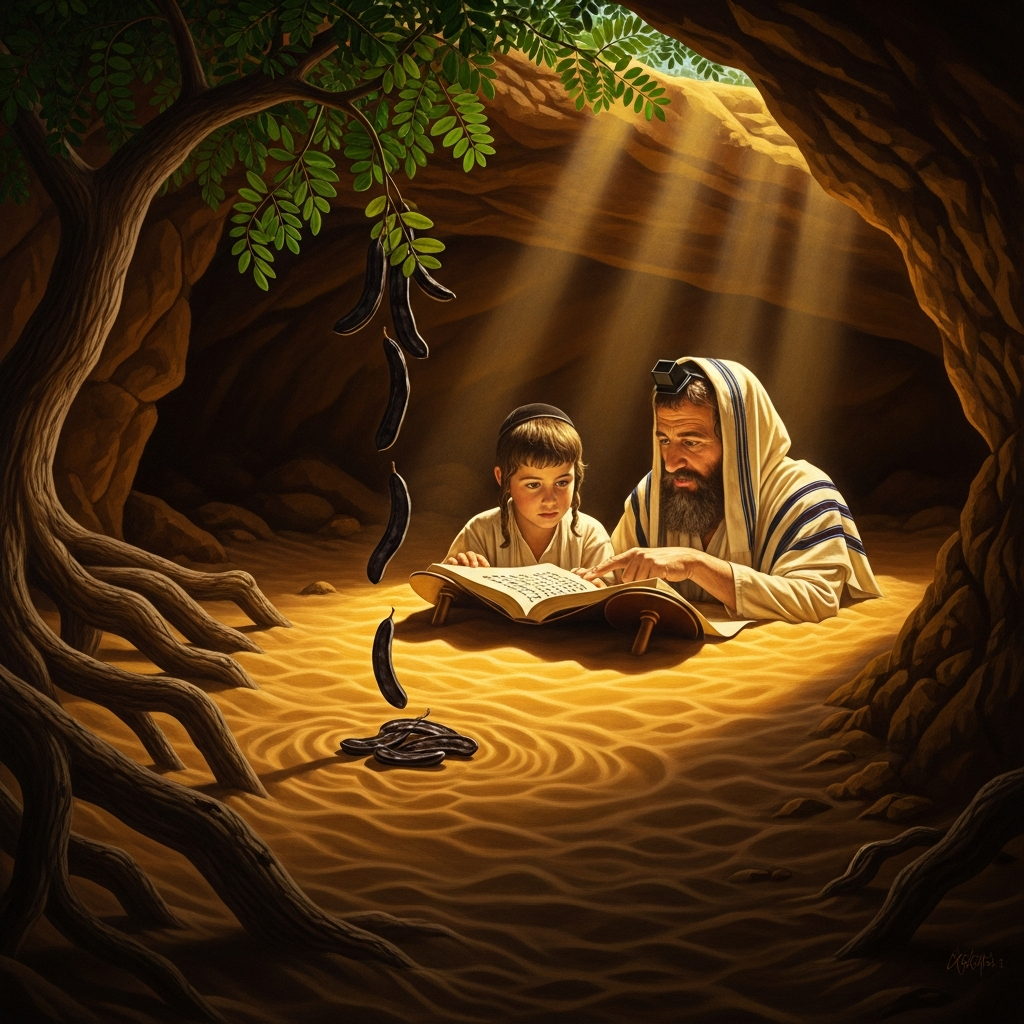
They know immediately they cannot preserve their clothes if they sit normally — cloth wears through on stone. They bury themselves in sand to their necks each day and study. They emerge from the sand only for prayer, dress again for prayer, and return to the sand. The Talmud is precise about this: the sand is not mortification, it is practical clothing conservation. They have one set of clothes. There is no market in a cave.
For twelve years this is the rhythm: sand by day, prayer at dawn and dusk, the sound of each other’s voices in the dark reciting texts the other already knows, the argument over a passage they have discussed ten times before, the argument opening something new the tenth time. They have nothing but each other’s minds and the Torah and the dark.
Then the carob tree appears outside the cave entrance. Then the spring.
Neither of them looks for a natural explanation. They are already past natural explanations.
On the day the Roman emperor dies, a Bath-Qol — a heavenly voice, literally daughter of a voice, the echo of prophecy that the rabbis say replaced direct prophecy after Malachi — speaks in the cave.
Go out.
They go out.
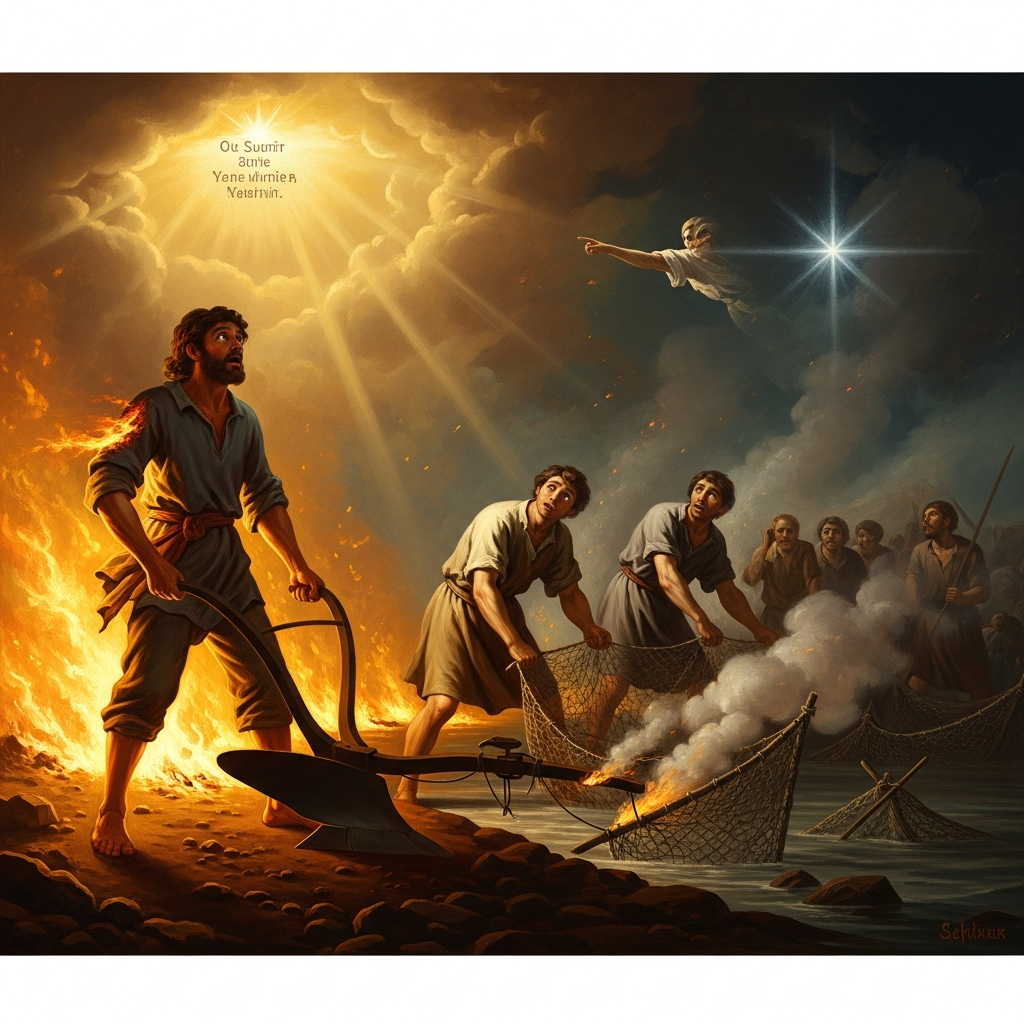
The first thing they see is a man plowing a field. They look at him. The field catches fire.
The second thing they see is a fisherman spreading nets. The nets turn to ash.
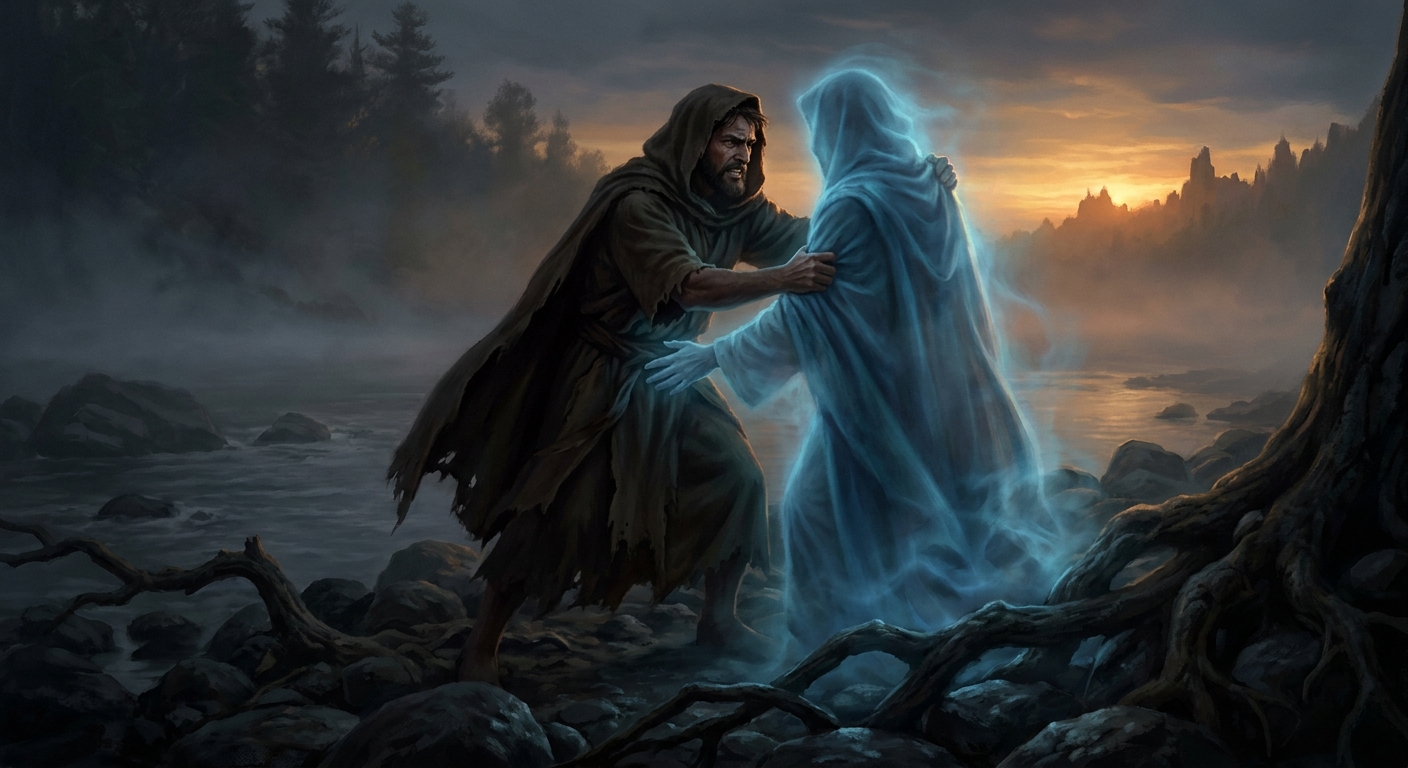
Shimon understands before Elazar does. We cannot be in this world, he says. The world cannot survive our gaze. He does not say it with pride. He says it the way a blacksmith says this forge is too hot for this kind of iron — as a technical assessment of incompatibility.
They go back into the cave.
The second year is harder than the first twelve.
Elazar falls into despair in the second year. He has seen what it means to be too holy for the world, and he is not certain he wants it — not certain holiness that burns the plowman’s field is a holiness worth having. He argues this with his father. The Talmud does not record his father’s answer. It records only that Shimon would heal whatever Elazar’s eyes damaged during the argument. That the son’s gaze scorched and the father’s gaze repaired. That they were necessary to each other in that second year in a way they had not been in the first twelve.
When the second Bath-Qol comes, it says: Go out.
They go out again, on a Friday afternoon.
An old man is running through the fields holding two bundles of myrtle. They call to him: Why do you run? He says: In honor of the Sabbath. They say: One bundle would be enough. He says: One is for Remember and one is for Observe — the two versions of the commandment, one in Exodus and one in Deuteronomy. Shimon turns to Elazar. See how Israel cherishes the commandments. Their minds ease. The world has not abandoned reverence. The world is a plowman and a fisherman and an old man running with myrtle, and it is not the world’s fault that twelve years of divine fire is too much for it.
They walk toward Tiberias in the long Galilean light, and nothing burns.
What Shimon carries out of the cave is not a book.
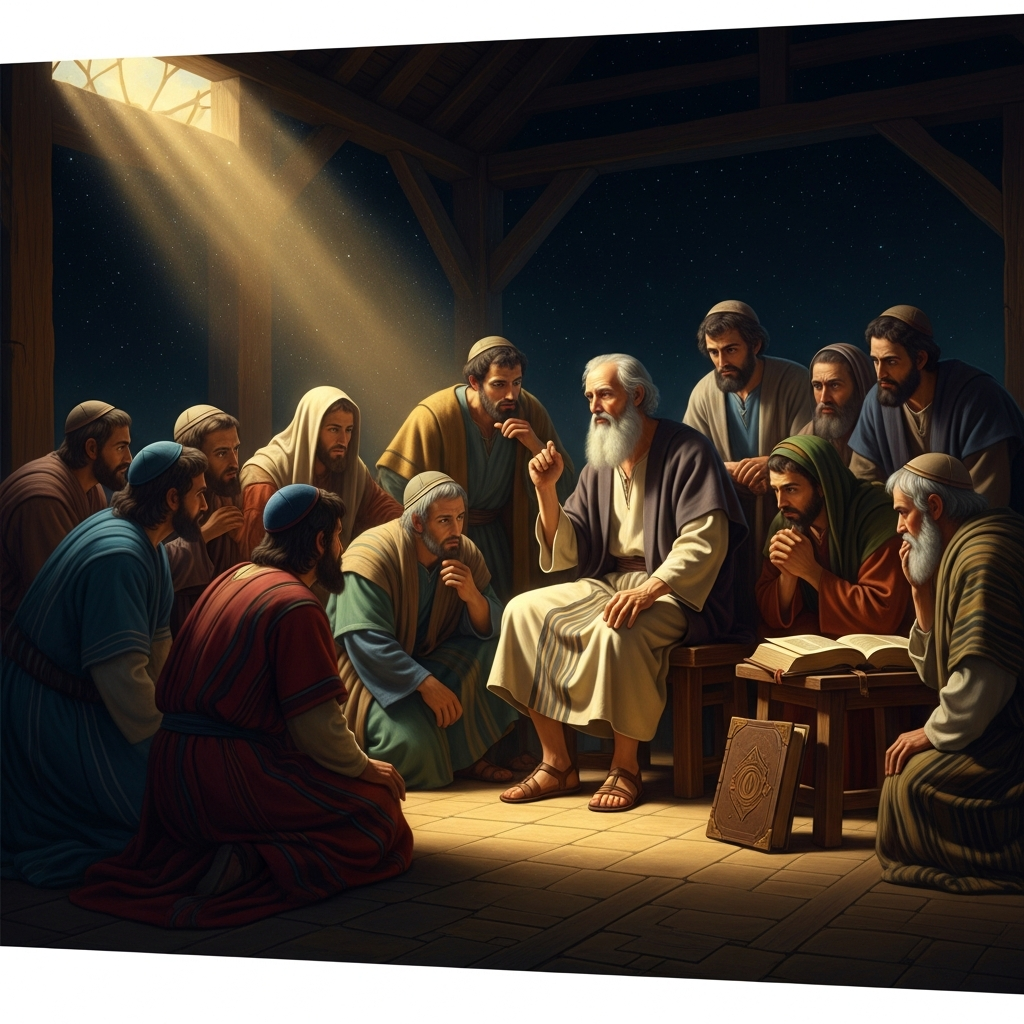
He carries a method: the reading of Torah as if each letter conceals a living structure behind it, as if the text is a skin over something breathing. He teaches this to his Companions — the circle the Zohar calls the Idra, the threshing house, because it is where the grain is beaten from the husk. He teaches them that the divine names are not labels but operations, that the letters are not symbols but forces, that to study Torah with this understanding is to participate in the ongoing creation of the world.
He does not write this down. The Zohar, the great Kabbalistic text attributed to him, presents itself as a dialogue among the Companions — Shimon and Elazar and the others, walking the Galilean roads, reading scripture, the conversation spiraling into depths the plain meaning of the text had hidden. Whether Moses de Leon, a thirteenth-century Spanish kabbalist, wrote it himself and attributed it to Shimon to give it authority, or whether the Companions’ conversations were somehow preserved across a thousand years of exile, the text argues about. What it does not argue about is that the cave is the source.
The tradition insists: the cave is where Torah burned hot enough to produce what became Kabbalah.
Shimon bar Yochai dies on Lag ba-Omer, the thirty-third day of the counting between Passover and Shavuot — a day that becomes, centuries later, a festival of bonfires lit on hilltops across Israel, in honor of the fire that was his signature.
On the day he dies, the Zohar records, he gathers the Companions for the great assembly, the Idra Zuta, the Small Threshing House. He teaches all day. His soul, the text says, departs with the word life — chayyim — still in his mouth, the sentence unfinished, because there was no time to finish it. He dies mid-teaching, which is exactly the kind of death the text requires.
His disciples carry him to the cave at Meron. Pillars of fire precede the bier. The cave closes after him.
The bonfires still burn on his anniversary. The smoke rises from Mount Meron, from Brooklyn rooftops, from backyards in Melbourne and Buenos Aires, wherever the diaspora can get wood in April.
He said: the world cannot survive us. He went back. He spent another year learning how to be in the world without burning it. That second year — the year of learning restraint, of learning to walk among plowmen without scorching them — is the year the tradition does not celebrate. The bonfires are for the fire. The second year, the year of descent back into ordinary life, is the secret interior of every mystical tradition: the saint who has been too far must learn to come back, and coming back is the harder journey.
Scenes
In the cave at Peki'in, buried to their necks in sand, father and son study Torah in the dark — the carob tree outside dropping its fruit exactly at the moment they need to eat
Generating art… At first emergence, whatever their eyes fall on bursts into flame — the plowman scorched, the fishermen's nets ash — and the voice from heaven sends them back
 Generating art…
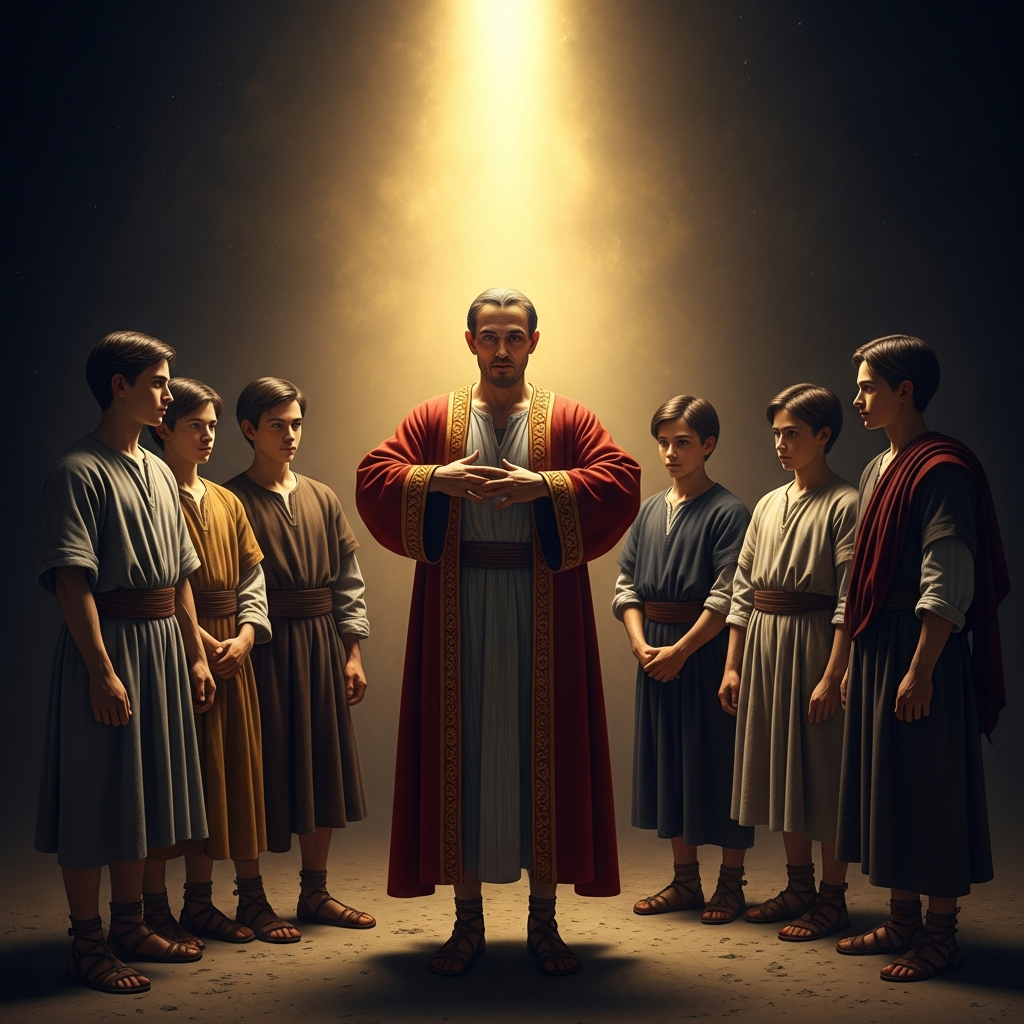
 In the great assembly of the Idra Rabba, the Companions gather around the old master in a threshing house to receive the secrets that could not be spoken until the cave had been endured
 Generating art…
 Echoes Across Traditions
Entities
- Shimon bar Yochai
- Elazar ben Shimon
- Rabbi Yehuda
- Rabbi Yose
- Bat-Qol
Sources
- Babylonian Talmud, *Shabbat* 33b — the primary Talmudic account of the cave and both emergences
- Gershom Scholem, *Major Trends in Jewish Mysticism* (Schocken, 1941), Lecture 5
- Yehuda Liebes, *Studies in the Zohar* (SUNY, 1993)
- Arthur Green, *A Guide to the Zohar* (Stanford, 2004)
- Daniel Matt (trans.), *The Zohar: Pritzker Edition*, vol. 1 (Stanford, 2004)