Seven Ways of Being True
c. 2nd century CE (Umaswami's *Tattvarthasutra*); the philosophical tradition elaborated through 5th–8th century CE · A monastic assembly hall — Pataliputra, Ujjain, or Valabhi; the tradition is geographically mobile
Contents
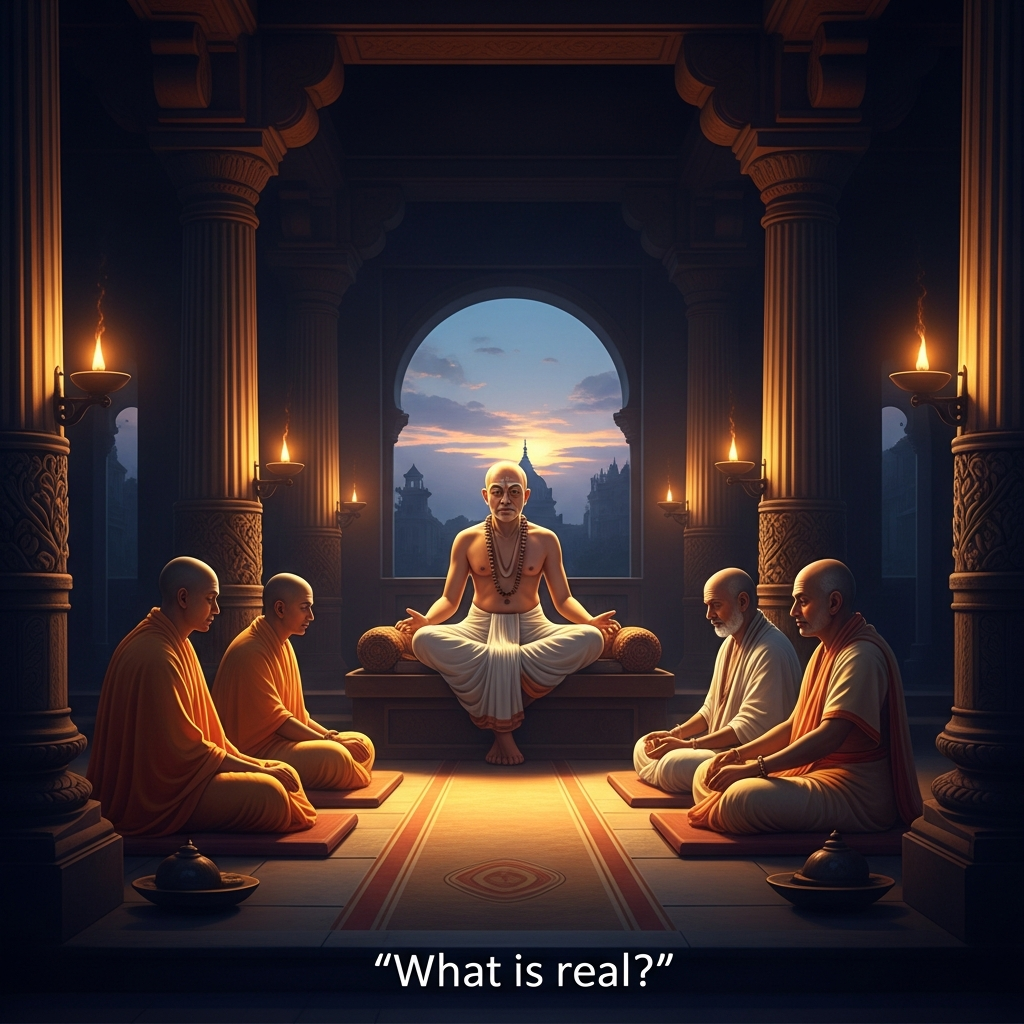
In a Jain assembly hall in classical India, a Buddhist monk and a Hindu Vedantin have both made absolute claims about the nature of reality. The Jain acharya demonstrates, through the seven modes of *Syadvada*, that both are right and both are wrong — not as a compromise but as the most rigorous philosophical position available. The drama: the doctrine that no complete description of reality is possible from any single standpoint is not skepticism. It is precision.
- When
- c. 2nd century CE (Umaswami's *Tattvarthasutra*); the philosophical tradition elaborated through 5th–8th century CE
- Where
- A monastic assembly hall — Pataliputra, Ujjain, or Valabhi; the tradition is geographically mobile
The Buddhist monk speaks first.
He has traveled three days to this assembly and he is confident, which is appropriate — he has argued this point before, in Pataliputra, in Varanasi, in three different monastic councils, and he has not been answered. The point is elegant. The Madhyamaka position, as Nagarjuna formulated it, is that all phenomena are empty of inherent existence — shunyata — and that this emptiness is itself empty, which means there is no final foundation anywhere, and any claim to have found one is a claim that analysis will dissolve. The universe, from this standpoint, is the process of dissolution itself, with nothing doing the dissolving and nothing being dissolved: pure interdependence, pure contingency, the gap where a substance was supposed to be.
He states this clearly. He states it in the precise technical vocabulary of the Madhyamaka school. He sits down.
The Vedantin brahmin takes a long breath.
He has also traveled to this assembly and he is also confident, which is also appropriate, because the Advaita position has the advantage of feeling both cosmically vast and formally tidy. Brahman — the one undivided reality, the pure consciousness that is the ground of all being — is all that exists. The apparent multiplicity of objects and persons and views is maya, the display-play of a mind that has forgotten what it is. The monk’s emptiness is a sophisticated version of maya: he has mistaken the appearance of emptiness for the reality, which is a particular kind of forgetting. The truth, from this standpoint, is not dissolution but identity. Tat tvam asi. That thou art. Everything is Brahman recognizing itself through the costume of separation.
He states this clearly. He also has precise technical vocabulary and he uses it. He sits down.
The hall is quiet.
The Jain acharya does not immediately speak. He looks at both of them for a moment that extends slightly beyond comfort. Then he says: both of you are right.
The Buddhist and the Vedantin look at each other.
This is not the response they expected. They have come prepared to debate. They have their counters to the standard Jain positions ready — the Jain insistence on the reality of individual souls (jivas), the Jain pluralism that contradicts both Buddhist no-self and Vedantic monism. They have not prepared for being told they are right.
The acharya continues: and both of you are wrong.
He reaches for the word that Umaswami has codified in the Tattvarthasutra, the word that the tradition will build its epistemology on: syat. From a standpoint. In some respects. With qualification. Perhaps — though that last translation is too weak, too much like a shrug. The word means something harder: a marker of the angle from which a statement is being made, required by intellectual honesty to precede every claim about reality, because every claim about reality is being made by a positioned observer, and a positioned observer is not the same as all possible observers.
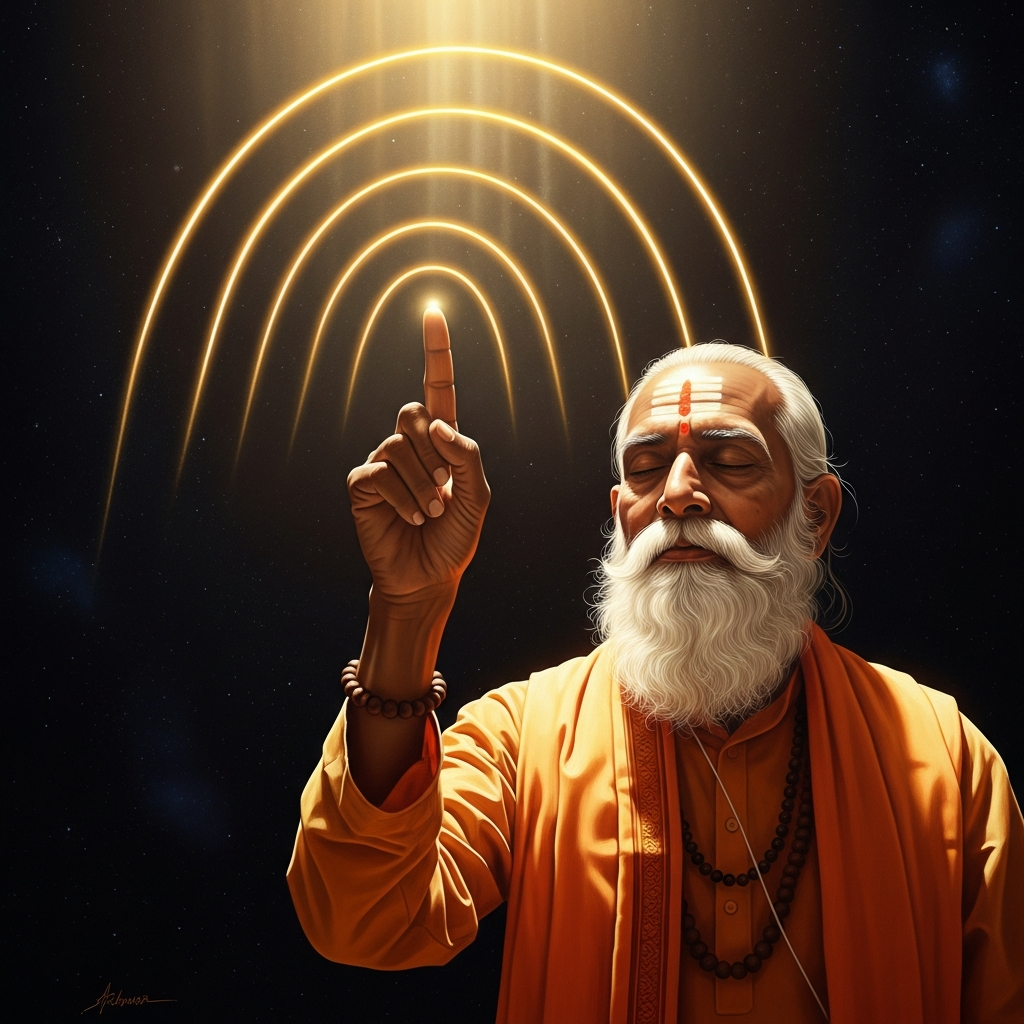
He counts to seven.
Syad asti. From one standpoint, the pot exists. This is true.
Syad nasti. From another standpoint, the pot does not exist — it is a temporary arrangement of clay-particles, a conventional designation, empty of inherent pot-nature. This is also true.
Syad asti nasti ca. From a third standpoint, the pot both exists and does not exist — this is the sequential truth, held in the mind as a two-part proposition. This is also true.
Syad avaktavya. From a fourth standpoint, the pot is inexpressible — because the simultaneous affirmation and negation cannot be held by ordinary language, which must speak one word at a time. Also true.
Three more modes follow: the inexpressible combined with existence, the inexpressible combined with non-existence, and the inexpressible combined with both existence and non-existence simultaneously. Seven modes. Seven angles. Seven true statements about the same pot, none of which can be reduced to any of the others.
The Buddhist recognizes mode two and three as his own territory. The Vedantin recognizes mode one as his. Both of them recognize that the system contains them and is larger than either.
This is not, the acharya says, a compromise. A compromise would say: you are both partly right and the truth is somewhere in the middle. Syadvada does not say the truth is in the middle. It says the truth is the seven-pointed structure that requires all seven statements to describe it, and that any single statement, even a true one, is a partial description of a partial view.
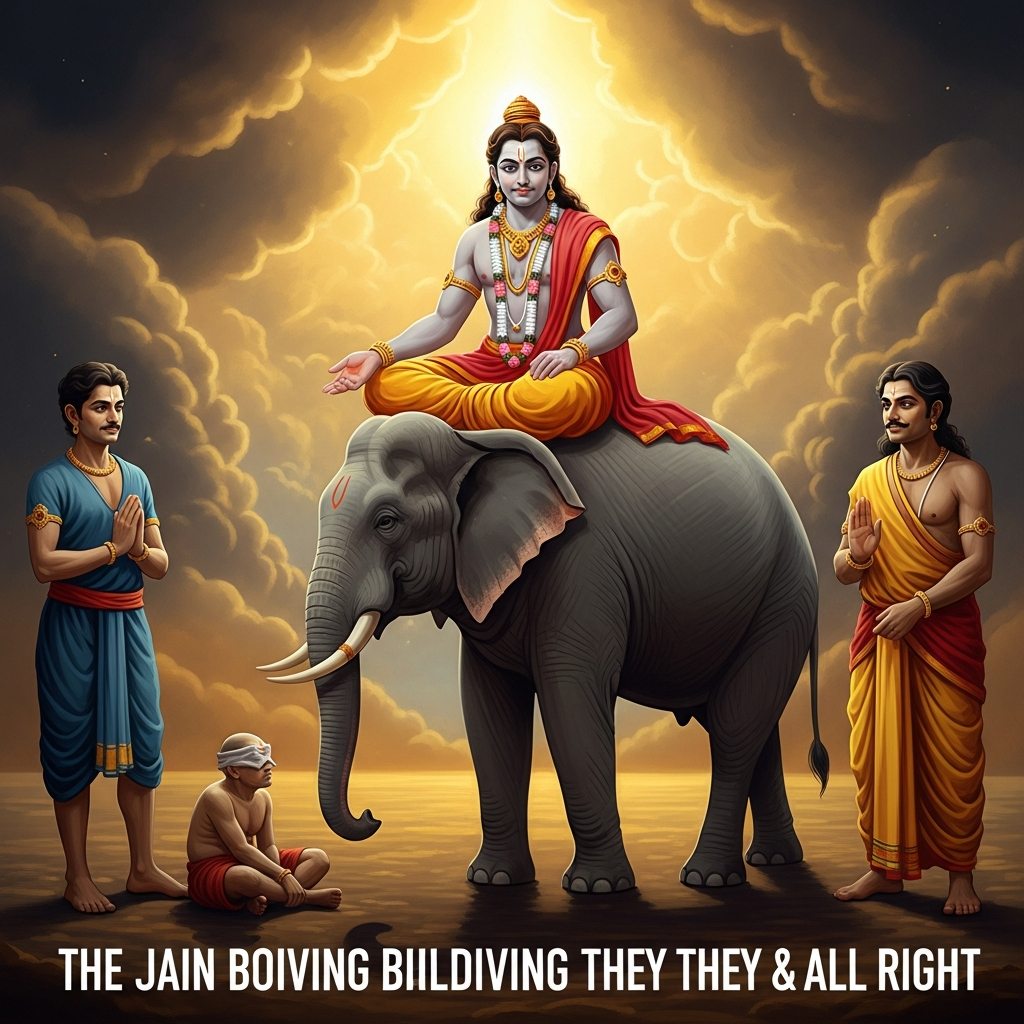
He uses the parable of the blind men and the elephant because every Indian philosophical tradition uses it, which is itself evidence of what he is describing: the same story, taken from the same treasury of parables, pressed into different service by different hands.
The Buddhist version says: see how each blind man insists he has found the whole truth from his partial touch, and learn from this that all positions are partial and no position has the whole. The lesson is to loosen your grip on any position.
The Vedantin version says: see how the blind men mistake the part for the whole, and how a sighted person could see the elephant all at once and end the argument. The lesson is to seek the standpoint from which the whole is visible.
The Jain version is different from both.
The Jain version says: the blind men are not making a mistake about the elephant. They are making a mistake about what kind of sentence they are using. If the man at the trunk says syad asti sarpavat — from this standpoint, it is like a snake — and the man at the leg says syad asti stambhavat — from this standpoint, it is like a pillar — they have said true things. The error comes when they drop the syat and say simply: it is a snake. The error is not in the touching. The error is in the claiming.
The Buddhist monk is quiet.
The Vedantin brahmin is also quiet.
The philosophical problem with Syadvada has always been the same and the Jain philosophers have always known it: if every claim is valid only from a standpoint, what is the standpoint from which that claim is made? Is the claim that all claims are standpoint-relative itself standpoint-relative?
The acharya has been waiting for one of them to raise this. The Vedantin raises it.
Yes, he says. The doctrine of anekantavada — non-one-sidedness — is itself being advanced from a Jain standpoint. He is not claiming omniscience. He is claiming that the Jain analytical framework, applied from its standpoint, yields this result. The only being who holds all seven modes simultaneously without the sequential structure of human language is the siddha — the liberated soul, the omniscient one, the Tirthankara who has burned away the karma-crust and perceives the entire cosmos at once without the angular distortion that embodiment creates. The rest of us are blind men who know we are blind, and this knowledge — that we are blind, that we are touching from one side of a very large animal — is itself the philosophical achievement.
The Buddhist finds this unsatisfying. The Vedantin finds the appeal to the omniscient soul too convenient. The acharya finds both objections interesting and says so without condescension, which is the most disarming move in the entire debate.
The assembly ends at dusk. The lamps have been lit for an hour. Nothing has been resolved in the sense that any of the three traditions has abandoned its framework. Everything has been advanced in the sense that the Jain position is now visible in its full structure: not a claim to have found the truth, but a claim to have found the grammar that makes true claims possible.
Umaswami’s Tattvarthasutra — the text the acharya has been drawing on — is a document of astonishing compression: a philosophical system of several hundred aphorisms that has generated two millennia of commentary across the Digambara and Shvetambara divisions of the tradition. It opens with a statement that is itself a demonstration of the method: samyag-darsana-jnana-caritrani mokshamargah — right vision, right knowledge, right conduct are the path to liberation. Not right vision alone. Not a view from nowhere. A view from a very specific somewhere — the cultivated perspective of a soul in the process of clearing its own obstructions — that is more comprehensive than an uncultivated view but not infinite, and not claimed to be.
The seven modes are still being taught in Jain colleges in Rajasthan and Gujarat, in English-medium schools and in traditional Sanskrit pathshalas, in academic philosophy departments and in the evening discourses of monks who have taken the five great vows.
The pot on the table in the assembly hall, around which the seven propositions were constructed and the three traditions debated, is still there in one sense and not there in another and inexpressible in a third and all three things simultaneously in a fourth and the remaining three modes are left as an exercise for the person willing to sit long enough with the question of what kind of sentence is adequate to a thing that exists in time.
Scenes
The assembly hall at dusk
 Generating art…
 The acharya traces seven arcs in the air with his finger
 Generating art…
 He uses the blind men and the elephant — the Indian philosophical parable that every tradition uses for its own purposes
 Generating art…
 Echoes Across Traditions
Entities
- Umaswami
- Siddhasena Divakara
- Haribhadra Suri
Sources
- Umaswami, *Tattvarthasutra* (c. 2nd century CE; Nathmal Tatia trans., *That Which Is*, Harper Collins, 1994)
- Siddhasena Divakara, *Nyayavatara* (c. 5th century CE)
- Haribhadra Suri, *Anekantajayapataka* (c. 8th century CE)
- Bimal Krishna Matilal, *The Central Philosophy of Jainism (Anekanta-vada)* (L.D. Institute, 1981)
- Paul Dundas, *The Jains* (Routledge, 2nd ed. 2002), ch. 4