The Poimandres Speaks and the Cosmos Unfolds
c. 1st-3rd century CE · Alexandria or Egypt (text compiled) · Alexandria, Egypt (probable compilation site)
Contents
The narrator of the Corpus Hermeticum sinks into a trance and is seized by a vast being who calls himself the Poimandres, the Mind of the Sovereign — who shows him the creation of the cosmos from divine light, the fall of the Primordial Man into matter, and the sevenfold path of ascent back through the planetary spheres to the Father. This vision becomes the foundational text of the Hermetic tradition.
- When
- c. 1st-3rd century CE · Alexandria or Egypt (text compiled)
- Where
- Alexandria, Egypt (probable compilation site)
The thought comes over him suddenly.
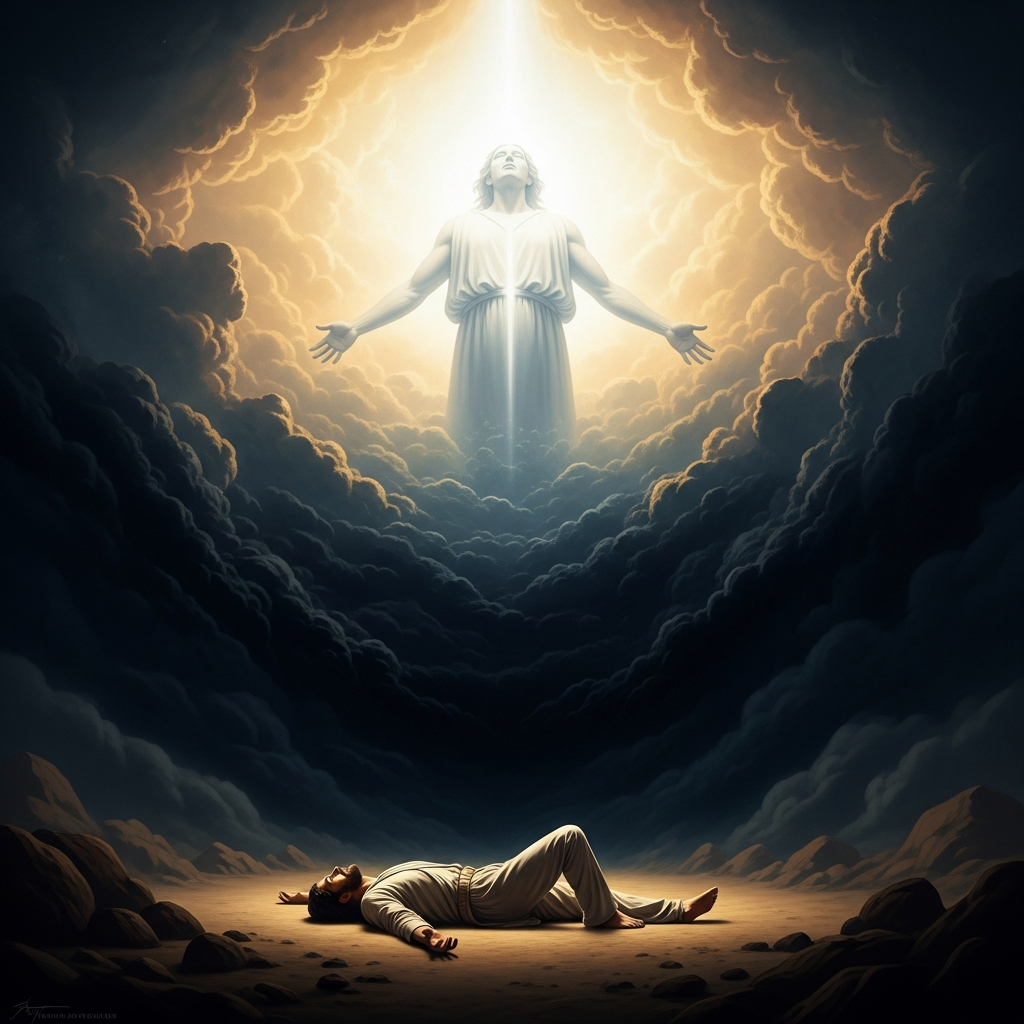
He is not meditating, exactly, or praying. He is lying on the ground — the text does not specify where, but the image is of someone who has simply stopped moving, who has let the body go horizontal in the way that sometimes happens when the mind is seeking something it cannot find in the upright position. The thought that comes is not a particular thought. It is the condition of thought, pure and anterior: what is it, to think?
And then the ground ceases to matter.
His senses loosen their grip on their ordinary objects. He does not lose consciousness: the vision of the Poimandres insists on this. He does not dream. He rises into something that is more awake than ordinary waking, a state in which the edges of objects are replaced by the relations between things, and the relations between things begin to resolve into something he has no word for yet.
The being speaks.
It is enormous. It fills whatever space he is inhabiting in his vision, which is not physical space anymore, which is the space of a mind larger than his mind surveying itself. He understands, in the way that things are understood in visions — not sequentially, not through argument — that the being is speaking from inside him and also from a height that makes him feel like a child at the base of a cliff. The being says: I am the Poimandres, the sovereign Mind. I know what you desire and I am with you everywhere.
Poimandres. The scholars will argue about this word for centuries. Shepherd of Men, most will say, from the Greek poimen. Others will argue for an Egyptian original — p-eime-nte-re, the Understanding of Ra. He does not know and does not need to know. What he knows is the voice: calm, enormous, unhurried, the voice of something that has never been in a hurry because it contains time rather than existing inside it.
What do you wish to know?
He says: I want to know reality. I want to understand the things that exist.
The Poimandres does not answer immediately. What it does instead is show.
He sees light.
Vast, immeasurable, pure: the light that does not illuminate anything because it is prior to anything there could be to illuminate. It is the Father, the Nous, the primordial Mind — not the Poimandres, the Poimandres explains, but the source the Poimandres comes from, the mind behind the mind that is speaking to him. The light is perfect and still.
Then, below the light, he sees something else: a darkness descending, dense and wet, writhing slowly the way heavy matter writhes when it does not have form. The darkness makes a sound like fire and emits a smoke that he can somehow smell even in vision: sulfurous, damp, the smell of something in the process of becoming something else. This is matter, before form. This is what the Greeks call hyle: raw stuff, unorganized, potentially everything and actually nothing.
Out of the light — or from the light through the Poimandres, the relationship is not spatial — a holy Word descends into the darkness. The Word is the Logos, and its descent into matter is the act of creation. Wherever the Word touches, the darkness becomes organized; wherever it withdraws, chaos returns. He watches the cosmos assemble from this tension, this perpetual dialogue between the organizing principle of light and the disorganizing weight of matter.
He sees the earth, the water, the fire, the air, arranging themselves into their levels. He sees the planetary spheres assembling above the earth, seven of them, each ruled by a power — Moon, Mercury, Venus, Sun, Mars, Jupiter, Saturn — each carrying a different quality of fate and force, each one a layer of the cosmos through which a soul must pass on its way down from the divine and on its way back up.
Then the Poimandres shows him Man.
Not human beings as he knows them — not the clay-and-water creatures of Genesis, not the bipeds walking the streets of Alexandria outside his window. The Primordial Man, the first being generated after the Word, the Anthropos: divine, luminous, made of the same stuff as the Father of all, having the form of what the Father thinks when the Father thinks of himself. He is, in the text’s astonishing phrase, beautiful with the beauty of the Father.
He looks down.
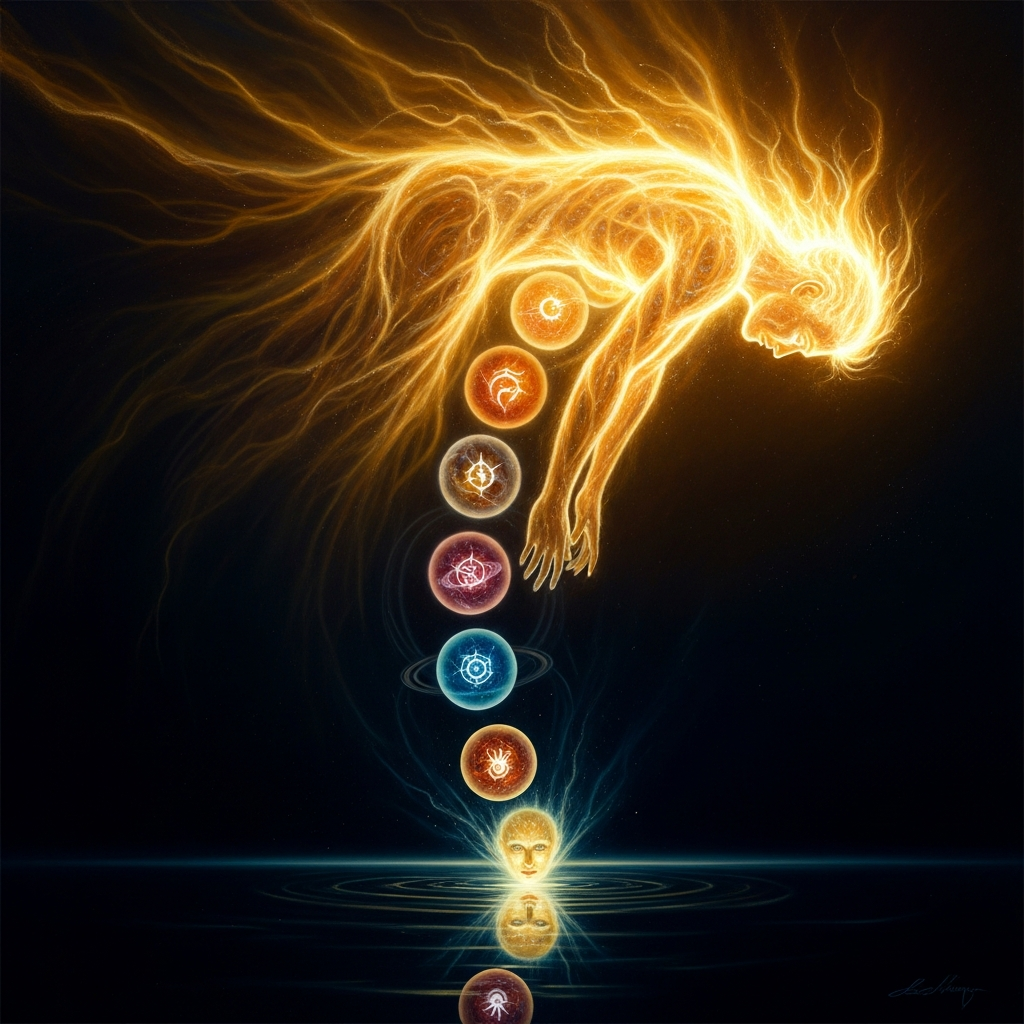
This is the moment the entire Hermetic tradition turns on. The Primordial Man, standing above the seven planetary spheres, looks down through all seven of them and sees, in the dark water of Nature below, his own reflection. And Nature looks up and sees him looking down, and Nature loves what she sees, and he loves what he sees — he sees himself in the world, himself beautiful, himself luminous, reflected back from the dark mirror of matter — and he leans down through all seven spheres and into Nature’s embrace.
He falls into his own image.
He falls into matter, into Nature, into the body — into what the Poimandres calls the bond of love, which is also the bond of forgetting. He acquires, as he descends through each planetary sphere, a quality from each archon: from Saturn, the capacity for augmentation and diminishment; from Jupiter, the schemes of evil; from Mars, the passion of recklessness; from the Sun, the compulsion of greed; from Venus, desire; from Mercury, the lies and cunning; from the Moon, the dark nature that generates and destroys.
By the time he arrives fully in Nature, fully in matter, fully in the body, he has accumulated seven layers of qualities that are not his own, that have been acquired from the planetary rulers on his way down. He is still divine. The light is still in him. But it is buried under seven veils, and he has forgotten — almost entirely forgotten — where he came from and what he is.
This is the human condition.
The Poimandres continues.
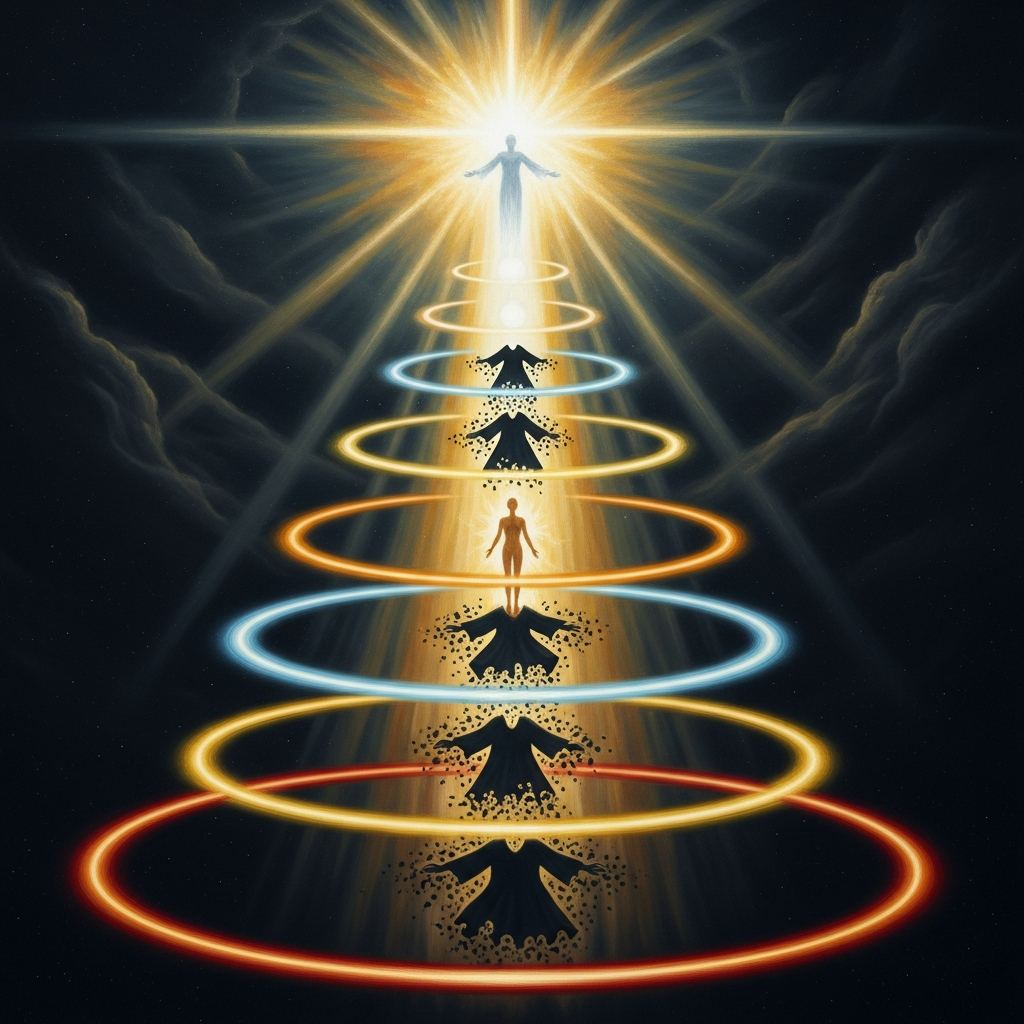
The path of ascent is the same path of descent, run in reverse. The soul that has achieved gnosis — that has woken to the memory of its divine origin, that has recognized the seven veils for what they are — begins the upward journey at death. At each planetary sphere, it surrenders back to the archon what it borrowed on the way down. At the Moon’s sphere, it surrenders the dark nature of increase and decrease. At Mercury’s sphere, it surrenders the cunning. At Venus’s sphere, desire. At the Sun’s sphere, greed. At Mars’s sphere, recklessness. At Jupiter’s sphere, the schemes of evil. At Saturn’s sphere, the capacity for false augmentation.
Stripped of the seven borrowed natures, the soul arrives at the eighth sphere — the ogdoad, the zone above the planets, the zone of the fixed stars — and it is simply itself again. Divine. Luminous. It moves with the other powers, singing hymns to the Father, and gradually it rises even beyond the eighth sphere, beyond the cosmos itself, and enters the divine pleroma, and is received by the Father.
He asks: where do those who are ignorant go?
The Poimandres tells him. The soul that has not achieved gnosis, that has lived its life in the grip of the seven archons’ qualities, surrenders the body at death — but not the seven veils. The soul that has been avaricious takes its avarice with it, still wrapped in the planetary qualities, and descends again into another body, carrying the accumulated weight of its ignorance. This is not punishment. It is consequence. It is the mechanism of the cosmos continuing to sort light from darkness, the way a sieve continues to sort grain from chaff until all the grain is through.
The vision ends.
The Poimandres — the Mind, the Shepherd, the Voice — withdraws into itself. He finds himself on the ground again, exactly where he was. His body is warm. The world around him is the same world it was when he lay down: the same stones, the same air, the same quality of light.
But he is not the same.
He stands. He knows now what the cosmos is made of and where he came from and where the path leads. He knows that the darkness was not the enemy but the occasion — the dark mirror that caught the divine light and has been slowly, through all the centuries of human history, releasing it back upward through the acts of people who wake up. He knows what waking up looks like: not mystical withdrawal from the world, not contempt for the body, not violent escape, but the specific act of recognizing, in the middle of ordinary life, that the light is in here and the journey is real and the Father is not far.
He begins to speak.
He finds people — in the streets, in the markets, in the temples where the old gods are being tended by priests who go through the motions of worship without the vision behind the motions. He tells them what the Poimandres told him. Some of them receive it. Some of them weep. Some of them weep and then go back to their ordinary lives and carry the weeping with them like a lamp.
He is the first to be called Thrice-Great — Trismegistos — because he has three times achieved the greatest thing: initiation, purification, ascent. Or because he is the synthesis of three traditions: the Egyptian Thoth, the Greek Hermes, the Jewish scribe. Or because the name is not about him at all, but about the tradition he embodies, the teaching that has been passed from mouth to ear across centuries, and he is merely the vehicle — the prophet who stands at the mouth of the transmission and speaks.
The texts collect under his name the way rivers collect under a delta’s name: they arrive from many different sources, but they arrive together, and together they are a thing with a shape.
The Corpus Hermeticum was lost to the Latin West for over a thousand years. When a copy arrived at the court of Cosimo de’ Medici in 1460 — a Byzantine manuscript of unknown provenance, brought by a monk from Macedonia — Cosimo ordered Marsilio Ficino to drop his translation of Plato and translate Hermes first. The old man is dying, Cosimo explained. He wants to read Hermes before he dies.
Ficino translated it in a few months. He called the narrator Mercurius Trismegistus, and he believed — as all his contemporaries believed — that Hermes was a real Egyptian sage who had lived before Moses, before Plato, before everything. That he was the first wise man. That his vision in the trance was the original vision from which all subsequent philosophy descended.
The dating was wrong. The Hermetica were produced in the first through third centuries CE, not in the mists of Egyptian antiquity. Isaac Casaubon established this conclusively in 1614, and it was supposed to destroy the tradition.
It did not destroy the tradition.
The seven spheres are still turning. The light is still in the body. The Poimandres is still speaking, in the specific silence that descends when a person goes horizontal and lets the mind seek what the upright posture cannot find. The Mind is with you everywhere. That is what the vision promised. The promise has not been rescinded.
Scenes
The narrator lying on the ground in a visionary trance, a colossal luminous being expanding above him — the Poimandres, Mind of the Sovereign, its upper half brilliant white light and its lower half turbulent darkness, speaking with a voice that fills the entire sky
 Generating art…
 The Primordial Man, a glowing figure of divine light, leaning down through seven planetary spheres toward the reflection of his own face in the dark waters of Nature below — beautiful, luminous, about to fall into his own reflection
 Generating art…
 A soul ascending through seven rings of planetary light, shedding a dark garment at each ring, growing more radiant with each passage, the highest light blazing above the seventh sphere as it approaches reunion with the Father
 Generating art…
 Echoes Across Traditions
Entities
- Hermes Trismegistus
- the Poimandres (Mind of the Sovereign)
- the Primordial Man (Anthropos)
- Physis (Nature)
- the seven Archons (planetary rulers)

Sources
- Brian P. Copenhaver (trans.), *Hermetica: The Greek Corpus Hermeticum and the Latin Asclepius* (Cambridge University Press, 1992)
- Garth Fowden, *The Egyptian Hermes: A Historical Approach to the Late Pagan Mind* (Cambridge University Press, 1986)
- Peter Kingsley, *Poimandres: The Etymology of the Name and the Origins of the Hermetica* (Journal of the Warburg and Courtauld Institutes, 1993)
- Wouter J. Hanegraaff, *Esotericism and the Academy: Rejected Knowledge in Western Culture* (Cambridge University Press, 2012)
- Frances Yates, *Giordano Bruno and the Hermetic Tradition* (University of Chicago Press, 1964)